Booked the Third Date, Not Feeling It, and Learning to End It Kindly

Finding Clarity in the Pret Queue
If you are a late-20s London hybrid-office woman who can send a client email in two minutes but cannot send one honest dating text after a perfectly decent second date, this is boundary guilt in early dating.
When Emma (name changed for privacy) came onto my screen, she was still carrying Wednesday lunch inside her body. She told me about 12:43 p.m. in the Pret line near her Soho office: the WhatsApp preview asking if she was still on for Thursday, the sharp espresso smell, the AC humming too loud, the sandwich wrapper crackling in her hand, the phone suddenly hot in her palm. She had opened Notes, typed, ‘I had a nice time but…’, deleted it, rewritten it softer, deleted it again, and finally sent a breezy confirmation just to stop the spike of guilt.
Emma was twenty-nine, a brand strategist, and exactly the kind of woman who could finesse a difficult client email before her coffee cooled. But this was different. ‘He’s nice on paper, so why do I feel relieved when plans get moved?’ she asked me. Then the real conflict arrived in one breath: she wanted to keep the third date to be fair and open-minded, and she also knew she was not feeling it. ‘I don’t want to lead him on,’ she said, looking down for half a second, ‘but I also don’t want to be the villain.’
I hear that question often, usually in some version of the same 11 p.m. Google search: why do I feel guilty ending early dating when nothing is technically wrong? What I saw in Emma was not dramatic indecision. It was a quiet, contracted tug-of-war between honesty and self-image. Her guilt felt like a seatbelt locked too tight across the stomach—nothing cinematic, just enough pressure to keep every breath shallow and every message unsent.
I leaned a little closer to the camera and said, ‘You are not actually confused about him. You are stuck between your body’s no and your fear that saying it out loud will make you unkind. Let’s make a map of that fog together. That’s our whole journey today: not to force a verdict, but to find the kind of clarity that gives the choice back to you.’

Choosing the Compass: A Decision Cross Tarot Spread
I started the session the way I often do, with my pre-meeting three-minute cosmic breathing. It is not theatre. It is simply a way to slow the nervous system so a real answer can surface before panic fills the room with static. I asked Emma to put both feet on the floor, inhale for four, hold for four, and exhale for six, like watching a satellite stop tumbling and regain orientation.
I do not use tarot to bully people into fate. I use it the way I use a star map at the Tokyo planetarium where I work: not to control the sky, but to help someone orient themselves inside a pattern that was already there. For Emma, I chose the Decision Cross · Context Edition, a five-card tarot spread for third-date clarity. It is the spread I reach for when someone is asking the question people type into their phones late at night: should I go on a third date if I am not feeling it?
This spread fits because the surface issue is a simple fork in the road, but the deeper issue is not lack of options. It is distortion. Emma did not need more evidence about whether he was nice. She needed to see what guilt was doing to her read. So this spread lets me examine the present emotional signal, the hidden fairness script crossing it, the energy of continuing, the energy of honest decline, and the guiding principle that can turn the whole thing from a moral crisis into a grounded next step.
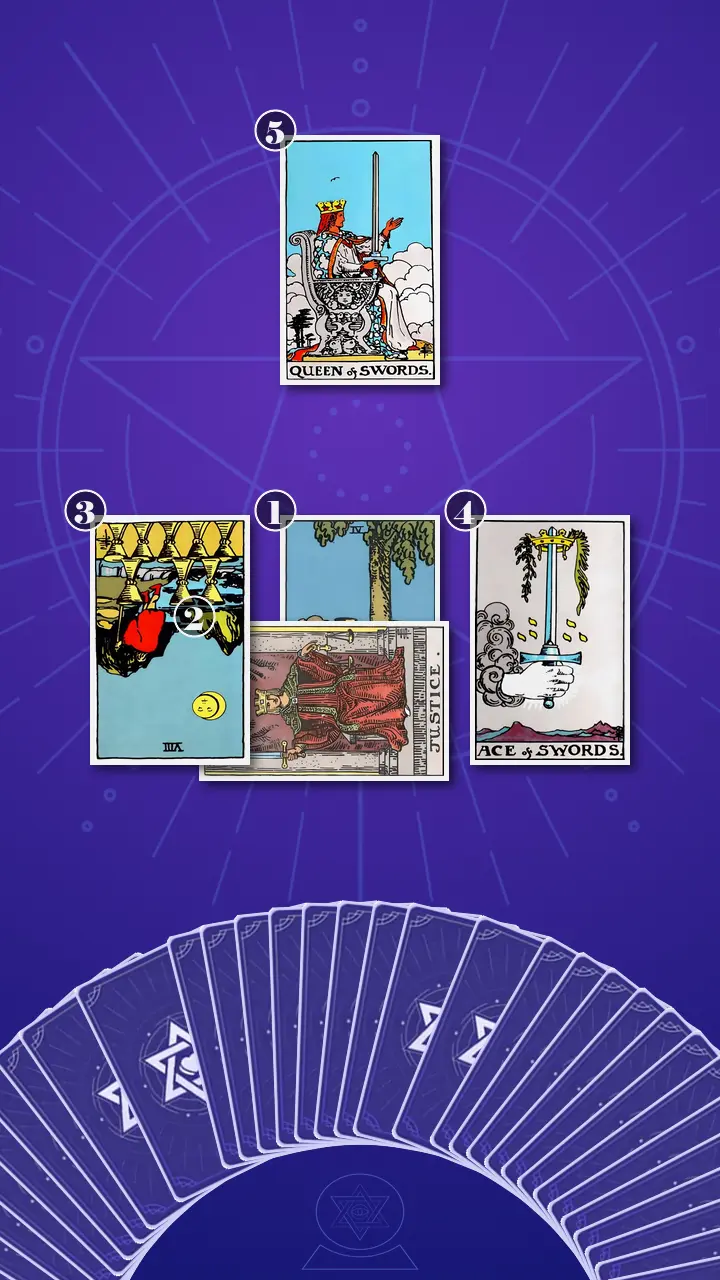
I told her how I would read it. The center card would show what the connection actually felt like in her system. The crossing card would reveal the guilt or fear clouding that signal. The left and right cards would compare the two paths in front of her. And the card above them would offer the clearest guidance. One emotional heart, one interference pattern, two diverging routes, and one higher line of truth.
Reading the Junction Sign
Position 1: The Date That Feels Like Admin
I turned over the card for the present situation: the actual emotional experience of this connection and the observable stuckness around the booked third date.
The card was the Four of Cups, upright.
I looked at the crossed arms, the offered cup, the figure who is not reaching back. Then I looked at Emma. ‘This is the Hinge-or-Bumble situation where the chat is fine, the green flags are visible, and still your body feels closed,’ I said. ‘You can list his good qualities in half a sentence, but when Thursday becomes real—calendar alert, outfit choice, commute—it stops feeling like possibility and starts feeling like admin.’
This is a card of emotional deficiency, not in the sense that something is wrong with you, but in the sense that the pull simply is not there. The energy is muted. The cup is being offered, but your system is not leaning in to receive it. Nice on paper is not the same thing as yes in your body. That was the center of her question.
Emma gave a short laugh that had grit in it. ‘That is so accurate it’s almost rude,’ she said. Her mouth lifted for a second, but her fingers tightened around her mug. I nodded. ‘I know,’ I told her. ‘Sometimes the first card is less mystical than mercilessly specific.’
Position 2: The Internal AITA Courtroom
I turned over the card for what was crossing her signal: the guilt, fairness script, and fear that distorted clear judgment.
The card was Justice, reversed.
‘Here’s the real bind,’ I said. ‘You are not just asking, “Do I want to go?” You are asking, “What does it mean about me if I don’t?”’ I pointed to the scales and the sword. ‘This is the Notes app rewrite. The group-chat screenshot audit. The search for enough evidence to make ending it feel morally allowed. It has the energy of an internal AITA thread where you are both the poster and the harshest commenter.’
When this card appears reversed, I use one of my favorite lenses: Dark Matter Detection. In astronomy, the biggest forces are often invisible at first. You do not see them directly; you see what they pull out of alignment. Here, the invisible mass was not him. It was the belief that if she sent an honest text now, she might prove herself cold, shallow, impatient, not caring enough. That belief was tugging her clear read off course. You do not need courtroom evidence to send a kind no.
This is what distorted fairness looks like. The scales keep moving, but truth never lands. The sword exists, but it stays sheathed because guilt keeps calling itself kindness. I told Emma, ‘Your blind spot is not that you’re too picky. It’s that you keep measuring kindness by how little discomfort you cause in the next ten minutes, not by the clarity of the whole interaction.’
She winced, glanced away from the screen, then let out that small, pained laugh people make when they catch themselves mid-pattern. ‘I really do act like I need a jury,’ she said. Her shoulders rose and fell in one long breath. That was the first crack in the distortion.
Position 3: One More Drink, One More Delay
I turned over the card for path A: what continuing to the third date would feel like internally, and what pattern it would reinforce.
The card was the Eight of Cups, reversed.
‘This,’ I said, ‘is the Elizabeth line card.’ I described it as I saw it in my mind from her story: 6:11 p.m., train heading east, Citymapper open, makeup touched up in the black train window, stale carriage air, phone warm in the palm, jaw set, body secretly hoping for a cancellation text so relief can arrive without you having to choose. ‘You still go,’ I said, ‘but you are already half gone.’
Reversed, this card is blocked departure. It is the hesitant leaver lingering at the threshold. In modern life it feels like keeping a browser tab open for days because closing it feels too final, even though you are not using it. The date becomes less about curiosity and more about proving you were fair. More time is not kinder if you are already halfway out.
I told her plainly, ‘If you go on the third date from this energy, you won’t actually be gathering new information. You’ll be postponing the uncomfortable text and teaching yourself, again, that your first clean read does not count unless other people approve it.’
Emma pressed her lips together, then nodded without looking at me. ‘I’ve literally done that commute hoping he’d reschedule,’ she said. Her hand moved to her collarbone, then dropped back to the table. It was the kind of recognition that feels heavy because it is true.
When the Sword Rose Above the Chat Thread
Position 4: The Clean Line Through the Fog
I turned over the card for path B: what admitting ‘I’m not feeling it’ would open up in clarity, integrity, and self-trust.
The card was the Ace of Swords, upright.
The room changed when that card appeared. Even through a screen, I felt it. Outside my window in Tokyo, a bus hissed past and then the sound fell away, as if the city itself had stepped back half a pace. I have spent ten years guiding people beneath artificial constellations, and every so often a card arrives with the same clean force as a planet snapping into view after cloud cover. This was one of those moments.
‘You do not need a dramatic reason to end early dating,’ I told her. ‘If the pull is missing and your body keeps bracing, that is already real information.’ I showed her the single vertical blade. ‘This is the shift from six softened drafts to one honest sentence. It is not about being brutal. It is about stopping the blur.’
At the planetarium, I often explain gravity assists: a spacecraft does not find a better future by lingering longer in the wrong orbit. It makes one precise, time-sensitive adjustment, and that small maneuver changes the whole trajectory. That flashed through me as soon as I saw the Ace. In my Gravity Assist Simulation, one honest message now creates a brief moment of discomfort and a much larger long-term gain: less dread, less mixed signal, more trust in your own navigation.
Emma was still inside the lunch-break loop when I said that—the honest text already written in Notes, the stomach already tight, the cheerful confirmation already sent because disappointing someone else for one minute had felt easier than disappointing herself for another week.
Stop treating more time as proof of kindness; raise the sword, say the simple truth, and let clarity do what overexplaining cannot.
She froze first. Not metaphorically—actually froze, with her breath caught high and her thumb suspended against the side of her phone. Then her eyes lost focus for a beat, as if she were replaying the Pret queue, the WhatsApp preview, the tiny wave of relief she felt whenever plans seemed unstable enough to disappear on their own. Then the feeling landed. Her jaw unclenched. Her shoulders dropped. Her eyes brightened, not with dramatic tears but with that sudden shine that comes when the body recognizes a door it has been leaning against from the wrong side. ‘But that means I already knew,’ she said, and for a second there was anger in it—not at me, but at how much energy she had burned trying to be acquitted. I let the silence hold. ‘You knew enough,’ I told her. ‘Not enough to condemn him. Enough to tell the truth.’ Then I asked, ‘With this new angle, was there a moment last week when this would have changed how you felt?’ She exhaled through her nose, slow and shaky. ‘The second he texted,’ she said. ‘I wanted the whole thing to vanish.’ That was the real shift: not from fear to perfection, but from guilt-tight hesitation to the first clean edge of self-trust.
Position 5: The Queen with the Open Hand
I turned over the final card for guidance: the principle that could turn honesty into a grounded next step instead of a morality test.
The card was the Queen of Swords, upright.
‘This,’ I said, ‘is the version of you I want to hand back to you at the end of this reading.’ I pointed to the raised sword and the open hand. ‘Boundary and consideration in the same body. Kind tone. Clear policy. No false promises. No apology spiral. No sudden emotional disappearance either. Warm does not have to mean open-ended.’
The Queen is balanced Air. She does not over-explain to earn permission. She does not turn a simple mismatch into a courtroom closing argument. She speaks like an adult who trusts her own discernment. In modern terms, it is almost like good customer support: direct, respectful, no reopening the ticket once the answer is clear.
I asked Emma, ‘If you stopped trying to prove you were a good person and focused only on being clear, what would your message sound like?’ She sat up a little straighter. ‘Shorter,’ she said. Then, after a beat: ‘And probably kinder than what I’m doing now.’ That was the Queen arriving.
From Orbit to Action: The Two-Sentence No
I laid the five cards back in their pattern and gave Emma the whole story in one line of sight. At the center was flat interest. Crossing it was guilt. On the left, more time became more ambiguity. On the right, honest language restored alignment. Above it all, the Queen of Swords showed the tone that would make this sustainable beyond one man, one Thursday, one chat thread.
This is why I value this Decision Cross for early dating clarity. It does not ask whether someone is objectively good enough. It asks what happens when politeness keeps overruling self-trust. The answer here was clear: Emma’s real struggle was not a lack of chemistry report. It was the gap between what her body already knew and what her mouth had not yet said.
I told her, ‘Your cognitive blind spot is treating immediate discomfort as proof that honesty is wrong. But the transformation here is the opposite: moving from using extra time to avoid guilt to using timely honesty as the kindest boundary.’
Emma looked at the Ace and the Queen, then back at me. ‘But if I keep it that brief, won’t I sound cold?’ she asked.
‘I understand why that scares you,’ I said. ‘But brief is not cold. Mixed signals are colder. Clarity can be brief and still be caring.’ In interstellar navigation, you do not steer by panic or apology. You steer by coordinates. So I gave her three.
- The Two-Sentence No Tonight, draft the message in Notes or directly in the app: one line of appreciation, one line of clarity. For example: ‘I enjoyed meeting you, but I’m not feeling the connection I’m looking for. Wishing you the best.’ Read it out loud once. If the wording starts slipping into apology loops or mixed signals, trim it back. Send it within a ten-minute window before asking another friend for a verdict. Brief can be respectful. Minimum version: one honest sentence.
- Witness, Not Verdict Text one trusted friend: ‘I don’t need advice. I just need a thumbs-up after I send this.’ After you send the message, archive the chat, mute notifications, or put your phone on Do Not Disturb for thirty minutes so you are not pulled into managing the reaction. Ask for company after the send, not permission before it.
- Constellation Alignment Check Before confirming any maybe-date this week, set a ninety-second timer and score three things in your Notes app from 0 to 10: curiosity, dread, and relief. Do it before the group chat. I use this as a quick constellation alignment: not endless pros and cons, just three honest stars to navigate by. If relief scores highest twice, treat that as usable information, not a sign you need more courtroom evidence.
That, to me, is how to trust your gut in dating without ghosting. Not by becoming harder. By becoming clearer. The cards were not telling Emma to be ruthless. They were showing her that a clean decline is often more respectful than dragging a lukewarm connection through one more evening just to look nice while feeling absent.

A Week Later: The Quiet Proof
Four days later, Emma sent me a message: ‘Sent it. Archived the chat. Felt horrible for about seven minutes, then weirdly calm.’ A day after that, she sent one more line that mattered even more to me: she had slept through the night, then woken with the old thought—what if I was too harsh?—and smiled at it before making coffee.
That was the proof I wanted for her. Not a cinematic transformation. Not a grand declaration that dating was suddenly easy. Just a small, bright piece of evidence that her words and her body had finally stopped arguing. This is the most useful kind of tarot reading, in my view. The cards do not hand down fate. They reveal the pattern, name the distortion, and return the agency to the person living the life. Emma made the choice. Tarot simply helped her hear herself clearly enough to make it.
When someone is perfectly decent on paper but your stomach still sinks when the date becomes real, the hardest part is often not saying no to them; it is surviving the fear that your no says something unkind about who you are.
If clarity counted as kindness too, what would the clean version of your next message sound like in your own voice—before the group chat, before the courtroom, before one more unnecessary orbit?
Every reading at AceTarot is a Journey to connect with inner wisdom and empower next step.
Learn more about our Journey to Clarity.