Grad Application Paralysis—and Testing the Life, Not the Gold Star

Finding Clarity in the 10:43 p.m. Portal Spiral
I know this pattern well: if you're a final-year student in Toronto who can write the essay but still can't press submit once the grad portal opens—especially after a classmate posts something glossy online—you're often dealing with grad application paralysis, not a simple time-management issue.
Jordan (name changed for privacy) came to me over video at 10:43 p.m. on a Sunday from a small apartment near campus. In the reflection of her glasses, I could see the exact three-tab spiral she was describing: a grad application portal, a half-finished statement of purpose, and someone else's polished LinkedIn update glowing with thrilled-to-announce energy. Her radiator hissed through the mic. The coffee beside her had gone cold. Every time her cursor hovered near Save, the muscle in her jaw jumped.
She told me she could picture the acceptance email in high definition—the subject line, the group-chat reactions, the relieved face at a family dinner—but she could not picture the actual Tuesdays after it. Not the seminars. Not the supervisor meetings. Not the tuition. Not another winter commute across the city. “I can't tell if this is ambition or just muscle memory,” she said. “What if I only want grad school because I miss being good at school?”
What I heard was the real split underneath the panic: wanting grad school if it genuinely fit, while fearing the urge was mostly about missing gold stars. In her body, that conflict looked like self-doubt turned physical—restless hands, a buzzing chest, a jaw locked like a drawer that would not quite close. It was like having 27 browser tabs open and none of them telling you where you actually wanted to go.
“You can miss being rewarded without wanting the life that used to reward you,” I told her. “And that doesn't make you fake. It makes you human. Let's not force a verdict tonight. Let's make a map for the fog and see what becomes clear when the audience gets quieter.”

Choosing the Compass: The Shadow Spread for Grad School Indecision
I asked Jordan to put both feet on the floor and unclench her jaw if she could. I shuffled slowly on my side of the screen while she took one long breath on hers. I do that not for theatre, but because a reading works best when the nervous system stops sprinting for a moment. Tarot, at its best, does not decide for someone. It shows where the signal is getting distorted.
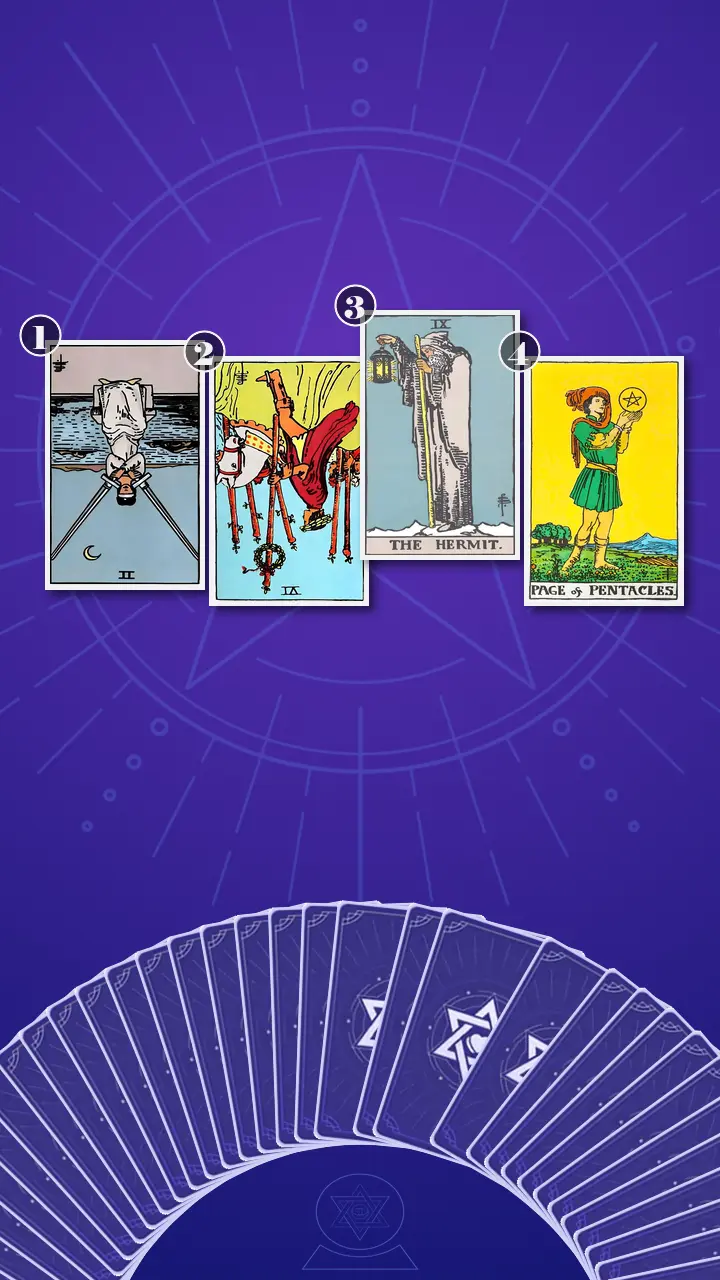
For this question, I chose a four-card layout I use often called The Shadow Spread. As a Jungian psychologist, I use the word shadow very plainly: it is the motive that stays offstage and therefore ends up running the scene. This spread is especially useful when someone is asking, “Do I actually want grad school, or do I just want validation?” because the logic is clean. The first card names the visible knot. The second reveals the hidden reward system underneath it. The third brings the integrating truth that can separate real curiosity from borrowed ambition. The fourth turns that insight into a low-stakes, reality-based next step.
In other words, this was the exact arc Jordan needed: surface spiral, hidden applause loop, inner guidance, grounded action. That is how tarot works in context when achievement identity hangover and comparison fatigue are louder than desire.
Reading the Map Before the Deadline
Position 1: The Surface Knot — Two of Swords Reversed
I turned the first card and showed her the position before the symbolism: this card represented the observable knot—the deadline pressure, the stop-start behavior, and the overthinking around whether to submit at all.
The card was the Two of Swords, reversed. I told her immediately that this was the 11:46 p.m. portal card. It looked exactly like toggling between the grad portal, the statement draft, and a rankings tab; editing one line; then closing the laptop because submitting feels like locking yourself into the wrong future and not submitting feels like falling behind in public.
In this card, the blindfold becomes data overload used to avoid naming a feeling. The crossed swords mirror the way she had been holding competing arguments over her own chest until nothing could move. This was Air energy in blockage: intelligence turned defensive, analysis used not to discover truth but to postpone contact with it. The decision jammed not because she was incapable, but because she was demanding perfect certainty before permitting ordinary honesty.
I asked her, “When your hand leaves the trackpad, what is the exact thought—‘I need more information,’ ‘What if I don't want it enough,’ or ‘What if I do nothing and look behind’?”
She didn't answer right away. Then she gave me a quick, bitter half-laugh. “All three,” she said. “Mostly the last two. And then I tell myself I'm procrastinating.”
“I don't think this is simple procrastination,” I said. “I think this is what I call Procrastination Decoding: trigger, avoidance, temporary relief, then self-blame. Maybe yes, maybe no, maybe one more tab, maybe one more edit. The system looks busy, so it feels productive. But really it's guarding you from the feeling underneath.”
Her fingers stopped drumming on the mug. That tiny stillness mattered. Immediate self-recognition had entered the room.
Position 2: The Crowd in the Room — Six of Wands Reversed
I turned the second card and named its job first: this position revealed the shadow driver beneath the choice, especially the pull of recognition, praise, and being seen as successful.
The card was the Six of Wands, reversed. I felt the whole reading sharpen. This card does not say ambition is fake. It says ambition has become tangled with an audience.
I told Jordan what I saw: she could picture the acceptance email, the group-chat reactions, the relieved family faces, and the LinkedIn update much more vividly than she could picture Tuesday seminars, supervisor fit, tuition payments, or the actual pace of graduate study. The imagined victory image was carrying more charge than the lived reality of the path. Strong LinkedIn “thrilled to announce” brain—except pointed inward until it turned comparison into a private emergency.
In energetic terms, this was Fire in distortion. The drive to achieve was real, but it kept getting recruited by approval hunger. It was like optimizing a life choice for the screenshot instead of the schedule. That is why every peer update on the TTC could make a master's feel urgently necessary for twenty minutes, then strangely empty once the imagined audience disappeared.
I asked her, “When you picture getting in, whose reaction do you see first?”
Her chest rose and held there for a second. Then came the three-beat reaction I have learned to watch for: first the pause, then the faraway eyes, then the small collapse of the shoulders. “My parents,” she said quietly. “And honestly... people from school. I want a clean answer when they ask what's next.”
“Of course you do,” I said. “A gold star can point at you. It cannot live your life for you. Prestige is not proof of fit.”
She pressed her lips together, then nodded once. “Achievement identity hangover is exactly it,” she said. “I think I've been wanting the headline more than the life.”
When the Hermit's Lantern Replaced the Feed
Position 3: The Integrating Truth — The Hermit
When I turned the third card, the atmosphere changed so clearly I almost smiled. On Jordan's side, the blue glare of the screen softened because she had finally clicked out of the social feed. On mine, the canal light outside my window had gone silver and still. We had reached the hinge of the reading—the place where the blindfold either stays on, or a smaller, truer light is chosen.
This position identified the integrating truth that could separate genuine desire from borrowed ambition and challenge the core blind spot. The card was The Hermit, upright.
I told her this was the antidote. Card one had shown blocked seeing. Card three answered it with a lantern. Not floodlights. Not a verdict from the sky. Just enough honest visibility to take the next few steps without pretending the whole future needed to be solved tonight.
I described the exact scene this card lived in: Line 1, phone warm in her hand, another acceptance post lighting up her chest with that sudden maybe I should just apply everywhere feeling. Then she gets home, opens the draft, and feels nothing but static. That is what happens when a person is trying to use grad school as proof of worth instead of asking whether the actual learning life fits. The loudest voice in the decision is not always desire; sometimes it is the old reward system panicking.
Stop chasing a gold star you can hold up to the crowd; pick up the Hermit's lantern and ask which path still matters when nobody is watching.
Not every urge to keep moving is desire; sometimes it is the old scoreboard lighting up. Clarity begins when you ask about the life, not the badge.
Jordan's reaction was not instant relief. First her breath caught. Then her hand froze halfway to her mouth. Then her eyes drifted past the camera, unfocused, as if a dozen late-night tabs were replaying themselves behind her face. When she finally spoke, there was a flash of anger in it. “But if that's true,” she said, “doesn't that mean I've been doing this all wrong?”
“No,” I said. “It means an old reward system has been doing its job too well. That's different. There is nothing shameful about wanting to be seen. The problem is only when being seen becomes the thing making the decision.”
Years ago, while training intuition on transoceanic ships, I learned that the prettiest harbor brochure tells me nothing about docking conditions. Crowds love a dramatic arrival. Captains still have to read depth, wind, cost, and timing. So I used my Choice X-Ray with her, the way I do when a life option looks brighter in public than it feels in private. I held grad school up to four lights: the work, the pace, the cost, and the identity. Did she want the reading load, the supervisor relationship, the tuition math, and the winter commute? Or did she want the announcement, the relieved reactions, the safe feeling of still being the high-achieving one? Without the audience, what remains? The Hermit asks for inner authority, patience, and self-trust. It moves us from public-feed mode to private-draft mode.
“The real question,” I told her, “is not ‘Would this look good?’ but ‘Would I want this on a tired Tuesday?’”
I watched the insight move through her in layers. Her jaw unclenched before her words did. The hand at her face dropped to the desk. Her shoulders loosened so suddenly she gave a small, almost startled laugh, the kind that comes after carrying a heavy backpack so long you forget it is there until you take it off. There was relief in that laugh, but also a moment of mild vertigo—the strange emptiness that can follow when the noise clears and the responsibility becomes yours again.
“I don't think I've ever asked what I'd choose if nobody knew,” she said.
“Stay with that,” I replied. “Using this new angle, look back at last week. Was there a moment when this insight would have changed the feeling in your body?”
She nodded slowly. “On the TTC,” she said. “I saw someone's acceptance post and got that buzzing rush. If I'd asked about the actual Tuesdays, not the email, I think half the panic would've dropped.”
I gave her the Hermit's first task immediately. “Within the next ten minutes, put your phone on Do Not Disturb and open a blank note. Title one side ‘Life I want’ and the other ‘Applause I want.’ Write three bullets in each. No research. No texting for input. And if your body starts to buzz too hard, you can stop after five minutes.”
That was the bridge we needed. Not total certainty—something better. A movement from deadline panic and gold-star confusion toward quieter curiosity and steadier self-trust. Clarity gets louder when the audience gets quieter.
Position 4: The Ground Under the Decision — Page of Pentacles
I turned the final card and named its role: this position showed a low-stakes, reality-based next step that would let Jordan test fit without turning the decision into a worth verdict.
The card was the Page of Pentacles, upright. After The Hermit's private lantern, I loved this landing. It is beginner Earth—grounded, curious, unglamorous, useful.
I told her to imagine the exact opposite of rebranding her whole life in one afternoon. This card says: pick one program. Read the sample syllabus. Check funding, commute reality, and weekly workload. Maybe message one current student. The Page studies one pentacle at a time. In modern life, that is free-trial energy. Test the product in real conditions before buying the annual plan.
Energetically, this was balance returning. Not more Air, not more public Fire—Earth. Something touchable. Something that could be built or declined based on lived fit. The question shifted from “Would this prove I'm driven?” to “Could I genuinely live and learn this way?”
Jordan gave me the first full nod of the session. “The one-program pilot,” she said, “is the first thing that's made this feel less impossible.”
From Headline to Tuesday: Actionable Next Steps
By the time all four cards were on the table, the story was clear. Jordan's visible problem was not lack of discipline. It was a stop-start loop created by overthinking a decision that had been overloaded with identity. Underneath that sat the real pressure point: recognition hunger, the wish for a visible next move, the fear that without another impressive milestone she might feel ordinary or hard to explain. The blind spot was subtle but powerful—she had been treating externally legible momentum as if it were the same thing as inner fit.
The cards offered a cleaner direction. Shift from using grad school as proof of worth to testing whether the actual learning life of the degree fits her values and curiosity. Or, in plainer language: less thinking at the problem, less performing the answer, more testing what fits in real life.
I told her I wanted to borrow two tools from my own practice. The first was my Port Decision Model: no captain commits to a port because it looks good on postcards; she checks whether the ship can actually land there safely, affordably, and on time. The second was Reality Testing: a 48-hour checklist that turns a charged identity decision into a small experiment. Her next steps needed to be private, concrete, and short enough to do before the next spiral started.
- No-Audience Desire AuditOn one evening this week, put your phone on Do Not Disturb for 20 minutes and open a blank note titled “No Audience.” In that note, make two bullet lists: “What I want from grad school” and “What praise grad school would give me.” Do it in your Notes app or on paper, at home, with no program websites open and no texting anyone for input.If you feel silly, activated, or tempted to research, treat that as part of the pattern rather than proof the exercise is failing. Five minutes counts.
- One-Program PilotChoose one specific program—only one—and spend 25 minutes with the real-life details: sample syllabus, funding page, commute, likely workload, and supervisor style. If it helps, send one concise message to a current student asking what an ordinary Tuesday actually looks like.The goal is not to decide your identity. It is to test the schedule, cost, and learning life. Think pilot project, not lifetime contract.
- 48-Hour Feed MuteFor the next 48 hours, mute LinkedIn or Instagram if peer updates are turning every announcement into a personal emergency. And if someone asks what your plan is this week, try one honest sentence: “I'm testing fit right now, not forcing a headline.”This is not anti-ambition. It is a boundary with noise. If muting feels too dramatic, log out for one evening or move the apps off your home screen.
These were not magic tricks. They were ways of giving Jordan her own signal back. The reading did not tell her whether to apply. It made the decision smaller, clearer, and more honest—exactly where real agency begins.

A Week Later, the Quieter Proof
A week later, I got a message from Jordan. She had done the No-Audience note first. “My applause list was embarrassingly easy,” she wrote. “My actual-life list was shorter, but it sounded more like me.” Then she muted LinkedIn for two days, picked one program, read the syllabus, looked at funding, and realized something important: she was genuinely interested in the research questions, but not in pretending she needed to apply everywhere just to feel legitimate.
She told me the shift was small but real. She still felt a sting when someone announced a next move. She still had moments of, “What if I skip this cycle and look behind?” But one morning she woke after a full night's sleep, had that thought, and laughed a little instead of obeying it. Then she made coffee and opened only one tab.
That, to me, is a real Journey to Clarity. Not certainty on command. Not a mystical answer dropped from nowhere. Just a person moving from applause-seeking to self-trust, from deadline panic to grounded fit-testing, from “Do I need this to matter?” to “Do I want the life inside it?”
When you've been taught to recognize yourself by gold stars, of course a quiet decision can make your chest buzz; it can feel like losing your place and meeting yourself at the same time.
So when the noise rises again, and you hold your own choice under a smaller, truer light, what tiny piece of the actual grad-school life would you want to test just for yourself this week—one syllabus, one commute, one tired Tuesday—if nobody needed a polished answer from you?
Every reading at AceTarot is a Journey to connect with inner wisdom and empower next step.
Learn more about our Journey to Clarity.