One Earbud on the Streetcar—And the Shift to Kind, Clear Limits

Boundary Guilt on the 6:18 p.m. Streetcar
I have learned that if one person’s name lighting up your phone after work makes your stomach drop before you even press play, you are not dramatic—you may be caught in boundary guilt with friends, the kind that turns one unread voice note into a whole evening gone sideways inside an emotionally one-sided friendship loop.
When Maya (name changed for privacy) sat across from me, she did not start with a theory. She started with Tuesday, 6:18 p.m., on the 504 King streetcar heading west. One earbud in. Coat still on. A 3:07 voice note glowing on her screen. The fluorescent light above her kept flickering; the car smelled faintly of wet wool and takeout; her phone had gone warm in her palm by the time she hit play. By the time she got home, dinner was still half-decided, pasta water had gone lukewarm, and her shoulders were somewhere near her ears.
“I know they’re having a hard time,” she told me, “but I can’t keep being on standby. And if I leave it too long, it feels mean.” There it was in one clean line: wanting to be a caring friend, and fearing that stepping back would make her selfish, cold, maybe abandoning.
Her guilt sounded to me like a silent emergency pager strapped inside her throat—every few minutes it buzzed again, and her stomach dropped with it. A delayed reply is not a character flaw, I told her. “You’re not replying, but you’re not free either. Let’s make a map for that.”

Choosing the Compass: A Relationship Spread for Friendship Boundaries
I asked Maya to place her phone face down, take one slow breath, and say the real question out loud: not “What is the perfect reply?” but “What is the most honest response I can stand behind tonight?” I shuffled slowly and laid out what I call the Relationship Spread · Context Edition.
This is the kind of relationship tarot spread I use when someone is asking how to respond to a heavy voice note without being cold. How tarot works, at its best, is not by replacing your judgment but by organizing the emotional field so you can actually see it. This spread fits friendship boundary dilemmas because it looks at five things with the fewest cards necessary: what you are bringing, what the other person’s energy is bringing, the pattern between you, the boundary lesson under the guilt, and the healthiest next step.
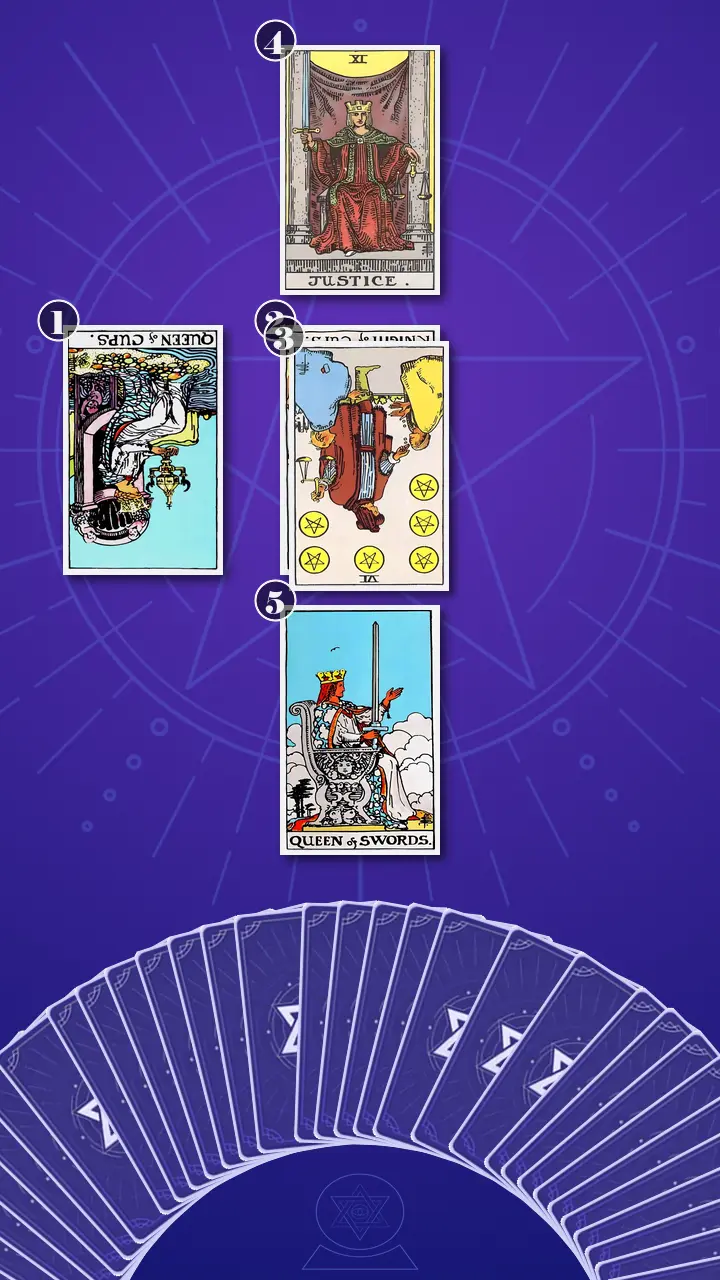
I placed card three at the center like the pressure point of a compass. Card one went to the left for Maya’s current state. Card two to the right for the friend’s incoming energy. Above the center sat the principle that would govern the whole reading. Below it, the action that could restore orientation. Before I turned anything over, I told her, “We’re not here to predict the friendship’s fate. We’re here to see whether this unread voice note is really a moral emergency, or a pattern asking for a clearer structure.”
Reading the Crossed Wires
Position 1: The Earbud, the Draft, and the Tight Throat
Now I turned the card that shows Maya’s current emotional state and the concrete behavior loop around the unread voice note.
Queen of Cups, reversed.
This looked exactly like the scene she had already described: hearing the voice note the second it came in on her streetcar ride home, feeling the friend’s mood move straight into her body, and then losing sight of her own bandwidth while drafting a careful, soothing reply in Notes she might never send. The Queen of Cups reversed is empathy in excess and self-protection in deficit. Care is present, but it is so over-absorbed that it becomes porous.
I pointed to the image of the lidded cup and told her, “You haven’t even decided to help yet, but your body is already acting like you said yes.” It was the friendship version of staying mentally logged into work after hours. A little Severance, honestly: after-work Maya had left the office, but on-call Maya was still clocked in on the same device.
Maya gave a short laugh that had more fatigue than humor in it. “Okay,” she said, rubbing her thumb along the edge of her phone case, “that’s accurate enough to be rude.” Her throat moved when she swallowed. I nodded. “That’s because this isn’t saying you care too much. It’s saying your care keeps skipping the part where you check whether you actually have capacity.”
Position 2: Urgency Before There’s Even an Ask
Next I turned the card that shows the relational energy the friend is bringing into the exchange, without diagnosing or predicting them.
Knight of Cups, reversed.
This card showed me the message arriving full of mood and momentum: a long voice note with dramatic emotional charge that makes everything feel urgent before any actual ask has been named. This is excess emotional velocity and blocked containment. The problem is not that the friend has feelings; the problem is that the feelings arrive in a form that presses on Maya’s nervous system before her thinking mind can sort out what, specifically, is being asked.
I asked her, “If you strip away the tone, what is the real request most of the time—witness, advice, practical help, or immediate access to you?” She stared at the card for a second, then looked up at me. “Sometimes there isn’t one,” she said. “It’s just... here’s the whole storm.”
Exactly, I told her. When a message lands like a “can you talk?” text with no context, the body often goes on alert before the facts arrive. That does not mean you are selfish for pausing. It means your system has learned to read atmosphere as obligation.
Position 3: The Splitwise Tab Nobody Logged
Then I turned the card that reveals the pattern of give-and-take that keeps the dilemma alive.
Six of Pentacles, reversed.
At the center of the spread, this was the hidden economy of emotional labor. Maya regularly absorbed the long updates, the late-night soothing, the follow-up, the emotional admin. Her own limits stayed mostly invisible. Support did exist in this friendship, but not in a way that landed back with the same grounded steadiness. This is blockage in reciprocity: the scales are there, but they are not level.
I told her, “The problem is not one hard night; it’s how often your care is expected to absorb the cost.” In my mind I saw a Splitwise tab no one had logged honestly: one person paying in time, attention, and recovery hours, month after month, because asking for fairness felt awkward. That was the real center of the reading.
Maya went very still. First her fingers stopped moving. Then her gaze slipped off the cards, as if she were replaying the last few months in fast cuts: the midnight check-ins, the careful paragraphs, the chats left open like unfinished tabs. Finally she said, quietly, “I can remember all of her crises. I genuinely don’t know the last time she asked how I was without it swinging back.”
“That’s why this feels so loaded,” I said. “If support only works when you erase yourself, it is not balance.”
When Justice Turned Guilt into Clarity
Position 4: The Boundary Principle Above the Noise
I always slow down before a key card, and I did here. Outside my window, a streetcar bell rang through the wet evening and then everything in the room seemed to go quieter around it. I turned the card that reveals the boundary principle and hidden test beneath the guilt.
Justice, upright.
Justice told the truth cleanly: this was not really about whether Maya was a good friend. It was about fairness, proportion, and accountability. The balanced scales and upright sword asked a better question than guilt ever does: not “How do I make this person feel better immediately?” but “What is a fair response I can actually sustain tonight?” This card was balance returning after excess water and uneven exchange. Access is not the same as care.
This is where my former Wall Street brain always clicks in with my tarot one. On the trading floor, urgency loved disguising itself as value. My signature tool for moments like this is what I call Strategic Crossroads Analysis: I lay out the options the way I once weighed live deals—reply from depletion tonight, send a brief boundaried response, or stay emotionally open-ended—and I look at the probability-weighted cost across three horizons: tonight, tomorrow, and a month from now. Justice is merciless in the best way. It does not reward the move that relieves guilt fastest. It rewards the move that remains fair when the adrenaline wears off.
Maya was caught in the old split: answer now and betray herself, wait and become the villain. She was still treating the unread message like a morality test instead of a capacity question.
Not "if I step back I am cold," but "if I respond from what is fair and true, the scales stay balanced" - that is Justice turning guilt into clarity.
I let the sentence sit between us for a beat.
Her reaction came in layers. First, a small physical freeze—her breath stalled halfway in, and her fingers hovered above the edge of the card without touching it. Then the thought landed deeper; her eyes lost focus for a second, as if she were watching old scenes rerun behind them: the Tuesday streetcar, the Wednesday desk, the lukewarm coffee, the chat preview checked one more time for moral clearance. Then the release arrived, messy and real. Her shoulders dropped. Her jaw unclenched. Her eyes brightened with the kind of water that is half relief and half anger. “But then what have I been doing?” she asked, voice thinner now. “Training people that I have bypass rights?”
“No,” I told her gently. “You’ve been surviving with the tools you had. Justice is not punishment. It’s calibration.” I slid a notebook toward her the way I used to slide a prep sheet across a conference table before market open. “Within the next ten minutes, write two lines: ‘Tonight I can offer ___.’ ‘Tonight I cannot offer ___.’ If you choose to reply, let those lines cap the message. Now, with this lens, think back to last week. Was there a moment when a fair response—not an instant one—would have changed how your body felt?”
She nodded before she answered. “Wednesday morning. The draft was sitting there in Notes, and I felt guilty in both directions.” That was the shift I wanted her to feel: not perfection, not certainty, but the first real movement from guilt-driven hypervigilance and resentment toward steadier compassion, relief, and self-trust.
Position 5: The Reply You Can Stand Behind Tomorrow
Finally, I turned the card that points to the clearest, most respectful next-step stance Maya can take.
Queen of Swords, upright.
This card gave us the actionable response. I described a split screen for her. On one side: the old version, a 300-word Notes draft full of disclaimers, softeners, and vague availability she would later regret. On the other: a brief, kind text sent from calm, with one acknowledgment and one limit. The Queen of Swords is balance through clarity. Warmth is still there, but it is no longer leaking.
“Short does not mean cruel,” I told her. “This is basically an out-of-office reply for your emotional bandwidth.” The open hand on the card said she could remain humane. The sword said she did not have to stay open-ended. Low Power Mode for the evening, not emotional exile.
Maya read the card, then looked back at me with a face that had noticeably more color in it. “So the healthiest path isn’t ghosting,” she said, “and it isn’t a whole debrief. It’s a kind-but-closed loop reply.”
“Exactly,” I said. “You can be kind without going on-call.”
Scales Before Send: Turning Insight into Next Steps
When I pulled the whole spread together for her, the story was clean. First came saturated Water: Maya’s empathy absorbing before she checked capacity, and the friend’s emotion arriving with urgency before clarity. Then came distorted Earth: the Six of Pentacles reversed naming the hidden imbalance, the way one hard message now carried the weight of months of uneven emotional labor. Then Air returned through Justice and the Queen of Swords: principle above, action below. This was not a story about caring less. It was a story about learning to care without disappearing.
The blind spot, I told her, was not lack of compassion. It was treating her own capacity like an inconvenience instead of data, and trying to solve a structural imbalance with ever more careful wording. The transformation direction was equally clear: shift from using instant availability as proof of care to using clear, sustainable limits as proof of self-trust and respect. The right reply starts with your actual bandwidth, not their panic.
Because guilt gets slippery when it stays abstract, I gave Maya one of my boardroom-style tools and translated it for friendship. I call it Scales Before Send. Not because friendship should feel corporate, but because visible criteria can calm a nervous system that keeps mistaking urgency for obligation.
- Capacity Line Before listening to any heavy voice note after work, open Notes and write one line: “Tonight I have capacity for ___, not ___.” Do it on the streetcar, at your kitchen counter, or in bed before you press play. Give it sixty seconds, no more. If the full sentence feels dramatic, go tiny: “brief check-in / not a debrief” is enough to start.
- One-Listen, Eight-Minute Rule If a message lands during your commute or while dinner is cooking, finish the current task first if you need to. Then set an eight-minute timer: listen once, identify the actual ask, decide what you can offer, and either send a brief reply or consciously wait until tomorrow. If your throat tightens or your body ramps up after listening, that is permission to pause, not proof you owe more.
- Kind-But-Closed Loop Text Save one two-sentence template in your own voice. For example: “I’m sorry you’re having such a rough night. I can’t fully process this tonight, but I can check in tomorrow.” Use it with this friend, or with any after-hours message that risks turning into unpaid on-call labor. Resist the urge to add three extra reassuring sentences. Truthful is kinder than over-defended.

A Week Later, the Chat Stayed Closed
A week later, Maya sent me a message after work. She had been making dinner when another heavy voice note came in from the same friend. This time she finished draining the pasta first. Then she wrote her capacity line, listened once, and sent a two-sentence reply she could actually stand behind. After that, she put the chat away for thirty minutes and let the evening keep its own shape.
It was not movie-ending perfect. She slept through the night, then woke with the old thought—what if that sounded cold?—and smiled at it instead of obeying it. Clear, but still human. That, to me, is real progress.
When I think about this reading now, I do not remember it as a question about whether to reply or step back. I remember it as a journey from access-based care to self-trust, from panic replies to steady compassion. Tarot did not make Maya’s decision for her. It helped her see the structure clearly enough that her own judgment could come back online.
If someone’s name lights up your phone and your throat tightens before you even press play, the hardest part is usually not caring too little. It is fearing that one pause will undo your whole identity as the reliable one.
If care were allowed to have edges for one evening, what would the most honest two-sentence reply in your own voice sound like—your own small Scales Before Send text?
Every reading at AceTarot is a Journey to connect with inner wisdom and empower next step.
Learn more about our Journey to Clarity.