Three Missed Calls at Work: From Family Alarm to a Fair-Share Check

Finding Clarity in the 2:13 p.m. Lock-Screen Spiral
I knew this was family-boundary guilt, not just being helpful, before Jordan (name changed for privacy) said the word move. She was 28, an operations coordinator in Toronto, the kind of late-20s city daughter who could run an ops mess at work and still lose all focus the second three missed calls from home landed on her lock screen.
She described Tuesday at 2:13 p.m. in her downtown office: Slack open, a spreadsheet half-finished, fluorescent lights buzzing overhead, burnt coffee cooling beside her laptop. The phone felt hot in her palm. She flipped it face down, but her Notes app was already open with fragments like flights, time off, who needs what, maybe sublet. Before she even knew what had happened, her body had already started volunteering.
That was the whole contradiction in one frame: she felt home’s pull for real, and at the same time she wanted to protect the life she had built from swallowing itself into the fixer role again. The dread in her sat like a subway brake squeal trapped under her ribs—metallic, sudden, impossible to ignore—with resentment and exhaustion packed underneath it.
‘Every time I think about going back,’ she told me, ‘I can’t tell whether it’s love or guilt talking.’
I nodded. ‘Good,’ I said gently. ‘That means the question isn’t whether you care. You do. Our job today is to slow the scene down and draw a map, so any next step comes from clarity instead of the family alarm system.’

Choosing the Compass, Not the Panic
I asked her to put both feet on the floor, take one slow breath, and say the question without solving it. While she breathed, I shuffled slowly—not as theatre, but as a way to stop urgency from taking the driver’s seat before we had facts.
For family-boundary guilt, fixer-role loops, and move-back-home questions like this, I use a spread I designed called the Transformation Path Grid · Context Edition. When people ask me how tarot works in situations like these, this is my most honest answer: the cards are not there to bark out a yes or no. They are there to reveal the pattern that a panicked mind keeps flattening into a false binary.
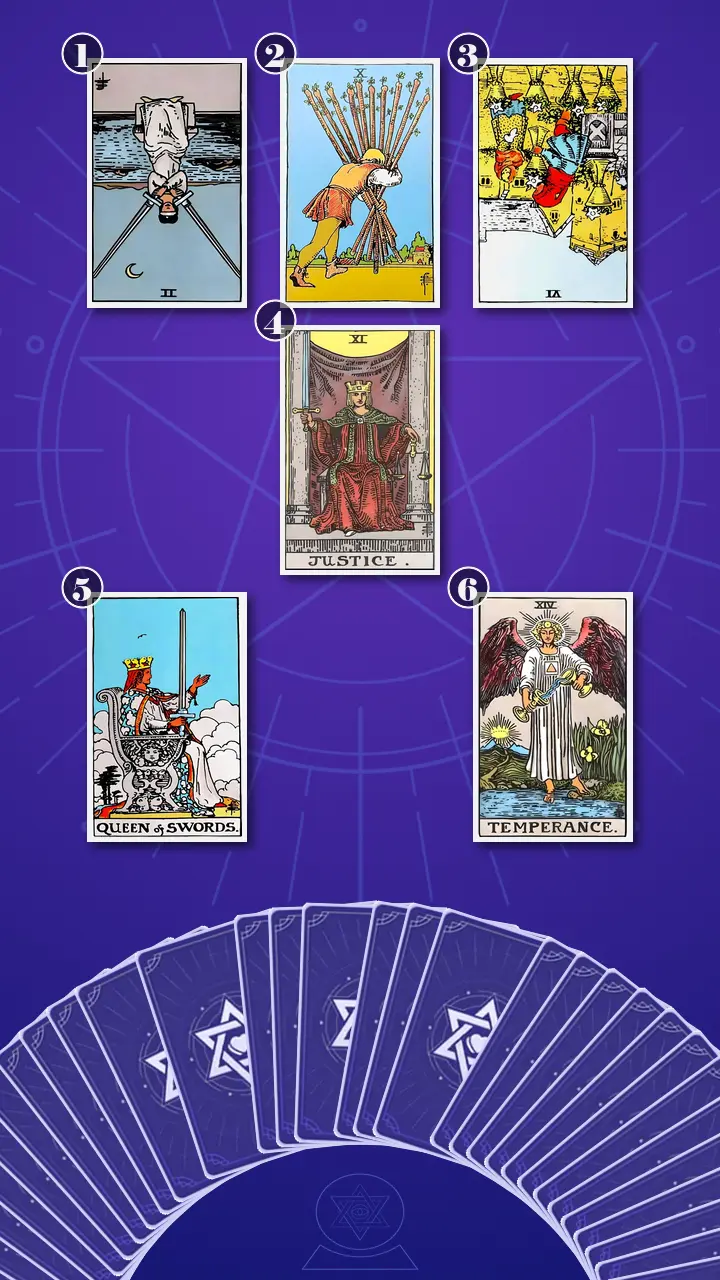
Jordan’s dilemma sounded like a choice between moving back and stepping in again. But the real structure underneath it was a repeating loop: alarm, guilt, over-functioning, resentment, then guilt again. A classic decision spread would have pushed us into external options too fast. This six-card grid let me trace one clean line instead—surface symptom, main blockage, older root, key catalyst, action pathway, and integration.
I told her what I would be watching for most closely: the card that showed what happened in the first five minutes after the missed calls, the card that revealed the older family script underneath it, and the catalyst card that could separate love from unfair responsibility before we talked about any big next steps. I laid the first three cards in a top row like an audit of the alarm, and the lower cards beneath them like a path back into proportion. Even visually, the spread moved from constriction into space.
Reading the Upper Floor of the Alarm
The Lock-Screen Freeze
I turned over the first card, the position showing the immediate surface symptom—what happened internally and behaviorally when those three missed calls landed. It was the Two of Swords, reversed.
In modern life, it looked exactly like her Tuesday at 2:11 p.m.: three missed calls between Slack pings, the phone flipped over, and then ten lost minutes to Notes-app triage, worst-case rehearsal, and half-built rescue plans before one factual question had been asked. The blindfold became the no-facts zone. The crossed swords became the freeze that somehow still buzzed with activity.
Energetically, this was blocked Air tipping into excess. Her mind was trying to outrun feeling by generating options, and the result was not clarity but overload—like opening ten browser tabs from one notification and calling that a decision. She was not failing to cope. She was reacting before she knew what she was reacting to.
Jordan gave a short laugh that had no amusement in it. She rubbed her thumb against the lip of her mug and said, ‘That’s accurate enough to feel rude.’ I told her the first correction was simple and difficult at once: separate what had happened from what fear had already added.
The Unpaid Operations Desk
I turned over the second card, the position revealing the main blockage—the burden identity that turned care into automatic over-responsibility. It was the Ten of Wands, upright.
One strained voicemail was enough for Jordan to load sibling logistics, a parent’s emotions, possible travel, and backup plans onto a week that was already full. The image in the card matched the body feeling perfectly: bent back, blocked line of sight, arms too full to tell which part of the load was actually theirs. It was like becoming unpaid project manager for a situation nobody had properly scoped.
This was excess Fire: useful energy overloaded into strain. The deeper trap was not only that she helped. It was that she had started treating being indispensable as proof of love. A whole shared Google Doc of unfinished family tasks kept migrating into her column, and because she was competent, everyone—including her—quietly accepted the transfer.
‘If I don’t pick it up, nobody will,’ she said, barely above a whisper.
I watched how high her shoulders had climbed without her noticing. ‘You can care without becoming the whole plan,’ I told her. The sentence landed in her chest before it reached her face. She went very still.
The Sixteen-Year-Old Who Still Answers First
I turned over the third card, the position uncovering the underlying root—the older family script that had taught her to equate love with stepping in. It was the Six of Cups, reversed.
In her adult Toronto life, Jordan was capable, independent, organized, fully built in the way city adulthood demands. But this card showed how quickly one strained family voice could make her feel sixteen again—voice softer, body tighter, eyes scanning the emotional weather before anyone had asked for a thing. It had The Bear ‘Fishes’ energy: the body knew the family script before the conversation had even properly started.
Energetically, this was Water pulled backward. Not tenderness, but regression. The enclosed courtyard on the card mirrored the way home could shrink her back into a familiar role, one where usefulness had once been the safest form of belonging. That older pattern had survival intelligence in it. It just was no longer fair to the adult life she had made.
‘Sometimes the guilt is old,’ I said. ‘That does not make it true.’
She inhaled slowly, then let the breath out through her nose. Her gaze dropped to the table. ‘That’s why visits home feel so weird,’ she said. ‘It’s like my apartment disappears for a second.’
When Justice Lifted the Scales
The Card That Refused the Old Verdict
When I reached for the fourth card, the room changed. Even through the faint traffic noise behind her window, there was a cleaner kind of silence—the kind that arrives when the real question is finally willing to be asked. This position identifies the key catalyst, the corrective insight that interrupts the old cycle. The card was Justice, upright.
In lived terms, it was one breath before promising anything. What happened? What was asked? What is actually mine? For Jordan, that was radical. She had been measuring choices by who might be upset, not by what was fair, wanted, or sustainable.
Justice always wakes up my old Wall Street reflex. On a trading floor, an alarm never automatically meant we owned the exposure; first we checked what was actually on our book. In readings like this, I use what I call my Strategic Crossroads Analysis. I do not let the loudest emotion set the valuation. I probability-weight the facts, the request, and the real cost of saying yes. That is what the scales in this card are doing: not becoming cold, but becoming accurate.
When a phone lights up three times in the middle of a workday and a stomach drops before the screen is even unlocked, the old role gets there faster than the facts. Jordan had been treating every ring like a verdict on whether she was loving enough.
Not every ringing alarm is your verdict to carry; weigh what is truly yours, let the scales rebalance the story, and choose from clarity instead of guilt.
I let the sentence sit between us for a beat, then said it even more plainly: urgency is not the same thing as ownership.
I watched her reaction arrive in three waves. First came the physical freeze: her fingers stopped halfway around the mug handle and her breath caught so sharply I could hear the tiny hitch of it through the microphone. Then came the cognitive seep: her eyes went slightly unfocused, as if she were replaying a Friday TTC Line 1 ride, the family group chat lighting up, the quick mental math of what part of her own life she was about to cancel. Finally came the emotional release, though it was not soft at first. Her jaw unclenched, her eyes brightened, and then anger flashed across her face.
‘So I’ve been sentencing myself before anyone even asks?’ she said.
‘No,’ I answered. ‘It means you learned speed as a survival language. And now you get to learn proportion.’
I asked her to think back over the last week and find one moment when this new lens would have changed the feeling in her body. She went straight to a voicemail that had sent her to Google Flights. Nobody had asked her to move. Nobody had asked her to book anything. She had gone from one stressed tone of voice to a whole life reorganization in under ten minutes.
Right there in session, I had her open a note and type three headings: ‘What happened.’ ‘What was asked.’ ‘What is mine.’ I told her that if her nervous system spiked, she was allowed to fill in only the first heading and come back later. That pause was not betrayal. It was the first real step from guilt-laced dread and hyper-responsibility toward steadier self-trust and a more regulated relationship to home.
A Warm Voice with Edges
I turned over the fifth card, the position giving the action pathway—the boundary practice she could try now, before making any life-altering decision. It was the Queen of Swords, upright.
In real life, I saw Jordan calling back with warmth and precision: ‘I can help compare two options tonight for 20 minutes, but I can’t coordinate the whole week.’ The raised sword and the open hand said the same thing in two languages: clarity and care do not cancel each other out. A warm voice can still have edges.
Energetically, this was balanced Air. Not overthinking, not defensiveness, but direct language used in real time. The card did not ask her to become distant. It asked her to stop speaking in vague availability and start naming real limits. In other words, it gave her a boundary script for parents when they call in crisis without making her disappear into coldness.
Jordan tested the sentence under her breath, like someone trying on a coat she had assumed was not made for her. ‘It sounds firm,’ she said.
‘Firm is not cruel,’ I told her. ‘It only feels harsh when guilt is used to having the microphone.’
The Slower Rhythm That Still Counts as Love
I turned over the final card, the position showing integration—the more regulated relationship to home and self that became possible when the new stance was practiced consistently. It was Temperance, upright.
This is one of my favorite cards in family readings because it never glamorizes sacrifice and it never glamorizes total withdrawal either. One foot on land, one in water; one cup pouring carefully into the other. In everyday terms, it looked like Jordan staying in touch with home while keeping Wednesday gym, answering a Sunday call without losing the rest of her evening, and not opening travel tabs at midnight because one text sounded stressed.
Energetically, Temperance brought balance after a spread that had started with jammed Air, strained Fire, and backward-pulling Water. It said that healing here would not look dramatic. It would look ordinary. Her own operating system would stay running while messages still arrived.
Jordan’s shoulders dropped an inch. ‘That sounds boring,’ she said, and for the first time she smiled without bracing.
‘Exactly,’ I said. ‘A steadier commute pace. Not sprint-stop-sprint every time the signal changes. Boring can be a nervous system finally feeling safe enough to stop performing emergency.’
The Fair-Share Ledger Before Any Big Move
When I gathered the story of the spread, it was clean. The missed calls were only the spark. The deeper machinery was older: a defended mind that panic-planned, a burden identity that treated usefulness as love, and a younger family self that still rushed to stabilize the room before anyone asked. The blind spot was not that Jordan cared too much. It was that she had been measuring her choices by urgency and potential disappointment instead of fairness, capacity, and desire.
That is why the move-back-home question felt so overwhelming. It was carrying several questions at once: Should I go back? Am I selfish if I do not? Why do missed calls from family make me panic at work? How do I stop being the fixer in my family without feeling selfish? Justice answered all of them with one redirection: ask what is actually mine before reorganizing my life.
Before we ended, I translated Justice and the Queen of Swords into one of my practical tools: a boardroom-style decision ledger. It came out of my finance life, but it works beautifully here. Facts, request, capacity. If guilt was the only column making noise, it did not get the deciding vote.
- The Three-Facts PauseI told Jordan to pin a note on her phone called ‘Before I Volunteer.’ Before the next callback, she would spend 60 seconds filling in three lines: ‘What happened?’ ‘What exactly is being asked?’ ‘What is actually mine?’ She was not to open travel, housing, or budget tabs until she had three concrete facts on the page.If guilt spikes, she only has to answer the first line first. A true emergency remains true after one clarifying text.
- The Warm Spine ResponseI had her draft three callback lines in her Notes app that same night. One of them was: ‘I can talk for 15 minutes after dinner, but I can’t coordinate everything.’ On the next call, she would offer one specific kind of help with a real time limit, using her calendar instead of vague panic-availability.Keep the sentence short. Over-explaining is often guilt trying to purchase permission.
- The Five-Minute Re-EntryAfter any emotionally loaded family call that week, I told her to do a five-minute reset before making plans: drink water, unclench her jaw, and walk once around the block. She also chose one routine to protect—Wednesday Pilates—and agreed not to offer that slot away preemptively.Start with one protected routine, not a dramatic boundary reset. Sustainability is the goal, not performance.

A Week Later, the Quiet Proof
A week later, Jordan sent me a message at 6:42 p.m., just before her Wednesday class. ‘Three missed calls again,’ it began. ‘I sent: I’m in the middle of something—what’s going on exactly? It was paperwork, not catastrophe. I called later, helped for 20 minutes, and still made it to Pilates.’ Then she added one more line: ‘My hands were shaking when I typed it, but I didn’t open Google Flights.’
That was the proof. Not a solved life. Not perfect boundaries. Just one clean interruption in an old loop. She kept the class, then sat alone on a bench outside the studio for three quiet minutes while the old guilt cleared its throat. This time, it did not get the last word.
That is all I ever want from a reading like this. The Transformation Path Grid · Context Edition did not tell Jordan who to be. It showed her the exact point where choice re-entered the room. From there, the power was always hers.
There is a very specific ache in loving your family while your body braces like one missed call could cost you the version of yourself you fought to build. If that ache is familiar, I hope you remember that a pause can be loving too. If the next call from home did not get to decide your role for you, what is one sentence you might want beside your phone before you answer—your own version of the scales, or simply: ‘What happened, what was asked, what is mine?’
Every reading at AceTarot is a Journey to connect with inner wisdom and empower next step.
Learn more about our Journey to Clarity.