Mortgage Pre-Approval Panic, Then a Fairer Buy-or-Rent Choice

Finding Clarity in the 8:47 p.m. HouseSigma Spiral
I hear a particular sentence a lot now: someone gets the mortgage pre-approval email, feels excited for five minutes, then opens six tabs and searches 'rent vs buy calculator Toronto.' When Jordan (name changed for privacy) came to me, that was almost word for word how she began. She could make crisp UX decisions at work all day and still freeze the second a housing tab opened at home.
It was 8:47 p.m. on a Tuesday in her one-bedroom rental in Toronto's west end. She was eating cold takeout over the sink, flipping between HouseSigma, Ratehub, and a color-coded budget spreadsheet while the fridge hummed and her laptop ran hot against her wrist. Soy-salt hung in the air. She zoomed in on a condo floor plan she actually liked, then opened a new tab to talk herself out of it because wanting it felt almost as scary as paying for it. 'I keep telling myself this is just math,' she said, 'so why does it feel like my entire adulthood is on trial?'
On paper, her question was straightforward: should she buy a condo now or keep renting? Underneath it, I could feel the real contradiction immediately. She wanted the security and ownership of buying, and she was just as afraid of getting locked into the wrong financial commitment. Her anxiety sat in the room like 27 browser tabs autoplaying behind her ribs: a tight chest, a clenched jaw, shoulders slightly raised, her whole body bracing as if a verdict were about to arrive. I told her, gently, 'A title deed is not a personality test.' Then I added what I knew she needed most: 'Let’s not ask this choice to prove your worth. Let’s make a map through the fog and find the kind of clarity that is fair to your real life.'

Choosing the Compass for a Buy-or-Rent Crossroads
I asked Jordan to put both feet on the floor, take one slow breath, and say the question once without defending either side. Then I shuffled. I have never cared for ritual as theatre; I care for it as a threshold. A practical tarot reading works best when it helps the mind step out of argument mode and into observation.
For her, I chose the Decision Cross · Context Edition. For a housing choice like this, it is the cleanest structure I know because it compares two concrete paths without inflating the spread or pretending tarot should replace licensed financial or legal advice. This is how tarot works best in a real-life dilemma: not by removing the numbers, but by arranging the visible facts and the invisible pressure into one readable picture. The center card would show the decision knot itself. The cards to the left and right would compare buying and renting as living options, not moral rankings. The card above would reveal the hidden pressure shaping the whole debate. The final card below would not forecast fate; it would offer the grounded principle most likely to help her move forward with responsibility and self-respect.
I told her that if she had been stuck in housing decision paralysis for weeks, this spread would let us read the issue in the only sequence that really mattered: what is stuck, what buying truly offers, what renting truly offers, what fear is pressing down on both, and what kind of finding clarity is actually possible when perfect certainty is not.
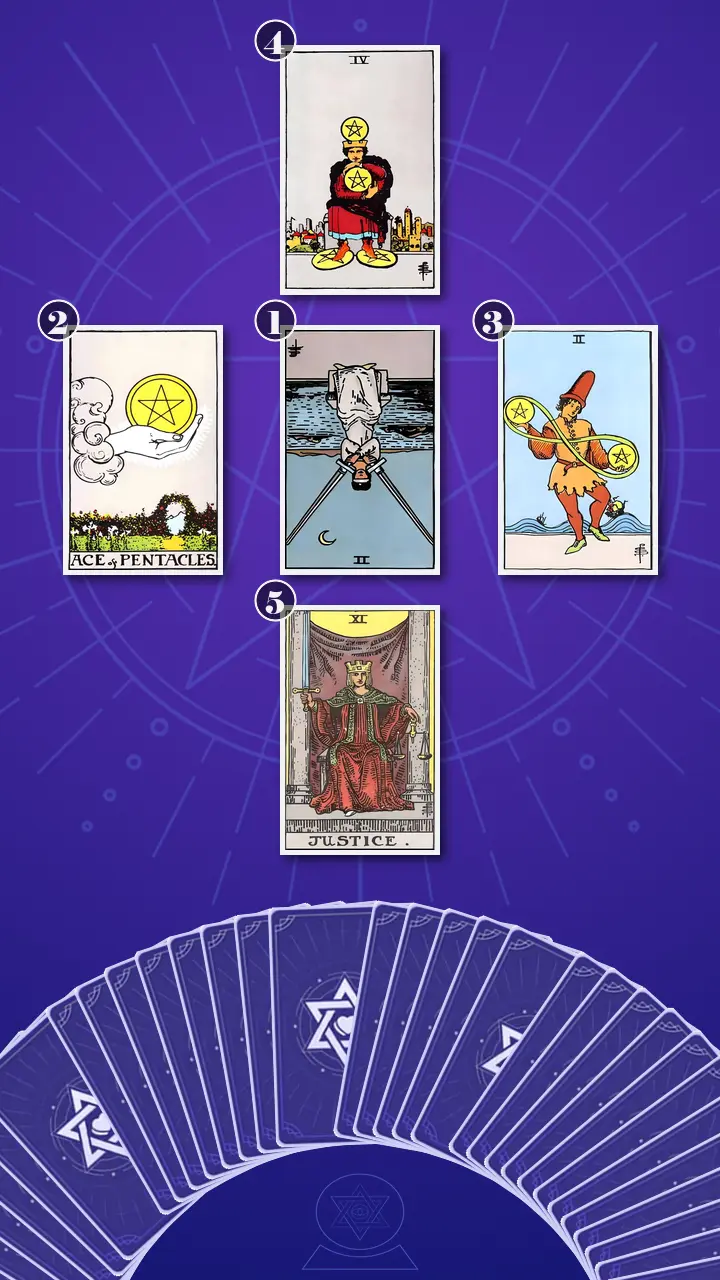
From Foggy Tabs to Money Reality
Position 1: The Tabs That Called Themselves Research
I turned over the first card, the one representing the concrete decision knot: the over-research, indecision, and mental gridlock keeping her from moving forward. It was the Two of Swords, reversed.
I told Jordan that this card was blocked Air. Not a lack of intelligence. Not poor judgment. Blocked Air is what happens when the mind becomes so overcrowded that it stops being a guide and starts acting like a shield. In modern life, it looked exactly like 11:23 p.m. with HouseSigma, Ratehub, her bank app, and a Notes list open at the same time; changing down-payment numbers, tweaking condo-fee assumptions, getting a brief hit of control, then shutting the laptop the second the total jumped. The blindfold on the card became, in her life, 'I have data but I still can’t feel my own preference.' The crossed swords became tabs and pros-and-cons lists held in tension so long that they stopped clarifying anything.
'Every time I think I found the answer,' I said, 'one new number blows a hole in it. That’s not more clarity. That’s the loop.' Jordan gave a short laugh, tight and a little bitter. 'That is so accurate it’s almost rude,' she said. First her breath caught. Then her fingers hovered over the edge of the table as if she were about to reach for her phone on instinct. Then she let her hand drop flat again. I nodded. 'Good,' I told her. 'Then we’re finally looking at the real thing. Clarity and 100% certainty are not the same thing.'
I asked her the question this position always wants answered: 'After the last time you reopened calculators or listings, what new fact did you actually gain—and what feeling were you trying not to sit with?' She stared at the card for a beat before answering. 'Honestly? Fear.' That answer opened the rest of the spread.
Position 2: The Doorway That Is Real, Not Just Impressive
The next card represented what the 'buy a condo now' path genuinely offers and demands, separating real stability from milestone fantasy. It was the Ace of Pentacles, upright.
This was balanced Earth: a true material opening. I told her I did not read the Ace as homeowner propaganda. I read it as a doorway. Pre-approval. Keys. A Saturday viewing in a mid-rise near a streetcar line. Her own walls. A place that could become a home base rather than just a recurring payment. But the Ace is a seed, not the finished garden. Mortgage, condo fees, closing costs, the risk of repairs, and the breathing room left after all of that mattered more than the milestone glow. Buying for rootedness is legitimate. Justice later would insist that the only real question is whether the foundation is sustainable enough to live inside, not merely celebrate.
When I asked which part of ownership relaxed first in her body—having her own place, building equity, or proving she could do it—she answered very quietly, 'Having my own place.' Her face softened on that sentence. That mattered. It separated a real need for rootedness from the fantasy of looking adult on paper.
Position 3: The Kind of Safety That Still Lets You Pivot
The card for the renting path was the Two of Pentacles, upright.
This was balanced but active energy: flexibility, cash-flow management, movement. I told her renting did not appear here as failure, delay, or immaturity. It looked like staying in a walkable neighbourhood she genuinely loved, keeping more buffer in her account, being able to travel, change jobs, or shift direction without a property anchoring every financial decision. The infinity loop around the coins reminded me of calendar Tetris that works because nothing is fixed in permanent ink. I said the line plainly so she could feel its dignity: 'Flexibility is not failure to commit.'
She exhaled then—the first full one of the session—and leaned back slightly. I could see shame loosening. But I also pointed to the ships on rough water behind the figure. Renting can be nourishing flexibility in one season and a permanent holding pattern in another. So the real question was not whether renting looked adult enough. It was whether this kind of adaptable stability genuinely protected her life now, or whether it only protected her from the discomfort of choosing.
Position 4: When Safety Hardens into Control
The fourth card, above the center, represented the deeper safety-and-control need driving the split, including the fear that a wrong choice would mean she could not trust her own judgment. It was the Four of Pentacles, upright.
This is excess Earth. Protection hardening into constriction. Beneath the condo math and rent comparisons, I told Jordan, the housing question had started operating like a security ritual. I could see the whole office-kitchen scene in it: the lease-renewal email open at 12:14 p.m., the microwave beeping, burnt coffee lingering in the room, her banking app glowing back like it was supposed to certify her competence. The pentacle held to the chest showed money fused with identity. The coins under the feet showed what happens when we try to stand only on control: movement itself begins to feel dangerous.
As I looked at that card, I had one of those quiet professional flashbacks I still get from archaeology. Years ago, cataloguing storage jars from a Levantine site, I learned that civilizations do not become stable simply because they grip harder. They become brittle when preservation turns into panic. I said it in simpler terms for her: 'This stopped being about housing the moment it became proof you could protect yourself.'
Jordan went very still. Her inhale paused. Her eyes lost focus for a beat, as if she were replaying a dozen late nights with her spreadsheet. Then she swallowed and said, more softly than before, 'That’s the part I didn’t want to admit. If I pick wrong, I think it means I can’t trust myself.' There it was. Not just fear of a mortgage. Fear that one wrong move would expose shaky judgment at the exact point in life where she believed she should already feel solid.
When Justice Set the Scales Down
Position 5: The Principle That Makes the Choice Bearable
The room changed when I turned over the final card. Outside, a streetcar bell rang once and then the apartment went strangely quiet, as though the city itself had paused between one argument and the next. This was the card offering the grounded decision principle that could carry the whole reading forward. It was Justice, upright.
For a housing choice, Justice tarot card meaning is unusually practical. This is the card of contracts, balance, accountability, and self-respect under pressure. Not vibes. Not panic. Not whatever will sound smartest in the group chat. It turns the question into something closer to a product scorecard before the loudest stakeholder walks in. Same inputs. Clear criteria. No improvising based on fear.
Whenever I see Justice in a reading like this, my archaeologist’s mind reaches for what I call Historical Case Matching. Ancient port cities did not survive by choosing the harbour that looked most impressive on a map. They survived by weighing wind, stores, repair capacity, and the endurance of the crew. A glorious route could still ruin a settlement if provisions did not match ambition. Jordan’s question was smaller in scale, of course, but structurally identical. Ownership and renting were both valid harbours. Justice asked which one fit her actual supplies, not her social mythology.
That Tuesday-night moment mattered: laptop heat on her legs, listing tabs multiplying, rent and mortgage numbers starting to blur, her chest getting tighter instead of calmer. By then she was no longer trying to choose a home. She was trapped inside a harsher task—finding the one option that could never be criticized.
Stop treating a title deed as proof that you've made it; let Justice's scales weigh freedom, cost, and commitment honestly, then use the sword to cut through other people's timelines.
Jordan’s whole body reacted before her words did. First she froze completely, even her blinking delayed, as if the sentence had reached her a half-second before her mind could organize it. Then her gaze drifted off the cards and into that middle distance people get when memory and meaning are trying to line up; I could almost see her replaying the key handover photos, the rent increase email, the late-night tabs, each one suddenly sorted into its proper column. Finally, her shoulders dropped—not dramatically, but enough that the room seemed to lower with them. Her jaw unclenched. She let out a breath that trembled on the way out and laughed once, this time without bitterness. Then came the second beat I often see after a hard truth lands: a moment of slight blankness, almost dizziness, as if she had set down a heavy bag and had to remember how to stand without it. 'So,' she said, eyes brightening and threatening to water at the same time, 'the adult move might actually be renewing on purpose?'
'It might,' I said. 'Or it might be buying, if the numbers, the lifestyle, and your capacity line up. Justice doesn’t reward the option that looks grown-up. It rewards the option that is fair.' I let that settle before I asked her, 'Now, with this new lens, think back over the last week. Was there a moment when this would have changed how you felt?'
She nodded almost immediately. 'On the train, after I saw my friend’s closing photo. I kept asking what I should do. I never asked what was fair to my month, or my nervous system.' That was the hinge of the entire reading: from mortgage pre-approval anxiety and adulthood pressure to grounded self-trust and criteria-based clarity. Not certainty. Something better—discernment.
The Fair-to-Me Rubric
By then the story of the spread was clean. The Two of Swords reversed showed the visible loop: certainty-hunting disguised as responsibility. The Ace of Pentacles showed that buying is a genuine material opening, but only if the runway is still there after the keys. The Two of Pentacles showed that renting can be a legitimate form of safety when flexibility, cash flow, and emotional bandwidth matter. The Four of Pentacles exposed the real distortion: Jordan had merged money with identity, so the decision was no longer simply 'condo or rent,' but 'am I competent enough to protect my own life?' Justice cut that knot by replacing the search for one guaranteed right move with a fair decision principle.
The blind spot was ruthless in its simplicity: she had been treating perfect certainty as proof of readiness. That is almost never how adult decisions work. The transformation direction was much cleaner: define what safety and freedom actually mean in this season, then let present-tense criteria do the weighing. Fair to your real life beats impressive on paper. And no, she did not owe the market a performance of adulthood.
I gave her three practical next steps. Two came directly from the cards. The third borrowed from my archaeological training, a small method I call the Time Stratigraphy Method: separate the fast layer of panic from the deeper layer of lasting value.
- Build the 'Fair to Me Right Now' noteOpen Notes tonight and write four lines only: the maximum monthly housing cost that still lets you breathe, the minimum flexibility you want for the next 12 months, one non-negotiable lifestyle or location need, and your honest stress capacity. Then score buying and renting from 1 to 5 on those same four lines. Do it once, in 10 minutes, without adding new criteria halfway through.If your brain tries to make the rubric bulletproof, that is the old loop. Rough numbers are enough. This is a clarity tool, not licensed financial or legal advice.
- Use a 30-Minute Housing WindowFor one week, keep all housing research to a single 30-minute window at the same time each day, on the same device. At the end of each session, write two sentences: 'What I already know is…' and 'What is still genuinely unanswered is…' No reopening HouseSigma, Ratehub, or Reddit later that night.If 30 minutes feels impossible, make it 15. Missing one listing is not a moral failure; it is how you stop feeding housing decision paralysis.
- Sort fear by layerThe next time a trigger hits—a friend’s key photo, a rate headline, a lease email—make two columns titled 'Practical risk' and 'Status or timeline pressure.' Put each worry into one column before you ask anyone for an opinion. That is my Time Stratigraphy Method: separate the surface debris from the deeper structure.Keep one trusted friend for reflection, not votes. Fifteen minutes is enough. Supportive listening helps; persuasion muddies the layers.
These were intentionally small steps. Tarot is most useful to me when it turns a foggy emotional knot into actionable advice. Jordan did not need more content, more headlines, or another rent-versus-buy spiral. She needed a fair framework and a steadier next 48 hours.

A Week Later, the Quieter Proof
A week later, Jordan sent me a message. She had made the note exactly as we discussed. Buying scored higher on rootedness. Renting scored higher on flexibility and emotional capacity. She stopped asking the group chat for a vote. She muted condo reels for the weekend. And then she chose, very consciously, to renew for another year while continuing to save—not because she had failed to 'make it,' but because renting was the fairer option for this version of her life.
Her proof was small and very real. She signed the renewal PDF, then sat alone in a coffee shop with a flat white and stared at the now-empty browser bar for a full minute. Lighter, not ecstatic. Clearer, and still a little fragile. The next morning her first thought was still, 'What if I’m wrong?' but this time she smiled at it instead of opening six tabs.
That is what a genuine journey to clarity often looks like from my side of the table: not fireworks, not prophecy, but a quieter jaw, a deeper breath, and a decision that belongs to the person living it. Jordan did not solve her whole future. She reclaimed authorship over one season of it.
If tonight you recognize the moment when a grown-up money decision starts feeling like proof you can keep yourself safe, then of course your chest tightens and every tab starts to feel like a test. Noticing that does not mean you are failing; it means the blindfold has already begun to loosen.
So when the noise rises again this week, what becomes a little clearer if you let Justice’s scales—affordability, stability, flexibility, and emotional capacity—judge the choice before the market, the timeline, or anyone else does?
Every reading at AceTarot is designed to connect you with your inner wisdom and empower your next step.
Learn more about our Journey to Clarity.