When the Lease Renewal Spiral Met the Minimum Livable Home Standard

Finding Clarity in the 11:26 p.m. Lease Renewal Spiral
If you keep telling yourself you're being practical while rebuilding the same budget spreadsheet and still can't decide whether to stay with a roommate, welcome to the rent-versus-rest dilemma.
When Jordan (name changed for privacy), a 28-year-old marketing coordinator from Toronto, sat across from me, she still had rain on the cuffs of her coat and the faint red line AirPods leave after a long TTC commute. She told me about Wednesday night: 11:26 p.m., cold pasta in a bowl, the fridge humming too loudly in the kitchen, her laptop fan warming her wrists while she bounced between the lease renewal email, YNAB, and Rentals.ca. A listing alert lit up her phone. She opened it, then her banking app, then the renewal email again—and still did not hit send. It was classic analysis paralysis around renewing a shared lease versus paying more for a calmer home, with lease renewal anxiety and decision fatigue braided so tightly together they had started to feel like personality traits.
She looked exhausted in that very urban-young-professional way: not dramatic, just overheld. 'I know the numbers,' she said, staring at the table instead of at me, 'but that is not the same as knowing what I can live with.' Her apartment had gone a little too Severance-adjacent—work stress and home stress bleeding into each other until there was nowhere to fully clock out. On paper, the choice was simple: split rent again, or pay more for peace. In her body, it felt like carrying a glass bowl filled to the rim down subway stairs—shoulders locked, stomach dropped, every step taken as if one wrong move would spill the whole thing.
I nodded. I know that kind of tension well: the kind that disguises itself as responsibility while quietly eating the place where rest should live. 'You're not here because you're bad at decisions,' I told her. 'You're here because this one has turned into a question about what gets to count. Let me help you make a map of the fog. That is what this journey to clarity is for.'

Choosing the Compass: A Decision Cross for Lease Renewal
I asked her to put both feet flat on the floor, take one full breath, and say the question once without editing it: split rent again, or pay more for peace? Then I shuffled. Slowly. Not as theatre, and definitely not as mysticism for mysticism's sake, but because a deliberate pause helps the nervous system stop refreshing the same internal browser tab.
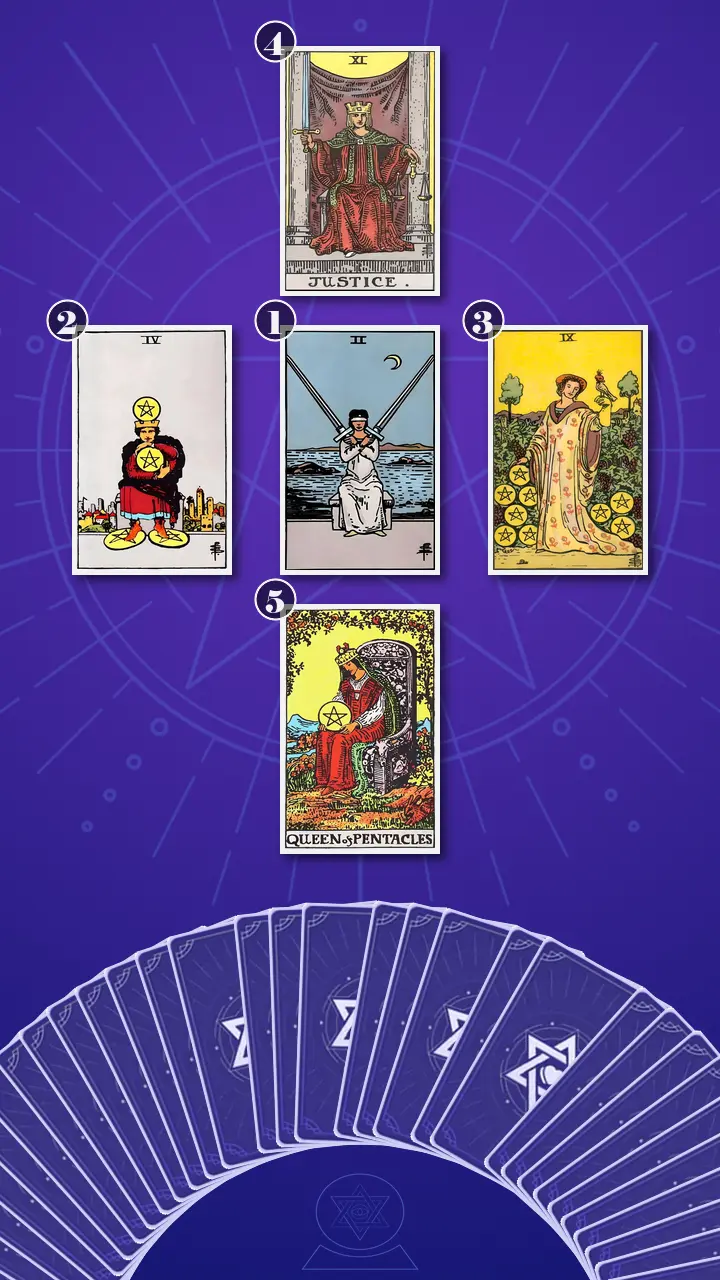
For this reading, I used a five-card Decision Cross tarot spread for lease renewal and housing choices. For anyone who has ever wondered whether tarot can help with a housing decision like this, this is one of the clearest ways I know how tarot works: card meanings in context, not fortune-cookie keywords. One card names the current knot. Two cards compare the two paths directly. A fourth reveals the deeper value conflict underneath the rent math. The final card points toward grounded guidance and actionable next steps.
This spread fit Jordan's roommate renewal indecision because the visible question already had two concrete options. What she did not need was more complication. She needed a clean comparison: current tension, Path A, Path B, the hidden criterion, and the grounded landing point underneath it all. In other words, not more tabs—just a better compass.
Reading the Knot Between Cheaper Rent and Real Rest
Position 1: The Loop That Calls Itself Research
'Now I'm turning the card that represents the choice paralysis at the center of all this,' I said. The card was the Two of Swords, upright.
I pointed to the blindfold and the crossed blades over the heart. 'This is the exact loop you described: headphones on, renewal email open, budget tabs multiplying, one more listing, one cleaner number, one more comparison. The problem is not intelligence. The problem is blocked discernment. This is Air energy in excess and in defense mode—thinking so hard that feeling gets locked outside the room.'
I translated it into her real life. 'This card looks like closing the laptop instead of replying because choosing feels like getting trapped. It looks like telling yourself you still need data while your shoulders are basically already writing the review. What information is actually missing—and what feeling have you been refusing to name?'
She let out a small laugh that had no humor in it. 'That is... uncomfortably specific,' she said, rubbing her thumb along the edge of her phone. Her jaw loosened a fraction. That was enough. Defense had not disappeared, but it had cracked. 'Good,' I said softly. 'Because you're not bad at decisions; you're trying to decide without naming your minimum.'
Position 2: The Price of Staying Tightly Held
'Now I'm turning the card that represents the split-rent-again path—what it preserves, and what it keeps asking you to tolerate.' The card was the Four of Pentacles, upright.
This was the cheaper option on paper, and the card admitted that honestly. 'There is real value here,' I said. 'Predictability. Lower monthly rent. A sense that you can stay ahead of bills.' But the image mattered just as much as the number: coin pressed to the chest, feet locked onto the ground, the whole figure holding on so hard there is no ease left in the body. This was Earth energy tipping from security into constriction.
I described the scene she had already lived a hundred times: key in the apartment door, TV noise coming through before the lock even turns, dishes clanking, other people's schedules already in the room before she is. 'This path can absolutely protect cash flow,' I told her, 'but it may also keep you arriving home already braced. Cheap enough to afford isn't always safe enough to live in. Sometimes we grip the lower number the way we grip a TTC pole during a sudden stop—understandable, but not relaxed.'
Jordan pressed her lips together and nodded once. 'I do the banking-app thing every time I see a place I like,' she said. 'Like I'm trying to punish myself back into being reasonable.' Her shoulders lifted again as she said it, and then, because she noticed that I noticed, they dropped.
Position 3: The Return on Calm
'Now I'm turning the card that represents the pay-more-for-peace path—what it protects, and what kind of self-trust it asks from you.' The card was the Nine of Pentacles, upright.
I smiled a little when it appeared, because it was so clean. 'This isn't reckless spending,' I said. 'This is cultivated independence. A walled garden. A door you can close. A kitchen you do not have to negotiate. A home that gives something back.' In modern life, this is the quieter solo place or calmer setup where you drop your keys, put one pan on the stove, and nobody else's energy has first claim on your evening. It is like paying for ad-free for your nervous system: higher cost, yes, but better attention in return.
The energy here was balanced Earth—not fantasy, not indulgence, but sufficiency built on discernment. 'The question this card asks,' I said, 'is not only, Can you stretch? It is, What happens in your body when you imagine coming home to silence? And what voice immediately shows up to call that irresponsible?'
She exhaled longer this time. I watched the exhale travel all the way down through her chest, as if her body trusted the image before her budget did. 'I relax first,' she said. 'Then I start arguing with myself.' I nodded. 'Exactly. This card legitimizes the appeal of peace without glamorizing it. It is not a Pinterest fantasy. It is an adult standard of livability.'
When Justice Sat Above the Lease
Position 4: The Standard That Was Missing
Before I turned the fourth card, the room went quieter in that particular way it sometimes does when a reading is about to stop being polite and start being true. A strip of afternoon light fell across the table like a ruled line. 'This next position shows the hidden criterion,' I said. 'The deeper truth underneath the numbers, guilt, and delay.' The card was Justice, upright.
Justice is the card that always brings back a memory from my old Wall Street life. On the trading floor, the deals that survived were rarely the ones built on the prettiest story. They were the ones whose assumptions were stated cleanly, whose hidden costs were not smuggled off-sheet. Clarity was not a mood. It was a structure.
'In your case,' I told Jordan, 'this is not money versus feelings. This is whether peace is allowed to count as legitimate evidence.' This is exactly where I use my Strategic Crossroads Analysis. In finance, two options can look close until you probability-weight the costs people like to pretend are intangible. In housing, those costs are not abstract at all: poor sleep, constant vigilance, takeout from exhaustion, café escape spending, silent resentment, the mental tax of never fully unclenching. Justice asks you to weigh those on purpose. This is the moment the reading stopped being about vibes and started defining minimum livable home standards so budget, sleep, privacy, and peace could finally sit on the same page.
She was still caught inside the same thought I see so often in high-functioning overthinkers: that a responsible adult should be able to tolerate the cheaper setup if she can technically make it work. 'You do know the numbers,' I told her. 'The stuck part is not that you do not know the numbers. It is that you've been trying to decide without letting peace count as part of the math.'
Stop treating peace like an optional luxury and start weighing it on the scales; let Justice's sword cut through guilt so you can choose what is fair to your whole life.
I let the sentence sit there for a beat.
Her reaction came in three waves. First, a tiny freeze—her breath caught mid-inhale, not dramatic, just enough to show the words had landed somewhere deeper than agreement. Then her eyes lost focus, as if she were replaying three late nights at once: the lease email open, the banking app open, the studio listing minimized the second it brought relief. Finally, feeling broke through. Her fingers, which had been hooked around the mug, slowly released.
'But if I do that,' she said, and now there was a brief spark of anger in it, 'doesn't that mean I've been using the wrong standard this whole time?' I shook my head. 'It means the old scorecard was incomplete. That's different. Peace is part of the budget.'
I asked her, 'Using this lens, can you think of a moment from last week that would have felt different?' Her answer came fast. 'Saturday. I opened a listing, felt immediate relief, and then acted like the relief was evidence against it.' Her voice thinned on the last few words, and then settled. Her shoulders dropped at last, but the release carried that odd little dizziness clarity sometimes brings—the wobble that comes after you set down a weight you've been calling normal. That was the real shift: from guilt-driven rent math to grounded standards-based housing choice.
Position 5: The Ordinary Wednesday Test
'Now I'm turning the card that represents guidance—the mindset and next step that help you land this choice in real life.' The card was the Queen of Pentacles, upright.
'This is the answer after the adrenaline,' I said. 'The setup that still makes sense on a random Wednesday in November. Bills paid. Groceries in the fridge. Laundry done. Enough quiet to make dinner, sleep, and log on the next morning without feeling like you've already spent yourself.' Where Justice gave the standard, the Queen gave the embodiment of it: Earth energy in balance, practical care without panic.
I traced the shape of the card with one finger. 'Notice how she holds the pentacle with care, not fear. This reading is not pushing you toward status, image, or a fantasy move-in montage. It is asking a simpler question: which option lets you live, not just manage? A livable home is not the same thing as a technically acceptable one.'
Jordan nodded slowly. There was no performance in it now, just recognition. 'That is the first version of this decision that feels adult instead of guilty,' she said. I believed her.
From Guilt Meter to Scorecard
When I stepped back and looked at the full spread, the story was clear. The Two of Swords showed why she felt frozen: analysis had become a hiding place because the real data was living in her body. The Four of Pentacles showed what the cheaper path preserved—money predictability—but also its hidden cost: a home life kept on Low Power Mode. The Nine of Pentacles showed the practical return on calm. Justice exposed the blind spot: she had been waiting for total certainty while treating peace as if it were financially invisible. The Queen of Pentacles translated the whole reading into one grounded rule—choose the home plan that supports your ordinary life, not just your most disciplined fantasy.
'So the transformation here,' I told her, 'is not from irresponsible to responsible. It is from cheapest tolerable to honestly sustainable. Your blind spot is not that you care too much about money. It is that you've been using a guilt meter instead of a scorecard. Clarity gets louder when guilt stops being the only voice on the scale.'
She looked down at the cards again. 'Okay,' she said. 'So what do I actually do before I spiral again tonight?' She wanted actionable advice and next steps, not a mystical shrug. That was the right question.
I gave her a short framework I use with clients who need clarity fast: a boardroom-style decision ledger, paired with the same pre-commitment ritual traders use when speed can distort judgment. No late-night doomscrolling first. No refreshing five apps. One breath, one note, one timer.
- Write your Minimum Livable Home StandardBefore you open Rentals.ca, YNAB, or your renewal email again, open Apple Notes on the TTC, at a café, or at your desk and type: 'My minimum livable home needs.' Then list three non-negotiables in plain language—quiet after work, predictable kitchen access, a door you can close, whatever is real for your life.Keep it under five minutes. If three lines feel too exposing, write one sentence and stop. Naming is the action.
- Build a Survival Budget vs. Settled BudgetIn Google Sheets or Notes, make two short columns: 'Survival Budget' for splitting rent again and 'Settled Budget' for the calmer option. In both, include rent, transit, groceries, laundry, takeout-from-exhaustion, coworking or café escape spending, and a small buffer. Then add three non-money rows—sleep, privacy, and after-work recovery—and score each from 1 to 5.Set a twenty-minute timer. Approximate numbers are enough. The point is to stop treating peace as off-book.
- Run a 9 p.m. Home Body AuditFor the next three evenings, write four tiny data points at 9 p.m.: time, sound, body, thought. For example: '9:12 / TV plus kitchen noise / shoulders tight / already want to leave my own home.' Let repetition tell the story.If body language feels too intense, use simple labels: tense, neutral, relaxed. Observation beats drama.
Jordan made a face halfway between a laugh and a groan. 'The annoying thing,' she said, 'is that this is exactly practical enough to work.' I smiled. 'That is usually where finding clarity begins.'

A Week Later, the Quiet Proof
A week later, Jordan sent me a screenshot. Not a listing. Not a spreadsheet. A note titled 'Minimum Livable Home Standard.' Under it were three lines: quiet after work, kitchen access without negotiation, and enough privacy to actually decompress. She had done the two-column ledger, scored sleep, privacy, and recovery, and the answer stopped feeling mystical. She chose not to renew the shared lease.
Sending the text to her roommate took thirty seconds. Then she sat alone in a café near Queen Street West and stared at the sent message for three minutes with her Americano going cold. That night she slept straight through, then woke with the old thought—what if I'm wrong?—and smiled instead of reopening the spreadsheet.
I think that is what a real journey to clarity looks like. Not a perfect ending. Not a magical absence of doubt. Just a steadier hand on your own criteria. In her case, home stopped being a problem to tolerate and became something she was finally allowed to choose with self-respect.
Sometimes the hardest part is not the rent number itself—it is the moment your hand hovers over 'renew' because your body already knows another year of coping at home will cost more than the spreadsheet can show.
If you let peace count as real data for once, what is one minimum condition your next home would need to meet before you call it livable?