Room, Inbox, Bank App: Turning Sunday Dread Into a Fair Audit

The Sunday-Night Room, Inbox, and Bank App Spiral
If you're a late-20s hybrid-office person in Toronto who can coordinate everyone else's deadlines but starts spiraling when your bank app, half-clean room, and Monday inbox all show up at once, this is the Sunday Scaries version nobody posts.
When Jordan (name changed for privacy) joined me, it was 9:32 p.m. in her small apartment. The overhead light behind her was too bright. The radiator hissed. Half-folded laundry sat on the duvet like a task she had been interrupted inside. Outlook was open on her laptop with three flagged emails in a row, and her phone was still in her hand with the banking app lit so long the screen had gone warm. Detergent and leftover soy sauce seemed to be sharing the same air. Her shoulders stayed lifted the whole time.
She gave me a short, embarrassed smile and said, 'I don't know if I need a better system or a different setup.' That was the heart of it. She wanted one clean weekly reset and the sense of control that came with it, but another part of her was scared the room-work-money setup itself had stopped being workable. The whole scene had a little Severance in it: work had followed her home and was sitting on the bed with the laundry.
I could feel the dread in the way she kept glancing off-screen, like there were three separate alarms going off in three corners of the same room. It was not abstract. It was a smoke detector wired directly into her chest, shrill and invisible, pushing her to move without letting her settle. This is not laziness. It is what overload looks like when it puts on a productivity outfit.
I told her gently that I knew this pattern well. 'We are not here to prove you're disciplined enough by midnight,' I said. 'We are here to draw a map through the fog and see whether this week needs a reset, a rethink, or one honest adjustment on the way to clarity.'

Choosing the Horseshoe: How I Read a Reset-or-Rethink Question
I always begin practical readings like this with my pre-meeting 3-minute cosmic breathing. Not as theatre. As calibration. I asked Jordan to put both feet on the floor, breathe in for four, hold for four, and let the exhale run long enough that her shoulders had a chance to hear it. By the third breath, the room sounded less like an alarm system and more like a room again.
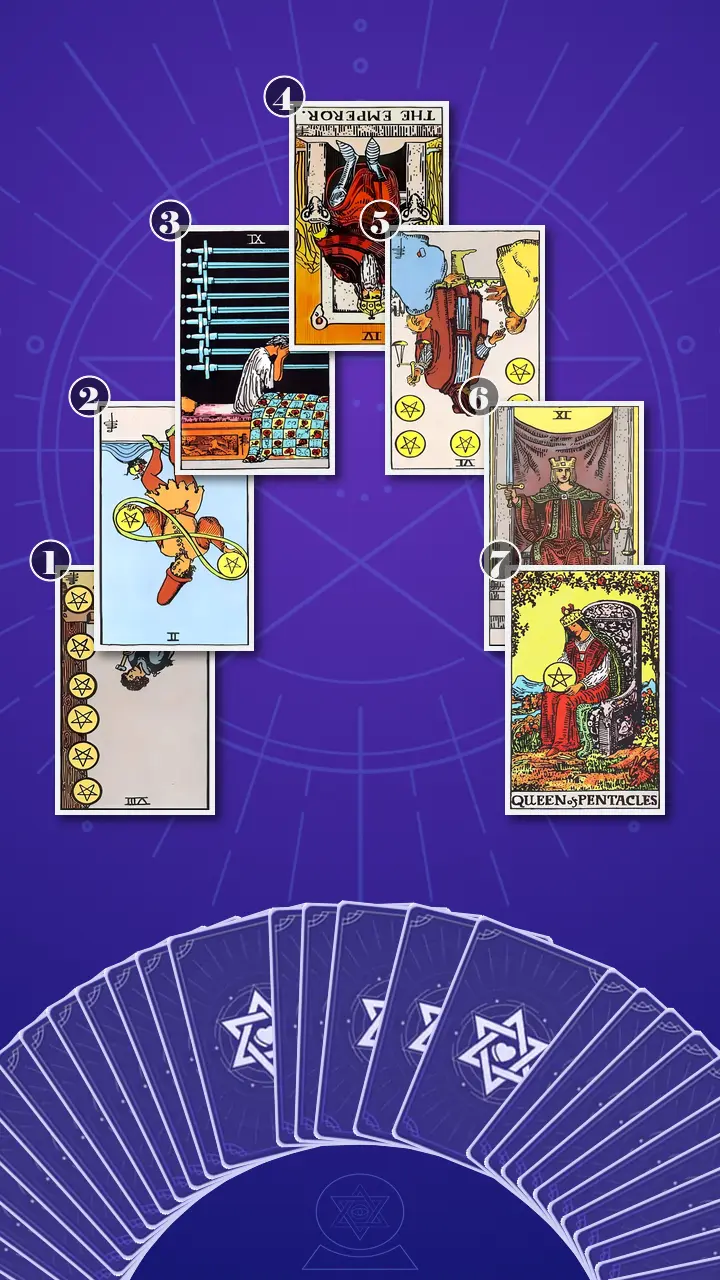
Then I shuffled and laid out a classic Horseshoe spread. This is how tarot works best for me: not as a magical shortcut, but as pattern recognition with symbolic precision. I use the Horseshoe when a question looks practical on the surface but is secretly structural. It separates what built the problem, what is active now, what stays hidden, what blocks change, what outside pressures are real, and what response would actually bring finding clarity.
A Horseshoe tarot reading is leaner than a Celtic Cross, but for work, money, and home overwhelm, it gives me the full diagnostic arc without burying the signal. The second position would show the present symptom cluster across the room, inbox, and bank app. The fourth would name the central blockage. The sixth, the advice position, would tell us how to choose clarity instead of another guilt cycle. As I placed the cards in their curve, I thought of the paths I trace under the planetarium dome: a moving body only looks chaotic until I show people the whole orbit.
Reading the Arc of the Week
Position 1: The Bench That Keeps You Busy
The first card I turned was the one revealing the recent habit pattern that built the Sunday-night pileup: the Eight of Pentacles, reversed.
I told Jordan that I never read this card as 'not trying.' I read it as effort getting trapped in maintenance. In her case, it looked exactly like refining the machinery of the reset instead of receiving the relief of it: reformatting a Notes checklist, re-flagging emails, reorganizing one visible corner of the room, editing the system instead of finishing the one task that would truly make Monday lighter. The craftsman's bench on the card became her apartment surfaces, full of tools and motion, but no finished object the nervous system could relax around.
Reversed, the energy was misdirected rather than absent. Too much labor was being spent polishing the process, not reducing the pressure. I asked her which Sunday habit makes her feel productive without actually changing Monday. She let out a quick laugh that had some sting in it. 'Okay,' she said, 'that's annoyingly accurate.' Her thumb stopped tapping the side of her phone.
Position 2: Three Tabs Auto-Refreshing
The next card represented the present symptom cluster: the visible overload making her spin without completion. It was the Two of Pentacles, reversed.
This card almost narrated her apartment back to me in real time. Bed. Laptop. Bank app. Back to the bed. Like three browser tabs auto-refreshing. 'Okay, just the laundry. No, email first. Wait, how much is left after rent?' Upright, this card can show flexible rhythm. Reversed, it becomes overload by context-switching. Motion replaces completion. The infinity loop around the coins looked like her nonstop toggling, and the rough-water ship behind the juggler matched how ordinary tasks had started landing with full emotional weather.
Here the energy was blocked by too many simultaneous demands. Not because she was incapable, but because home, work, and money were all trying to occupy the same hour. She grimaced and gave me the exact half-laugh I expected. 'This is literally what I do,' she said. Her shoulders stayed high even while she smiled.
Position 3: When Backlog Turns Into a Verdict
The third card uncovered the hidden mental script operating beneath the surface: Nine of Swords, upright.
I told her this was where the scene stopped being about unfinished tasks and started becoming personal. This is the phone reopening after teeth brushed. The blue light on the face. The glance from the bank balance to the unopened emails to the pile of clean clothes still visible from bed. The fact is simple backlog. The story arrives like a prosecutor: 'Normal adults don't need this much effort for basic life.'
Nine of Swords is excess air. Not helpful planning, but threat-scanning and private worst-case thinking. I watched Jordan go still in that small way people do when a card speaks a sentence they did not want anyone else to hear out loud. Her gaze dropped to the table. One finger pressed into the seam of her sleeve, then released.
Position 4: The Inner Manager With No Chill
The fourth card named the central blockage keeping her stuck between doing another reset and questioning the setup itself: The Emperor, reversed.
This is the part of the reading that often stings, because The Emperor reversed rarely means 'you need more discipline.' It means structure has become brittle, punitive, or unrealistic. Jordan was answering overload with stricter rules: no-spend week, inbox zero by noon, laundry fully done, gym before work, no slipping. Supportive structure says, 'What can this week actually hold?' Punitive structure says, 'If I were better, I would hold all of it.'
The stone throne and barren mountains on this card always make me think of a system that looks solid on paper and feels impossible to live inside. A harsh system can make a competent person feel chaotic. That was the hidden architecture here. In my own mental shorthand, this is where I use Dark Matter Detection: I look for the invisible mass distorting the orbit. Not laziness. Not lack of character. Small-space living. Rising costs. Hybrid-office seepage. Recovery time getting volunteered away before she agrees to it.
When I said that, she exhaled so slowly it almost sounded like defeat at first. Then she said, quieter, 'I keep writing rules that already make me tired.' Her hands, which had been clasped hard together, finally loosened.
Position 5: The Leaks Outside the Frame
The fifth card showed the outside pressures and material realities intensifying the pattern: Six of Pentacles, reversed.
I pointed to the scales on the card before I said anything else. In this position, they told me the exchange around Jordan's life had gone uneven. Rent leaves. Groceries cost more. Transit adds up. A few work requests slip past office hours. Sunday becomes the moment she tries to manually redistribute scarce time, energy, and cash with the same tired nervous system that has already been carrying the week.
Reversed, this pentacles energy is not greed so much as imbalance: too much flowing out, not enough coming back. The bank app was not haunting her for no reason. Part of the pressure was material. Part of it was structural. I told her, 'You are not imagining this. Some of these scales really are off.' She blinked hard once, as if that sentence had given her somewhere to set something down.
When Justice Lifted the Scales
By the time I reached the sixth card, the room had gone very quiet. Even the radiator seemed farther away. As I turned the card and saw Justice upright, I had the same thought I sometimes have under the planetarium dome when I trace a satellite path for visitors: panic wants raw thrust, but trajectory responds to cleaner math.
Position 6: The Fair System Audit
This card sat in the advice position, the place offering the key reorientation if the goal was clarity rather than another guilt cycle. It was Justice, upright.
Justice is not cold. It is precise. In tarot, Justice is boundaries and balance without shame. Jordan had been asking, 'How do I prove discipline tonight?' Justice asked the better question: 'What is actually out of proportion here?' Your room, inbox, and bank balance are not a jury. They are three forms of information. The fact is the laundry is unfinished. The story is that unfinished laundry means she is failing at adulthood. The fact is there are unread emails. The story is that Monday will expose her. They are not the same thing.
By late Sunday, when the bed is still occupied by clothes, the inbox is half-open, and the bank app keeps getting refreshed as if one more glance might change the feeling, life admin stops feeling like admin and starts feeling like a verdict. I could see Jordan bracing to rescue the whole week in one night.
This is not a moral mess to clean at midnight; it is a set of scales to rebalance with clear facts, cleaner boundaries, and Justice-level honesty.
I let that sit between us for a beat. Then I said it again in plainer words: 'You do not need to rescue your whole life in one night. You need a setup that stops requiring rescue.'
At the planetarium, when I explain a gravity assist, I tell people a spacecraft does not win by firing harder in every direction. It wins by using one well-chosen angle that changes the whole journey. That is how I read Justice here, and this was my Gravity Assist Simulation in action. Jordan did not need a grand performance of discipline. She needed one honest correction with long-range effect: one boundary, one real number, one task chosen for actual impact. Not a midnight rescue. A fair system audit.
Her reaction came in layers. First, the physiological freeze: her breath paused halfway in, and her thumb hovered above the dark screen of her phone as if even unlocking it had become a question. Then came the cognitive drift; her eyes lost focus and tracked somewhere past me, replaying a week I could almost see in fragments, late replies, the laundry on the bed, that small stomach-drop after groceries. What surfaced next was not relief. It was anger. 'But then what have I been doing all this time?' she said. 'Just blaming myself for bad engineering?'
I told her no. She had been surviving inside a setup that kept requiring emergency behavior, and survival strategies can look a lot like personality flaws when no one names the pressure correctly. The fight went out of her shoulders first. Then her jaw loosened. Then came that strange, almost dizzy softness that sometimes follows real clarity, when the burden drops and the body does not quite know what to do with the extra space. She laughed once, shaky this time. Her eyes went bright. I asked, 'Using this lens, can you find one moment last week when facts and story fused together?' She nodded immediately. 'The bank app after groceries,' she said. 'The number was one thing. The panic was another.' That was the crossing point: from guilt-driven micromanaging and Sunday dread toward steadier self-trust and workable calm.
Position 7: A Home Base That Does Not Judge Back
The final card showed the integrated state that becomes more available if she follows the guidance and rebalances the setup: Queen of Pentacles, upright.
I loved seeing her here. Not because it promised perfect optimization, but because it promised warmth, stewardship, and a life she could actually live inside. The Queen of Pentacles is the opposite of performing control. She holds practical life with steadiness. In Jordan's language, this looked like clearing the bed before sleep, checking the balance once with purpose, answering one meaningful email, and letting the apartment feel inhabited instead of judged. The sensory field of the reading changed with her: less hot phone screen, less harsh light, more home base.
That was the outcome worth aiming for. Not showroom order. Not inbox zero as a personality trait. A workable week beats a punishing plan. Jordan gave me the softest exhale of the session and said, 'I don't even want perfect. I want that.'
From Insight to Action: The Sunday Scale Check
When I looked back across the Horseshoe spread, the story was clean. The reversed Eight of Pentacles showed maintenance without stability. The reversed Two showed overload by context-switching. Nine of Swords showed how backlog became self-verdict. The Emperor reversed revealed the real blockage: she had been using punishment as structure. Six of Pentacles reversed confirmed that some of the pressure was external and uneven, not personal failure. Justice brought the turn. Queen of Pentacles showed where that turn could lead. This was not a lazy resident in a messy apartment. It was an overworked system in a shaky frame.
The blind spot was calling a structural mismatch a discipline problem. The transformation direction was simpler and harder: move from trying to prove discipline in one frantic evening to auditing what is structurally unsustainable and changing one pressure point at a time. I framed the next steps the way I do when I talk about interstellar navigation: we do not steer by every light in the sky. We choose the next bearing that changes the route.
- The 3-Minute Cosmic Breath + Fairness Note On Sunday or Monday evening, sit on the edge of the bed or at the kitchen counter. Set a three-minute timer. Inhale for four, hold for four, exhale for six. Then open one plain note and write only three lines: Facts, Can wait, Pressure point. Put one item under each from the room, inbox, and bank app. If you start making it pretty or building a whole new system, stop. Ugly and fast is the point.
- The One-Pressure-Point Reset Set a 10-minute timer and pick the single task most likely to make Monday easier: send one clarifying email, fold one full load of laundry, or review one spending category. Work only on that one thing until the timer ends. No bonus tasks. Stopping on time is part of the medicine, especially if your brain wants to keep proving something.
- One Real Boundary for Seven Days Replace one harsh weekly rule with one livable boundary. For example: 'I answer non-urgent email in two windows and stop checking after 7 p.m.,' or 'I clear the bed before sleep even if the rest of the room stays real.' Keep that sentence visible at the top of your Notes or planner. Design for the version of you who has a commute, bills, and an actual nervous system, not for a fantasy productivity montage.
Before we ended, I repeated one line and asked her to save it somewhere visible: Pick the pressure point, not the whole life.

A Week Later, the Quieter Proof
A week later, Jordan sent me a message from Line 1 on her way downtown: 'I did the note. One email. One load. Closed the bank app after one number. It was weirdly quiet.'
She slept a full night, though Monday's first thought was still, 'What if I missed something?' This time she smiled at it, cleared her bed, and kept moving.
That is what finding clarity often looks like in real life. Not a perfect Sunday reset. Not a personality transplant. Just the moment the room, inbox, and bank balance stop acting like accusations and start acting like coordinates.
If tonight you are standing in a half-clean room with your chest tight and your phone in your hand, trying to fix three parts of your life before Monday so you do not have to feel how little margin is left, please know this: noticing that strain is already a form of movement.
If you stopped trying to win Sunday night and treated it like a fairness check instead, one small orbital correction instead of a moral exam, which one pressure point would you want to rebalance first?