At 8:47 on the Streetcar, Four Decision Rules Changed the Terms

Finding Clarity in the 8:47 Streetcar Scroll
When Jordan (name changed for privacy) sat down with me, I recognized a pattern I see more and more often in young professionals across Toronto: RTO-driven choice paralysis. She could not decide whether to move closer to work or start job hunting, and every evening she researched both options until neither felt livable.
If you are a late-20s Toronto professional doing return-to-office math on the streetcar and your Sunday Scaries spike the second the Monday in-office reminder hits, this will probably feel familiar. Jordan described 8:47 p.m. on the 504 King heading west: TTC brakes shrieking, winter-wet coats giving off that stale damp smell, her phone warm in her palm as she flipped between Rentals.ca, LinkedIn Easy Apply, and a budgeting sheet. Save a Midtown one-bedroom. Save a hybrid role. Recheck the same commute on Google Maps as if the app might suddenly choose for her.
By the time she got home, her jaw was locked, her breath had gone shallow, and her stomach kept doing that awful drop that arrives before a bad elevator lands. On paper, her question sounded simple: move closer for Monday office days, or start job hunting? But the real contradiction was sharper than that. She wanted relief from the commute, and she hated the idea of reorganizing her whole life around a job she might not even want six months from now. The pressure sat in her like a browser fan whining under seventeen tabs.
‘I can handle hard work,’ she told me. ‘I hate feeling cornered.’
I nodded. ‘That makes sense to me. We are not here to force a perfect answer tonight. We are here to draw a map through the noise, so the choice comes back into your hands.’

Choosing the Compass: The Decision Cross · Context Edition
I asked her to wrap both hands around her mug, take one slow breath, and hold the actual question in mind—not the spreadsheet, not her friends’ hot takes, just the question. Then I shuffled. The dry whisper of the cards against one another gave the room a steadier rhythm than the one she had arrived with.
I chose the Decision Cross · Context Edition, a five-card crossroads reading I use when someone is caught between two live options and neither deserves a rushed yes-or-no. For anyone wondering whether tarot can actually help with a work decision like this, this is how tarot works at its best: it does not make the decision for you. It organizes the pressure. It shows the current bottleneck, the truth in each path, the hidden driver, and the principle that can turn confusion into actionable next steps.
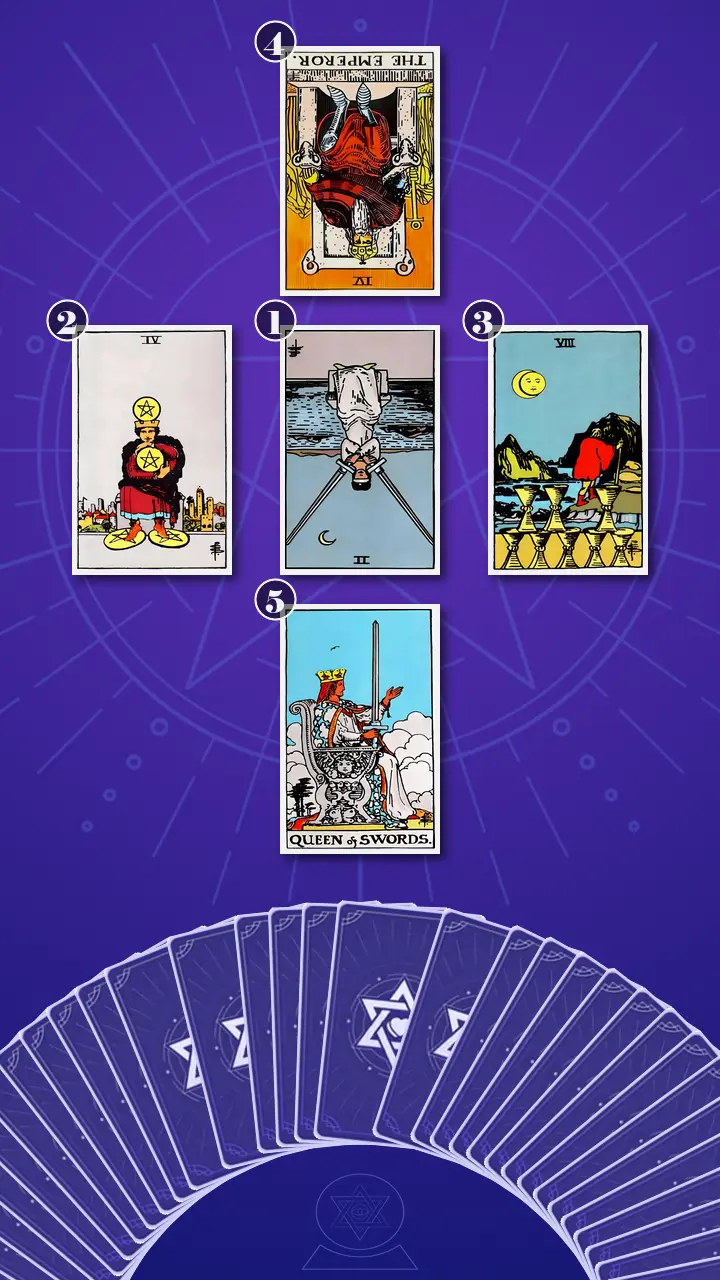
This spread was the cleanest fit for her move-closer-or-job-hunt dilemma because it kept both routes visible without letting the reading stay trapped at the surface level of rent versus job ads. The center card would show the concrete loop currently running the show. The left card would tell me what moving closer was trying to protect. The right card would explore what job hunting was really asking her to seek or risk. The card above would reveal why the office mandate felt so loaded. The card below would name the integrating principle that could bring the decision back into her own authority.
Reading the Crossroads
The Loop That Feels Like Research
I turned the card representing the concrete bottleneck behavior and emotional pressure around the Monday return-to-office demand: The Two of Swords, reversed.
I told her this card was almost painfully literal. Jordan on the streetcar, LinkedIn Easy Apply, Rentals.ca, and a Google Sheet all open; saving a Midtown apartment, then a hybrid role, then checking the same commute again—that is the modern-life version of this card. The blindfold is not a lack of intelligence. It is the habit of using more information to avoid naming a preference. The crossed swords over the chest look like someone physically keeping her own truth locked in.
Energetically, this is blocked Air spilling out of containment. Thought is no longer creating clarity; it is creating traffic. Research can feel productive and still be a stall. Every extra tab brings a flash of relief because it feels responsible, but the real decision stays suspended, and her body pays the price with the tight jaw, the lifted shoulders, the shallow breathing.
She let out a short laugh with a bitter edge. ‘Okay,’ she said, glancing at the card. ‘That’s almost rude.’
I smiled. ‘Only because it’s precise. This isn’t a card of incapability. It’s a card of self-protection turning into gridlock.’
The Apartment That Solves One Problem by Making Life Smaller
Next I turned the card representing what moving closer was psychologically asking Jordan to protect, pay for, or tighten around: the Four of Pentacles, upright.
I asked her to picture the tiny condo near Union—the kind of place where the commute drops from seventy minutes to twenty-five, and the relief is real the second you imagine it. Then the second thought arrives: fewer dinners out, maybe cancel yoga, maybe no weekend trips, maybe less room to change your mind later. That is this card in plain language. The pentacle clutched to the chest becomes the instinct to pay more just to feel less exposed.
This is Earth energy in excess: stability, budget control, predictability. Useful qualities, but clenched too hard. The card does not tell me moving closer is wrong. It tells me that path reduces immediate friction by tightening life around security. A shorter commute is not automatically a better life if it shrinks everything else. This is the higher-rent-versus-shorter-commute pressure distilled into one image: what exact problem are you solving, and how much of your life are you trimming to solve it?
Her fingers rolled the edge of her sleeve once and then let it go. That tiny motion told me more than a full paragraph would have.
The Quiet Honesty in Job Hunting
Then I turned the card representing what starting a job hunt was psychologically asking Jordan to leave, seek, or risk: the Eight of Cups, upright.
I described the scene that lives inside this card: 11:06 p.m., another polished leadership email about in-office culture, and instead of rage-posting or quitting, she updates her résumé. Nothing is actively on fire at work. The team is fine. The pay is fine. That is exactly why this card matters. The stacked cups show something that still has value, but no longer feels whole.
This is Water doing honest work. Not melodrama. Not fantasy. Just the body admitting what the spreadsheet cannot. Leaving is not the same as failing to cope. Job hunting here is not only about escaping a commute; it may be about admitting that the current setup no longer matches the kind of week she wants to live inside.
She exhaled more softly this time and looked down, not away. ‘That one’s sad,’ she said. ‘Because it’s true. It’s not that the job is terrible. I just don’t want my whole week shaped like this anymore.’
When Policy Starts Sounding Like Fate
Then I turned the card above the center, the one that reveals the underlying fear and authority dynamic making the choice feel heavier than a simple housing or career logistics question: The Emperor, reversed.
The moment I saw it, I had one of those flashes my archaeological life still gives me. On a dig, the first discipline is learning that a collapse layer is loud but not foundational. Rubble spreads fast; structure lies deeper. Jordan had been treating one policy email like bedrock.
I told her this card was the real pressure point. A leadership email lands in her inbox, or a coworker says, ‘Honestly, I’d just move closer,’ and suddenly the whole thing takes on a little Severance energy—not because the office is literally dystopian, but because the system’s logic starts sounding louder than her own. She stops asking what is negotiable, what is tolerable, and what she would actually refuse. She starts making housing and career choices inside the company’s frame, like letting a Slack policy announcement become her personal GPS.
Energetically, this is distorted Fire: structure, control, and authority hardened into pressure. That is why this dilemma feels so much bigger than move versus leave. It is autonomy versus obedience. Policy is information, not destiny.
Her reaction came in three quiet beats. First, she went so still that even her breath seemed to pause. Then her eyes lost focus, as if replaying the last policy email and the group-chat screenshots that followed. Then the air left her in one long drop from the chest. ‘Yes,’ she said. ‘That’s why it feels so loaded. It’s not just the commute. It feels like they’re deciding my whole life.’
When the Queen Lifted Her Sword
One Clear Standard Instead of Ten Competing Thoughts
We turned the final card, the one naming the key shift that could turn panic-driven comparison into a boundary-based next step. Even the faint hum from the mini-fridge in my reading room seemed to recede for a moment. It was the Queen of Swords, upright.
The setup was already visible on Jordan’s face. She had spent weeks asking the most responsible-sounding version of the wrong question: which option is less risky, less embarrassing, less likely to backfire? That is how smart people get trapped. They wait for certainty to arrive before they allow themselves standards.
You do not need to stay blindfolded until a perfect answer appears; raise the Queen’s sword, name your non-negotiables, and let clear boundaries rather than panic make the cut.
I let the sentence sit in the room. Then I translated the card into ordinary life. The Queen is not abstract here. She is Jordan opening a blank document and writing four lines only: maximum rent, maximum one-way commute, minimum flexibility, and what kind of work life she is no longer willing to normalize. One upright sword replacing ten competing thoughts.
This is where my historical instincts become useful. I often use what I privately call a long-term value assessment. Across history, I have seen cities at a crossroads spend everything reinforcing a temporary wall, when what they truly needed was to decide what kind of place remained livable over time. Civilizations rarely decline because they failed to remove every risk. They decline because they build their future around the loudest immediate threat. The Queen of Swords refuses that mistake. She asks the question panic hates most: which option respects your time, budget, boundaries, and actual life six months from now, once the Monday adrenaline burns off?
Jordan’s thumb stopped against the rim of her mug. Her shoulders stayed high for one heartbeat more, then dropped as if someone had quietly unclipped invisible straps from them. Her mouth opened, closed, and when she spoke there was a flicker of resistance in it. ‘But if I write the non-negotiables down,’ she said, ‘then I might have to admit one of these options obviously doesn’t fit. And I think I’ve been hiding inside the comparison.’
‘Exactly,’ I said, gently. ‘The panic is not telling you which option is right. It is telling you the decision needs standards.’
She stared past the cards, eyes slightly unfocused, replaying some private scene. Then came the small reaction I trust more than any dramatic breakthrough: a blink that lasted a fraction too long, a breath that shook once on the way out, the faint dizziness of somebody feeling the weight leave and responsibility arrive at the same time. I asked her, ‘Using this lens, think back to last week. Was there a moment this would have changed how the choice felt?’
She nodded almost immediately. ‘The condo viewing,’ she said. ‘I was standing there doing mental budget surgery on my entire life. If I’d had max rent written down, it would’ve been a no in thirty seconds.’
That was the hinge of the reading: not from confusion to magical certainty, but from deadline panic and authority-triggered overanalysis to boundary-based clarity and steadier self-trust. The blindfolded figure at the center of the spread had become someone holding one clear sword.
The Boundary-First Decision Sheet
When I laid the whole spread together, the story became clean. The Two of Swords reversed showed the surface symptom: too many tabs, too much mental noise, not enough ownership. The Four of Pentacles showed that moving closer could buy immediate logistical relief, but might do it by tightening her budget and shrinking her life around a job she was already questioning. The Eight of Cups showed that job hunting was not reckless drama; it was a sober sign she may already be outgrowing the current arrangement. And The Emperor reversed named the real magnifier: she had been making housing and career decisions inside somebody else’s frame, as if the office mandate were a verdict on her identity rather than a piece of information.
I told her the blind spot was not laziness or lack of discipline. It was confusing more data with more agency. The direction of change was simpler and harder: stop trying to find the one risk-free answer, name the non-negotiables, and test the option that fits them best.
Here I brought in one of my own practical methods, what I call the Time Stratigraphy Method. In a dig, the uppermost layer is often the noisiest—fresh ash, broken fragments, signs of sudden disturbance. But the deeper layer tells you what was built to last. Monday panic is a top layer. Your enduring standards sit lower. We separate them before we decide where to build next.
- Make the Queen’s one-page filter Open a blank note on your phone tonight and title it Work Decision Rules. Write only four lines: your maximum monthly rent, your maximum one-way commute, your minimum flexibility, and one lifestyle deal-breaker. Then compare exactly one apartment and one job posting against that page this week. Use ranges if exact numbers feel too sharp. If you catch yourself adding ten more categories, stop. A working filter beats a perfect manifesto.
- Cap the nightly dig at 30 minutes On weeknights, set a 30-minute timer and choose one lane only: rentals, jobs, or budget—not all three. When the timer ends, write one sentence that begins, ‘What I actually need from work is...’ and close the tabs. The anxiety spike at the end does not mean you stopped too early. It usually means you interrupted the loop.
- Split authority from facts Draft three calm questions for your manager or HR about what is mandatory, what is flexible, and what your team actually expects. Keep the answers in one note with two columns: company facts and my assumptions. Keep the tone practical, not defiant. You are not arguing the whole policy; you are gathering enough reality to make a cleaner decision.

A Week Later, the Quiet Proof
Six days later, Jordan sent me a message. She had written the four-line note, ruled out one condo in under a minute because the rent broke her own max, and sent one tailored application instead of saving four maybes. ‘Still scared,’ she wrote, ‘but less foggy.’
That is the kind of evidence I trust. Not a cinematic ending. Just one clear no, one real yes, and a nervous system no longer asking Google Maps to make a life decision for her.
This is why I return, again and again, to a Decision Cross · Context Edition tarot spread for a move-versus-job-hunt RTO dilemma. It does not hand down fate. It gives shape to the pressure, separates policy from identity, and helps someone move from panic to criteria, from authority pressure to inner authority, from overresearch to grounded discernment.
When a Monday office mandate makes your jaw lock and your Notes app turn into a courtroom, the hardest part is often the fear that one wrong move will hand your time, money, and self-trust over to a life you did not fully choose. If that is where you are tonight, simply noticing the bind may already be the moment your blindfold starts to loosen.
So when the next reminder hits and the tabs begin multiplying, what would be the first non-negotiable you would write on your own Queen of Swords page?