From Late-Night Tab Spiral Anxiety to Self-Trust: A 7-Day Test

Finding Clarity in the 11:22 p.m. Tab Spiral
If you found an old sketchbook and instantly felt that gut-punch mix of nostalgia + panic—like you just unearthed a version of you you’ve been avoiding—welcome to the art school vs safe job spiral.
Jordan (name changed for privacy) showed up on my screen from Toronto with their hoodie strings pulled uneven, like they’d been tugging them while thinking. They were 28, a marketing and communications specialist, and they looked like someone who could run a meeting, ship a campaign, and still somehow feel like their own life was stuck buffering.
They told me they’d found an old sketchbook while reorganizing a closet—one with half-finished drawings, graphite smudges, and that unmistakable smell of paper that’s been closed for years.
“I don’t need a dream,” they said, voice tight in a way that wasn’t dramatic, just braced. “I need a plan.”
Then they described the scene that had been haunting their week: 11:22 p.m., condo kitchen in Toronto, kettle clicks off. Tea poured. Laptop open. The glow of a budget spreadsheet makes the room feel colder. The sketchbook sits on the counter like a dare. Two minutes of flipping pages—then the spiral: tuition pages, OSAP threads, salary sites, job listings. Tabs opening and closing like restless hands trying to find the one window that could hand them certainty.
I watched their jaw flex as they spoke. It wasn’t just worry—it was the kind of anxiety that feels like holding your breath in a crowded elevator, hoping no one notices you’re about to press the wrong button.
“So,” Jordan said, finally landing the question. “Do I apply to art school… or do I keep the safe job and stop pretending I’m going to change?”
I nodded, letting the silence settle for a beat. “You’re not stuck because you don’t care,” I told them. “You’re stuck because both options feel like they say something about who you are. Let’s not try to force a verdict tonight. Let’s draw a map—something that gets you out of the fog and into actual next steps. That’s our journey to clarity.”

Choosing the Compass: The Decision Cross Spread
I’m Laila Hoshino—a planetarium guide in Tokyo by day, and someone who’s spent years translating big, intimidating systems into something people can actually use. In the dome, it’s celestial motion. In sessions like this, it’s tarot: a structured way to see what’s already happening, so you can move with it instead of wrestling it at 2 a.m.
Before we touched the cards, I asked Jordan to do my pre-meeting 3-minute cosmic breathing. Nothing mystical—just a nervous system reset. “In through the nose,” I said. “Slow exhale like you’re fogging a spaceship window. Let your shoulders drop one millimeter at a time.”
Then I shuffled while they held the question in mind. Not “What should I do?”—but “How do I decide without ruining my life?” That wording matters. Tarot works best when it’s used as a decision-making tool, not a fortune dispenser.
“For this,” I said, “we’ll use a Decision Cross—a simple 5-card spread built for decision paralysis.”
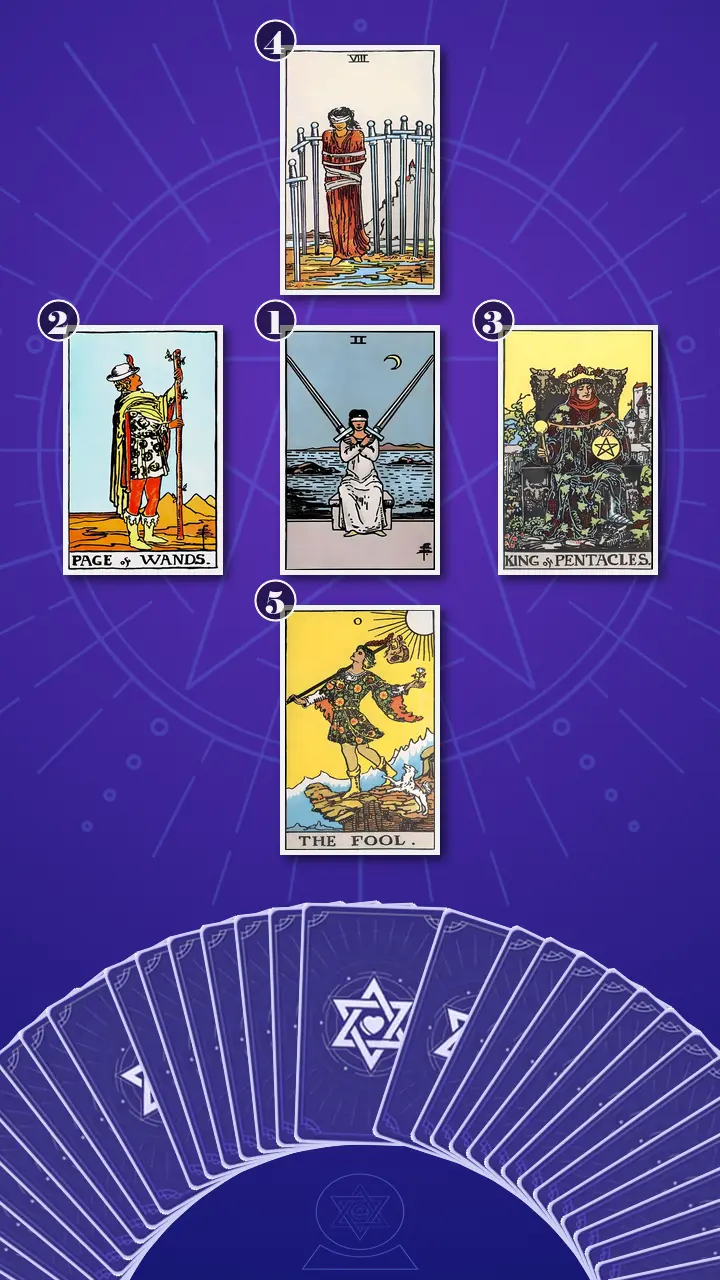
To you, the reader: I like this spread for career crossroads—art school vs stable job is a clean two-path dilemma, but the real problem is almost never the two options. It’s the hidden pressure system that turns the choice into a referendum on worth. The Decision Cross shows (1) the current stuck point, (2) what option A activates, (3) what option B provides and costs, (4) the underlying fear inflating the stakes, and (5) integration and advice—an actionable next step that reduces decision fatigue without forcing a premature final decision.
“We’ll read it like a crossroads sign,” I told Jordan. “Center first—what’s knotted. Above—what’s driving it. Left and right—what each path really brings. And then the bottom card—the landing step.”
When The Fool Stepped to the Edge
I turned the first card over slowly, because the first card often hits like cold water: not because it’s cruel, but because it’s precise.
Position 1: The current stuck point—how indecision shows up on a normal weeknight
“Now we turn over the card that represents the current stuck point: the specific way indecision shows up in daily behavior and thinking,” I said.
Two of Swords, upright.
In the classic image, a figure sits perfectly still, blindfolded, holding two swords crossed over their chest. Calm posture. Still water behind them. It’s the energy of ‘I’m fine’ on the surface, while something essential is being kept out of the room.
I used the translation that matched Jordan’s exact life: “This is you looking composed all day at your marketing job, and then at night sitting at the kitchen counter with the sketchbook open and a spreadsheet glowing on the laptop—art school tab on the left, savings tab on the right. Keeping it perfectly balanced so you don’t have to feel the risk.”
Energetically, this is a blockage—Air (analysis) trying to do the whole job alone. The Two of Swords doesn’t say you’re careless. It says you’re guarded. The blindfold is the part that won’t let desire count as data. The crossed swords are the part that protects your heart by turning longing into “research.”
Jordan let out a small laugh—sharp, almost embarrassed. “That’s… kind of brutal,” they said. “Because it feels like I’m being responsible.”
“It does feel responsible,” I agreed, soft but firm. “And here’s the twist: research feels safe because it’s invisible. Practice is scary because it’s real. Two of Swords is what happens when ‘being careful’ quietly becomes ‘staying stuck.’”
I watched their hands move off-screen—probably to their mug, probably to something to hold. Their shoulders lifted, then dropped a fraction, like their body had been waiting for someone to name the thing without shaming it.
Position 4: Underlying fear—the belief that keeps the choice high-stakes
“Now we turn over the card that represents the underlying fear/hidden influence: the belief that keeps the choice high-stakes and self-worth loaded,” I said.
Eight of Swords, upright.
If the Two of Swords is the calm freeze, the Eight of Swords is the cage built out of that freeze. A blindfold again. Bindings again—except in this card, they’re loose. There’s open ground beyond the ring of swords. The trap is real in feeling, but not absolute in structure.
I kept it modern and uncomfortably specific: “This is the ‘I literally can’t move unless I’m 100% sure’ voice. The late-night doom-researching—‘is art school worth it,’ tuition recalculations, scrolling success stories until you feel smaller. It’s being afraid of being seen trying and not instantly being good.”
Here’s the psychological loop I named out loud, because it’s how you break it: “Trigger—finding the sketchbook, feeling the pull. Belief—‘If I choose wrong, I’ll waste years and prove I’m not competent.’ Coping behavior—compulsive research, spreadsheets, asking everyone’s opinion, avoiding a real step. Short-term relief—control. Long-term cost—no progress, more regret, and that ‘it’s too late’ feeling gets louder. Then the belief hardens: ‘See, I can’t trust myself.’”
Jordan’s breathing paused—just a beat. Their eyes went unfocused like they were replaying every midnight tab spiral at once. Then they exhaled, long and quiet, the kind of exhale that comes from being accurately seen.
“Yeah,” they said. “It’s like… if I don’t choose, I can’t be wrong. But if I don’t choose, I’m still losing time.”
“Exactly,” I said. “That tight jaw? That’s the blindfold in the body.”
Position 2: Option A (art school)—what it activates in identity, energy, day-to-day life
“Now we turn over the card that represents Option A: art school—what this path activates in identity, energy, and day-to-day lived experience,” I said.
Page of Wands, upright.
The Page looks at the wand like it’s the first interesting thing anyone has ever handed them. That’s not foolishness—it’s curiosity, beginner courage, and a self that can learn in public without needing to be crowned an expert first.
I brought Jordan back to the sketchbook moment, scene-first, because this card is sensory: “This is the jolt when you open the sketchbook and think, ‘I could do this again.’ The paper smell. The graphite on your thumb. The room going quieter for a second—not because life got easier, but because something in you woke up.”
Energetically, this is movement—Fire entering a spread that’s been dominated by Air. Not a full blaze, not a dramatic bonfire. A pilot light. Page energy looks like booking one intro class, making one piece this week, letting momentum build before the mind demands guarantees.
Jordan’s mouth softened into a small smile they seemed surprised by. “I hate that I miss it,” they admitted. “Like I’m grieving a version of myself.”
“Missing it is information,” I said. “Not a moral failing. Not irresponsibility.”
Position 3: Option B (safe job)—what it provides, protects, and costs emotionally over time
“Now we turn over the card that represents Option B: the safe job—what this path provides, protects, and costs emotionally over time,” I said.
King of Pentacles, upright.
This is rent paid. This is benefits. This is being good at what you do and knowing what next quarter looks like. In the card, the King holds the pentacle close—not greedily, but protectively. Vines and abundance everywhere. It’s earned stability.
I translated it exactly into Jordan’s life: “This is you checking your bank app and feeling real relief—payday deposited, you can breathe. Your job ladder is clear. People respect you. Competence is comfortable in your nervous system.”
Then I added the tension that makes this card honest instead of preachy: “Stability isn’t the villain. It’s the container—unless it becomes the cage. The question isn’t ‘Is your job bad?’ It’s: is it supporting your values, or quietly shrinking your future because it’s the only place you feel allowed to be competent?”
Jordan nodded slowly. Relief crossed their face first—permission to want security. Then something darker behind the eyes: sadness, maybe, that security had started asking for their whole identity in exchange.
In my head, I flashed to the planetarium dome: how we teach that an orbit isn’t a single point—it’s a path shaped by gravity, timing, and repeated passes. People forget that stable things can still move.
“Okay,” Jordan whispered. “So… what do I do with that?”
Position 5: Integration and advice—the next step that reduces paralysis without forcing a forever decision
I let my hand rest on the deck for a second. This position is where I often feel the room change—even through a screen. Like the air thins in a way that makes you pay attention.
“Now we turn over the card that represents integration and advice: the most empowering next step that reduces paralysis without forcing a premature final decision,” I said. “This is the landing step.”
The Fool, upright.
The Fool carries a light pack. Not nothing—just enough. They’re not leaping because they’re reckless; they’re moving because standing still has become its own risk. And yes, there’s a cliff edge—because beginnings always feel like that when your self-worth is on the line.
Setup: I looked at Jordan and named the exact trap, so we could stop pretending it was wisdom. “You know that late-night tab spiral: budget spreadsheet open, art school page open, loan calculator open—tea going cold while your jaw clenches. It feels like you’re being ‘responsible,’ but it’s also you trying to avoid making anything visible.”
Delivery:
Stop treating the choice like a final verdict; take one honest step with a light pack and let the road teach you.
I didn’t fill the silence after. I let it hang there, like a constellation you have to stare at before it becomes a shape.
Reinforcement: Jordan’s reaction came in layers. First, a physiological freeze: their lips parted, but no sound came out; their breath stalled like they’d been interrupted mid-sprint. Second, cognitive seep-through: their gaze drifted slightly down and left, the way people look when they’re replaying something—probably themselves at 11:22 p.m., cursor hovering over “Request Info,” then closing the tab like it was too intimate. Third, emotion: their shoulders dropped so visibly it startled me, and their hands—off-screen—stopped fidgeting. When they finally spoke, it came out rough, like they’d been holding it behind their teeth. “But… if I do that,” they said, and there was a flash of anger in it, “doesn’t it mean I’ve wasted years?”
I kept my voice steady. “No,” I said. “It means you were protecting yourself with the tools you had. The Fool isn’t calling you late. The Fool is calling you lighter.”
Then I pulled in my signature lens—what I call Dark Matter Detection. “What’s been invisible here,” I said, “is that your fear isn’t only money. It’s the fear of being seen as a beginner again. That’s the dark matter shaping this orbit. Once we name it, we can plan around it instead of obeying it.”
I leaned closer. “Now, with this new perspective, think back to last week. Was there a moment—just one—where this would’ve changed how you felt? Where one small, visible step would’ve been kinder than another hour of research?”
Jordan swallowed, then nodded once. “Tuesday night,” they said. “I had the email draft open to ask a program advisor one question. I deleted it because it felt… delusional.”
“That’s your data point,” I said gently. “Not that you’re delusional—that visibility is the threshold.”
And I anchored the emotional transformation explicitly: “This isn’t just about choosing a program or a job. It’s a move from tight, frozen indecision into calm self-trust—built through one small, real experiment.”
The One-Week Orbit Test: Actionable Next Steps
Once all five cards were on the table, the story they told was clean.
The Two of Swords said: you’ve been balancing the options so perfectly that you’ve accidentally built a lifestyle around not choosing. The Eight of Swords said: the hidden driver is the fear of a visible wrong choice—being seen trying, starting over, wanting something badly. The Page of Wands said: the creative spark is real and present; it’s not a fantasy. The King of Pentacles said: your stability is real, earned, and legitimate—it can be a container. And The Fool said: stop trying to solve this like a courtroom case. Run it like a prototype.
Jordan’s cognitive blind spot was obvious once it was named: they were treating the decision like a single irreversible publish button, when their life is actually a series of drafts.
“So here’s the shift,” I told them. “We’re moving from ‘I must guarantee the right path’ to ‘I will run a low-risk creative experiment that gives me actual data.’”
I used my Decision-making as interstellar navigation metaphor—because it’s the truest thing I know: “Spacecraft don’t decide their entire mission at launch. They adjust course. They do mid-course corrections. They use gravity assists. Your job is not to pick one perfect lane; it’s to set a direction and take the next navigable step.”
Then I made it practical—actionable advice, not vibes.
- The 10-Minute Fool DraftSet a 10-minute timer tonight. Write one sentence at the top of a note: “This week, my reversible creative step is ____.” Fill in the blank with just ONE step: book one intro class, schedule one 45-minute studio appointment, or email one advisor one specific question.If your chest tightens or you feel embarrassed, do my “spacecraft attitude adjustment”: take three slow breaths, then scale it down to a 5-minute version. Stopping is allowed—shipping the tiny draft still counts.
- A 45-Minute Studio Appointment (Toronto Edition)Put a 45-minute “Studio Appointment” on your calendar this week with the same seriousness as a work meeting. Sit at your table/counter. One page. One sketch start-to-finish. No portfolio pressure. No tuition calculator open.Close every tab except a single reference image or playlist. When the urge to “just check costs” hits, write it on a sticky note and keep drawing until the timer ends.
- The Stability Container (3 Non-Negotiables)Write a short list of three boundaries that keep your nervous system steady while you experiment—e.g., “rent paid,” “maintain a $X buffer,” “no new debt this month,” or “keep job for 6 more months while testing.” This turns King of Pentacles into support instead of control.Set a 20-minute timer for any money research. When it rings, stop. Over-research isn’t extra responsibility—it’s avoidance in a suit.
Jordan raised a practical obstacle immediately—exactly the kind of real-world friction that makes advice either usable or useless. “But I don’t have time,” they said. “Work is insane. By the time I’m done, I’m toast.”
“That’s valid,” I said. “So we make it smaller and earlier. Not more heroic.” I pointed to The Fool’s light pack. “A reversible step still counts as a real step. Could the studio appointment be 20 minutes, right after work, before you sit down? Could it be one TTC ride where you thumbnail sketch in Notes? We’re not building your whole future this week. We’re collecting data.”
Then I ran my Gravity Assist Simulation out loud—my way of evaluating long-term impact without spiraling. “If you do nothing for six months,” I said, “the cost is regret compounding and your creative muscles atrophying. If you run a bounded one-week experiment, the worst-case cost is one hour and maybe $30–$100. The upside is clarity. That’s a good trade.”
To seal it, I offered my “constellation alignment” pros/cons method—not a giant spreadsheet, but a quick alignment check: “Pick three ‘stars’ you won’t sacrifice: financial stability, creative aliveness, and self-respect. Any next step that protects all three is aligned. Anything that trashes one is not.”

A Week Later: The Quiet Proof
A week later, Jordan messaged me. Just a screenshot: a calendar block titled “Studio Appointment — 45 min,” and beneath it, a photo of a single finished sketch on their kitchen counter. Not a masterpiece. Not a portfolio-ready statement. But complete.
“I woke up the next morning and my first thought was still ‘What if I’m too late?’” they wrote. “But then I looked at the sketch and… I felt weirdly calm. Like I’m not asking my brain for permission anymore.”
That’s what a journey to clarity usually looks like in real life: not fireworks—more like a jaw unclenching you didn’t realize you were holding all day.
When the sketchbook cracks something open, it’s not just a career question—it’s that tight-jaw feeling of needing the ‘right’ choice so you don’t have to risk being seen trying, starting over, or wanting something badly.
If you didn’t have to decide your whole life this week, what’s one small, reversible creative step you’d be willing to take—just to get honest data from real experience?