A High-Functioning Burnout Loop: From Quick Relief to Visible Limits

The 11:47 p.m. Spiral of High-Functioning Burnout
If you're a late-20s account manager in Toronto who can answer a client Slack in two minutes but leaves a friend's “you alive?” text unopened until Thursday, this will probably feel familiar. When Jordan (name changed for privacy) sat down with me, I recognized the shape of her question immediately: why do I ignore texts when I'm overwhelmed, why do I stress shop after work, and why am I too tired to sleep because work anxiety still feels switched on?
She told me about Tuesday at 11:47 p.m. in her condo near St. Clair West. In my mind I could see it as clearly as if I were standing in the doorway: laptop half-closed on the duvet, a warm phone in one hand, two shopping apps hiding beneath a client deck, the charger humming softly, the screen light bluish and mean. A friend's message—“You alive?”—sat unread while her email refreshed one more time. By day she looked responsive; by night her life went into read later.
Her Google Calendar had already looked like Tetris before the late-day Slack pings even started. What she wanted was simple and very human: to stay on top of work and feel competent. What she feared was sharper: that if she slowed down, asked for pacing, or admitted she was overloaded, someone would hear it as proof that she couldn't handle her role. The overwhelm wasn't abstract. It felt, as she described it and as I could almost feel in my own chest, like fluorescent bees trapped under her collarbones—tight chest, buzzing shoulders, a body desperate for sleep but too activated to land.
I listened, then said the first thing I needed her to hear. “These habits aren't random. They're what emergency mode looks like in a polished life.” Her mouth tightened in recognition. “So,” I told her, “let's not moralize it. Let's map it. Today, our whole journey is about finding clarity without turning you into a project.”

Choosing the Narrow Bridge: A Situation-Obstacle-Advice-Outcome Spread
I asked her to put both feet on the floor and take a slow breath with me before I shuffled. I often use a short cosmic breathing reset at the start of a reading—not as mystique, but because a nervous system needs a landing strip before it can tell the truth.
For her question, I chose a Situation-Obstacle-Advice-Outcome spread. It is one of the cleanest ways I know to read a high-functioning burnout loop of stress spending, avoidance texting, and work-driven insomnia, because it traces the chain without adding noise. How tarot works best in a case like this is not by predicting some dramatic future event. It works by showing card meanings in context: what the pattern looks like on the surface, what hidden rule is driving it, what energy interrupts it, and what practical next steps can actually be tested this week.
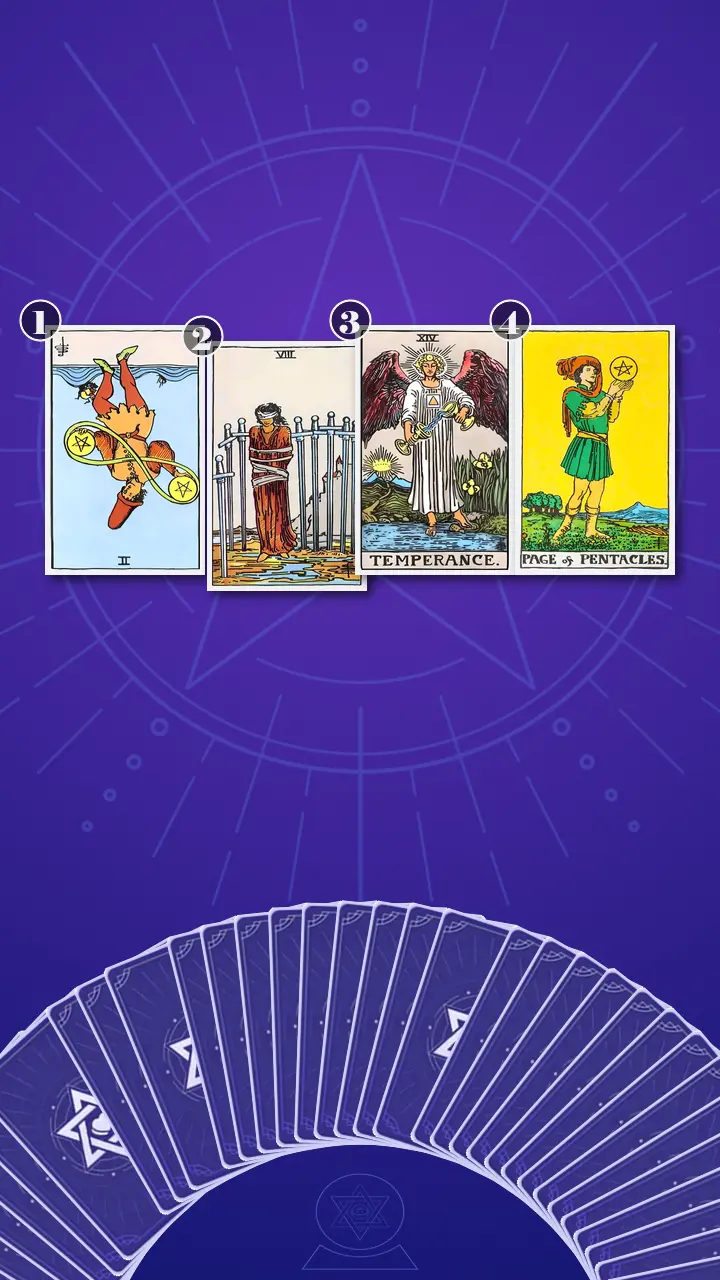
I laid the cards in a straight line from left to right like stepping stones across a narrow bridge. The first position would show the visible symptom cluster—overspending, ignored texts, late-night wiredness. The second would reveal the hidden obstacle under the behavior loop, especially the fear around competence and control. The third, the key card of the reading, would show the corrective energy strong enough to interrupt the cycle. The fourth would ground everything into a practical mindset Jordan could try before the week was over.
Reading the Tabs, the Drafts, and the Hidden Rule
Position 1: The Night That Looks Productive From Across the Room
The first card I turned over was the one representing the surface pattern named in her question. It was the Two of Pentacles, reversed.
I nodded as soon as I saw it. “This is you at 11:47 p.m.,” I said. “Client deck. Banking app. Shopping cart. Unread texts. One more email check. It feels like you're staying on top of everything, but your attention is scattering harder by the minute.” Reversed, this card shows blocked earth energy: practical life wobbling under too many moving pieces. It is the false productivity of constant switching—the kind of night that feels full, yet nothing truly settles.
In modern life, this card reminds me of a phone at 2% battery trying to run maps, Spotify, Slack, and a shopping app at the same time. Technically, it can do that for a moment. It cannot do it steadily. The infinity loop around the pentacles is the endless tab-switching; the raised foot is the body never fully coming down. Money, sleep, and connection all become collateral damage.
Jordan let out a quick, pained laugh and rubbed her forehead. “Okay,” she said, “that's literally my phone screen.” I smiled. Shame loosened a notch right there, which mattered. I wanted her to see the pattern before she judged it. “You're not bad at adulthood,” I told her. “You're over-juggling inside a storm and calling it efficiency.”
Position 2: The Draft Folder in Your Chest
The second card I turned over represented the hidden obstacle beneath the behavior loop. It was the Eight of Swords, upright.
“Here is the actual cage,” I said. “Not the workload by itself. The rule underneath it.” I asked her about the message she almost sends on heavy days—the honest one that says, I can't do all of this tonight, or I need a slower pace on this deliverable. Her eyes shifted before she answered, and I knew we'd found the live wire.
This card is constricting air energy: a mental blockage built from fear, self-monitoring, and quiet catastrophizing. The modern version is brutal in its simplicity. Jordan starts typing a work message asking whether something can move to tomorrow, deletes it twice, and sends nothing. Or she reads a kind text from a friend, thinks, I'll reply when I can sound normal, and then vanishes for three days because silence feels easier for ten minutes and heavier for three days. The blindfold is assumption. The loose ropes are the part that breaks my heart: she is not as trapped as she feels, but her body believes she is.
This is where I used one of my favorite lenses, what I call Dark Matter Detection. In astronomy, invisible mass bends visible motion. In a reading, the hidden rule does the same. The unseen sentence shaping all her visible behavior was this: “If I say I'm overwhelmed, people will hear that I'm not cut out for this.” That sentence had more gravity in her system than the actual facts on her calendar.
Jordan went quiet. First her fingers stilled on the mug. Then her jaw set. Then her gaze drifted somewhere just past my shoulder, as if she were replaying every half-written draft she had never sent. “That,” she said finally, very softly, “is exactly it.”
When Temperance Poured Between Two Cups
Position 3: The Antidote, Not Another Rule
When I turned over the third card, the room changed a little. The phone screen on the table timed out, and the softer lamp light took over. After the storm-gray feeling of the first two cards, the gold in Temperance looked almost warm enough to hear.
This position identifies the corrective energy that can interrupt the stress-compensation cycle and loosen the belief underneath it. The card was Temperance, upright—the clearest antidote in the deck for this kind of emergency mode.
“This isn't a character flaw. It's emergency mode replacing balance—and emergency mode does not get calmer because you pressure it harder.” I see this card all the time when someone is asking about work stress insomnia, stress shopping after work, or why ignoring texts when overwhelmed keeps happening in the same season. They look like three habits. Temperance says they are one system running too hot.
She was in the exact hour this card speaks to: the workday technically over, but her shoulders, phone, and thoughts still acting like the office never closed; the same hour when a cart, an unread text, and a sleepless night can all start to look like one coping strategy wearing three outfits.
The Sentence That Changed the Air
You do not need to grip every spinning plate harder; you need to pour between the cups and let balance, not panic, set the pace.
For a second she did not move at all. That was the first reaction: a small physical freeze, breath held halfway in, fingers hovering over the sleeve of her sweater. Then came the second: her eyes unfocused, not dissociating exactly, but replaying something—Tuesday night, the checkout screen, the unread “You alive?” text, the extra email refresh in the dark. The third reaction was emotional and messier. Her face tightened, and before the relief arrived, irritation flashed. “But if that's true,” she said, voice thin and sharper than before, “doesn't that mean I've been making it worse by trying to be responsible?”
I shook my head. “Not irresponsible. Unprotected. Emergency mode learns fast and protects hard. It just doesn't know the difference between a client escalation and your own bedtime.” Looking at Temperance, I had one of those quiet flashes I sometimes get from years under a planetarium dome in Tokyo: when a spacecraft drifts off course, mission control does not shame it into a better orbit. I run what I call a Gravity Assist Simulation in my head—less interested in the five-minute relief of the current move, more interested in the next day's trajectory. One tiny adjustment now changes where the craft ends up tomorrow. Temperance is exactly that. Balance is not underperforming. It's choosing a pace your body can actually live with.
Her shoulders dropped, then dropped again, as if even her body needed a second to believe me. There was relief in that, but also the slight dizziness that sometimes comes when a long-carried rule stops feeling holy. I asked her, “With this in mind, can you see a moment from last week that would have felt different if balance, not panic, had been setting the pace?” She nodded slowly. “The minute I deleted the message asking for more time,” she said. “And the minute I opened the shopping app after.” That was the shift, right there: from secret emergency mode to the first edge of steadier self-trust and workable limits.
Position 4: Boring Reps, Real Repair
The fourth card I turned over represented the practical next-step mindset if the advice was integrated. It was the Page of Pentacles, upright.
“Good,” I said, almost before I finished setting it down. “Because this card does not want a dramatic reset.” Upright, the Page of Pentacles is balanced earth energy returning in a healthier form. It is grounded learning, practical curiosity, and the willingness to build skill through small repeatable actions instead of trying to perform instant mastery.
Its modern translation is almost annoyingly simple: a spending pause, a two-line honest text, a paper list before bed, repeated long enough to matter. Duolingo streak energy for the nervous system. Not glamorous. Effective. This card moves Jordan from proving to practicing.
She exhaled through a smile that looked tired but real. “So I don't have to fix my entire personality by Friday?”
“No,” I said. “Self-trust comes back in boring reps, not dramatic resets.” Her whole face softened at that. I could feel the reading land not as pressure, but as permission.
The Enough-for-Tonight Map
Once all four cards were on the table, the story was clean. The reversed Two of Pentacles showed the visible mess: late-night stress spending, unread texts, and a body too tired to sleep because work still felt on. The Eight of Swords showed the real engine under it: the private rule that overload must be handled silently and flawlessly. Temperance interrupted that loop with measured regulation through visible limits, smaller priorities, and early check-ins instead of secrecy and quick dopamine. The Page of Pentacles grounded the whole thing in practice. That is exactly why I had chosen a Situation-Obstacle-Advice-Outcome spread rather than a prediction reading: her future did not need a prophecy. It needed a bridge.
I told Jordan her main blind spot was confusing hyper-vigilance with responsibility. Constant monitoring felt like control, but it was actually what kept her system from settling. The transformation direction was not to become less ambitious or less caring. It was to stop treating every busy week like a secret character test and start making the pressure visible before it leaked into spending, silence, and sleep.
She gave me the objection I expected. “I can already hear myself saying I don't even have five minutes for this on a bad night.” I nodded. “That's why the next steps have to be smaller than your panic thinks they deserve.” Then I gave her three course corrections—my version of interstellar navigation for a busy week.
- The Enough-for-Tonight Check Before 9:30 p.m. on your next busy night, open Notes or grab a sticky note and write only three lines: 1 work task still open, 1 thing that can wait, and 1 stop time. This turns invisible pressure into a visible limit. If your body is still at meeting speed, do my three-minute cosmic breathing first—feet on the floor, inhale for 4, exhale for 6—and if writing all three lines feels like too much, write only the first one.
- The 20-Minute Purchase Pause Before any nonessential purchase this week, type one sentence into your phone: “I want to buy this because work made me feel ___.” Then wait 20 minutes before checkout. If you still want the item after the pause, choose it consciously. Move one shopping app off your home screen or log out of saved checkout on one app so relief is not one tap faster than awareness. The goal is not a punishment plan; the goal is to notice the trigger before autopilot closes the loop.
- The Two-Line Honest Reply Pick one safe unread thread and send the minimum viable answer: “Hey, I saw this. Work got intense and I went avoidant. Thinking of you—I'll reply properly tomorrow.” Short honesty regulates faster than three more days of silence. Send it somewhere that isn't your bed. If voice feels easier than typing, record a 20-second note while making tea or walking home from the TTC. You don't need a perfect explanation to make a real limit visible.
A Week Later, the Quiet Proof
Five days later, Jordan sent me a photo of a sticky note beside her lamp. It read: “Deck to client by 9:15. Budget review can wait. Phone charges in kitchen.” Under it was a screenshot of the text she had finally sent her friend. No essay. No polished comeback. Just contact.
She told me she had still felt the pull to check email in bed. She had still thought about buying a serum she didn't need. But she wrote the note first, sent the text first, and put her phone across the room first. She slept through the night, and when she woke up her first thought was still, What if I missed something? This time, she smiled, checked the sticky note, and not her inbox.
That is what a journey to clarity often looks like when it is real. Not a new personality. Not a cinematic reset. Just a person moving from wired self-protection toward grounded self-trust, one honest limit at a time.
When your chest is tight at midnight and even a kind text feels like too much, it usually isn't because you care too little. More often, part of you is scared that pausing will reveal how hard you've already been working just to hold everything together.
So the next time your evening turns into four open tabs and no landing strip, what would one small, honest “enough for tonight” choice look like for you?