When a Partner's Text Feels Like Homework: A Shift to Honest Limits

When a Partner’s Text Feels Like Pressure at 11:48 p.m.
If you spend all day being responsive at work and then your partner’s totally normal message lands like relationship homework, I want to say what I told Jordan before I turned a single card: you’re not imagining the pressure.
Jordan (name changed for privacy) sat across from me and gave me a scene so specific I could feel it in my own jaw. It was 11:48 p.m. on a Wednesday in her small Toronto apartment. She was still in work pants on the edge of the bed, three budgeting tabs open on her laptop, the bathroom fan humming, blue screen light making her face look colder than it was. Her tea had gone lukewarm. A text from her partner glowed on screen: ‘hey, are you up?’ Her thumb hovered, locked the phone, unlocked it again, typed ‘sorry, long day’ three different ways, and sent nothing for forty minutes.
Then she looked at me and said, ‘I know it’s just a text, but it lands like homework.’
I believed her immediately. This is burnout-driven text back anxiety in a relationship: a partner’s message feels like pressure not because love disappeared, but because the body is already braced for one more demand. A loving text can still hit a burnt-out body like a demand. In Jordan, that feeling lived as a tight chest, a jaw clamped so hard it almost changed her voice, and the strange buzzing sensation of someone waiting for impact. It was like her whole day had become an overstuffed tote bag, and one more tiny item made the strap feel as if it might snap.
I told her, gently, that I did not hear a bad partner in any of this. I heard a woman trying to protect the last inch of energy she had left. ‘Let’s make a map of the pressure,’ I said. ‘We don’t need to force clarity. We just need to find where the weight is getting misnamed.’

Choosing the Map: The Shadow Spread
I asked Jordan to take one slow breath and keep only one question in view: why does my partner’s text feel overwhelming after work, bills, and no sleep? Then I shuffled. For me, that opening ritual is not theatre. It is a handoff from reaction to attention, a way of telling the nervous system that we are going to look at the pattern instead of becoming it.
For this session, I chose a five-card Shadow Spread tarot reading. I use this spread when a problem looks relational on the surface but is really being driven by survival stress, inner judgment, and a hidden loop underneath. It is the cleanest small structure I know for separating the surface trigger from the unseen load, the shadow belief attached to it, the medicine that restores balance, and the next step that turns insight into action.
I laid the cards in a gentle rising line from left to right, like a staircase out of a tight room. The first card would show the symptom Jordan already knew too well: why an ordinary text currently lands like an extra task. The second would reveal the hidden load from work, bills, and poor sleep. The third, sitting at the hinge of the spread, would uncover the shadow lens that turns contact into perceived pressure. The fourth would offer the balancing energy that interrupts the overload-to-withdrawal loop. The fifth would show how that inner shift becomes a real message, in real life, on an actual phone.
As both a Jungian psychologist and a tarot reader, I am never interested in card meanings in isolation. I want card meanings in context. A purely relational spread would have over-focused on Jordan’s partner. A timeline spread would have missed the exact psychological mechanism. What I needed here was a map from trigger, to burden, to inner verdict, to regulation, to speech.
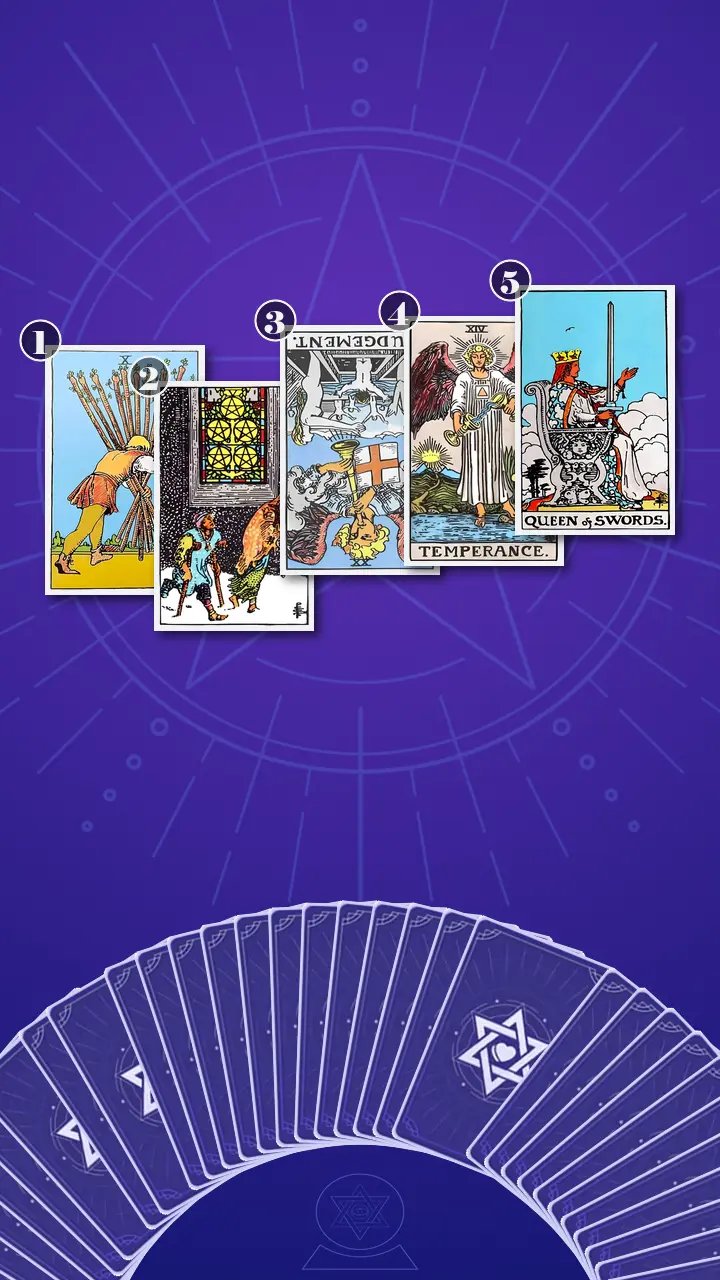
The Compression Chamber
Position 1: The Load That Arrives Before the Words
I turned the first card, the one that shows the observable symptom from the diagnosis: why an ordinary text currently lands like an extra task. The Ten of Wands, upright.
I told Jordan this was the picture of her phone at night. Not because the message itself was heavy, but because it was landing on top of a day already carried past capacity. In modern life terms, this card looks like getting home from a long shift with work stress, commute fatigue, and money worries still sitting in the body, then seeing a partner’s message and reacting as if the phone has just added another item to a load you were barely managing. The words on the screen are small. The body response is huge.
The energy here is excess strain. Too much fire. Too much carrying. In the Rider-Waite image, the figure’s line of sight is blocked by what they are carrying, and that mattered to me immediately. Jordan was not seeing her partner’s text as just a text, because overload had filled the whole frame first. It had serious The Bear energy in the nervous system: everything technically manageable, and somehow still one notch too intense.
I asked her, ‘When the notification lands, what does your body do in the first ten seconds before you even decide what it means?’
She gave a short laugh, dry and a little bitter. ‘My jaw locks first,’ she said. ‘Then I put the phone face down like it sent me an invoice.’
I smiled, because the image was painfully exact. ‘Yes,’ I said. ‘Sometimes “I’ll reply later” is not avoidance. It’s an empty tank trying not to spill.’ Her fingers tightened around her mug, then loosened. That small release told me the first layer of shame had already started to lift.
Position 2: The Scarcity Filter Underneath It
I turned the second card, the one that reveals the hidden load from work, bills, and no sleep that is feeding the reaction beneath the relationship trigger. The Five of Pentacles, upright.
This is where practical strain takes over the emotional weather. I told her this card looked exactly like the TTC ride home after checking rent, groceries, transit, maybe the banking app, and then receiving even caring contact through a not-enough filter. Not ‘someone wants me,’ but ‘I don’t have enough left for this too.’ When relationship text anxiety is fueled by material stress, emotional availability starts to feel like something that also has to be budgeted.
The energy here is deficiency and survival mode. Not weakness. Not failure. Just depletion. In the card, there is a lit window nearby, but the people in the cold do not experience it as reachable. That is the part I wanted Jordan to hear: support may exist, love may exist, but a body running on low sleep and money stress often cannot feel it as available from where it is standing.
She looked down at the spread and went quiet. Her thumb rubbed the edge of her phone again and again. ‘That’s the part nobody sees,’ she said. ‘From the outside I still look functional.’
I asked what she was usually already carrying right before the message hit hardest. Work follow-ups. Grocery math. The low-grade dread of ordinary spending feeling personal. Several nights of sleeping lightly. She nodded before I finished listing them. The card had landed exactly where it needed to.
When the Notification Became a Verdict
Position 3: The Inner Subtitle Track
I turned the third card, the one that uncovers the core fear and limiting interpretation that turns contact into perceived pressure. Judgement, reversed.
Whenever Judgement appears reversed in a reading like this, I stop and slow down. This is the hinge card. In modern life, it is the moment a neutral text becomes a verdict. The phone says, ‘How was your day?’ and the exhausted brain auto-generates subtitles that were never actually written: ‘Why are you distant?’ ‘Why can’t you do this right?’ ‘You’re failing someone again.’ It is Severance logic in miniature—work-brain colonizing personal space until intimacy starts to sound like a performance review.
The energy here is blockage through inner criticism. The trumpet on the card becomes the notification tone that suddenly feels louder than it is, more final than it is, more accusing than it is. Jordan was not only reacting to contact. She was reacting to the fear that any reply would expose how close to the edge she already felt.
I looked at her and said the sentence I most wanted her to keep: ‘Reply to the actual words, not the accusation your exhaustion added.’
Her whole body did a tiny stop-start. First her breath caught. Then her gaze slipped away from me, not avoidant so much as replaying a stack of recent conversations in fast-forward. When she spoke, her voice was quieter. ‘If I open it, I owe a good answer,’ she said. ‘If I don’t, I look cold.’
There it was. The loop in one perfect line: low capacity, delayed reply, brief relief, more guilt, more pressure next time. I told her I did not think the text itself was the problem. The blind spot was that she had begun treating low capacity as moral failure. That is why even a loving check-in could feel like criticism.
When Temperance Poured Between Two Cups
Position 4: The Bridge Between Capacity and Closeness
When I turned the fourth card, the room changed. The street noise outside my window seemed to step back for a moment, and the white-gold of the card caught the light differently from the others. This was the key card of the reading, the bridge between compression and release. Temperance, upright.
I told Jordan this card was not asking her to become instantly more available. It was offering the exact alternative to shutdown and overextension. In modern life terms, Temperance looks like noticing the body spike, taking one breath, and sending one truthful line before the spiral takes over. Not disappearing. Not pretending to have energy she does not have. Answering from the middle.
At 11:48 p.m., with budget tabs still open and her body nowhere near settled, a completely ordinary text could feel heavier than it was because it was landing on top of everything else, not in isolation.
Your partner’s message is not another wand to carry; pour only what is real between the cups, and let balance make room for connection.
I let the sentence rest there between us.
Then I added, more plainly, ‘The pressure is not proof that your partner is asking too much. It is a sign that your system is already over capacity—and honest pacing is what lets connection stay real instead of turning into debt.’
She went very still. First came the physiological freeze: her fingers stopped halfway around the mug, and even her blinking seemed to pause. Then came the cognitive seep-through: her eyes lost focus for a beat, as if she were replaying every late-night scene at once—the blue screen, the lukewarm tea, the draft-delete-delay loop, the second unread notification that always made the first one feel worse. Then the emotion moved. Her shoulders dropped by half an inch. Her jaw unclenched. And what arrived first was not relief. It was anger edged with grief. ‘So I’ve been treating every text like a bill,’ she said. ‘Like if I open it, I owe.’
I nodded. ‘Yes. But that does not mean you’ve been doing love wrong. It means depletion has been writing the invoice.’ As I said it, I had one of those quick private flashes from my years training intuition on transatlantic cruise routes: the best captains never lied about weather, fuel, or distance to port. They adjusted early. They told the truth about conditions before strain became damage. Temperance always feels like that to me—measured self-regulation, not emotional heroics.
Then I reached for one of my own diagnostic tools, what I call the Choice X-Ray. I laid three invisible options beside the card and priced them honestly. Silence looked cheap in the moment, but its hidden cost was guilt, dread, and a colder conversation tomorrow. Overexplaining promised innocence, but it charged interest in exhaustion and turned a check-in into a defense brief. One honest line cost ten seconds of discomfort and returned something far more valuable: sleep, trust, and room. When Jordan saw the choice that way, her face softened. This was the real shift—from overwhelmed defensiveness and guilt into paced honesty, clear limits, and manageable connection.
I asked her, ‘Using this new lens, can you think of a moment last week when one truthful sentence would have changed the temperature?’
This time her laugh had warmth in it. ‘Wednesday,’ she said. ‘Easily.’
Position 5: The Warm Boundary Text
I turned the fifth and final card, the one that translates the inner shift into a concrete communication stance and next relational step. The Queen of Swords, upright.
This card did not want an essay. It wanted clean air. In modern life, it looks like texting: ‘I’m fried and I care about you. Can we talk tomorrow after work?’ No long apology. No silent retreat. No performance of being totally fine. Just clarity with emotional presence. The raised sword and the open hand say the same thing at once: firmness and warmth can live together.
The energy here is balance becoming language. Queen of Swords is not coldness. She is discernment. She is the difference between saying what is true and defending yourself against a crime that never happened. Warmth and limits can live in the same sentence.
Jordan opened her Notes app while I was still speaking. Her shoulders were no longer up by her ears. ‘A warm boundary text,’ she said, trying the phrase out. ‘That I could actually send.’
The Warm Boundary Script for the Next 48 Hours
When I looked back across the full spread, the story was clean. The Ten of Wands showed the visible symptom: an already overloaded nervous system reading one more notification as one more weight. The Five of Pentacles showed the hidden load underneath: bills, poor sleep, cost-of-living pressure, low margin. Judgement reversed named the tightest knot in the pattern: Jordan was not only reading the message, she was reading herself through it, and harshly. Temperance restored regulation. Queen of Swords turned that regulation into actual words.
The cognitive blind spot was simple and brutal: Jordan had been treating low capacity as evidence of personal failure. That is why a neutral check-in kept turning into proof that she was behind. The transformation direction was just as clear: stop treating every message as a test of availability, and start answering with honest limits plus small, real contact.
I gave her a 48-hour reality test, because insight works better when it is small enough to try before perfectionism can turn it into another assignment. I also borrowed a lesson from my old life at sea. In my Port Decision Model, a ship does not promise a long, graceful visit when conditions do not allow it. It states the docking window clearly, protects what matters, and returns when it actually can. Texting from low capacity works the same way.
- Use a Capacity-First Reply.Tonight, before opening your partner’s thread, take one full breath and silently rate your capacity from 0 to 10. If you’re at 0 to 3, send one honest line within three minutes: ‘I’m really wiped and I care about you. I don’t have much in me tonight.’Pin the line in your Notes app. If your chest tightens, copy-paste it without editing. The goal is not to sound impressive. The goal is to sound true.
- Run the Actual Words Filter.The next time a text hits hard, write down the exact message you received on one line, and on the line below it write the sentence your exhausted inner critic added. Reply only to the first line—the actual words, not the imagined accusation.If you feel silly doing it for something as small as a text, that is usually a sign the exercise is pointed in exactly the right place. Read the incoming message out loud once if you need help breaking the subtitle track.
- Send a Port Window Message.At a neutral time this week, not in the middle of a spiral, send a proactive note like: ‘If I go quiet after work, it usually means I’m maxed out, not mad at you. If I’m fried, an emoji check-in or planning for tomorrow helps more than a surprise late-night talk.’ Keep it under four sentences and offer one realistic window, like Thursday after 7:30 p.m. or Sunday on a walk.Think of this as clarity, not confession. You are naming your docking window, not arguing your case for being lovable.
None of these next steps asked Jordan to become instantly more available. They asked her to become more accurate. That is how tarot works best for me in moments like this: not as prediction, but as actionable advice about the loop that keeps making connection feel heavier than it is.

A Week Later, the Quiet Proof
A week later, Jordan sent me a screenshot. It was the message we had workshopped in the reading, almost word for word: ‘I’m fried and I care about you. Can we talk tomorrow after work?’ Under it was her partner’s reply: ‘Of course. Thanks for telling me. Sleep well.’
She told me the hardest part was not sending it. The hardest part was resisting the urge to add a second paragraph and explain herself into innocence. She didn’t. She put her phone down, rinsed her mug, and let the night stay smaller than her panic had predicted.
She slept a whole night. Morning still arrived with one quick old thought—What if that sounded cold?—but this time she smiled into her coffee instead of reopening the thread.
That is the kind of journey to clarity I trust most. Not from mess to perfection, but from bracing to choice. In this five-card Shadow Spread, Jordan did not erase burnout, rent, or sleep debt in one sweep. She found the hinge point where connection stopped feeling like an exam and started feeling manageable again. Connection gets lighter when it stops being an exam.
When you’re already running on fumes, even a loving text can make your chest lock up—not because you don’t care, but because some part of you is afraid one more small ask will expose how close to the edge you already are. If that is where you are tonight, I hope you let that truth reduce the shame by even one degree.
If you didn’t have to sound fully available tonight, what one honest line could you pour between the cups—a warm boundary text that lets you stay real and kind at the same time?