Speaker Invite Anxiety at Work—and the Reply-Then-Build Shift

The Starred Email and the Shape of Visibility Anxiety
If you open the invite on your commute home, research the event, research the speakers, research the audience, and somehow still do not answer, that is not just preparation; that is career visibility fear in a very professional disguise.
That was already in my mind when Jordan (name changed for privacy) joined my evening session from her rented flat in London. It was 6:21 on a Sunday. Her laptop was open to a half-written reply, the tea beside it had gone cold, and through the call I could hear the radiator clicking in little metallic bursts. Every few seconds the light from the starred Gmail thread shifted across her face as if the email itself were still asking for an answer.
'I know I could do it,' she told me, tucking one leg under herself in the chair. 'Which is exactly why it feels risky.' Her fingers went to the base of her throat as she said it. The apprehension around her felt like standing on a Tube platform while the train is already there: you can board or keep pacing, but the longer you wait, the more your body mistakes movement for danger. I told her I understood. Wanting the opportunity and fearing what public visibility might reveal can exist in the same breath. 'Let's draw a map for the fog,' I said. 'Not to force a yes, but to find clarity about what your not-ready loop is really protecting.'

Choosing the Compass: A Four-Card Map for Speaker Invite Anxiety
I asked Jordan to take one slow breath and hold the real question in mind: was she hesitating because the invite was wrong, or because being seen felt too intimate? While she did that, I shuffled slowly. For me, that moment is not theater. It is a way of helping the nervous system stop free-scrolling long enough to notice what it already knows.
For this session, I chose the Situation-Obstacle-Advice-Outcome spread. I often use this four-card structure when someone is stuck at a career crossroads and wants to understand how tarot works in context, because it is small enough to stay honest. A larger spread would have given Jordan more places to hide in analysis. A simple pros-and-cons spread would have missed the real engine of the dilemma, which was not logistics at all, but visibility anxiety disguised as overpreparation.
I told her I would read the line from left to right like a bridge. The first card would show the visible stall around the invite. The second would reveal the deeper fear underneath it. The third would name the energy that could interrupt the pattern. The fourth would show the realistic next step if she chose to move.
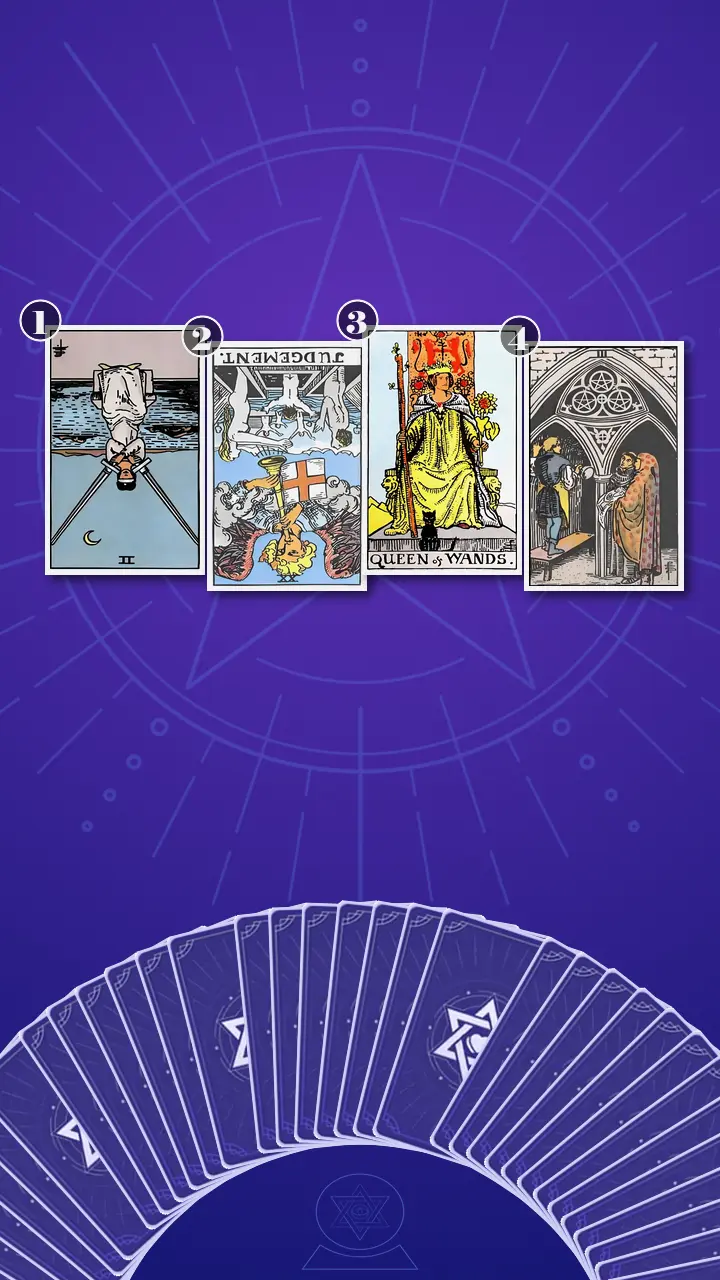
The Cards That Named the Loop
Position 1: The Holding Pattern in the Inbox
The first card I turned was for the concrete stalled behavior she had been living inside. It was the Two of Swords, reversed.
In modern life, this is Jordan on the Jubilee line with the invite open, toggling between the draft, the event page, and the other speakers' bios, telling herself she just needs a bit more context when her body is already in a full don't-make-this-real freeze. The air energy here is blocked and overflowing at once: too much analysis, not enough decision. The starred email is not a strategy. It is a holding pattern.
When I use my Procrastination Decoding lens, the loop becomes painfully clear. Trigger: the flattering invite. Avoidance: research tabs, bio edits, a Notion page called speaker notes, maybe one more skim of LinkedIn panel clips. Relief: brief and seductive, because she has postponed exposure. Cost: the invite swells until it feels like a referendum on competence. It reminded me of keeping a product in endless internal review because launch day feels like a verdict on the whole team, not a chance to learn from real users. She had been calling the delay responsible when it was really self-protection.
Jordan let out a short laugh that had no real humor in it. 'Okay,' she said, rubbing her jaw. 'That is accurate enough to be rude.' I smiled and told her accuracy was useful here, because the body usually confesses before the mind does.
Position 2: When an Invitation Starts Sounding Like a Verdict
The next card represented the psychological mechanic beneath the stall, especially the fear that public imperfection would damage self-worth. It was Judgement, reversed.
This is the moment the invite stops feeling flattering and starts feeling exposing. The trumpet in the card becomes the inbox call she did not manufacture herself; the rising figures become the terrifying fact of being asked to step into visibility before she feels internally upgraded enough for it. In real life, I see this when a normal work email lands in the body like a public audit. She reads other speakers' bios late at night, hears an invisible second message under the invitation - can you prove you're as good as we think you are? - and suddenly the whole thing takes on a faint Black Mirror flavor, as if one panel could permanently set her market value.
The energy here is contraction through self-verdict. Not a lack of talent. A blockage around being seen before perfection arrives. 'An invitation is not a verdict,' I told her. 'You are not underprepared. You are overexposed in your own imagination.'
I watched the reaction move through her in three small stages. First, the freeze: her breathing paused, and her fingers stopped over the mug handle. Then the cognitive hit: her gaze unfocused, as if she were replaying every half-muted LinkedIn panel clip and every private thought of If I sound ordinary, they will remember that. Finally, the release: one long exhale, shoulders lowering by a fraction. 'That is exactly what it feels like,' she said quietly. 'Like I've turned one email into a courtroom.'
When the Queen of Wands Turned on the Light
Position 3: The Energy That Changes the Entire Room
When I reached the third card, the atmosphere changed. Outside her kitchen window a bus sighed at the stop, then the street went quiet enough that even the radiator clicks sounded deliberate. This was the hinge of the whole reading, the antidote card.
The card representing the key shift that interrupts the pattern was the Queen of Wands, upright. In modern life, this is Jordan answering from warmth and clarity instead of from fear-management. She does not wait to become the most polished version of herself in private first; she picks one message she actually believes in, lets that lead the prep, and shows up as someone useful, engaged, and visibly alive rather than hyper-curated. The fire here is balanced. Not performance. Not bravado. Warm self-trust.
You know that moment on the train home when you reopen the invite, tweak one line, check the other speakers again, and call it preparation even though your throat has already gone tight? That is usually not a skills gap. It is the cost of being seen.
Stop treating readiness like a locked door; let the Queen's sunflower remind you that confidence grows in the light, not in hiding.
Readiness is not the ticket price for being visible. Sometimes visibility is the place where readiness finally gets built.
At that point I brought in one of my own tools, what I call Choice X-Ray. Being raised among Venetian canals taught me early that water never waits for your perfect confidence, and years of reading for travelers taught me the same about thresholds. So I laid her options side by side. The visible cost of saying yes was nerves, rehearsal, and being seen before she felt perfect. The hidden cost of saying no was steeper: teaching her nervous system that fear gets veto power over career growth, and making every future invitation feel even larger. The Queen of Wands does not ask, Will they be impressed? She asks, Can I make the room better with one true useful thing I know?
'But if that is true,' Jordan said, and this time there was resistance in her voice, almost anger, 'have I just been doing this backwards?' I told her no. Fear is not stupidity. It is protection that has outlived the moment it was designed for.
Then I watched the insight land. Her jaw unclenched first. Then her eyes filled, not dramatically, just enough for the screen-light to catch. She leaned back from the laptop as if her body needed a few extra inches of space to absorb the idea that she did not have to audition for her own opportunity. When she spoke again, her voice had that slightly startled softness people get when a sentence has found the exact knot. 'So my job is not to look perfect,' she said. 'It is to make one useful thing clear.' I nodded and let the silence do some of the work. After a few breaths, I asked, 'Now, with this new perspective, can you think of a moment last week when this would have changed how you felt?' She laughed through her nose. 'Lunch on Thursday,' she said. 'I told a friend the one thing I actually wanted to say about launches, and my whole body loosened.' That was the real crossing: from contracted apprehension and self-verdict toward grounded self-trust and visible participation. The relief was real, but so was the strange vulnerability that follows it - that slight internal dizziness that comes when the old excuse falls away and the next step becomes yours again.
Build the Talk, Not the Courtroom
Position 4: The Blueprint That Makes It Manageable
The final card showed how to ground the shift into actual career life, how readiness could be built through structure and support. It was the Three of Pentacles, upright.
This is the blueprint card, and Jordan relaxed the second she saw me smile. For a product marketing manager, its language is wonderfully unglamorous: scope, audience, version one, feedback round, rehearsal partner. The earth energy here is stabilizing. Not more private fantasy, but actual structure. This is Jordan confirming the topic and format, booking a prep call, sending a rough outline to one trusted colleague, and practicing the opening once out loud in her flat. This is not a final exam. This is a build. Build the talk. Do not build a courtroom.
'That makes it feel manageable,' she said, and there it was: not a personality transplant, just the first tiny turn from frozen self-monitoring to warm participation.
From Holding Pattern to Reply-Then-Build
When I pulled the whole line together, the story was remarkably clean. The Two of Swords reversed showed the surface loop: the starred email, the draft, the research tabs, the promise to answer later. Judgement reversed showed the engine beneath it: she was not simply deciding whether to speak; she was bracing against the fantasy that public imperfection would downgrade her worth. The Queen of Wands interrupted that fantasy by moving the question from polished image to real contribution. The Three of Pentacles grounded the change in process. In elemental terms, the reading moved from air-choked indecision, to fire-led permission, to earth-based construction. Her cognitive blind spot was simple and brutal: she kept treating private overpreparation as safety, when the indecision itself was what kept her nervous system activated. The transformation direction was just as clear: move from using readiness as a gate for saying yes to using acceptance as the container in which readiness gets built.
Because I spent years around ships and docking windows, I gave her a version of my Port Decision Model. A captain does not circle offshore waiting for a mythical perfect sky. She chooses the port window, names the conditions, and works with the real tide in front of her. For Jordan, that meant a boundary-first reply and a short build plan, not another week of hovering over the inbox.
- Send the boundary-first replyOpen the email within the next 24 hours and write only two moves: your decision and one practical boundary. For Jordan, that meant saying yes to the event and asking to focus on a specific topic with a prep call next week. Do it in the actual inbox, not in a separate notes app, and keep the block to 15 minutes.If your chest tightens, save the human version instead of optimizing the perfect version. Same-day return only; no disappearing into extra tabs.
- Make a lived-experience outlineBefore touching slides, bios, or LinkedIn, write three sentences that begin with What I know from doing this work is. Then choose one audience takeaway and place it at the top of your notes. Jordan's version centered on how launches fail when messaging tries to sound smarter than it is.If writing feels stiff, record a 60-second voice note and pull the cleanest line from that. Aim for useful, not universally impressive.
- Run a 48-hour reality test with one trusted personWithin two days of replying, book one 20-minute rehearsal with a colleague or friend who knows your work. Stand up, say the opening once without editing mid-sentence, and ask only two questions: What was clear? Where did I sound most alive?This is my Reality Testing method: let real feedback replace the invisible jury in your head. Version one is enough.

A Week Later, the Jaw Unclenched
Five days later, Jordan sent me a screenshot of the email thread. She had replied yes, asked for a prep call, and suggested the angle she actually cared about. Her message underneath it was pure London understatement: 'Sent it. Did not combust. Also booked time with a colleague on Thursday.'
She told me that night she slept properly for the first time in days. The next morning her first thought was still, What if I sound ordinary? She smiled at that voice, stood in her kitchen, and practiced the opening anyway.
I have seen this many times in readings and in life: clarity rarely arrives as a trumpet blast. More often it sounds like a human reply finally sent, a body softening by a few degrees, a person moving from self-protection toward participation. That is the Journey to Clarity I care about.
Sometimes the tightest part is not the talk itself, but the moment an ordinary 'we'd love to have you' lands in your body like 'prove you deserve to be here.' If tonight you recognize your own starred email, your own half-built Notion page, your own very professional form of hiding, please know that seeing the pattern is already a form of movement.
If saying yes did not have to mean I am fully finished, what might your smallest honest version of participation look like: a boundary-first reply, one sentence you are willing to bring into the light, or a rehearsal with one real person?