From Tight-Chest Overthinking to Timely Follow-Through: The Referral Ask

Finding Clarity in the Draft-Folder Loop
If you’ve rewritten a referral email at midnight like it’s a court document, because you’re terrified they’ll read “not qualified” between your lines—welcome to the draft-folder loop.
Jordan (name changed for privacy) met me over a late Zoom call from Toronto. They didn’t need to tell me the time; I could hear it in the room. The fridge hum had that loud-in-the-quiet quality, and their laptop glow turned the kitchen counter into a pale little stage. Every few seconds, the cursor hovered over Send like it was a cliff edge.
They said, “I have the referral email ready. I just… can’t hit send. Part of me thinks I should send it now. Part of me is like, no, keep proving I can do it alone. I hate feeling like I’m taking from people.”
I watched their jaw tighten as if they were holding a bite back. Their chest rose shallowly, like they were trying to breathe through a hoodie pulled too high. The whole thing felt like standing at a locked door holding the key—then checking the key a hundred times instead of turning it.
“We can work with this,” I told them, gentle but steady. “Not to force you into a ‘perfect’ decision—just to get you out of imagined judgment and into real data. Let’s draw you a map through this fog and find some clarity you can actually act on.”

Choosing the Compass: The Decision Cross Spread
I asked Jordan to set their hands on the table for a moment and take what I call my pre-meeting 3-minute cosmic breathing: inhale like you’re widening your ribs into orbit, exhale like you’re letting the gravity of the chair hold you. It’s not mystical. It’s nervous-system math—getting the body out of “threat scanning” so the mind can stop tone-policing every word.
Then I shuffled. Slow, deliberate, like the way I cue a planetarium audience to look up right before the stars appear—one beat of darkness, one beat of quiet, and then the pattern emerges.
“Today we’ll use a Decision Cross,” I said. “It’s a clean spread for a yes-or-no career decision—send the email versus wait and keep proving independence—without pretending we can predict the other person’s response.”
For readers who wonder how tarot works in a practical situation like this: the Decision Cross is minimal structure with maximum honesty. The left/right cards show the energy and cost of each path. The card below reveals the hidden driver behind the hesitation. The card above integrates the best next step—ethics-forward, boundary-aware, and actionable.
“We’ll start at the center,” I told Jordan, “to name the stuck loop you’re living in. Then we’ll look at the two options. Then we’ll go under the surface to see what’s actually running the show. And finally, we’ll rise into the most workable way forward.”
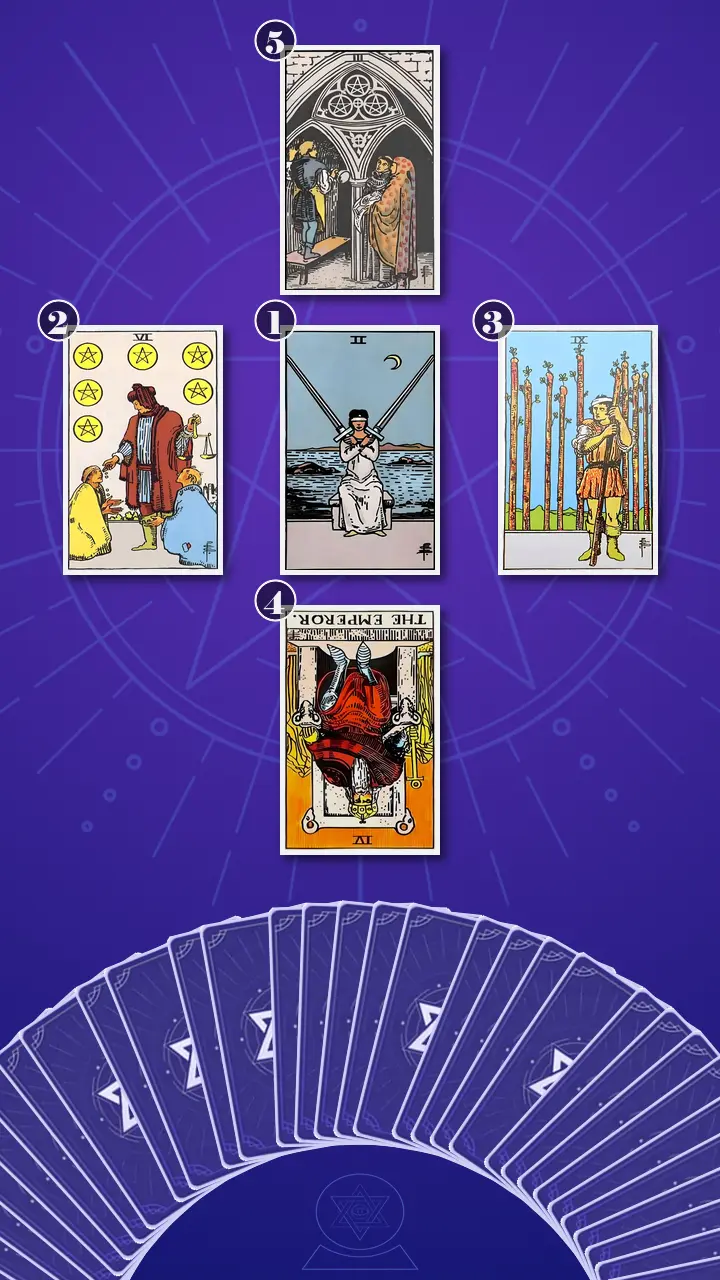
Reading the Map: Air, Earth, Fire—and the Inner Rulebook
Position 1: The present stuck point
“Now we turn over the card that represents The present stuck point: what the draft-email loop looks like in real behavior and mindset.”
Two of Swords, upright.
In the most modern, painfully specific translation: it’s 11:45 PM, you’re at the kitchen table, and you keep rewriting two sentences for “tone,” reading them out loud, then freezing with your cursor over Send. Not sending lets you avoid a possible “no,” but it also keeps your career move locked in the drafts folder.
This is Air energy in blockage form—thinking as a barricade. The blindfold and crossed swords aren’t about ignorance; they’re about protection. If you don’t choose, you don’t have to feel the risk of being seen. And yet the water behind the figure is calm with rocks in the distance: the consequences don’t announce themselves loudly, they just sit there—timing windows closing, opportunities moving on.
I used the cinematic cut I’ve learned young professionals recognize immediately: “Cursor hovering. Inbox glare. Jaw clenched. Inner monologue: If I don’t send, I can’t be judged… but I also can’t move. Safe neutrality tonight. Quiet consequences tomorrow.”
Jordan gave a short laugh that was more bitter than amused. “That’s… too accurate,” they said, eyes flicking away from the screen like it had just exposed them. “It’s kind of brutal.”
“I know,” I said. “And here’s the reframe that matters: You’re not stuck because the email is unclear—you’re stuck because being seen feels unsafe. That’s why ‘one more edit’ feels like relief.”
Position 2: Option A (Send)
“Now we turn over the card that represents Option A (Send): what this choice invites you to practice about receiving support and professional reciprocity.”
Six of Pentacles, upright.
Jordan’s shoulders dropped by a millimeter the second the card landed, like their body recognized something solid.
The Six of Pentacles is Earth energy in balance. The scales in the giver’s hand matter here: a referral request can be fair, proportionate, and easy to answer. In modern terms, this card is: you send a concise referral request with just enough context, a link to the role, and a short blurb they can forward. You include a line that makes declining easy. It feels less like begging and more like using a normal career tool.
I said it plainly, because this is the phrase Jordan needed to borrow until it became theirs: A referral request is a professional tool, not a verdict on your worth.
“But I don’t want to sound desperate,” Jordan said quickly, like the words had been waiting at the edge of their teeth.
“That’s exactly why the scales are here,” I replied. “Boundaries. Clear ask, easy decline, gratitude. It’s the difference between ‘Can you save me?’ and ‘Here’s what I’m applying to—would you be willing to refer me?’ That’s not desperation. That’s a well-scoped ticket.”
Position 3: Option B (Prove alone)
“Now we turn over the card that represents Option B (Prove alone): what this choice reinforces about self-reliance, protection, and cost.”
Nine of Wands, upright.
This card doesn’t shame grit. It respects it. The problem is what it costs when grit becomes your entire personality.
In real-life Toronto kitchen terms, the Nine of Wands is: instead of sending the email, you decide you’ll “earn it” first—stay late, take on extra tasks, polish your portfolio again. It feels temporarily safer because you’re in control and no one can judge your ask—but you’re exhausted, isolated, and still not closer to the door-opening step.
Fire energy here is overextended—perseverance turning into bracing. The fence of wands behind the figure looks like a calendar packed with “proof work”: one more deliverable, one more deck, one more bullet point. Protected, yes. But also boxed in.
I mirrored Jordan’s posture gently. “Notice your shoulders,” I said. “When you imagine ‘one more week of solid output,’ do you feel them creep up?”
Jordan winced, then huffed a small laugh. “Yeah. It’s like my whole body goes into… guard mode.”
“Exactly. Staying protected can start to look a lot like staying isolated.”
Position 4: The hidden driver
“Now we turn over the card that represents The hidden driver: the underlying fear and control pattern that makes sending feel risky.”
The Emperor, reversed.
The air in the call changed—like when the dome lights dim at the planetarium and you can feel a room of strangers get quiet together. Jordan didn’t speak. Their lips pressed into a line, and I saw their throat bob once like they’d swallowed a truth too fast.
This is the inner antagonist: the rulebook voice. The Emperor reversed is the part of you that equates control with worth. Stone throne, armor under the robe—image-management mode. In modern life: you treat one referral email like a legitimacy test. Your inner compliance officer keeps inventing new requirements before you’re “allowed” to ask.
I said, “Control can look like competence. Sometimes it’s just fear in business casual.”
And then I used my own diagnostic lens—the one I’ve developed from years of watching celestial mechanics and human panic behave in similar patterns. I call it Dark Matter Detection: the art of finding what’s influencing the whole system even when you can’t ‘see’ it directly.
“Your visible behavior is the draft edits,” I told Jordan. “But the dark matter is the belief underneath: If I ask now, they’ll label me incompetent or opportunistic. That’s why you spin on the subject line, reread it out loud, check LinkedIn again, then ‘prove’ with one more resume bullet. You’re trying to control perception instead of collecting data.”
Jordan went through a small, honest reaction chain: their breathing paused; then their eyes unfocused, like they were replaying a dozen nights of hovering over Send; then they exhaled through their nose, slow, almost reluctant. “It really is like… an internal policy manual,” they said. “And it keeps updating.”
“Yes,” I said. “And policies can be rewritten.”
When the Three of Pentacles Became a Blueprint
Position 5: Integration
“Now we turn over the card that represents Integration: the healthiest way to move forward that honors competence while allowing support.”
Three of Pentacles, upright.
This was the moment the whole reading clicked into place—not in a magical way, but in a systems way. The Three of Pentacles is Earth energy in balance: craft plus collaboration, visible work plus coordinated input. It’s a team sprint. It’s the shared blueprint on the table.
Setup (30–50 words): Jordan had been trapped in the belief that clarity must come before the send—that if they could just polish the email enough, they could guarantee they wouldn’t be judged. But their body was already telling the truth: the tight chest wasn’t about grammar. It was about visibility.
Delivery:
Stop treating the email as a weakness and start treating it like a shared blueprint for good work, because Three of Pentacles grows careers through coordinated craft.
Reinforcement (100–200 words): Jordan froze, just for a beat—their eyes widening slightly, like a lens shifting focus. Their jaw unclenched in stages: first the tiniest release at the corners of their mouth, then a deeper softening in their cheeks. Their shoulders, which had been hovering near their ears all call, lowered as if someone had finally loosened a strap on a too-heavy backpack.
They didn’t look instantly joyful. They looked relieved and a little disoriented—like when you step off a treadmill and your legs still expect the belt to move. “But if I make it that simple,” they said, voice thinner, “doesn’t it mean I was… making this harder than it needed to be?”
“It means you were trying to stay safe,” I said. “And now you’re choosing something smarter.” I paused, letting the idea land in the quiet between us. “Now, with this new lens—think back to last week. Was there a moment when you opened the draft, tightened up, and closed it? How would it have felt different if you’d treated it like a mini project brief instead of a verdict?”
Jordan nodded once, slow. “Tuesday night. Exactly. I could’ve just… sent the brief.”
In my own head, a memory flickered from my planetarium work: gravity assists—how a spacecraft doesn’t “fail” because it uses a planet’s pull; it becomes more efficient. This is the emotional transformation in human terms: from self-doubt-driven over-control and help-seeking shame to grounded confidence built through clear reciprocity and follow-through. Not a personality swap—just a trajectory change.
“Professional competence isn’t doing it alone,” I added, steady as a metronome. “It’s knowing when to loop people in—clearly, respectfully, and on time.”
The Timer-Send Experiment: Actionable Next Steps
I pulled the story together for Jordan, like tracing a constellation line by line.
“Here’s what the spread says in one breath,” I told them. “Two of Swords is you staying neutral to avoid being judged. Six of Pentacles says sending can be a clean, bounded exchange. Nine of Wands shows the solo path: admirable, but exhausting and isolating. The Emperor reversed reveals why it feels so loaded—control is standing in for self-worth. And Three of Pentacles offers the integration: a structured ask that treats help as part of doing good work.”
“Your blind spot,” I continued, “is that you’ve been treating control as the only form of safety. But control isn’t data. The transformation direction is the exact shift you’re ready for: from ‘I must prove I deserve help first’ to ‘I can ask clearly and respectfully, and let the response give me real data.’”
Then I gave Jordan a small, tangible navigation plan—my interstellar metaphor made practical. “We’re not launching into deep space,” I said. “We’re doing a short burn to change your orbit.”
- Build the Two-Line Clear Ask BlockOpen the draft and paste a two-line core: (1) the role you’re applying for + the link, (2) what you’re requesting (referral/intro). Delete anything that doesn’t support those two lines.If you start tone-policing, ask: “Is this about clarity—or about control?” Then stop editing.
- Add the “Easy Out” Boundary LineAdd one sentence that makes “no” easy: “If you’re not able to help, no worries at all—thanks for considering.”Boundaries reduce awkwardness. You’re not asking them to process your feelings—just to answer a clear request.
- Run the 15-Minute Timer-Send + Body ResetSet a 15-minute timer. Do one read-through for clarity only. When the timer ends: hit Send. Then do a 3-minute body reset—stand up, unclench your jaw, shake out your hands, drink water.This is my “Spacecraft Attitude Adjustment”: you’re teaching your system that visibility isn’t danger. The win is follow-through, not forcing yourself to feel fearless.
Before we ended, I offered one more tool—my Gravity Assist Simulation. “If you don’t send,” I said, “you keep burning fuel alone, trying to brute-force a trajectory change. If you send a clear, bounded brief, you let the network’s gravity help—no drama, just physics. Over time, that’s how careers actually move.”

A Week Later: The Quiet Proof
Six days later, Jordan emailed me—three sentences, no apology tour. “I did the 15-minute timer. I used the two-line block. I hit Send when the timer ended. They replied the next morning and said yes.”
They added, almost as an afterthought: “I slept through the night for the first time in a while. I still woke up and thought, ‘What if I sounded cringe?’—but then I laughed a little and made coffee. It didn’t hijack my whole day.”
That’s the kind of clarity I trust: not certainty carved in stone, but a steady self-trust built through small follow-through. Measure progress by follow-through, not by solitary struggle.
When you’re staring at a perfectly good draft with a tight chest and clenched jaw, it’s rarely about the email—it’s about trying to control whether asking will expose you as “not enough.”
If you treated this referral email like a simple project brief—not a verdict—what’s the smallest, clearest version of your ask you’d be willing to send this week?