Homework Tab Open for Hours—Then the One 'The truth is...' Line

The Homework Tab That Felt Like a Read Receipt (Blank-Page Freeze)
You open your therapy portal at night, stare at the worksheet, and suddenly the simplest prompt feels like a trap—classic blank-page freeze.
Maya (name changed for privacy) said it like she was confessing to a minor crime. She was 28, Toronto, client-facing job, the kind of person who can sound calm in a meeting while her brain is quietly juggling five tabs of doubt.
She described 9:41 PM on a Tuesday in her small apartment: laptop open on the portal, peppermint tea going lukewarm, the fridge hum filling the quiet like it had opinions. Outside, the city made its distant, metallic exhale—cars on wet pavement, a faint TTC rumble somewhere far enough to feel like memory. On her screen, the cursor blinked in a blank text box, steady as a metronome.
“I’m not ignoring it,” she told me, fingers tightening around her mug. “I’m just waiting until I can do it properly.”
I watched her jaw lock as she said properly. Her shoulders had crept up as if they were trying to become earmuffs. The fear wasn’t loud. It was concentrated—like her whole nervous system had been shrink-wrapped around that empty box.
She wanted to do the inner work and grow, and she was terrified of what honesty would force her to admit once she started writing.
“We can work with that,” I said, keeping my voice simple. “Not by forcing a breakthrough—by making a map. Tonight is a journey to clarity, but it can start with something very small and very real.”

Choosing the Compass: The Four-Layer Insight Ladder
I asked Maya to take one slow breath—nothing mystical, just a clear transition from “performing competence” to noticing what was actually happening. While she held the question in mind, I shuffled in an unhurried rhythm that has always reminded me of brushing soil from a fragile shard: patient, precise, no rushing the truth.
“For this,” I said, “I want to use a spread called the Four-Layer Insight Ladder · Context Edition.”
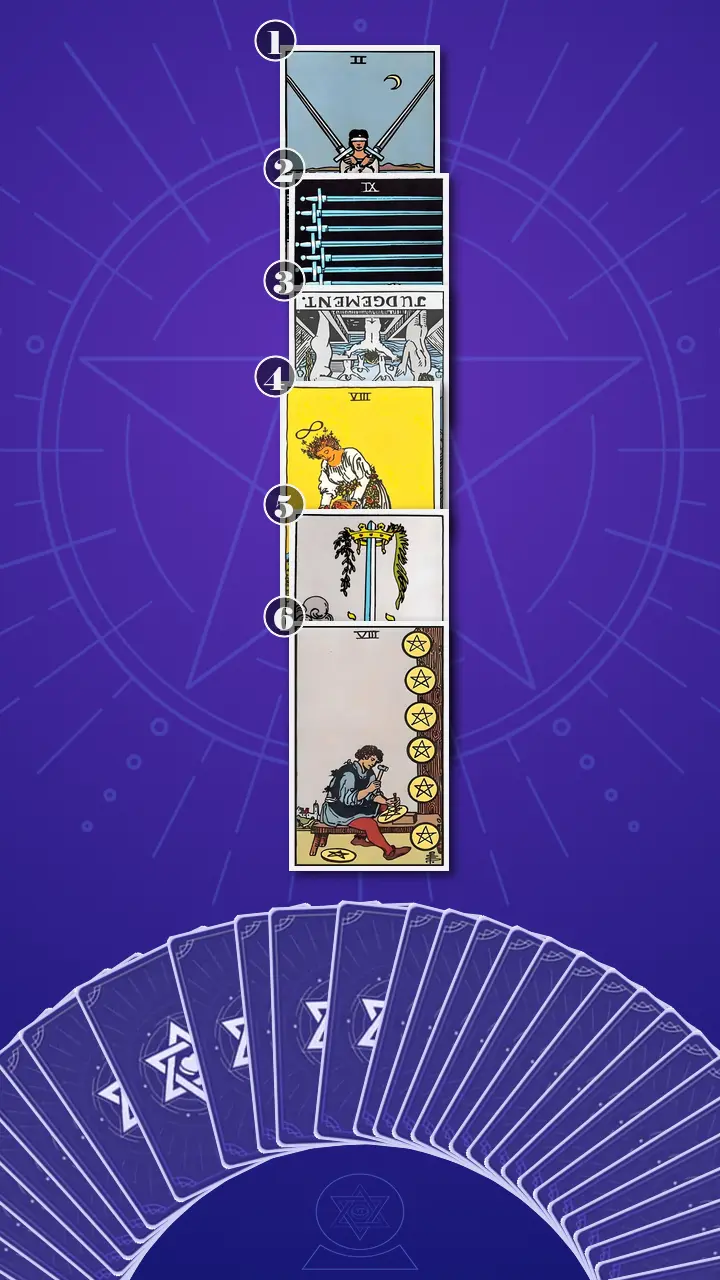
To you, the reader: I choose this ladder when the problem is an inner loop—fear turning into overthinking, overthinking turning into freezing, freezing turning into shame. The structure is deliberately minimal: six positions are enough to separate what’s visible (the stall) from what’s hidden (what the stall protects), name the core fear, and then climb back out with a workable plan. It’s a tarot spread for therapy homework avoidance and fear of being seen, without turning the session into a prediction about outcomes.
I told Maya what the ladder would cover: the moment she freezes, what she’s avoiding touching, the underlying fear that makes the worksheet feel high-stakes, the inner resource available, the turning point, and one practical next step for this week.
Reading the Map: When “Doing Therapy Right” Becomes a Trap
Position 1: The observable stuck point
“Now turning over,” I said, “is the card that represents the observable stuck point: what you do at the moment you try to start the therapy homework.”
Two of Swords, upright.
“This is painfully modern,” I told her, and I meant it. “You’re on your couch with the worksheet open, telling yourself you’re about to start—yet you keep rereading the prompt and mentally debating what the ‘right’ answer should be. It doesn’t feel like avoidance. It feels like being careful.”
In the card, the blindfold isn’t ignorance; it’s self-protection. The crossed swords held close to the chest are a guard stance. Energetically, it’s blockage: Air (thought) used to prevent contact rather than create clarity.
“It’s like staring at a Slack message draft forever,” I added, “because hitting send feels irreversible—even though you can edit later.”
Maya gave a small, bitter laugh—quick, almost embarrassed. “That’s… actually kind of cruelly accurate.”
“Cruel would be calling it laziness,” I said. “This looks like protection. The question is: what decision are you postponing by staying on the blank page—choosing honesty over polish, or choosing action over certainty?”
Position 2: What you’re trying not to touch
“Now turning over is the card that represents what feeling or thought you’re trying not to touch when you keep the page blank.”
Nine of Swords, upright.
“The homework stays blank,” I said, “but your mind is loud. At night you replay what you’ll say in therapy, imagine disappointment, spiral into ‘I’m wasting therapy’ narratives. The page isn’t empty—it’s crowded with worst-case scripts.”
This is excess Air: thoughts multiplying until they become a ceiling. Like a browser with 27 tabs open—none of them are the one where you actually write the thing.
“It’s like opening your front camera by accident,” I said, “and instantly feeling perceived—even though no one’s actually there.”
Her gaze dropped to the table; her thumb rubbed the edge of her phone case as if she could sand down the feeling. I saw the split-screen in her: (A) the worksheet tab sitting open like a “good person” alibi, (B) her brain running a late-night internal meeting with zero agenda and a lot of panic.
I offered her a simple template: “If I write the wrong thing, it means ___.”
She swallowed. “It means I’m not making progress. Like… I’m failing at therapy.”
Position 3: The core fear making it feel unsafe
“Now turning over is the card that represents the core fear that makes the homework feel unsafe or high-stakes.”
Judgement, reversed.
“Deep down,” I said, “the worksheet feels like a pass/fail test. If you write the ‘wrong’ thing, it means you’re not progressing—and if you write the real thing, it might prove something unflattering you can’t un-know. So your mind tries to pre-write an answer that sounds insightful.”
Reversed, Judgement becomes the dread of a verdict. The energy here is overcorrection risk: you over-script so you won’t be judged, and the conversation stays abstract. Safe—but sterile.
“It’s like treating a weekly check-in as a performance review,” I said, “instead of a conversation starter.”
My own mind flashed—uninvited, as it often does—to excavation reports I’ve read from collapsed cities: layers of ash where people were not lazy, just afraid, and the fear made the next step feel fatal. Human beings don’t avoid what is trivial; they avoid what feels like it could redefine them.
Position 4: The inner resource you can access
“Now turning over is the card that represents the inner resource you can access to stay present with discomfort long enough to write.”
Strength, upright.
“This isn’t ‘push harder,’” I said. “This is ‘stay kinder.’ Instead of forcing discipline, you create a calmer container: timer, softer posture, smaller goal. You treat the scared part of you like it’s allowed to exist at the table while you write anyway.”
Strength is balance Fire: not intensity, but steady warmth. I watched Maya’s body respond before her words did—one hand on the trackpad, the other unclenching on her lap; her breath finally moving lower in her chest. Change, in real life, often arrives as a soft pivot first.
“Like switching from grind mode to a focus timer and a lo-fi playlist,” I said. “Same task. Totally different nervous system.”
When the Ace Cut Through the Noise (Finding Clarity with One Honest Sentence)
Position 5: The key shift that breaks the loop
I let the room go quiet on purpose before turning the next card. Even in a bright Toronto evening, there’s a particular hush that happens when someone is about to stop negotiating with themselves.
“Now turning over,” I said, “is the card that represents the key cognitive/behavioral shift that breaks the avoidance–fear loop.”
Ace of Swords, upright.
Maya’s shoulders rose a fraction, the way they do when someone expects a complicated answer and is already bracing to get it wrong. In her mind, I could almost hear the grading mode warming up: Will it be deep enough? Will it be the right insight? Will this prove I’m still a mess?
Stop treating the homework like a verdict; write one true line and let the Ace of Swords cut a path through the noise.
I paused and let it hang there—clean, unsentimental, almost startling in its simplicity.
Her reaction came in a three-part chain I’ve seen in students before an exam and in dig teams before uncovering a burial: first, a brief freeze—her breath stopped mid-inhale, fingers hovering as if they didn’t know where to land. Then, the cognition slipped in—her eyes unfocused, as though she replayed every Tuesday night with the tab open and the tea cooling. Finally, the release: a quiet “oh,” and her shoulders dropped with a small, involuntary tremor, like a muscle realizing it can finally unclench.
“That’s… terrifying,” she said, and then, almost annoyed at herself, “and also weirdly relieving.”
“Both make sense,” I replied. “The Ace doesn’t ask for the whole story. It asks for one precise line. Keep it true, not polished. One sentence. Not the whole identity.”
This is where my archaeological brain offers a frame. I call it Historical Case Matching: civilizations at crossroads rarely collapse because they lack information—they collapse because they can’t choose a first move without needing it to be perfect. The Ace of Swords is the first move. It’s the moment a society—or a person—stops holding everything in suspension and names what’s real enough to act on.
“Now,” I asked her, “use this new lens and think about last week. Was there a moment—Tuesday night, Sunday Scaries, 2 a.m.—where one honest line would’ve changed how trapped you felt?”
She blinked hard. “Sunday. I was folding laundry instead of writing, and I literally thought: ‘If I write what I actually feel, it’ll prove I’m not worth fixing.’”
“That,” I said gently, “isn’t you being bad at therapy. That’s you protecting something tender. And it’s the first real material.”
In that moment, the journey shifted: from blank-page freeze and shame-driven perfectionism toward honest self-naming—one clean cut through the fog, and then we build from there.
Position 6: The practical next step this week
“Now turning over,” I said, “is the card that represents a practical next step you can do this week to rebuild self-trust through follow-through.”
Eight of Pentacles, upright.
“Good,” I said, and I meant it the way you mean it when you see a sturdy bridge after miles of unsure ground. “This reframes homework as craft. A workshop bench, not a stage. Reps, not revelations.”
The Eight is balance Earth: routine, repetition, and the quiet dignity of showing up. “Like Duolingo streak energy,” I added, “but for honest self-naming. Tiny reps that compound.”
The Workshop-Not-Courtroom Plan: Actionable Next Steps for This Week
Here’s the story the ladder told us, in plain terms: you sit down to do the homework (Two of Swords), your mind fills the silence with catastrophic scripts (Nine of Swords), and underneath it all is a fear that honesty will become a verdict on your worth (Judgement reversed). Strength shows the way through—not by fighting the fear, but by containing it gently. The Ace of Swords is the turning point: one true line. And the Eight of Pentacles turns that insight into a repeatable practice that rebuilds self-trust.
Your cognitive blind spot is subtle but common: you’ve been treating process as proof. As if a messy sentence means a messy self. The transformation direction is the opposite: from trying to produce the “correct” therapeutic answer to practicing one small act of honest naming—even if it’s imperfect.
I offered Maya a set of small experiments, borrowing from my own Time Stratigraphy Method: we separate the “impulse layer” (panic, grading, comparison) from the “lasting value layer” (one true statement we can actually work with). Then we log the voyage like ancient navigators—short entries, consistent bearings, no demand for drama.
- The One Honest Sentence Start (6–7 minutes)Open the worksheet (or a Notes app titled “Therapy draft”). Set a timer for 6–7 minutes. Write exactly one line that starts with: “The truth is…” Then stop—no editing. Screenshot it or save it as-is to bring into session.If your chest tightens or your brain goes into grading mode, take three slower breaths and end the sprint on purpose. Stopping on purpose is still follow-through.
- The “Messy Truth” Sprint (3 blunt sentences)Do a 7-minute sprint where you write three sentences that start with: “The part of me that doesn’t want to do this is afraid that…” Keep them blunt and human. Bring the raw version to therapy as material, not as a final answer.Expect resistance like “this is too basic.” Treat that as data, not a stop sign. Bullet points and voice-to-text count.
- Two-Block Therapy Rep System (Eight of Pentacles)Put two 10-minute blocks on your calendar this week (e.g., Tue 9:10 PM, Thu 8:30 PM). After each block, write a one-line voyage log: “I showed up for __ minutes. The feeling was __. The fear said __.”Make the win “I showed up,” not “I sounded insightful.” Practice reps build self-trust. Not perfect insights.

A Week Later: The Quiet Proof
A week later, Maya sent me a message that was almost comically unceremonious: “Did the one sentence thing. Hated it. Brought it anyway.”
She told me she’d done it on the TTC after work—standing on Line 1, one hand on the pole, the other typing in Notes. Not a dramatic catharsis. Just one line, unedited, screenshot for session. And then, for the first time in weeks, she didn’t spend Sunday night bargaining with the blank page like it was a courtroom judge.
That is what clarity often looks like in real life: not certainty, but ownership. Not a perfect story, but true enough material to bring into the room.
When a blank worksheet makes your jaw lock and your stomach drop, it’s not because you’re “bad at therapy”—it’s because part of you is terrified that one honest sentence will turn into a verdict on your worth.
If you didn’t have to sound insightful—only honest—what’s the one sentence you’d let be “true enough” to bring into the room this week?