Quarter-End Life Audit: From Notification Overwhelm to Foundation-First

Finding Clarity in the 9:41 p.m. Tab Rotation
If quarter-end deadlines hit the same week rent is due and you keep rewriting your ‘life audit’ list instead of starting the one stabilizing task—this is that kind of moment.
Jordan (name changed for privacy) sat on the edge of her bed in a fourth-floor NYC walk-up, laptop half-open like it might snap shut from exhaustion on its own. Slack glowed in the corner of the screen. Her phone was warm from refreshing her Chase balance again—thumbprint, number, refresh, number. The radiator hissed like it was impatient with her, and street noise leaked through the window in thin, gritty layers.
“Quarter ends today,” she said, like she was delivering a verdict. “Work, rent, friends, sleep. I keep doing a life audit, and I still can’t tell what comes first without… failing somewhere.”
The way she said first tightened her body. Not metaphorically—her chest literally held its breath, like she was bracing for impact. It felt like watching someone try to breathe through a straw while juggling four glass cups.
She glanced at her Notes app, already open to a color-coded list. “If I start with sleep, I’m failing at work. If I start with work, I’m failing at money. If I say no to friends, I’m failing at having a life.”
I nodded, slow and steady. “Okay. We’re not going to fix your whole life tonight. We’re going to get you out of the notification-driven triage loop and into clarity—one fair first move, then realistic next steps.”

Choosing the Compass: The Energy Diagnostic Map Spread
I asked her to take one breath that went all the way down—no performance, just oxygen. Then I shuffled slowly, the way I used to slow my own hands on a trading floor before a volatile open: not mystical, just focus. “Hold the question,” I said. “Quarter ends today. What first?”
“Today we’ll use a spread I call the Energy Diagnostic Map · Context Edition,” I explained, setting seven cards in a circular layout with one in the center.
For you reading this: this spread works especially well for prioritizing when everything feels urgent—work performance, rent money, friends, sleep—because the circle makes the loop visible. It shows how you ping-pong between categories, and then the center card isolates what’s actually blocking clarity. After that, it deliberately routes us toward resource → transformation → next step, so the reading produces actionable advice rather than more analysis.
“Here’s what we’re looking at,” I told her, tapping the positions lightly. “This first card is the surface snapshot—what your last few hours have actually looked like. This next one is the inner tug-of-war—what tradeoff you’re avoiding naming. The center is the core blockage. And toward the end, we’ll find the key shift and the next practical move you can do without needing perfection.”
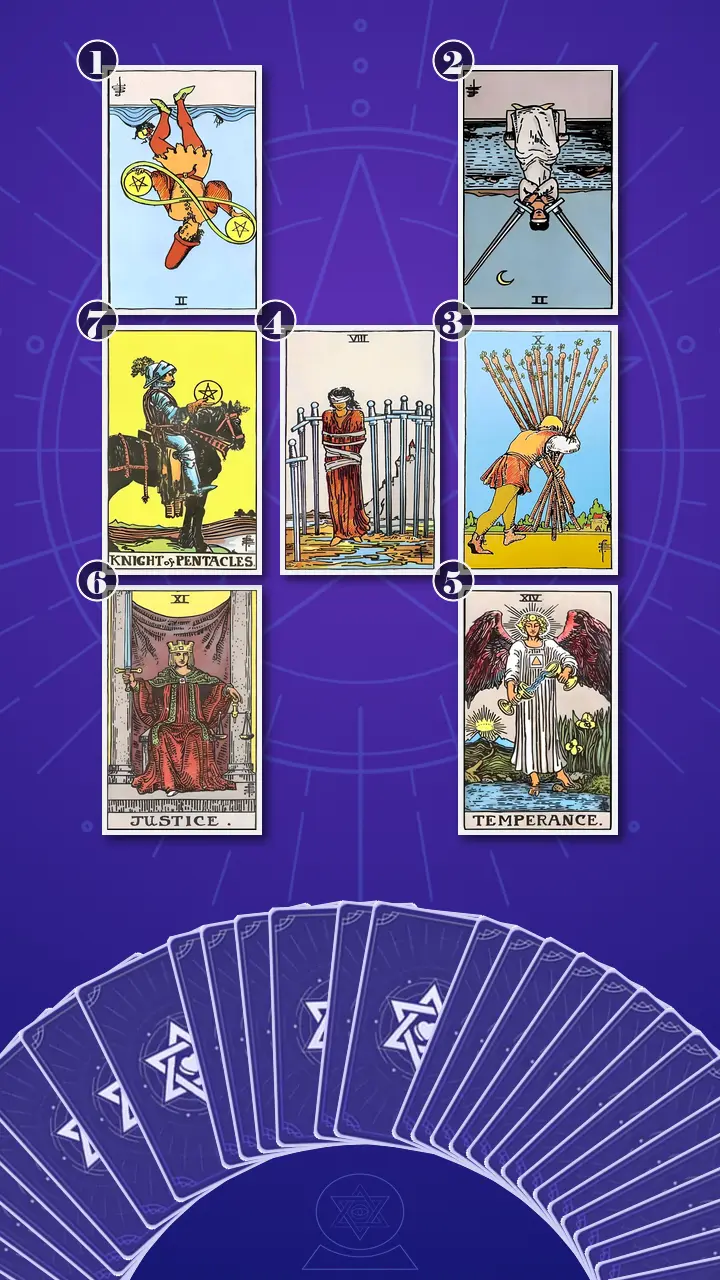
Reading the Map: The Cards That Named the Chaos
Jordan watched my hands like she wanted them to hurry, but also like she was scared of what would be said out loud. That’s always the tell: decision fatigue doesn’t just live in the mind. It lives in the shoulders and jaw.
Position 1: The Surface Snapshot (What’s happening on your screen-time, not your intentions)
“Now flipped over,” I said, “is the card representing your surface snapshot of how the ‘quarter ends today’ urgency is showing up in day-to-day behavior and time use.”
Two of Pentacles, reversed.
It landed like a mirror. “This is you trying to keep four categories ‘moving’ so none of them can accuse you of neglect: you reply to Slack, then check your balance, then confirm weekend plans, then look up sleep hacks—on repeat. It looks like productivity, but it’s actually unstable juggling where the loudest tab becomes the ‘priority.’”
Reversed, that juggling energy isn’t a flex—it’s a blockage. Too much motion, not enough completion. “The system stops being playful,” I added, “and becomes drop-risk.”
Jordan gave a small laugh—dry, almost embarrassed. “That’s… too accurate. It’s kind of brutal.” Her eyes flicked to her phone, then back to the card, like she’d been caught mid-refresh.
“Checking isn’t the same as stabilizing,” I said, gently. “And you don’t need a perfect life plan today—you need one loop closed.”
Position 2: The Inner Tug-of-War (The tradeoff you keep reopening)
“Now,” I said, “we’re looking at the card that represents your inner tug-of-war—the specific decision paralysis that keeps priorities stuck.”
Two of Swords, reversed.
“You keep debating the same question—work, rent, friends, or sleep first—like there’s a perfect choice that won’t cost anything. You ask for opinions, make a list, rewrite the list, and still can’t commit, because committing feels like being responsible for the consequences.”
Reversed, the Two of Swords isn’t a calm pause. It’s a stalled engine. The energy is overactive Air: pros/cons, guilt, second-guessing—until your brain feels loud even when the apartment is quiet.
I watched her mouth press into a thin line. She didn’t nod—she went still. Then, almost under her breath: “If I commit, I can’t pretend it’s not my fault if it goes wrong.”
“Exactly,” I said. “Keeping everything pending is a modern blindfold. Four apps open, none chosen.”
Position 3: External Pressure (The load that’s actually real)
“Now we flip the card representing external pressure sources—work, rent, social expectations, time constraints—the stuff that amplifies urgency.”
Ten of Wands, upright.
“The pressure is real: quarter-end deliverables, performance visibility, rent due, friend group momentum, and a sleep debt that’s catching up. You’re carrying it all at once, so your nervous system treats everything like an emergency and you end up moving through the week with narrowed vision.”
This card always makes people feel seen, not scolded. The energy here is excess—too much weight, too little visibility.
Jordan’s shoulders rose, then dropped like she’d set something down for half a second. “So I’m not just… being dramatic.”
“No,” I said. “You’re not failing at balance; you’re carrying a stack that blocks your view.”
Position 4 (Center): The Core Blockage (The belief that turns life admin into an identity trial)
I tapped the center card. “Now flipped over is the card representing the core blockage—the belief-pattern that turns a practical life audit into an all-or-nothing crisis.”
Eight of Swords, upright.
“You tell yourself you’re trapped: by adult responsibilities, by money, by expectations, by time. But the trap tightens most when you avoid choosing. The moment you make one small, reversible decision—one boundary text, one bill paid, one email sent—the story of ‘no options’ starts to crack.”
This is a blockage card, but it’s also a negotiation card. The bindings are looser than they look.
Jordan stared at the image, then at the floor. “It’s like I’m in a courtroom with myself,” she said. “And every option is evidence.”
That line landed in me—because I know that courtroom. I’ve sat in meetings where a single number got treated like a moral verdict. And the thing I learned back then was this: the market doesn’t care how hard you tried. Reality rewards structure.
Position 5: Available Resources (What actually works this week)
“Now we look for your resource,” I said. “This card represents the most usable inner capacity or supportive approach for regaining balance this week.”
Temperance, upright.
“Instead of a grand life overhaul, you build a workable mix for today: one money move (stability), one work move (progress), and one sleep lever (energy). You stop trying to max out all four categories and start aiming for a calm, finishable blend that keeps tomorrow from getting worse.”
The energy here is balance—not a perfect equilibrium, but a regulated flow. “Think of it like adjusting audio levels,” I said. “Not rewriting the whole playlist.”
Jordan’s face softened. Not a smile—more like her forehead stopped fighting gravity. “I can do a blend,” she said. “I can’t do a ‘new life’.”
When Justice Held the Scales at Quarter-End
Position 6: The Key Transformation (The rule that answers ‘what first?’)
I let the silence settle for a beat. Even the radiator seemed to pause between hisses.
“We’re flipping the key card now,” I said. “This one represents the mindset shift that answers ‘what first?’ with clear criteria and a fair decision rule.”
Justice, upright.
Jordan swallowed like she’d been waiting for this—like she wanted permission and was mad she needed it.
Setup: It’s 9:38 PM and you’ve got Slack open, your banking app open, and a half-written “life audit” list—plus a friend texting “drinks?” Your chest is tight, and somehow even resting feels like you’re making a bad choice.
Delivery:
Not every plate deserves equal airtime—put your life on the scales, make one clean cut with the sword, and let fairness replace panic.
I didn’t rush the next moment. I let that sentence sit in the room the way a gavel sits after it hits wood.
Reinforcement: Jordan’s reaction came in a chain. First: a physical freeze—her breath stopped halfway in, fingers hovering over her phone like she’d been caught mid-tap. Second: cognitive seep—her eyes unfocused, like she was replaying the last week in fast-forward and noticing every time she’d tried to “be responsible” by refreshing apps instead of choosing. Third: emotional release—a quiet exhale she didn’t seem to plan, shoulders lowering as if they’d been holding up the Ten of Wands all day.
“But if I pick one,” she said, and there was a flash of anger in it, “doesn’t that mean I’ve been doing it wrong?”
I kept my voice even. “It means you’ve been doing what smart people do under fear: you’ve been trying to keep optionality. Justice isn’t here to shame you. It’s here to give you criteria.”
This is where my Wall Street brain and my Tarot brain speak the same language. “When I assess two deals,” I told her, “I don’t ask which one makes me feel like a good person. I run probability-weighted scenarios. What’s the downside if it slips 72 hours? What’s the opportunity cost of not acting? Justice is your decision model. The scales are your criteria. The sword is your commitment.”
I leaned in slightly. “Now, with that frame: use this new perspective and think back to last week—was there a moment when you were refreshing Slack and your balance, and this one fairness rule could’ve changed what you did first?”
Jordan nodded once, sharp. “Tuesday night. Rent. I kept checking the number instead of just confirming the auto-pay.” She blinked hard, like her eyes were tired of being brave. “I could’ve closed it in five minutes.”
“That’s the shift,” I said. “From notification-driven overwhelm and guilt to integrity-based clarity. Not certainty—clarity.”
Position 7: The Next Step (The boring move that rebuilds trust)
“Last card,” I said. “This represents your next step: a realistic first action that stabilizes the foundation and reduces future pressure without requiring perfection.”
Knight of Pentacles, upright.
“You pick one practical task you can complete in 30–60 minutes that makes tomorrow easier—then you do it the same way next time. It’s not glamorous. It’s reliable. Consistency becomes the thing that makes work steadier, money less scary, sleep more possible, and social life less charged.”
The energy here is balance through repetition. The antidote to urgency theater. “Boring is not failure—boring is sustainable,” I said.
Jordan exhaled again, smaller this time. “Okay,” she said. “But real question: what if I don’t even have 30 minutes? My calendar is feral. And if I say no to drinks, I’m going to feel like I’m disappearing.”
“That’s honest,” I said. “So we’re not asking you for 30 minutes. We’re asking for a first move that is finishable. Fifteen minutes counts. Seven minutes counts. The Knight doesn’t sprint. He closes one loop.”
The One-Page “Justice Cut” for Next Steps
I pulled the whole story together for her in plain language: the Two of Pentacles reversed showed the visible juggling—switching tabs so fast you feel busy without feeling safe. The Two of Swords reversed and Eight of Swords revealed the blindfold loop underneath: avoiding the tradeoff so you don’t have to be responsible for consequences, until avoidance starts to feel like a cage. The Ten of Wands validated the truth: the load is heavy—quarter-end isn’t a vibe, it’s a real demand stack. Temperance offered the stabilizer: small blending and pacing. And Justice provided the turning point: criteria and one clean cut. The Knight of Pentacles then grounded it into a repeatable routine.
The cognitive blind spot here is subtle but brutal: you’ve been treating “priority” like a moral referendum on whether you’re a real adult, which is why every option feels loaded with shame. The transformation direction is the opposite: treat it like a fairness-based decision with consequences, then act once—before you re-plan.
“Here’s how we make this real,” I said. “In my world, we’d call this a decision ledger—boardroom simple. And we’ll keep it gentle.”
- The 72-Hour Priority SentenceOpen your Notes app and write: “For the next 72 hours, my priority is ___ because ___.” Then add one proof-action (15–30 minutes) and one consciously-postponed item (with a time you’ll revisit it).If anxiety spikes, stop after the sentence. The win is choosing a criterion, not fixing your whole life tonight.
- Foundation First Calendar BlockPut only the proof-action on your calendar today as a 15–30 minute block titled “Foundation First”—before you answer any “drinks?” texts or open Slack “just in case.”Use my pre-commitment ritual from the trading floor: phone on charger, notifications off, timer on. You’re building a protected micro-window, not willpower.
- Close One Loop RuleChoose one foundation money move you can finish fast: confirm rent payment date, pay one bill, or transfer even $25 to a bills buffer. Do it start-to-finish before opening another app.Expect your brain to say “too small to matter.” That’s the old system talking. Small is finishable—and finishable is stabilizing.
Jordan looked at the list, then at her phone, like she was seeing it as a tool again instead of a judge. “So rent confirmation first,” she said. “Not because I’m obsessed with money. Because consequences.”
“Because fairness,” I agreed. “And because the opportunity cost of not doing it is hours of mental noise.”

A Week Later: Ownership, Not Perfection
Six days later, Jordan texted me a screenshot—just her Notes widget at the top of her home screen. It read: “For the next 72 hours, my priority is rent + quarter-end deliverable because instability multiplies stress.” Under it: “Proof: confirm auto-pay + send first draft bullets.” And then: “Postpone: drinks—Sunday 4 p.m. check-in.”
Her message was only one line: “I did the rent confirmation in 9 minutes. I slept like a person.”
It wasn’t a cinematic transformation. It was smaller—and real: a full night’s sleep, then waking up with the first thought still being “What if I’m behind?”—but this time she wrote the next move on a sticky note, drank water, and didn’t open Slack in bed.
That’s the Journey to Clarity I trust: not a new personality, not a perfect week—just the quiet proof that one fair first move can turn “everything is urgent” into an actual operating system.
When everything is urgent, choosing one first move can feel less like planning—and more like putting your entire adulthood on trial.
If you gave yourself permission to be fair (not perfect) for the next 72 hours, what would your single “foundation-first” move be?