From IC vs Manager Panic to a 90-Day HR Email You Can Send Today

The HR Email That Turned Tuesday Into a Trial
You get an HR email with two internal transfer options—IC track or manager track—and somehow it turns a normal Tuesday into a full-body “Career Pivot Anxiety” spiral.
Jordan met me exactly in that spiral: 8:41 p.m. on the TTC Line 1 heading north, her phone screen a hard rectangle of light against her own reflection in the dark window. The train hummed; someone’s earbuds leaked bass; the air felt dry enough to make your throat scratch. Her thumb toggled between the internal career framework PDF and LinkedIn like it was a life-support machine. Her jaw was clenched so tight I could see the muscle jump when she swallowed.
“Both options sound good,” she said, and then her voice got smaller. “And that’s what’s making me panic.”
I watched her try to laugh it off, the way people do when they want to look capable in front of their own fear. But her chest kept doing that buzzing, electric pressure that doesn’t care about professionalism.
“I want a clear next step that proves growth,” she admitted, staring at the HR subject line like it could bite. “But if I pick wrong, I’m afraid it’ll follow me for years. Like… I’ll lock myself into the wrong version of me.”
Her anxiety didn’t feel like a thought. It felt like running eighteen browser tabs on an old laptop—fan screaming, screen glare in your eyes, everything technically still working but one more click away from overheating.
I leaned in, gentle but direct. “You’re not broken for reacting like this,” I told her. “Your nervous system is treating one email as if it’s a lifetime verdict. Let’s slow it down and turn this into something we can actually hold. We’re going to draw a map through the fog—toward clarity you can use, not just clarity you can admire.”

Choosing the Compass: The Decision Cross Tarot Spread
I asked Jordan to take one breath that went all the way down—shoulders, ribs, belly—and to hold the question in a single sentence: “HR offered IC or manager. What’s my next move?” Not forever. Just next.
I shuffled slowly, not as a performance, but as a reset—like clearing a cluttered desktop so you can see the one file you actually need. Then I laid out the Decision Cross, a career decision tarot spread designed for exactly this kind of two-option fork.
For anyone reading who’s curious how tarot works in a practical career crossroads moment: this spread doesn’t “predict your fate.” It organizes information—your patterns, your values, your blind spots—and gives you a structure for actionable advice and next steps. The horizontal line compares the two paths (IC vs manager) without pushing you into a moral story about ambition. The vertical line exposes what’s really driving the paralysis and what inner stance will help you choose cleanly. The final card is framed as a concrete move—how to communicate—because a decision that can’t be expressed tends to stay a daydream.
“Here’s the map,” I said, tapping the layout lightly. “The center is what’s happening right now—your decision fatigue. Left is what the IC track actually offers day to day. Right is what the manager track truly asks of you. Above is the hidden driver—what you’re optimizing for without admitting it. Below is the stance that steadies you. And then, one step forward: how you reply to HR in a way you can stand behind.”
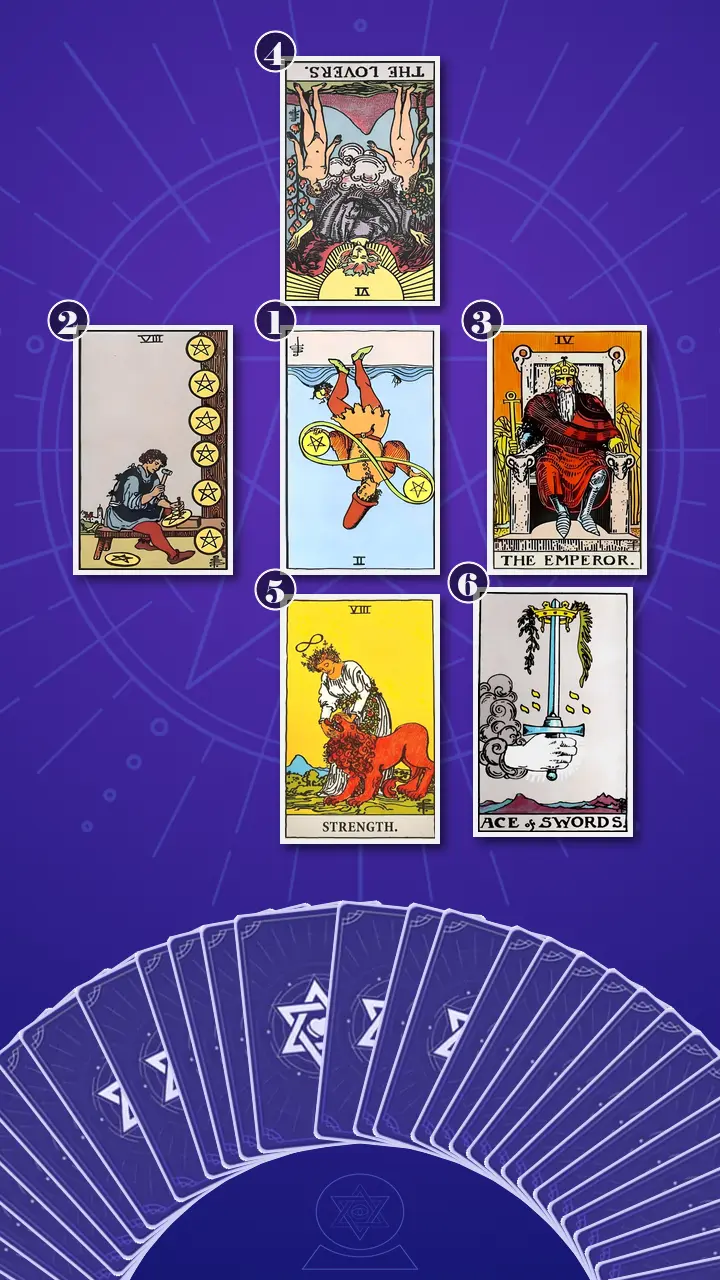
Reading the Map at a Career Crossroads (Card Meanings in Context)
Position 1: The Loop That Looks Like “Being Strategic”
“Now we’re turning over the card that represents your current stuck point and observable decision-fatigue behavior—the juggling loop.”
Two of Pentacles, reversed.
The image is simple: someone trying to keep two coins moving inside an infinity loop, body swaying, sea behind them rough enough to make the ships look like they’re working overtime just to stay upright.
I didn’t have to reach for symbolism; Jordan’s week was already living inside it. “This is you keeping two versions of yourself alive in parallel,” I said, using the card’s modern translation because it fit too precisely. “Two sets of competencies bookmarked, two email drafts saved, two mental calendars—‘manager meetings life’ versus ‘IC deep work life.’ It feels like staying flexible, but it’s draining your focus. And it makes the simplest task—replying to HR—feel like a high-stakes performance.”
Reversed, this energy isn’t balance. It’s blockage through overload: too many variables, too much toggling, not enough landing.
Jordan gave me that unexpected reaction I’ve come to respect: a short, bitter laugh that sounded like relief and accusation at once. “That’s literally me this week,” she said. “It’s… accurate in a way that’s kind of rude.”
I nodded. “Rude, but useful. More tabs won’t create more truth. This card says the bottleneck isn’t information. It’s that your priorities haven’t been named, so your mind keeps spinning the coins to avoid dropping one.”
Position 2: What the IC Track Actually Gives You
“Now we’re turning over the card that represents what the IC track is really offering you in growth, skills, and day-to-day energy.”
Eight of Pentacles, upright.
The craftsman is at a bench, steady hands, a row of pentacles like a visible portfolio. There’s something almost soothing about how unglamorous it is.
“This is the IC path as mastery,” I said. “Clean deliverables. Measurable progress. The quiet confidence that comes from getting genuinely good at a craft. It’s the version of you that feels grounded after you ship a dashboard that changes a decision, or you fix a system nobody else noticed.”
Upright, this card is balance through repetition: disciplined focus, a learning curve you can touch, credibility built from visible work product.
Jordan’s shoulders lowered a fraction—barely, but I saw it. Like some part of her body recognized, “Oh. I know how to do this kind of growth.”
I asked the question I ask when someone’s terrified of the optics: “Which skills would you be excited to practice for six months even if nobody applauded it? Even if LinkedIn stayed quiet?”
She looked at the card, not at me. “I like… shipping,” she said. “I like being able to point to something and say, that’s better now.”
Position 3: What the Manager Track Asks You to Hold
“Now we’re turning over the card that represents what the manager track is really asking of you in responsibility, visibility, and boundaries.”
The Emperor, upright.
The throne is stone. The posture is immovable. There’s armor beneath the robes—protection that isn’t flashy, just necessary.
“This isn’t the ‘boss’ fantasy,” I said. “This is management as container. Setting priorities. Making calls with incomplete info. Giving feedback. Saying no—then living with the consequences. It’s calendar-heavy and more visible, and the visibility isn’t always praise.”
Upright, The Emperor is strength through structure: authority, clear boundaries, a willingness to be decisive when things are ambiguous.
Jordan swallowed, and I noticed her fingers tighten around her phone as if it were an anchor. “I can do it,” she said quickly—too quickly. Then softer: “I just don’t know if I want to be… on display like that.”
“That’s a sober question,” I told her. “Not ‘Am I capable?’ but ‘Do I want to practice power and accountability right now?’ Those are different.”
Position 4: The Hidden Driver—Status Logic vs Values Logic
“Now we’re turning over the card that represents the hidden value conflict or fear pattern keeping you stuck—what you’re optimizing for without admitting it.”
The Lovers, reversed.
Reversed, the card loses harmony. The choice doesn’t feel like alignment; it feels like being pulled apart.
“Here’s the twist,” I said, and kept my voice plain on purpose. “You think you’re choosing IC vs manager. But you’re also choosing between two stories: the impressive story and the sustainable story.”
I gave her the modern, painfully contemporary scene: “It’s updating a LinkedIn headline in your head before you’ve lived the job. It’s picturing what coworkers will say in Slack. It’s checking org charts like they’re scripture. And then this loop starts: ‘If I choose manager, they’ll think I’m ambitious—but what if I struggle?’ ‘If I choose IC, they’ll think I’m avoiding growth.’”
Reversed Lovers is blockage through misalignment: external perception has gotten louder than internal fit.
Jordan’s face did the exact sequence I’ve seen a thousand times in different people: (1) a brief freeze—her breath stopped mid-inhale; (2) her eyes went slightly unfocused, like she was replaying every “Thrilled to announce…” post she’d hate-scrolled; (3) a nervous laugh, this time with a sting. “I hate that you said ‘imagined audience,’” she muttered. “Because yes. That’s it.”
“Status logic is loud,” I said, letting the phrase land. “Values logic is quiet—but consistent.”
And because I’m an archaeologist as much as I’m a tarot reader, my mind went to a familiar pattern: ancient crossroads where traders didn’t get to consult five mentors and a spreadsheet. They made choices based on provisions, season, weather, and what they could realistically carry. They weren’t choosing a whole identity. They were choosing a route that fit the conditions of the next stretch.
“This card is saying the fear isn’t ‘What if the work is hard?’” I added. “It’s ‘What if the title makes me look a certain way, and then I can’t outrun the story?’”
When Strength Spoke: Calming the Lion Instead of Letting It Write the Email
Position 5 (Key Card): The Inner Stance That Makes a Choice Possible
I let my hand hover over the next card for a beat. “We’re turning over the most central card in this reading,” I said. “Not because it decides for you—but because it tells you how to decide without turning it into self-punishment.”
Strength, upright.
The image always gets me: a person not wrestling a lion into submission, but holding it—calm hands, steady presence. The infinity symbol returns, but it’s no longer frantic toggling. It’s mastery.
Setup. I watched Jordan’s eyes flick toward her phone, toward the HR draft, toward the future. She was right back in that familiar 10:43 p.m. moment: rereading the career ladder doc for the third time, LinkedIn open in another tab, hunting for one more signal so the “right” version of herself would finally appear.
Delivery.
Stop trying to wrestle the decision into certainty; start holding your fear gently and choosing from strength—like calming the lion instead of letting it drive the email.
There was a small, clean silence after I said it—like the room itself decided to listen.
Reinforcement. Jordan’s reaction came in layers, not in a movie-moment burst. First her jaw unclenched, almost involuntarily, as if the sentence had given her permission to stop bracing. Then her shoulders dropped—but not in relief exactly. More like surrendering a job she’d been doing without realizing it: trying to be perfectly un-regrettable. Her eyes went glassy for a second, not with tears yet, but with that recognition that stings because it’s true. When she spoke, her voice had a slight tremor.
“But if I’m not certain,” she said, and then she stopped herself—like she could hear her own script. “If I’m not certain, I feel like I’m being irresponsible.”
“That’s the old agreement,” I said quietly. “That responsibility equals certainty. Strength offers a new agreement: responsibility equals steadiness.”
This is where I used what I call Skill Archaeology—my habit of unearthing overlooked talents the way I’d brush dust off a shard at a dig. “Jordan,” I said, “you’ve been measuring yourself by your ability to analyze. But there’s another skill here you’re undercounting: the ability to regulate and lead yourself in discomfort. Strength is evidence that you already have it. It’s not a mood. It’s a practice.”
I gave her a simple reset script, because sometimes language is the first tool you can actually pick up: “I’m allowed to feel unsure. I’m still allowed to choose.”
Her breath came out in a quiet exhale, the kind that doesn’t sound dramatic but changes the pressure in the whole chest. She looked down at the card again, and her face softened as if she’d stopped arguing with herself for a second.
“Now,” I said, “with this new frame—can you think of one moment last week where the jaw-clench started, the chest buzzed, and you tried to research your way back into safety? If Strength had been in the room, what would it have told you to do with your body first?”
She blinked, once, like she was replaying the scene. “Tuesday night,” she said. “I had the draft open. Cursor blinking. And I kept thinking… I’m about to send a sentence that proves who I am.”
“Exactly,” I told her. “This reading is your first step from anxiety-driven analysis paralysis into grounded self-trust. Not ‘never doubting again.’ Just choosing without needing the choice to prove your worth.”
Position 6: The Clean Next Move—One Rule, One Email, One Question
“Now we’re turning over the card that represents a concrete next move—your decision criteria and how to communicate your lean to HR.”
Ace of Swords, upright.
After all that earth and fire—workload, craft, authority, courage—this air felt like opening a window. One blade. One line. No extra ornaments.
“This is the pivot from spiraling to sending,” I said. “A single decision rule. A simple thesis you can put in writing. The crown on the sword is the principle that gets to rule the choice instead of endless comparison.”
I watched Jordan’s eyes sharpen a little, like she could finally see the signal in the noise. That was the Ace of Swords effect: fewer words, more truth.
“Here’s the micro-action scene,” I said, borrowing the contrast her week needed. “Fourteen tabs becomes one note. ‘More research’ becomes ‘one decision rule.’ And then you write the email.”
She let out a half-laugh—lighter this time. “I want to open my inbox right now,” she said, almost annoyed at how ready she suddenly felt.
“Good,” I replied. “Because clarity isn’t a feeling. It’s a sentence you’re willing to send.”
From Insight to Action: A 90-Day Direction You Can Measure
I drew the thread through the whole spread, like stringing artifacts in order on a table so the story becomes undeniable.
“Here’s what the cards say in plain language,” I told Jordan. “You’re exhausted because you’re juggling two identities in midair (Two of Pentacles reversed). The IC track offers you grounded, trackable mastery (Eight of Pentacles). The manager track offers structure and authority, but it demands visibility and boundary-holding as a daily practice (The Emperor). What’s keeping you stuck isn’t a lack of options—it’s the status-versus-values split, the imagined audience, the fear of being ‘found out’ if you commit (The Lovers reversed). Strength is your antidote: lead yourself gently instead of trying to bully yourself into certainty. Then Ace of Swords turns that stance into one clear rule and one clean email.”
“Your blind spot,” I said, “is thinking you need more data to trust yourself. What you actually need is a measurable experiment that lets you gather evidence without shame.”
As an archaeologist, I can’t help but think in verification methods. “When I authenticate a relic,” I said, “I don’t stare at it until certainty appears. I look for provenance, wear patterns, context—signals that can be checked. Careers are similar: you don’t need a perfect prophecy. You need a way to test what holds up.”
Then I brought in my most practical strategy—what I call Megalith Transport. “Ancient builders didn’t move a stone by arguing about the perfect route,” I said. “They broke the impossible into steps small enough to repeat.”
“So we’re going to do the same. Small, structured steps. No heroics.”
- The 10-Minute Three-Criteria DraftSet a 10-minute timer. In a blank phone note, write: (1) “My top 3 criteria for the next 90 days are: ___, ___, ___.” (2) Define each in one sentence (e.g., “Autonomy = I can own projects end-to-end without constant meetings”).If your chest starts buzzing or your jaw tightens, drop your shoulders and take three slow breaths. You’re allowed to pause. You are not allowed to add a 4th criterion today.
- Status-vs-Values Reality Check (Two Micro-Memos)Draft two short paragraphs: (A) “If nobody could see my title, I would choose ___ because ___.” (B) “If I’m honest about my energy, I need ___.” Use only paragraph B to decide.Expect your brain to protest, “This is too simplistic.” That’s the old pattern buying time. Keep it in Notes, not a 40-column spreadsheet.
- The Ace of Swords Email: Four Sentences, One QuestionSend HR a clean reply: (1) Thank you for the options. (2) My top priorities for the next 90 days are X and Y. (3) Based on that, I’m leaning toward IC/manager. (4) The one thing I’d like to confirm is ___. Then ask one high-leverage question: “How is success measured in the first 90 days for this transfer?”If you feel the urge to add five caveats (“I could go either way…”), replace them with one honest line: “This is my current lean based on my priorities.” Clear doesn’t mean arrogant.

A Week Later: Ownership, Not Certainty
Six days later, I got a message from Jordan while I was making tea—an old habit from long days in libraries and even longer days in the field.
“Sent it,” she wrote. “Four sentences. One question. I didn’t apologize.”
Then, a second text: “I slept the whole night. First thought this morning was still ‘What if I’m wrong?’ But it didn’t hit like a truck. It was just… a thought. And I went to work anyway.”
That’s what a real Journey to Clarity often looks like: not fireworks, but a looseness in the jaw; a quieter chest; a decision you can name without punishing yourself for making it.
When two “great on paper” options show up, it can feel like your whole credibility is on trial—and your body starts treating one email reply like a lifetime verdict on whether you’re actually competent.
If you let this be a 90-day experiment instead of an identity sentence, what’s the smallest criterion you’d trust yourself to choose by—today, not forever?