From Expires-Today Pressure to Written Boundaries: Retainer or Freelance

The “Expires Today” Email at a King West Desk
You’ve reread the same retainer PDF three times today, drafted a reply twice, and still haven’t hit send because the email says “expires today” and your brain goes full Deadline Doom Spiral.
Alex (name changed for privacy) appeared on my screen from a Toronto coworking space near King West, shoulders slightly hunched like they were bracing against weather only they could feel. Behind them, the day-pass crowd had thinned; the fluorescent lights did that relentless office-hum thing, and a Slack ping landed every few minutes like a tiny jab. Their coffee had gone lukewarm in that way that tastes like giving up halfway.
They angled their laptop so I could see the setup they were embarrassed by: contract PDF on one monitor, a Google Sheet budget on the other, and a Gmail draft that began with “Hi—thanks so much…” The cursor blinked like a metronome. Their jaw looked locked, and one leg bounced so steadily it was basically its own soundtrack.
“I want stable money,” they said, voice tight but controlled, “but I don’t want to feel owned. It’s twelve months. That’s… a whole year. If I say yes, I’m scared I’ll resent it. If I say no, I’m scared I’ll regret it.”
I watched their eyes flick to the top of the email where the deadline lived—expires today—and then away, like it was too bright to stare at directly. The pressure in the room wasn’t loud; it was buzzy, like a phone vibrating against your palm with no way to silence it.
“You want stability,” I said gently, “but the moment you reach for it, it starts to feel like a cage. And you want freedom, but the moment you picture it, it starts to feel like falling.”
Alex let out a sharp breath through their nose—almost a laugh, almost a flinch. “Yeah. And I keep telling myself, I just need one more piece of info and then I’ll know.”
“Okay,” I said, the way I used to speak to anxious travelers on long ocean crossings when a storm was forecast and everyone wanted certainty I couldn’t promise. “Let’s not chase certainty tonight. Let’s make a map. We’re going on a Journey to Clarity—something you can actually use today.”

Choosing the Compass: The Decision Cross · Context Edition
I asked Alex to take one slow breath—not as a mystical thing, just a nervous-system handbrake—and to hold the question in plain language: Retainer offer expires today—commit 12 months or stay freelance?
On my side of the call, the canal outside my Venice apartment made its soft, liquid hush against stone. I shuffled slowly, the way I do when I’m trying to help someone’s mind stop sprinting. “This isn’t about fate,” I told them. “It’s about clarity—what you can see, name, and put into words.”
“We’ll use a spread I designed for moments exactly like this,” I said. “It’s called the Decision Cross · Context Edition.”
For a same-day deadline, a big spread can turn into more noise. This one keeps the card count tight on purpose: it shows the current pressure loop, lays out the lived reality of each option (retainer vs freelance), reveals the hidden fear that makes the deadline feel like a trap, and then anchors you in one grounded move you can take tonight—an accept, a decline, or a counteroffer with boundaries.
I previewed the map the way I would for a client who needs structure before they can relax: “Card 1 is what’s happening right now—your stuck loop. Card 2 is the retainer path: what it offers, what it asks. Card 3 is freelance: what it gives, what it demands. Card 4 is the hidden driver—what’s tightening the decision. And Card 5 is your decision support: the most grounded next step you can take today.”
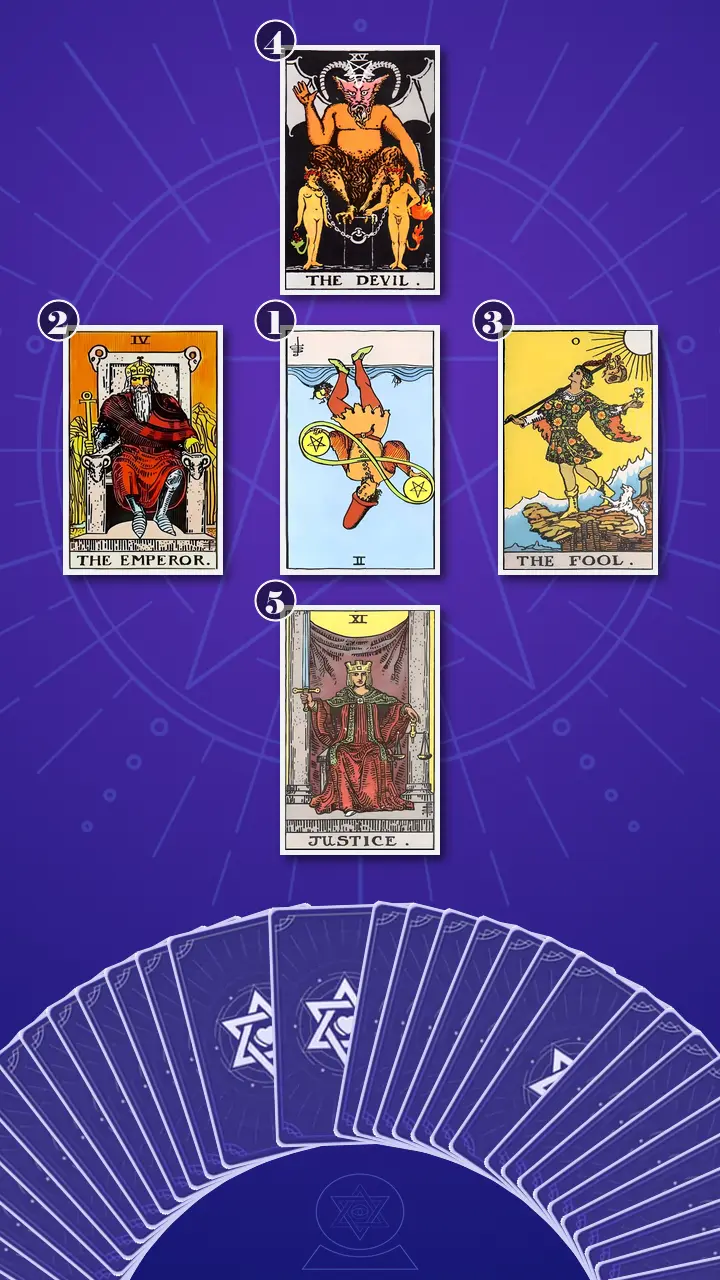
Reading the Map: Tarot for a Contract Decision Under a Deadline
Position 1: The Current Stuck Point — Two of Pentacles (reversed)
“Now we flip the card that represents the current stuck point: the specific behavior loop and pressure response happening right now,” I said.
Two of Pentacles, reversed.
The image landed like a screenshot of Alex’s desktop. “This is you at the coworking desk,” I said, “with the contract PDF open, the budget spreadsheet full of scenarios, and an email draft you keep tweaking. You bounce between tabs like juggling is the decision. The deadline makes you speed up, and the speed makes you drop the one thing that matters: choosing a priority and sending a clear reply.”
Reversed, this isn’t ‘balance’—it’s overload. The energy isn’t missing effort; it’s missing landing. It’s Earth energy spinning so fast it turns into instability. You can feel productive while your confidence quietly drains.
I narrated it as a jump-cut, because that’s how it lives in the body: “Contract PDF → Google Sheets → LinkedIn → back to the email draft. And every loop has the same thought: If I just check one more thing… Then two minutes later: Why do I feel worse?”
Alex stared at the card, then did the exact thing my clients do when they feel seen too accurately: their lips twitched into a small, bitter smile. They exhaled hard, and a short laugh escaped. “Yep,” they said, almost wincing. “That’s exactly what I’m doing. It’s kind of… brutal.”
“Not brutal,” I corrected softly. “Specific. There’s a difference. And the specificity is good news, because loops can be interrupted.”
This is where my Jungian training always steps in: when someone is caught in compulsive ‘research,’ it’s often not curiosity—it’s avoidance wearing a responsible outfit. In my own language, I call it Procrastination Decoding: trigger → avoid → self-blame. The trigger is the email line expires today. The avoidance is one more tab, one more rewrite. The self-blame shows up as, “Why can’t I just decide like a normal adult?”
Alex’s fingers pinched the bridge of their nose, then released. Their shoulders didn’t relax yet—but the spell had cracked. Naming the loop without shaming it is the first inch of traction.
Position 2: Path A (12-month retainer) — The Emperor (upright)
“Now we look at Path A: the 12-month retainer—what it offers and what it asks of you day-to-day,” I said.
The Emperor, upright.
“The Emperor is structure,” I told them. “A defined scope, steady monthly income, fewer daily decisions. A calendar you can plan. Less pitching, less invoicing panic, fewer ‘am I booked enough?’ mornings.”
But The Emperor also asks you to live inside a container. Not a vibe. A container. Recurring deadlines. Predictable availability windows. The maturity to say, “That’s out of scope,” without apologizing like you’re confessing to a crime.
“A retainer isn’t a cage—unless the boundaries are missing,” I added, and I saw Alex’s body react to both halves of that sentence: their shoulders lowered at the thought of steady deposits, then their chest tightened at the words twelve months.
They nodded anyway—mixed feelings, visible. “It sounds… calming. And also like I disappear.”
“That’s the fear talking in absolutes,” I said. “The Emperor isn’t asking you to disappear. He’s asking you to define the rules so you don’t get swallowed by unspoken expectations.”
Position 3: Path B (stay freelance) — The Fool (upright)
“Now we open Path B: staying freelance—what it offers and what it demands emotionally and practically,” I said.
The Fool, upright.
“This is the part of you that wants air,” I said. “Variety. Creative control. The ability to pivot fast. It’s the version of you that remembers you’ve survived uncertain months before—and even grown from them.”
But The Fool is honest: the cliff edge is real. It asks for tolerance of uncertainty. And practically, it asks you to build a safety net on purpose—pipeline habits, savings rules, a consistent outreach block—rather than hoping motivation shows up like a rescue boat.
“Freedom feels better when it has a safety net you actually use,” I said, and Alex’s eyes brightened for a split second—then immediately flickered with the familiar but what if.
They swallowed. “Freedom feels like air,” they admitted. “And then it instantly feels like falling. Like I’m one slow month away from disaster.”
“Exactly,” I said. “The Fool isn’t reckless. The Fool is willing to learn by doing. But your nervous system wants guarantees, and freelancing doesn’t offer them.”
Position 4: Hidden Driver — The Devil (upright)
“Now we look at the hidden driver: the fear, attachment, or assumption intensifying the deadline and narrowing your perceived choices,” I said.
The Devil, upright.
The room seemed to get quieter on Alex’s end—like even the coworking hum backed off for a second. Their leg kept bouncing, but slower now, as if their body was listening despite itself.
“This is the moment,” I said, “when the deadline email stops being information and starts being a chain.”
The Devil doesn’t mean you’re doomed. It means your mind is telling what I call chain stories—narratives that tighten the moment you believe them.
“Here are the scripts I hear,” I said, and I spoke them plainly, like we were reading a draft aloud so it couldn’t hide in the margins: “The retainer is the only adult move. And: Freelance is the only authentic move.”
Alex’s breath caught—just for a beat. Their eyes went unfocused, like they were replaying the last two hours of tab-juggling in fast-forward. Then their mouth pressed into a line that wasn’t anger exactly; it was the uncomfortable recognition of being called out by their own mind.
“Urgency can turn a decision into a chain story,” I said. “And The Devil’s detail that matters most?” I tapped the card gently. “The chains are loose. That means the ‘trap’ feeling is real, but it’s not always the same as the actual terms on the page. Choices still exist: negotiate scope, propose a shorter term, ask for an exit clause, set a calendar boundary. Panic calls itself realism. But realism can still breathe.”
Alex’s shoulders rose, then dropped. A quiet, reluctant nod. “I hate that this is true,” they whispered. “Because it means I’m… doing it to myself.”
“It means your nervous system is trying to protect you,” I corrected. “And it picked a strategy that worked in the short term: more checking, more drafting, more control. But it’s costing you clarity.”
Position 5 (Key Card): Decision Support — Justice (upright)
I slowed my hands before turning the last card. “This is the anchor,” I said. “The card that turns all of this into a next step you can actually take tonight.”
Justice, upright.
“Justice is scales and a sword,” I said. “Criteria and clean communication. Not vibes. Not proving you’re the ‘right’ kind of freelancer. Just: what is fair, sustainable, and something you can stand behind—on paper and in your body.”
And here, my own history always flashes—Venice taught me trade isn’t romantic; it’s agreements, routes, timing, weather. I used to train cruise staff to read energy shifts the way you read sea changes: not to predict, but to respond well. Justice feels like that. Calm. Adult. Precise.
I brought in my Choice X-Ray the way I naturally do when someone is stuck between two attractive pains. “Let’s X-ray this choice,” I said. “Not ‘retainer versus freelance’ as identities—retainer versus freelance as terms. Hidden costs and hidden benefits show up when we look in three dimensions: money, time, autonomy. You don’t need a perfect future. You need standards.”
Setup. I could see Alex right back in the familiar moment: late, half-empty coworking space, toggling between the contract PDF, the budget spreadsheet, and a half-written email—trying to find the one perfect answer before the “expires today” clock wins. Their jaw clenched harder when they imagined “12 months,” as if their body thought a signature was a handcuff.
Stop trying to outrun uncertainty and start using the scales and sword: weigh by your real non-negotiables, then communicate one clean decision.
There was a pause—actual silence. Even the fluorescent hum seemed to thin out through the laptop speakers.
Reinforcement. Alex went through a three-step reaction chain so clean I could almost timestamp it: first, a brief freeze—breath held, shoulders pinned. Then the cognitive shift—eyes drifting off the screen, like they were watching their own spiral from above for the first time. And then the release—air leaving their chest in a shaky exhale, jaw unclenching millimeter by millimeter as if it had been gripping a secret for hours.
“But… if I don’t have certainty,” they said, voice quieter, “how do I know I won’t hate myself later?” The question came with a flash of anger, not at me—at the whole situation. At being forced to choose. At the idea that adulthood is just contracts and consequences.
“You won’t get certainty,” I said, steady. “But you can get self-respect. And self-respect is a structure you can return to.” I watched their eyes glisten—not tears, not yet; the beginning of them. “Clarity isn’t the moment you eliminate uncertainty—it’s the moment you can name your standards and put them in writing.”
I leaned closer to the camera. “Now—use this new lens and look back at last week. Was there a moment you could’ve responded differently if you’d had standards instead of panic? A moment where one clean boundary would’ve saved you two hours of spiraling?”
Alex blinked, twice. “Yeah,” they said. “Yesterday. I rewrote the email like ten times because I didn’t want to sound ‘difficult.’ I could’ve just asked about scope.”
“That,” I said, “is your first step out of deadline-driven commitment paralysis and into values-based clarity—written boundaries, steadier self-trust. This is the shift: Move from “I must choose the perfect path today” to “I’ll choose the path that matches my values and set boundaries in writing.””
The One-Paragraph Reply: Actionable Advice You Can Send Tonight
I gathered the whole spread into one simple story, the way I would for a traveler who needs the route more than the weather report.
“Here’s what happened,” I said. “Two of Pentacles reversed is the infinity-tab loop—overwhelm masquerading as responsibility. Then you split into two archetypes: The Emperor offers a container (and asks for boundaries), The Fool offers openness (and asks for a safety net). The Devil shows the hidden pressure: a chain story makes the deadline feel like captivity, so you try to research your way into certainty. Justice is the antidote: standards in writing and one clean message. Not panic. Terms.”
“Your cognitive blind spot,” I added, “is treating ‘commit’ like it’s irreversible. That’s the Devil talking. In real business life—especially freelance—agreements can be designed. This is where my old Venetian instinct kicks in: merchants never bought ‘a year of risk’ without specifying the route, the cargo, and the exit when the weather turned. That’s not pessimism. That’s craft.”
“So we’re going to make your email a dock,” I said, introducing the strategy I use when time pressure is the whole problem. “I call it the Port Decision Model: you don’t have to sail the whole ocean tonight. You choose where to dock, for how long, under what conditions—and you put it in writing.”
The Justice Rubric: Money floor / Time boundary / Autonomy boundary
“Your inbox is loud,” I told Alex, “but your standards can be simple.”
- Do the 10-minute Justice DraftSet a 10-minute timer. Write three lines: Money floor / Time boundary / Autonomy boundary. Under each, write one number or rule you can live with (example: “$X/month minimum,” “max Y hours/week,” “no weekend deadlines”). Then choose your “today move”: YES, NO, or COUNTER—only one.If your brain starts bargaining, don’t negotiate with it. Let the timer end and stop. Clarity doesn’t require suffering.
- Send one clean question or one boundary-first counterofferWrite a single sentence that turns panic into terms. Example question: “To make this sustainable, can we confirm scope and expected weekly hours?” Example counter: “I can commit for 6 months with a renewal option,” or “12 months works with a 30-day exit clause.” Add one boundary in writing: meeting frequency, response time expectations, or out-of-scope rate.If you’re afraid of sounding demanding, keep the tone neutral. One paragraph beats ten perfect drafts.
- Reality-test the choice with a calendar proof-of-lifeBefore you hit send, open your calendar and schedule one 30-minute block tomorrow that matches the path you’re choosing. If it’s the retainer: a block labeled “Retainer Scope + Boundaries.” If it’s freelance: a block labeled “Pipeline (2 outreach emails).”This is my Reality Testing rule: if the plan can’t survive 30 minutes on your calendar, it won’t survive 12 months in your life.
I also gave Alex one final guardrail—what I call a Sunk Cost Alert. “If you catch yourself thinking, ‘I’ve already spent three hours on this, so I need the perfect email,’ that’s a trap,” I said. “Time spent spiraling doesn’t need to be justified. The only thing you need to ‘earn’ is a clean next step.”

A Week Later: The Quiet Proof of Finding Clarity
Seven days later, Alex sent me a message that was almost aggressively simple: “I did the rubric. I sent one question about scope and added a 30-day exit clause request. They said yes. Also—I didn’t apologize.”
They added, as an afterthought: “I slept through the night for the first time in a while. This morning my first thought was still, ‘What if I’m wrong?’—but it didn’t land like a punch. It landed like a question I could handle.”
I reread that line and thought about how often people confuse clarity with certainty. On ships, on canals, in boardrooms, in coworking spaces—certainty is rare. But standards? Standards are buildable.
That was the real Journey to Clarity: not choosing the path that guarantees happiness, but choosing the path you can respect because you protected something real in writing—your time, your energy, your autonomy.
When a deadline hits, it can feel like you’re choosing between being safe and being yourself—and your body reacts like whichever option you pick will trap you for a whole year.
If you let your next email be less about proving you chose the “right” path and more about protecting one real boundary, what would you put in writing today?