From Hovering Over the Deposit Link to Self-Trust: A 20-Minute Shift

The 10:47 p.m. Monzo-and-WhatsApp Loop
If you’re a late-20s London renter with a WhatsApp group chat popping off and a trip deposit due tonight, and you keep bouncing between Monzo and the payment link like it’s a ‘Sunday Scaries’ decision—even on a Tuesday.
Jordan came onto our call with her laptop angled toward the sofa cushion, the deposit page glowing like a tiny stage spotlight. I could hear the radiator in her flat clicking in uneven bursts—one of those London sounds that makes the whole room feel like it’s holding its breath. Her phone kept vibrating against the fabric beside her, screen flashing WhatsApp previews: “OMG can’t wait”, “Payment link!!”, a countdown emoji that hit like a dare.
She didn’t say hello so much as exhale. “It’s due tonight,” she said, jaw set like she was trying to physically clamp the decision into place. “I keep reopening it. I keep doing the maths. And I don’t even know if I want the trip or I just want to not be left out.”
I watched her hands—restless, quick, hovering between keyboard and phone like a pianist who can’t find the first note. The anxiety wasn’t an abstract feeling; it was a buzzing in her chest that spiked with every notification, a tightness at the hinge of her jaw, the strange heat of a screen in your palm at midnight when you know you should be asleep.
“It’s not the money,” I said gently, because I could hear her trying not to sound “dramatic.” “It’s what the money means in the group.”
She gave a short, guilty laugh. “Exactly. If I say no, it feels like I’m saying no to the friendship.”
“Then let’s not treat this like a personality verdict,” I told her. “Let’s treat it like a decision that deserves clarity. We’re going to make you a map you can actually use tonight.”

Choosing the Compass: The Decision Cross Spread
I asked Jordan for three slow breaths—not as theatre, not as mysticism, just as a practical handbrake for a nervous system that’s been sprinting in place. Then I shuffled while she held the question in her mind: Trip deposit due tonight—pay it, or bow out of FOMO?
For a time-sensitive yes-or-no like this, I use a spread called the Decision Cross. It’s one of the clearest ways to work with tarot when the problem isn’t “lack of information,” but too much emotional weather. The cross structure holds the pressure at the centre, sets the two paths side-by-side, lifts us toward a guiding principle, and then forces the reading to land in a single action you can complete tonight.
If you’ve ever wondered how tarot works in real life, this is a good example: it doesn’t magically remove the deadline. It makes the deadline legible. It shows you what you’re actually negotiating—belonging vs stability—and it gives you an actionable next step instead of another spiral.
Here’s what I told Jordan to expect before I turned the first card: the centre card would show the current loop making this feel like an emergency; the left and right cards would show what each path truly offers; the card above would be her inner compass (the “Justice” kind of clarity people search for when they type Justice tarot meaning for decision making); and the final card would be the landing step to close the tabs in her mind.
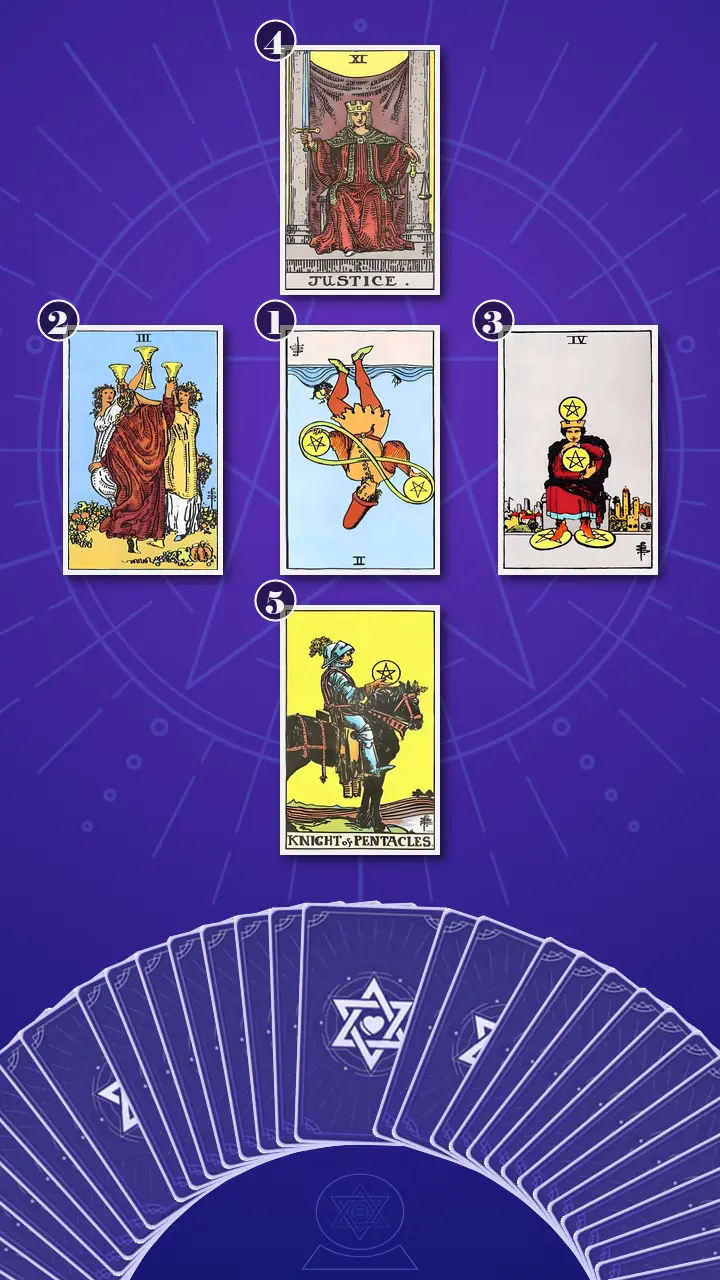
Reading the Fork in the Road
Position 1 — The current pressure point: the indecision loop
“Now flipped,” I said, “is the card that represents the current pressure point: the observable indecision loop and what’s making the deadline feel emotionally urgent.”
Two of Pentacles, reversed.
Jordan’s eyes darted to the card and back to her phone as it buzzed again, like the universe had decided to add sound effects. I didn’t need to reach for anything abstract; this one translates almost too easily into modern life.
“This is 11 p.m. you,” I said. “Deposit link → bank balance → group chat → Instagram Stories → deposit link. You’re not deciding—you’re keeping both futures alive so you don’t have to feel the discomfort of choosing. The more you juggle, the more urgent it feels, even though the numbers haven’t changed.”
I named the energy plainly: reversed, the Two of Pentacles isn’t ‘balance’—it’s overwhelm. Too many tabs open. Too many micro-checks. The nervous system treats each refresh like a wave hitting the side of a small boat.
Jordan’s reaction came in a small chain, so quick most people would miss it: first her breath caught, like a brief freeze; then her gaze went slightly unfocused, as if replaying the last hour; then she let out a knowing exhale that turned into a bitter little laugh.
“Yep,” she said. “That’s literally what I’m doing. It’s… honestly kind of brutal hearing it out loud.”
“Brutal,” I agreed, “but not shameful. This is a common pattern when money meets belonging. FOMO makes money feel like a membership fee. And the Two of Pentacles reversed is the membership-fee panic: ‘Pay fast or lose your place.’”
I added a quiet warning, because the reversal has a trap: “If you get sick of feeling stretched, you might overcorrect—swing into rigid control, or send a harsh defensive message that makes you look withdrawn. The antidote isn’t a harder personality. It’s one clean constraint.”
Position 2 — Path A (pay): what “yes” is really offering
“Now flipped,” I said, “is the card for Path A: pay the deposit—what you’re truly hoping to gain emotionally and socially by saying yes.”
Three of Cups, upright.
I watched Jordan’s face soften in spite of herself—like her body recognised the picture before her brain could argue with it.
“This card is honest,” I told her. “The ‘yes’ path isn’t just aesthetics. It’s the real pull of being part of the circle: late-night laughs in a cramped Airbnb kitchen at 1:12 a.m. with cheap wine and inside jokes. It’s the warmth of being included without having to ask.”
Then I asked the question the Three of Cups always asks when Instagram is involved: “If nobody could post about this trip—no Stories, no countdown sticker—would you still want it? Would it still feel like your joy, not just your proof?”
Jordan nodded slowly. “I… I do want the closeness. I want to be there when the jokes happen. That part feels real.”
“Good,” I said. “You’re not shallow for wanting that.”
Position 3 — Path B (bow out): what “no” protects
“Now flipped is the card for Path B: bow out—what you protect or reclaim by saying no, and what boundary this choice could serve.”
Four of Pentacles, upright.
“This is the part of you that wants to put your finances on Do Not Disturb,” I said, careful with my tone. “Not because you’re boring. Because you’re tired of the cycle where you say yes at 11:58 and then punish yourself for a week.”
Upright, the Four of Pentacles can be healthy: it’s stability, limits, self-protection. The energy is containment—the ability to hold your resources without leaking them to soothe social pressure.
But I pointed at the risk in the image—coin held tight to the chest, posture locked. “This card also warns: protection can harden into isolation if it’s fear-led. If you bow out, the real skill is saying no without turning it into a shame story, without muting the chat and disappearing.”
Jordan swallowed. “That’s what I’m scared of,” she said. “I don’t want to be the person who always opts out. But I also don’t want to keep recovering from impulsive spending with shame.”
“You’re naming the real crossroads,” I said. “Not ‘fun friend’ vs ‘responsible friend.’ It’s intimacy vs boundary, fun-now vs future-you.”
When Justice Held the Scales
Position 4 — The decision compass: the fairest principle
I let the room go quiet on purpose. Even through a screen, you can feel when someone is ready for the centre of the reading—when the noise has finally tired itself out.
“Now flipped,” I said, “is the card for the decision compass: the fairest, most self-respecting principle to use when the group vibe and finances pull you in opposite directions.”
Justice, upright.
Justice is one of those cards people fear because they think it’s here to sentence them. It isn’t. It’s here to stop you from turning your life into a courtroom where the evidence is other people’s reactions.
“Scales,” I said, “are cost vs value in plain language. The sword is one clear message that cuts off the spiral.”
Jordan stared at the card a little too hard, like she wanted it to blink first. “So what do I do?” she asked, and then—almost resentful—“Because this feels like a test.”
That resistance mattered. When people hit Justice, they sometimes flinch not from the answer, but from the implication that they can choose without external permission. Jordan’s shoulders rose half an inch, as if bracing for me to tell her what a ‘good’ person would do.
I drew on my own way of thinking—what I privately call Historical Case Matching. I’ve spent decades studying moments when societies stood at crossroads: fund the voyage or shore up the walls, host the festival or save grain for winter. In ruins, you can see the cost of decisions made to impress the crowd rather than serve the long-term life of the city.
“Here’s the thing,” I said, leaning in. “In every civilisation I’ve studied, the decline doesn’t start with one big ‘wrong’ choice. It starts when leaders can’t tell the difference between signal and noise—when they react to social pressure as if it’s truth. Justice is your signal.”
To make it concrete, I asked her to literalise the symbol. “Put two sticky notes on your coffee table,” I said. “Write Belonging on one and Stability on the other. And notice how you’ve been moving your phone between them like it’s a bargaining chip.”
I could hear her do it—the soft rip of paper, the tap of the pen on the table. “Okay,” she said, quieter. “They’re there.”
Then I gave her the principle that Justice demands, the kind that doesn’t require a committee vote: “A fair decision is one you don’t have to defend at 9 a.m. tomorrow.”
And then I slowed down, because this was the turning point.
Setup: It’s late, the payment link is open again, your bank app is open again, and the group chat is doing that ‘OMG can’t wait’ thing. Your thumb keeps hovering—like you’re trying to buy certainty before midnight, not just a trip.
Stop treating the deposit like a vote on your likability, and start weighing it with clear scales—then cut one path clean with the sword of Justice.
For a moment, Jordan went very still—like the sentence had reached her body before it reached her pride. First came that tiny physiological freeze: her mouth parted slightly, breath paused. Then her eyes shifted away from the camera to the sticky notes, pupils widening a fraction as if the words had turned into a picture she couldn’t unsee. Then her shoulders dropped, not dramatically, but enough to change the whole shape of her on the sofa. Her hands—those restless, buzzing hands—stopped hovering and rested flat on her thighs.
“But if I cut one path,” she said, voice smaller, “then I have to accept it. Like… really accept it. No keeping the option warm.”
“Yes,” I said, and kept my tone kind. “And that’s why it feels like a threat. But it’s also why it’s relief. Closure isn’t cold. It’s kind.”
Her eyes shone in that particular way people get when they’re not crying, but they’re close to it—more like the nervous system releasing a pressure valve than sadness. She rubbed the side of her jaw as if she’d just realised she’d been clenching for hours.
“Okay,” she whispered. “Okay. I hate that it’s true.”
I asked the question that anchors the insight into real life: “Now, using this new lens—can you think of a moment last week when you felt that same buzzing pressure? A time you almost paid for certainty?”
She nodded immediately. “A work thing,” she said. “I bought drinks after a client meeting I didn’t even want to stay for, because I didn’t want to seem… difficult. I resented it the next day.”
“That’s the pattern,” I said. “And what we’re doing right now is the shift: from FOMO-driven decision paralysis and reassurance-seeking to values-based clarity and clean follow-through. Not perfect certainty. Clean clarity.”
Position 5 — Tonight’s landing step: close the loop
“Now flipped,” I said, “is the card for tonight’s landing step: the most grounded, actionable way to close the loop—pay or decline—without reopening the spiral.”
Knight of Pentacles, upright.
I smiled, because this is one of my favourite endings for a deadline situation. “This is the ‘no drama’ card,” I said. “A simple checklist. Decide, do the one task, then move on with your night.”
The Knight’s energy is steady follow-through—Earth returning to health after the Two of Pentacles reversed scatter. “Whichever choice you make,” I told her, “the win is that you commit and handle the details calmly. Tonight isn’t about proving you’re fun or disciplined. It’s about being reliable to yourself.”
I felt my own professional reflex kick in—what I call Long-Term Value Assessment. Archaeology teaches you that what lasts is rarely what’s loudest in the moment. The Knight of Pentacles isn’t glamorous, but it’s the energy that keeps a life from collapsing under the weight of constant ‘urgent’ decisions.
“Decide once,” I said. “Do one thing. Then let your nervous system stand down.”
The One-Page Fairness Test (and a Text You Can Send Tonight)
I pulled the reading together for Jordan the way I would explain a site report: what’s happening on the surface, what layer beneath is driving it, and what intervention actually stabilises the structure.
“Here’s the story the spread tells,” I said. “You’re stuck in a loop (Two of Pentacles reversed) where you keep both outcomes alive to avoid the sting of choosing. The ‘yes’ path is a real desire for closeness and shared memories (Three of Cups). The ‘no’ path is a real need for safety and financial self-respect (Four of Pentacles). The mistake is turning it into a moral trial—‘good friend’ vs ‘boring friend.’ Justice says: weigh the trade-offs fairly, then cut one path clean. And the Knight says: follow through once, calmly, tonight.”
“Your cognitive blind spot,” I added, “is believing that a clear boundary will automatically mean social loss. That’s the fear talking, not evidence. The transformation direction is exactly what you named: from ‘I have to buy my way into the moment’ to ‘I make one values-based decision and communicate it clearly.’”
Then I offered her a method drawn from my own tool kit—my Time Stratigraphy Method. “Think like an archaeologist,” I said. “Tonight’s impulses are the topsoil—loud, fresh, emotional. Underneath are older layers: your rent reality, your long-term goals, your actual capacity for stress. We’re not judging the top layer. We’re separating it from what lasts.”
And because Jordan needed something she could do in minutes—not an essay—I gave her the smallest actionable steps.
- One-Number Yes BudgetOpen Monzo/Starling and write one number: the maximum you can pay tonight (deposit + essentials) without next-week panic. No spreadsheets, no “girl math,” no extra tabs—one constraint.If your brain tries to turn this into a dissertation, tell it: “One number is enough for tonight.” Set a 20-minute timer so the loop can’t drag on.
- Two-Column Truth List (Costs vs Gives)In Notes, write two headers: Costs me and Gives me. Add 3 bullets under each (money, time, stress, energy, closeness). Underline the one cost you’d resent most and the one benefit you’d miss most.If you feel your chest buzz or your jaw clench, pause for three slow breaths. Only continue when it feels safe to hit send—clarity doesn’t require self-force.
- One-Sentence Boundary TextChoose one clean sentence and send it: “I’m in—paid tonight,” or “I’m out this time—can’t swing it, but I’d love a dinner when you’re back.” Then close every tab except the one you need to complete the action.Short doesn’t mean cold. It means boundaried. If you’re tempted to write an apology essay, delete everything after the first full stop.
I offered one more framework—my Voyage Log Technique, because it pairs perfectly with the Knight of Pentacles. “Ancient navigators didn’t wait for perfect weather,” I said. “They logged their heading and made one adjustment at a time. If you go, make a three-line log: deposit paid, remaining budget, one cost-cutting swap you won’t resent. If you don’t go, log your alternative: one concrete plan within seven days. That’s how you stay connected without buying belonging.”

A Week Later: The Quiet Proof
Six days later, Jordan messaged me at 8:14 a.m. on a grey London morning: “I didn’t go. I sent the one sentence. And I suggested a Sunday roast next week. Nobody was mad. I slept. I can’t believe I slept.”
She added, almost as an afterthought: “I watched their Stories for like thirty seconds and felt that little sting… but it didn’t turn into a spiral. I just thought, ‘I made a fair call.’”
That’s what I mean when I say clarity isn’t a thunderbolt. It’s the nervous system standing down because the decision is clean enough to live with—because you stopped outsourcing the verdict, weighed the trade honestly, and followed through like the steady Knight.
When the payment deadline is ticking, it can feel like you’re not choosing a trip—you’re choosing whether you still get to be ‘in,’ and your body reacts like belonging is something you have to purchase before it sells out.
If you didn’t have to buy your way into the moment, what would a fair ‘yes’ or ‘no’—one you can respect tomorrow morning—sound like in a single sentence?