From Counteroffer Paralysis to Clean Commitment: Writing the Reply

Finding Clarity in the 8:47 p.m. Two-Tab Reflex
If you’ve refreshed your inbox so many times today that your phone is warm, and you still haven’t replied because counteroffer paralysis has you stuck between money vs meaning… you’re not alone.
Jordan (29, Toronto, mid-level PM on a tech-adjacent team) showed up to our session with that exact heat-in-the-palm restlessness. They described it like a reflex they couldn’t turn off: condo living room near King West, laptop fan whirring like it’s mildly annoyed at them, blue light making the room feel sharper than it needs to be. Two tabs side-by-side—counteroffer PDF on the left, new role offer email on the right—toggle, toggle, toggle, like switching could become a decision.
They said, quietly, like they were admitting a secret: “I keep rewriting the reply email. Draft #7. Same sentence, different tone. I hover over ‘Send’ and my jaw just… locks.”
I watched their throat move as they swallowed, the way their shoulders stayed a little too high even when they tried to sound casual. Pressure doesn’t always announce itself as panic. Sometimes it’s a held breath that turns your whole body into a bracket around one unread message.
“It feels like if I choose wrong, I’m going to lose years fixing it,” they added. “The raise feels validating, but the new role feels like movement.”
The contradiction was the engine of everything: torn between staying for the raise and taking the new role—while believing one email reply would slam a door and lock their identity into place.
The way Jordan described it, I could practically see their nervous system gripping the steering wheel with white knuckles, trying to keep control by refusing to pick a lane. That kind of pressure is like trying to keep a planet from moving: you can tense your muscles all you want, but gravity still exists.
I leaned in, not to push them, but to meet them. “We can work with this,” I said. “Not by forcing a ‘right answer’—but by getting you out of the loop and into something you can stand behind. Let’s make a map through the fog. We’re here to find clarity, not a consequence-free fantasy.”
Choosing the Compass: A Decision Cross Tarot Spread for a Career Fork
I asked Jordan to put both offer tabs away for thirty seconds—not to be dramatic, just to give their brain a clean break. “Before we touch the cards,” I said, “I want to steady your body. Three minutes.”
It’s one of my go-to practices—what I call a pre-meeting 3-minute cosmic breathing. Not mystical. Just a reset: inhale like you’re widening your ribs, exhale like you’re unclenching your jaw. The kind of breath you’d take before stepping into a meeting that matters.
As a planetarium guide in Tokyo, I’ve spent a decade narrating celestial motion to people sitting in the dark, waiting for a picture to form overhead. The thing about orbit paths is: they look chaotic up close. But zoom out, add time, and suddenly you can see the shape. Tarot works similarly when you use it as a structure for attention.
“Today,” I told Jordan (and, honestly, anyone reading this who’s stuck at a career crossroads), “we’ll use a classic spread called the Decision Cross.”
This spread fits a counteroffer vs new job decision because it separates the two paths cleanly: one card for your current decision-lock, one for what staying truly offers, one for what leaving truly asks, then a single clarifying principle to break the analysis loop, and finally an integration card that turns insight into boundaries and next steps. No fate language. No guarantees. Just clarity and usable leverage.
I previewed the map out loud: “The first card shows what your mind and body are doing right now when you try to choose. The left and right cards show what each option develops beyond the headline number or title. The top card is the deciding lens—what you need to name to choose with self-trust. And the last card grounds it into what you do next, in real life.”
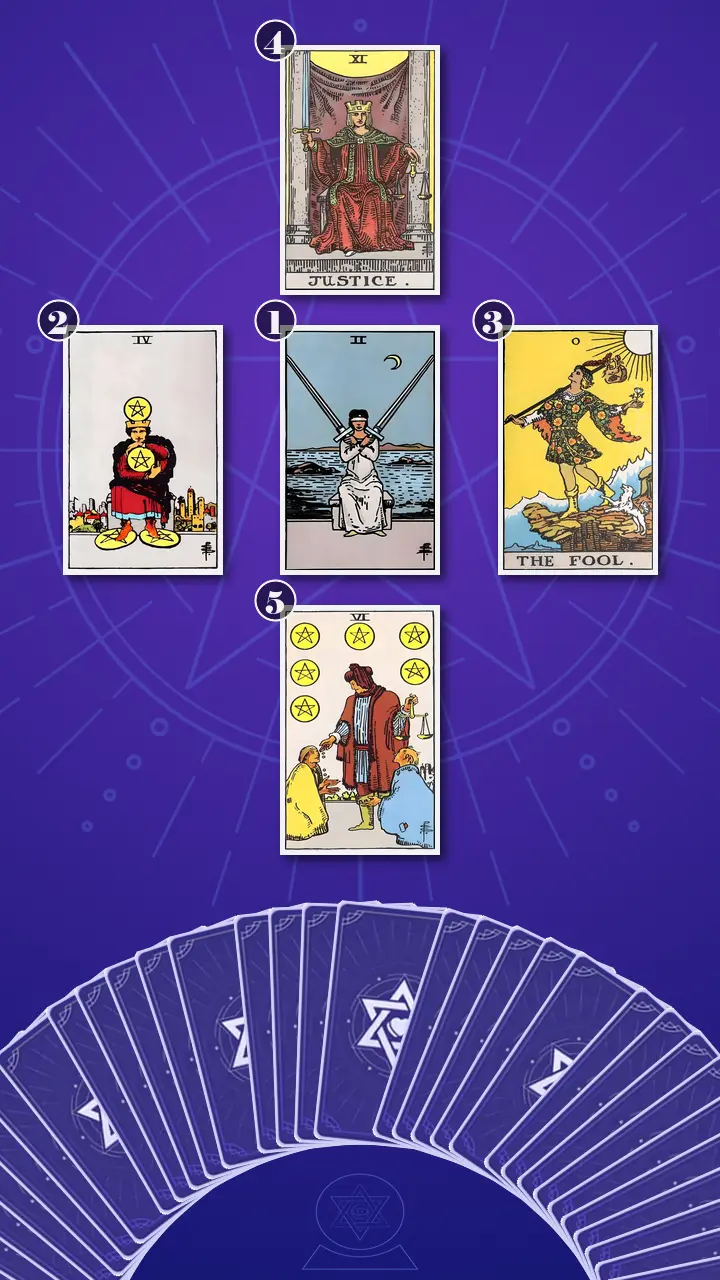
Reading the Map: How Tarot Card Meanings Land in Real Life
Position 1 — The Current Decision-Lock
“Now flipping,” I said, “is the card that represents the current decision-lock: what your mind/body are doing right now when you try to choose.”
Two of Swords, upright.
In the card, a figure sits with a blindfold on, arms crossed, swords crossed over their chest. Behind them: still water, quiet—but not peaceful. More like paused.
I nodded toward Jordan’s laptop, still closed but sitting between us like a third person. “This is exactly that draft-email moment,” I said. “You’ve got a reply open to your manager and a reply open to the recruiter, but you keep saving instead of sending. You toggle between compensation breakdowns and scope docs like it’s research—but your body is braced: jaw tight, breath held. The ‘neutral’ stance is a shield. If you don’t decide today, you don’t have to face regret today.”
The energy here isn’t laziness. It’s blockage—Air energy frozen in place. Protection that has turned into paralysis.
I let the inner loop sound the way it actually sounds in your head, short and clipped, like a cursor blinking in judgment:
“Just confirm the equity cliff.”
“Just ask about start date flexibility.”
“Just tweak the tone so I don’t sound difficult.”
“Just one more Reddit thread.”
“Just one more Levels.fyi comparison.”
Jordan gave an unexpected little laugh—dry, almost embarrassed. “That’s… brutal,” they said. “Like, accurate. But brutal.”
“You’re not indecisive—you’re overprotecting yourself from regret,” I told them gently. “The blindfold is you filtering out preference, because preference forces a choice. The crossed swords are you bracing so hard you can’t move.”
Their shoulders lowered by a millimeter—tiny, but real—like their body recognized itself in the description.
Position 2 — Option A: Stay for the Raise
“Now flipping is the card for Option A: staying for the raise—what this path is really offering you beyond the headline number.”
Four of Pentacles, upright.
This is the card of holding on: a figure gripping coins—one pressed to the chest, one balanced on the head like a crown, two pinned under the feet.
“Staying,” I said, “isn’t just about the money. The raise is emotional safety. It’s proof. It’s that feeling of: Okay, I didn’t imagine how much I’ve been carrying. You look at the higher number and your shoulders drop.”
Jordan’s eyes flicked down, like they could see the PDF in their mind. “Yeah,” they admitted. “It feels validating. Like… someone finally sees it.”
“That’s the coin to the chest,” I said. “Compensation as reassurance. The risk is excess Earth energy—grip. If the scope stays vague, the raise can become a golden handcuff: more pay, more gripping, less breathing room.”
I added, plain and practical: “If you stay, you’ll want to define exactly what you’re protecting—and what you refuse to trade away. Because staying without terms is how people end up paying for a raise with their nervous system.”
Position 3 — Option B: Take the New Role
“Now flipping is the card for Option B: taking the new role—what this path is really asking of you and what it opens.”
The Fool, upright.
The Fool stands near a cliff edge with a small bag—prepared enough, not prepared forever. A white rose in hand: intention, not guarantee.
“This is you on the TTC, imagining day one,” I said, “new tools, new team, the slightly awkward ‘where do I find everything?’ feeling. It’s scary, and it’s also the first time your body feels alive instead of clenched.”
I used the structure I love for this card—two truths side by side: “I’m scared, and I feel awake.”
Jordan smiled—small, surprised, like they’d forgotten they were allowed to want something that wasn’t fully controllable. “I forgot I’m allowed to choose growth even if it’s not guaranteed,” they said, almost to themselves.
“Exactly,” I replied. “The Fool isn’t reckless. This is movement as a strategy—shipping a v1 instead of waiting for the mythical perfect launch. The energy is open Air—initiation. The question becomes: what’s your ‘prepared enough’ threshold? What safety net—savings runway, benefits clarity, start-date flexibility—lets you take the step without pretending it’s certainty?”
When Justice Spoke: The Clean Commit That Ends the Spiral
Position 4 — The Decision Principle
I slowed down before turning the next card. The room got quieter in that way it does right before a planetarium show begins—people settling, waiting for the image to appear.
“We’re flipping the core card now,” I said. “This is the decision principle: what you need to weigh, clarify, or name to choose with self-trust.”
Justice, upright.
Scales in one hand, an upright sword in the other. Eyes forward. No blindfold.
“This is the pivot,” I told Jordan. “Justice is where we stop asking ‘Which is better?’ and start asking, ‘Which is fair—and which can I commit to without resentment?’ It’s values-and-terms decision-making: scope, expectations, reciprocity, timeline. Not vibes. Not adrenaline.”
Here’s what I noticed as I spoke: Jordan’s fingers had been pinching the edge of their sleeve since the Two of Swords. When Justice appeared, their grip paused—like their body didn’t know whether to tighten or let go.
The Aha Moment (Setup)
You know that moment—laptop open, two tabs up, the cursor blinking in your draft reply—where your jaw locks because hitting ‘Send’ feels like choosing a whole future? That’s where Jordan had been living: trying to outthink trade-offs until only a perfect option remained, as if the right spreadsheet could remove consequence entirely.
The Aha Moment (Delivery)
Stop hunting for a perfect, consequence-free choice; choose the fairest terms you can stand behind, like Justice holding the scales steady.
I let it sit in the air for a beat—long enough that neither of us could rush past it.
The Aha Moment (Reinforcement)
Jordan’s reaction came in layers—the kind I’ve learned to watch for after years of explaining eclipses to a roomful of skeptical teenagers. First: a tiny physiological freeze. Their breath caught, and their gaze fixed on the card like it had suddenly become a mirror.
Then: the cognition shifted. Their eyes unfocused for a second, like they were replaying the last week—Draft #7, the warm phone, the Slack pings feeling like countdown timers. I could almost see the internal calculus softening from “find the correct answer” to “name what I can live with.”
Finally: the emotional release. Their shoulders dropped properly this time. Their jaw loosened like a knot untying. “Oh,” they said, voice rougher. “I’ve been trying to avoid trade-offs instead of choosing them.”
“Yes,” I said. And this is where my own way of thinking comes in—my astronomy brain that’s obsessed with time and trajectory. “Let’s run what I call a Gravity Assist Simulation.” In spaceflight, you don’t muscle your way out of a tight situation—you use the pull that already exists to change your path. So instead of asking which offer eliminates risk, we ask which offer gives you the best trajectory with its trade-offs: 6 months from now, 18 months, 3 years. What does each option make easier? What does it make harder?”
I added a second lens: “And a Dark Matter Detection check—what’s the hidden mass influencing you that you haven’t named? For you, it’s the need for the choice to prove you’re competent. That’s not a career metric. That’s a self-worth contract.”
Jordan blinked hard, eyes shiny but steady. I asked them, softly but directly: “Now, using this new frame—values and terms—think back: was there a moment last week where you felt your breath come back for one option, and disappear for the other? Not the LinkedIn narrative. Your actual body.”
They didn’t answer right away. Then: “When I imagined staying… I felt relief. But also smaller. When I imagined the new role, I felt scared. But… awake.”
That was the step from pressure-and-rumination toward fair-minded clarity: not certainty, but self-trust beginning to reappear.
Position 5 — Integration Outcome: Balanced Exchange
“Now flipping is the card for integration: what becomes possible when you commit and align your boundaries with your choice—not a prediction, a direction.”
Six of Pentacles, upright.
Scales again—measured giving, measured receiving. This is what Justice looks like after it leaves the idea stage and enters your calendar.
“The win after you decide,” I said, “isn’t the number. It’s the exchange staying balanced. Pay matches responsibilities. Expectations are written down. You stop performing for approval because the deal is clear.”
I used my favorite line here because it cuts through salary-only thinking without shaming it: “Money is part of the deal. Scope is the rest of the deal.”
Jordan nodded slowly. “That’s what I want,” they said. “Not perfect. Just… balanced.”
I pictured a future Tuesday for them: inbox quieter, fewer draft emails titled “Offer Decision v3 FINAL,” boundaries stated like a project brief, not implied like a social test. Not euphoric. Just steadier.
The One-Page Decision Rule: Actionable Next Steps for a Counteroffer Decision
Here’s the story the spread told, start to finish: you began in the Two of Swords—protecting yourself from regret by staying “neutral,” which looked professional but kept you frozen. The Four of Pentacles showed why the counteroffer hit so hard: security and validation, the number as reassurance. The Fool showed why the new role wouldn’t leave you alone: not certainty, but aliveness—movement, learning, a new chapter. Justice cut through the loop by demanding something adult and workable: name your values, negotiate your terms, accept the trade-offs directly. And the Six of Pentacles grounded it all into reciprocity—making sure whichever path you choose doesn’t quietly invoice your nervous system later.
The cognitive blind spot was subtle but powerful: you were treating clarity like something you discover if you collect enough information, when really clarity comes from authoring a rule you can respect. The transformation direction is exactly this: shifting from trying to secure the “perfect” option to choosing the option that best matches your values and negotiating the trade-offs directly.
I told Jordan, “We’re going to treat this like interstellar navigation. You don’t wait for the universe to stop moving. You pick a heading, confirm your essentials, then you commit.”
Then I gave them a small, practical plan—because insight without next steps just becomes another tab you keep open:
- The 12-Minute Justice ScaleSet a timer for 12 minutes. In Apple Notes, write three non-negotiables for the next 6 months (examples: scope clarity in writing, manager support, no constant after-hours urgency, comp floor). Score each offer 1–5 on each non-negotiable—no extra categories allowed.If your brain says “this is too simplistic,” treat that as proof it’s working. Simplicity forces values to speak. If 12 minutes is too much, do a 5-minute version with just one non-negotiable: your floor.
- The Two-Sentence Trade-OffFor each option, write two blunt sentences: “If I choose this, I’m choosing ___.” and “I’m not choosing ___.” Keep it human, not resume-speak. Read both sets out loud once.If you notice your jaw clench mid-sentence, pause and do three slow breaths. Your body is giving you signal; you don’t need to argue with it.
- The One-Clarification Limit + Reciprocity QuestionPut a 24-hour decision window on your calendar. During that window, you get exactly one clarification request total—choose the most decision-relevant one. Then ask one concrete reciprocity question before signing: “What does success look like at 30/60/90 days, and what support/resources are included?”If you worry this makes you sound high-maintenance, reframe it: clarity is professional, not needy. If asking live feels intense, email it: “Answering even briefly will help me align expectations.”

A Week Later: The Quiet Proof of a Clean Commit
Eight days later, I got a message from Jordan. It wasn’t a paragraph. It was two screenshots and one line: “I sent the email. No Draft #8.”
They’d used the Justice Scale, picked their non-negotiables, and committed—then asked the 30/60/90 question instead of spiraling on title wording. They said the strangest part was the silence afterward: the inbox didn’t immediately fill with catastrophe. Their shoulders had dropped on their own. They slept through the night once—still waking up with a flicker of “what if I’m wrong?” but this time, they noticed it… and didn’t obey it.
In my mind, that’s real clarity: not a fireworks moment. Just the quiet return of breath. A choice is a chapter—not a life sentence.
When a single email reply feels like it will lock your whole identity into place, it makes sense that your jaw clenches and you keep searching for the one consequence-free answer that would let you breathe.
If you stopped trying to pick the option that guarantees no regret, what’s one small ‘clean term’ you’d want in place so you could commit and still respect yourself?