Severance or Earnout? Trading Spreadsheet Panic for Clean Asks

Finding Clarity in the 2 a.m. Acquisition Spiral (Severance vs Earnout)
If you got a last-minute calendar invite titled “Acquisition Update” with a random HR attendee and your brain instantly went into spreadsheet mode (hello, acquisition limbo), I already know what your night looks like.
Jordan (name changed for privacy) slid into the chair across from me like they’d been holding their breath for hours. They’re 29, a product manager in Toronto, and tonight they were living the very specific kind of decision paralysis the night before an acquisition call—the kind where you’re torn between taking severance now or staying for an earnout later, and somehow both options feel like a verdict on your competence.
They described 8:52 PM at their condo kitchen island: laptop open to a Google Sheet literally named “Runway,” the term summary PDF half-scrolled, Slack on their phone. The under-cabinet LED light made everything look too sharp—like it was outlining every risk in hard edges. Their coffee tasted stale-cold. Their jaw was tight, and their leg wouldn’t stop bouncing, as if their body was trying to sprint while their life stayed stuck on “waiting room.”
“I can’t tell if I’m being strategic,” they said, voice clipped the way people talk when they’re trying not to sound panicked, “or if I’m just… scared. Tomorrow is the call. Either I take the severance and move on, or I stay for the earnout. And I keep prepping, but I’m not actually landing on questions. I’m just… toggling.”
The anxious pressure in them wasn’t a thought—it was a physical hum, like a phone vibrating on a table that never stops, except the vibration was inside their chest and teeth. It spiked every time they pictured HR’s face on tomorrow’s Zoom grid.
I let that land without trying to fix it too fast. “That makes so much sense,” I told them. “When someone else sets the timeline, your nervous system goes looking for control wherever it can find it—numbers, wording, scenarios. Let’s not force certainty tonight. Let’s build you a map that gets you to clarity and a self-respecting next step.”

Choosing the Compass: The Decision Cross · Context Edition
I’m Giulia Canale—Jungian psychologist by training, and for years I worked on transoceanic voyages, teaching intuition to crews and reading energy shifts for travelers who were making “one call, one choice” decisions somewhere between ports. I still think in harbors and docking windows: you don’t control the sea, but you can choose how you approach the next landing.
I asked Jordan to take one slow breath—nothing mystical, just a clean transition from spiraling to observing. While they held the question in mind—“Tomorrow: severance or stay for the earnout?”—I shuffled, the cards making that soft paper-thrum I’ve always found grounding, like a metronome resetting a racing brain.
“For this,” I said, “I’m using a spread called Decision Cross · Context Edition—a Decision Cross tarot spread for a severance vs earnout acquisition call. It’s designed for moments like yours: not to ‘predict the outcome,’ but to compare the immediate tone of each option, surface the hidden factor you need in writing, and give you a decision method so you walk into the call with agency.”
To you reading this: that’s how tarot works at its most practical. It’s not a fortune teller. It’s a structured mirror. Under pressure, our brains loop—tarot interrupts the loop long enough to name what’s happening and choose a better next step.
“Card 1 will show what the acquisition pressure looks like in your real behavior tonight,” I told Jordan. “Card 2 is the severance path—what it buys you immediately. Card 3 is the earnout path—what it offers, and what it quietly binds you to. Card 4 is the blind spot: the missing term, leverage point, or assumption. Card 5 is your North Star—values and non-negotiables. And Card 6 is the method: the exact next step for before, during, and after the call.”
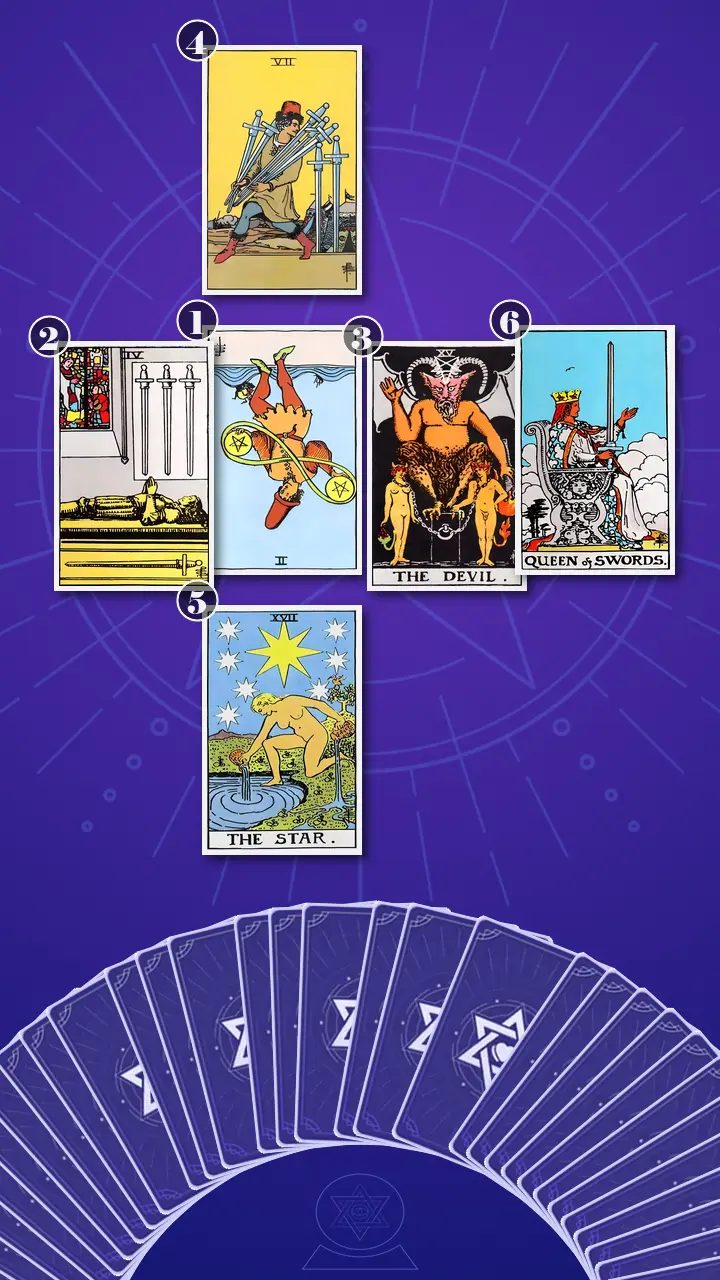
Reading the Map: Six Cards, One Call
Position 1: The Loop That Feels Like “Being Responsible”
“Now turning over,” I said, “is the card representing Current situation: the concrete way the acquisition pressure is showing up in your behavior and mental load right now.”
Two of Pentacles, reversed.
I didn’t need to dramatize it. This card always looks like what it feels like. “It’s 10:30 PM,” I told them, using the scene the card was already describing, “and you’ve got Google Sheets, a calculator, and the term summary open at the same time. You keep toggling—severance math, tax estimates, job market notes—until everything feels equally urgent. The juggling soothes you in the moment… and wrecks you an hour later.”
Reversed, the energy is a blockage: motion without direction. “The infinity loop in the picture,” I added, “is that sensation of, ‘If I just adjust one assumption, I’ll finally feel calm.’ And the sea behind the juggler—those rough waves—are the acquisition terms shifting under your feet.”
I let my voice go even more matter-of-fact. “Here’s the blunt line this card is asking: what are you dropping to keep both options emotionally alive—sleep, focus, self-respect, time?”
Jordan let out a small laugh that had a bitter edge, like they’d been called out by their own browser history. Then they sighed. Their fingers tapped once against their water glass and stopped.
“Motion isn’t the same thing as agency,” I said, and I watched their shoulders flinch like the sentence hit a nerve—in a useful way.
Position 2: Severance as Breathing Room (Not a Disappearance)
“Now turning over is the card representing Severance path: what this option offers immediately in terms of capacity, time, and psychological breathing room.”
Four of Swords, upright.
“Severance here isn’t framed as ‘giving up,’” I said. “It looks like blocking two weeks where Slack isn’t your nervous system’s metronome. Turning off notifications. Letting your brain downshift before you make your next career move.”
This card’s energy is balance—rest with structure. “There’s a single sword carved below the resting figure,” I pointed out, “and I read it like this: rest, but with a plan. Not rest that becomes two weeks of rumination disguised as ‘research.’”
Jordan swallowed. Their jaw unclenched for half a second, then tightened again, like their body wanted the exhale but didn’t trust it yet.
“If you did take severance,” I asked gently, “what would you be buying immediately—time, autonomy, recovery? And what scares you about allowing that purchase to count as competence?”
Position 3: Earnout, and the Hook Under the Headline Number
“Now turning over is the card representing Earnout path: what this option offers immediately, and what it binds you to emotionally or practically.”
The Devil, upright.
The room got quieter, the way it does when a truth you’ve been trying to keep ‘professional’ shows up anyway. The Devil’s energy here is excess: attachment that narrows freedom.
“Earnout energy,” I said, “feels like a deal you can’t stop justifying. You tell yourself it’s purely strategic, but you also don’t want to be the person who ‘got acquired and bailed.’ The payout number starts doing emotional work—soothing FOMO, proving competence, keeping you attached to the identity of being the dependable one.”
I watched their throat move. A flush crept up their cheekbones. They were doing that thing people do when they want to disagree, but their body already believes it.
“Here’s the contrast,” I continued, keeping my tone non-shaming. “Chosen commitment versus binding obligation. The chains in this card are loose enough to remove—but only if you admit they’re there.”
Jordan went very still for a beat. Then, softly: “If I leave… what does that say about me?”
“That’s the hook,” I said. “And you’re not a bad person for having it. But you do deserve to see it clearly.”
“Golden handcuffs work best when you pretend they’re just ‘logic,’” I added. Their eyes flicked down to the card, then back up, like they were catching themselves mid-rationalization.
Position 4: The Missing-in-Writing Detail
“Now turning over is the card representing Hidden factor: the missing detail, leverage point, or blind spot you need to clarify before you can decide cleanly.”
Seven of Swords, upright.
“This isn’t about paranoia,” I said immediately, because I could feel their defensiveness trying to rise. “This is strategy. In acquisition conversations, the risk isn’t only the option—it’s the ambiguity you don’t name.”
I translated it straight into modern life. “You know that friendly summary email that reads confident but stays vague? The one that makes you feel like you ‘shouldn’t’ ask too many questions because the tone is upbeat?”
Jordan’s posture straightened. It was subtle—like someone pulling a string at the back of their shirt. Their hands stopped fidgeting.
“Here’s the rule of thumb this card gives you,” I said. “If it’s not in writing, it’s not a term—it’s a vibe.”
Then I offered a micro-script, the way I would to a client who has ten minutes before a meeting and needs their brain to stop inventing worst cases.
Three calm-PM questions:
1) “What are the earnout metrics, exactly?”
2) “Who decides whether they’re met?”
3) “What happens to the earnout if my role or scope changes?”
The Seven’s energy is clarifying—taking what’s off-camera and bringing it into definition. I could almost see Jordan’s anxiety shift shape: less fog, more targeted curiosity.
Position 5: Your North Star Before Numbers
“Now turning over is the card representing North Star: the non-negotiable value(s) you need to protect so the decision doesn’t become a self-worth trap.”
The Star, upright.
The Star’s energy is balance, not in a vague inspirational way, but in a practical one: two steady streams of water, poured without drama. “This card is asking you to choose the decision you can actually live inside,” I said.
I used the card’s modern translation exactly as it wanted to be used. “Write one sentence that feels calm and true: ‘I want my next six months to feel sustainable and self-directed.’ Then use it like a filter. Not to romanticize anything—just to stop this from becoming a referendum on worth.”
Jordan blinked slower. Their leg still bounced, but with less violence—like their body heard, for the first time tonight, that wellbeing was allowed to be part of the math.
“You’re allowed to care about money and wellbeing in the same sentence,” I reminded them.
When the Queen Lifted Her Sword
“We’re turning over the last card,” I said, and I let the moment slow down on purpose. “This is the core of the reading.” Outside Jordan’s window, Toronto traffic hissed on wet pavement, and the sound suddenly felt like white noise—like the world backing up to make room for a single clear thought.
“Now turning over is the card representing Decision method: the most grounded next step to take before/during/after the call to restore agency and move forward.”
Queen of Swords, upright.
Before I said anything clever, I said what was true. “Tomorrow,” I told them, “your power isn’t predicting the outcome. It’s choosing clean language, requesting specifics, and giving yourself permission to decide from facts and self-respect.”
Setup: I could feel exactly where Jordan was trapped: Runway spreadsheet open, Slack half-muted, jaw clenched—recalculating the same scenarios like the numbers would finally spit out certainty. They wanted to walk into that call sounding like they already understood the game, so they kept polishing, hedging, delaying—anything but the discomfort of one direct ask.
Stop juggling for certainty; choose clear, direct questions and let the Queen’s raised sword cut through the fog.
There was a pause after I said it. Not a dramatic one—an honest one, the kind that feels like the brain actually stopping its background process for a second.
Reinforcement: Jordan’s reaction came in layers. First, a physiological freeze—their breath caught, and their fingers hovered mid-air above their phone like they’d been caught opening Slack on Do Not Disturb. Then the cognitive seep: their eyes unfocused, not because they checked out, but because they were replaying a dozen meetings where they’d over-explained a simple question and left with vibes instead of terms. Finally, the release: a shaky exhale through their nose, shoulders sinking half an inch like something heavy had been set down without anyone making a big deal about it.
And then—an unexpected flash of anger, quick and honest. “But if I talk like that,” they said, heat in their voice, “won’t I sound… difficult? Like I’m not being a team player?”
I nodded. “That fear is real. And it’s also part of the power dynamic The Devil showed us—where you pre-negotiate against yourself.” I leaned in slightly, keeping my tone steady. “Let’s do the Queen’s work instead of the brain’s performance work.”
This is where I used my Choice X-Ray—my way of pulling hidden costs and benefits into the light without turning it into another spreadsheet. “In your Choice X-Ray,” I said, “we’re not just comparing severance dollars to earnout dollars. We’re comparing: time cost (how many months of ambiguity), energy cost (what your body can tolerate), identity cost (proving-worth hooks), and option value (how easily you can pivot if the terms shift). The Queen of Swords doesn’t apologize for wanting the terms of the trade.”
I flashed back, briefly, to my years on ships: docking is a window. Miss it, and you don’t get to argue with the tide—you wait, you burn fuel, you lose leverage. “Tomorrow’s call is a docking window,” I told them. “The Queen’s sword is how you dock cleanly: one question at a time, early, before the conversation drifts.”
Then I gave them the practical ritual from the card’s reinforcement—because insight without a next action is just another loop.
“Set a 10-minute timer tonight,” I said. “Open a blank note titled: ‘Tomorrow’s Call — Queen of Swords.’ Write exactly five yes/no or short-answer questions. No background paragraphs. Then add one sentence: ‘I will decide after I have X in writing.’ Screenshot it. If your chest tightens or you feel silly, take three slower breaths. This is practice, not a commitment.”
“Now,” I added, “use this new lens and tell me: last week, was there a moment you almost asked the direct question—and didn’t?”
Jordan’s mouth twitched in recognition. “In the all-hands,” they admitted. “I had the question in Notes. I kept making it… nicer. And then time ran out.”
“That’s the shift,” I said. “This isn’t just about tomorrow’s call. It’s about moving from spreadsheet-driven anxious pressure and FOMO to boundary-led clarity and steadier self-trust. The Queen is your nervous system learning that you can be direct and still be safe.”
The One-Page Docking Plan for Tomorrow
I took the whole spread and threaded it into one story—because people calm down when their experience finally has a plot.
“Here’s what I see,” I told Jordan. “Right now you’re in Two of Pentacles reversed: constant toggling to outrun the discomfort of choosing. Severance (Four of Swords) offers immediate nervous-system breathing room, but you’ll need structure so rest doesn’t turn into rumination. Earnout (The Devil) offers money and status, but it also carries a hook—proving-worth pressure that can turn into tolerance creep. The Seven of Swords says the real leverage is specificity: define metrics, decision-makers, role-change clauses, and get it in writing. The Star says your values are the anchor: sustainability and self-direction, not just the headline number. And the Queen of Swords gives the method: clean questions, asked early.”
“Your cognitive blind spot,” I continued, “is believing you have to predict the perfect outcome to be smart. That belief keeps you collecting inputs instead of setting boundaries. The transformation direction is the opposite: define non-negotiables, ask for specifics, and let clarity—not adrenaline—drive the next step.”
Then I gave them a plan that would actually fit into a real human evening.
- Tonight: The 10-Minute Queen NoteSet a timer for 10 minutes. In your phone Notes app, write exactly 5 short questions (metrics, who decides, timeline, role-change clause, payout conditions). Keep each question under 12 words. End with: “I will decide after I have X in writing.”If you feel the urge to add context, that’s anxiety trying to be ‘polite.’ Don’t feed it—short questions are the point.
- Tomorrow: Ask One Question Early (First 10 Minutes)On the call, ask one direct question before the conversation turns into “exciting next chapter” vibes. Use Queen language: “What are the earnout metrics, exactly—and who owns the decision?”If silence shows up, don’t fill it. Let the question do its job.
- After: The In-Writing Confirmation EmailSend a short follow-up email: “Here’s what I heard—please confirm in writing.” Bullet the answers. Ask for the document/term sheet if it exists, and request definitions for anything still vague.If the call was chaotic, you can say, “I’m capturing this to confirm accuracy.” That’s adult, not difficult.
In my own framework, I call this a Port Decision Model: you don’t need to decide your whole career by sunrise. You decide what you need to dock safely in the next port—terms, timelines, and your right to review them. Then you decide from there.

A Week Later: Ownership, Not Certainty
A week later, Jordan messaged me a screenshot. It wasn’t their severance number. It wasn’t a perfect plan. It was a Note titled “Tomorrow’s Call — Queen of Swords,” five questions in clean lines, plus one boundary sentence. “I asked one question early,” their message said. “It changed the whole tone.”
They didn’t tell me everything was resolved. They told me something better: they left the call with facts, and when the urge to spiral hit, they had an email thread—terms moving from air into writing.
And in one small, almost throwaway detail, I heard the nervous system shift: they said they slept through the night. In the morning, their first thought was still, What if I’m wrong?—but this time, they noticed their jaw wasn’t clenched when they thought it. They wrote, “I actually smiled at that.”
That’s what a Journey to Clarity often looks like in real life: not certainty, but ownership. Not a perfect outcome, but a steadier self-trust that says, I can handle what I learn next.
When you’re stuck between severance and an earnout, it can feel like your whole worth is on the line—and your body knows it, because your jaw stays tight while you try to spreadsheet your way into certainty you were never given.
If you didn’t have to predict the perfect outcome, what’s one specific thing you’d want in writing tomorrow so the decision stays yours?