Missed-Class Shame Spiral: One Repeatable Way Back Into Student Life

Finding Clarity in the 11:40 a.m. Functional Freeze
If your room looks like the physical version of your unread notifications, and comparison fatigue hits every time classmates post tidy desks or actual plans, I want you to stay with me for this one. That was the exact energy Maya (name changed for privacy) brought to my screen from Toronto.
Before I touched the cards, I asked her to take me to the moment the spiral becomes real. She didn’t have to think. Tuesday, 11:40 a.m. Her phone was buzzing itself warm against the sheet. Gray noon light was leaking through half-closed curtains. Her room smelled faintly like yesterday’s coffee and fabric softener, and she had to kick a hoodie and two pairs of jeans off the duvet just to sit up. When she opened Quercus, the lecture was already live.
Her face did that tiny wince people make when the disappointment lands before the thought does. “I know exactly what I should do, which somehow makes it worse,” she told me. Then, quieter: “If I miss one thing, the whole day feels unrecoverable.”
I could hear the real question underneath the messy room, missed class, and unanswered texts: why did she keep sleeping through alarms and missing class even when she cared? In her body, it sounded like low power mode for a human life — heavy limbs in the morning, a mind that turned into a subway train stuck between stations at night, technically moving, never arriving. She wanted to keep up with school and friends, but she felt too depleted and too disorganized to show up imperfectly.
I told her what I tell a lot of students when the backlog has started to feel personal: this is not a character flaw. It is a backlog that has gone emotional. And when that happens, tarot is useful not as a verdict, but as a map. “Let’s see if we can make this day re-enterable again,” I said.

Choosing the Weather Map for School, Sleep, and Friends
I asked her to put both feet on the floor, take one slower breath, and notice what was loudest in her body — heavy, buzzy, tight, hollow, or numb. Then I shuffled slowly while she held the question in mind. I never treat this part like theater. The point is focus. It gives the nervous system a doorway between spiraling and seeing.
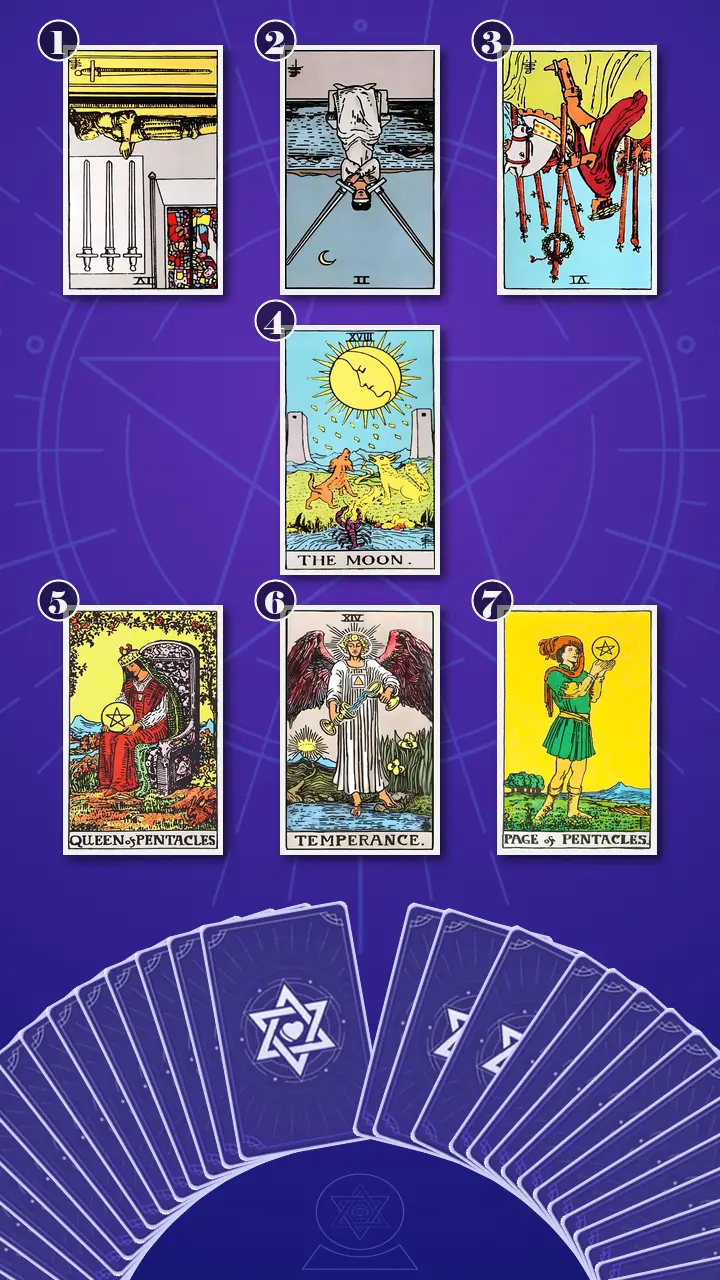
For her, I chose my Energy Diagnostic Map · Context Edition, the spread I reach for when someone feels behind in school and life and wants to know whether tarot can actually help with school stress, sleep problems, and ignored texts all at once. This was not a simple timeline problem. Her room, alarms, lecture attendance, and silence with friends were feeding each other in a loop. If I had forced that into a past-present-future spread, I would have flattened the real pattern.
So I read it the way I read a weather system under a planetarium dome: symptom first, then the internal split, then the outside pressure, then the deeper fog underneath, then the resource, the key shift, and the grounded next step. The first card would show the visible spillover. The center card would name the root blockage. And the sixth position — the bridge of the spread — would show the shift that could change the pattern rather than just describe it.
Reading the Top Row of the Storm
Position 1: When Rest Never Lands
I turned the card representing the visible spillover of the issue: missed class, room chaos, and a body-mind rhythm that feels off. The card was the Four of Swords, reversed.
In card meanings in context, this was not abstract at all. This was the hot phone, six alarms missed, lying in bed while mentally speed-running everything already late, and realizing that staying horizontal was not actually giving her energy back. The body was paused, but the pressure was fully online. The recumbent knight in the image always looks restful at first glance, but reversed, the Air element is blocked: recovery is interrupted, thin, or never really received.
“Rest under pressure does not always land as rest,” I said. “From the outside, this can look like bed rot. But it’s the non-cute version — panic parking.”
Maya gave one short laugh that came out sharper than she meant it to. Her fingers stopped on the edge of her sleeve, then tightened. She looked down at the blanket bunched in her lap and said, “That is... uncomfortably specific.” I nodded. Sometimes the first card does not feel gentle. It feels accurate enough to loosen the shame.
Position 2: The Tab-Switching Mind
Next came the card representing the inner split between wanting to get back on track and freezing when everything feels urgent at once. The card was the Two of Swords, reversed.
This is the planner-course-portal-group-chat moment. Laptop half-open. Notifications waiting. One text draft, three possible replies, none sent. Too many loaded tabs, no click. Reversed, the card shows Air energy spilling past its limit: the mind keeps protecting itself from one uncomfortable choice by refusing the first small choice, which means everything stays equally loud.
I asked her, “When you wake up behind, what are you usually stuck between in the first fifteen minutes? Going back to sleep, rushing to class, cleaning first, or disappearing into your phone until the choice hurts less?”
“All of them at once,” she said immediately. Her shoulders climbed toward her ears as she said it, then dropped a fraction, as if hearing the absurdity out loud made it easier to see. That was the point. The problem was not a lack of options. It was choice paralysis turning ordinary tasks into an all-at-once wall.
Position 3: The Spotlight That Isn’t Real but Feels Real
Then I turned the card that mapped the outside pressure — the academic visibility and social comparison making ordinary participation feel high-stakes. The card was the Six of Wands, reversed.
I have seen this card hit young people like a camera flash. In modern life, it is Instagram Stories as a tiny public scoreboard you never agreed to compete on. It is standing on a subway platform knowing you will walk into lecture ten minutes late and feeling your face go hot before anyone has even looked at you. It is not that you cannot go; it is that you cannot bear being seen going like this.
Reversed, Fire does not disappear. It curls inward. Confidence becomes self-consciousness. Public energy becomes a spotlight you drag around in your own head. “You are not avoiding life because you do not care; you are avoiding the feeling of being seen behind,” I told her.
That landed exactly where I expected it to. Her breath caught first. Then her gaze went somewhere past the cards, as if she were back on a cold platform with the train brakes screaming in. After that came the grim little nod. “Yeah,” she said. “If I walk in late, messy, and obviously behind, it feels like it confirms everything.” Nothing petty about that. It was embarrassment doing too much work in the nervous system.
Position 4: The Room in Moonlight
Then I dropped to the center of the spread, the place naming the deeper rhythm disruption and emotional fog underneath the surface mess. The card was The Moon, upright.
Whenever I see The Moon, part of me is back under the planetarium dome before a show begins, when the lights are low enough that people stop trusting their own eyes. They think nothing is there yet, but their sight has simply not adjusted. That is what this card felt like for her: not emptiness, not laziness, but life on low brightness.
The moonlit path, the dog and the wolf, the creature rising out of water — all of it spoke to mixed signals. Was she tired, ashamed, lonely, overstimulated, or just scared to re-enter class and friendships after a few off days? Possibly all at once. Under Moon-water, perception gets muddy. Every task starts looking bigger and stranger than it is. That is why a course portal and an unanswered text can feel equally impossible at 12:06 p.m.
I said, very quietly, “I think the deepest issue here is not that you do not care. It’s that you can no longer read your own internal weather clearly. You’re trying to fix the week while the brightness is turned all the way down.”
The room on my side of the screen had gone still. Even the kettle I had forgotten on the side table gave a soft metal tick as it cooled. On her screen, the gray light behind her had shifted; one bar of daylight had found the edge of a laundry pile. She swallowed once. “That’s exactly it,” she said. “I can’t even tell what is wrong, so how am I supposed to fix it?” That was the chest-drop moment. Less accusation. More recognition.
Position 5: The Queen Who Makes Life Livable
From there I turned the card representing the practical, self-supportive resource already available to her. The card was the Queen of Pentacles, upright.
This was the first card in the spread that felt warm to the touch. In real life, the Queen of Pentacles is not a Pinterest room-reset montage. She is a clean mug, a refillable water bottle, a cleared nightstand, a snack in the bag, a bed made usable enough to sleep in. Earth energy, balanced and steady. Useful, not decorative.
“Your way back starts with making life easier to inhabit,” I told her. “Not prettier. Not more impressive. Easier to inhabit.” I pointed to the way the Queen holds her pentacle in both hands. “Care needs to become something you can literally touch.”
Her face softened for the first time. The line between her brows eased. “Maybe this counts more than I let it,” she said, almost to herself. Exactly. Useful beats impressive when you are rebuilding rhythm. And in this spread, the Queen was the first believable sign that the system could change.
When Temperance Poured Between Two Cups
Position 6: The Bridge Back Into Daily Life
Then I turned the card at the bridge of the spread, the position that points to the central shift from all-or-nothing reset thinking toward regulation and moderation. The room seemed to hush around it. The card was Temperance, upright.
In a student-life functional freeze, Temperance is not boring balance advice. It is the exact opposite of the midnight Notion reset that looks amazing until the next morning. In modern terms, it is a day composed like a playlist that actually flows: sleep a bit earlier, one class or one chunk of coursework, one human reply. Not three separate emergencies. One sequence your system can hold. Balanced energy, not rescue energy.
At the planetarium, I often explain orbital resonance — the way separate bodies stop fighting each other when they find a timing ratio they can actually keep. I felt that old dome-show sentence rise in me as I looked at the angel pouring between the cups. Maya had been trying to force school, sleep, and friendship into perfect alignment, as if one dramatic comeback day could snap the whole system back into place. Temperance said something wiser: stability is not sameness. It is sustainable proportion. That is the lens I call Orbital Resonance, and here it showed me that her life did not need a heroic reboot. It needed rhythms that stopped colliding.
It was basically noon in the story she had brought me: the room still felt like early morning, her phone was hot from alarms, and she was already negotiating with a day she had not fully entered yet. That is where people start demanding a total reset. That is where they lose the day before lunch.
You do not need a dramatic comeback. You need a rhythm gentle enough that your body and mind will actually believe it.
Stop demanding a perfect reset and start blending your days like Temperance's cups, one manageable mix of rest, work, and reconnection at a time.
She froze in three clear beats. First, her inhale stalled, and her fingers hovered over the warm mug beside her laptop as if she had forgotten what she meant to do with them. Then her eyes went slightly unfocused — not blank, but replaying something — and I would have bet money she was seeing one of those 1:20 a.m. notes-app masterplans that died before the first lecture. Then came the resistance. Her jaw set. “But if I make it smaller,” she said, a little sharper now, “doesn’t that mean I’ve been doing this wrong? Or that I’m just lowering the bar because I can’t handle it?”
I answered her the way I answer people when shame is trying to disguise itself as standards. “No,” I said. “It means you are finally including your nervous system in the plan. Rescue is dramatic. Regulation is repeatable. Those are not the same thing.”
Her shoulders dropped after that, slowly, almost in stages. The tightness in her mouth loosened. There was that strange, tender moment I see so often in real breakthroughs — relief mixed with a little dizziness, because once the path becomes clear, responsibility comes back with it. I gave her the next ten minutes instead of the next month. “Tonight, create one landing strip for tomorrow,” I said. “Open the curtains or turn on a lamp. Put water by the bed. Place your student card and charger in your bag. If it feels doable, send one low-stakes honest message. Stop after the first step if that is enough. This is not a test, and you do not have to earn the right to make it small.”
Then I asked, “Using this new lens, think about last week. Was there a moment when the job was not to rescue the week, but just to make tomorrow trustworthy again?”
She let out a long breath that sounded older than twenty. “Thursday,” she said. “I could have watched fifteen minutes of the lecture recording, eaten literally anything before two, and texted Sam back. I didn’t need a whole new life. I needed... that.” This was the turning point of the reading: not certainty, but the first move from shut-down overwhelm toward gentle self-regulation, growing self-trust, and steadier calm.
Position 7: One Proof, Not a Whole New Personality
Finally I turned the card representing the grounded next step that reconnects school, sleep, and friendship to daily life. The card was the Page of Pentacles, upright.
I love this card after Temperance because it refuses the montage. In real life, it is one lecture link opened. One honest email sent. One plate washed. One load of laundry started. The Page does not audit the semester. The Page looks at one real object and cares for it. Earth energy is balanced again, but lighter now — teachable, curious, evidence-based.
“Not the whole semester,” I said. “Not the whole room. Not the whole social life. This one thing.” She nodded immediately. Confidence did not need to arrive first. Evidence did. And that is how self-trust starts rebuilding — one grounded proof at a time.
From Insight to Action: The Re-Enterable Day
When I laid the spread back out in my mind, the story was clean. She had been collapsing without real recovery at the surface. Under that sat a split mind that kept opening too many tabs at once. Outside pressure — class visibility, Instagram-story comparison, the fear of being read too quickly — turned ordinary participation into a performance test. At the root was The Moon: a deeper rhythm disruption that made every signal harder to trust. The resource was not more analysis. It was the Queen’s grounded care. The bridge was Temperance. The Page turned that into an evidence-before-confidence method: one completed thing, then let the system update.
The blind spot was this: Maya had been treating school, sleep, and friends like three separate crises, when they were really one system tugging the same orbit. She kept waiting for a clean-slate self to reappear before rejoining her life. The actual transformation was smaller and more powerful — move from total-reset pressure to one repeatable imperfect re-entry anchor.
- 90-Second Morning AnchorTonight, place your phone on the desk across the room, leave one glass of water and one wearable outfit piece within reach of the bed, and for two mornings this week do the same sequence before Quercus, Instagram, or texts: feet on the floor, curtains open, one sip of water.Keep the minimum version. If curtains are impossible, turn on a lamp. If the phone cannot go across the room, move it off the pillow. Tiny is not trivial.
- The Three-Part Temperance SequenceOn one sticky note, write one school task, one body task, and one reconnection task for a single day — for example: watch 15 minutes of the lecture recording before 4 p.m., eat something with protein before 2 p.m., and send one honest two-line text to the friend you have been avoiding.When the three parts are done, stop. Do not turn one good hour into a surprise productivity marathon. The point is proportion, not rescue.
- Earth-Rotation ResetIf you still miss the first class, use what I call my Earth-rotation perspective before morning meetings: stand up anyway, do the same anchor sequence, and choose the next available part of the day — the 1 p.m. class, the recording, the laundry, the message — instead of declaring the whole day dead.Say it out loud if you need to: “The morning went sideways, but the planet kept moving.” Re-entry counts even when it starts late.
I reminded her of the sentence the whole spread had been building toward: you do not need a comeback. You need an entry point.

A Week Later: The Quiet Proof
Four days later, Maya sent me a message with a photo I still remember: one clear desk corner, a glass of water by the bed, and a sticky note that read, lecture recording / bagel / text Sam back. She had missed one morning class that week, done the anchor anyway, watched fifteen minutes of the recording, and replied, “I’ve been a bit underwater, but I’m here.”
There was nothing cinematic about the change. She told me she went to one lecture, then sat alone in a café afterward eating a toasted bagel and staring out at the streetcar wires. The next morning her first thought was still, What if I slide again? This time, though, she smiled at the thought, opened the curtains, and put her feet on the floor.
That is what a real Journey to Clarity often looks like in student life. Not fixing everything. Not becoming a whole new person by Monday. Just moving from shame-driven avoidance to a steadier, kinder rhythm that your own body will trust.
When a few off days pile up, it is often not the laundry or the missed class that hurts most; it is that stomach-drop fear that someone will finally see you as a person who is slipping.
If tonight you stopped waiting for the clean-slate version of yourself, what one small orbit-anchor — curtains, water, one honest text, one usable corner — would make tomorrow a little easier to step back into?