The Draft Email I Wouldn’t Send—Until I Ran a One-Week Decision Test

Finding Clarity in the Unsent Draft at the Kitchen Island
You have a polite mentor email draft sitting unsent while your LinkedIn tabs are still open—like you’re trying to keep both doors half-open without anyone noticing.
Jordan (name changed for privacy) slid into the chair across from me on a video call, shoulders slightly raised like they’d been holding them there all day. Behind them was the unmistakable downtown Toronto condo lighting: those overhead LEDs that make everything look a little too honest. They were perched at a tiny kitchen island with a laptop open, a phone face-down, and a mug that had clearly gone cold hours ago.
“It’s so stupid,” they said, rubbing their jaw with the heel of their palm. “My mentor offered a referral for an internal move. It’s… good. It’s a real door. But I’m also job hunting. And I keep thinking if I say yes, I’m settling. If I don’t, I’m wasting the offer.”
I watched the way their fingers hovered near the trackpad, like even talking about it made their body want to alt-tab into something safer. Their chest wasn’t “anxious” in an abstract way—it was more like a seatbelt cinched too tight: functional, restrictive, impossible to forget.
“That makes complete sense,” I told them, keeping my voice steady. “We’re not here to force a forever answer tonight. We’re here to map what’s actually going on—so you can take a clean next step without treating one email like it decides your entire identity. Think of this as a Journey to Clarity, not a verdict.”

Choosing the Compass: How the Decision Cross Spread Works
I asked Jordan to take one slow breath with me—not as a ritual for luck, but as a way to bring their attention out of the LinkedIn spiral and back into the room. While they exhaled, I shuffled and reminded them: tarot doesn’t replace your judgment; it helps you see the decision you’re already making underneath the noise.
“Today I’m using a spread called the Decision Cross,” I said. “It’s a clean, minimal map for a career crossroads—especially when the question is how do I choose, not what will magically happen.”
For anyone reading along who’s ever Googled ‘tarot spread for internal transfer vs keep job hunting’: this is exactly why it works. The Decision Cross holds the full conflict in six cards—your current dilemma, Path A, Path B, the hidden pressure distorting everything, the next grounded step, and finally the decision rule that creates resolution. It’s practical by design, because “more information” isn’t always the same as actionable advice.
“Here’s what we’ll pay closest attention to,” I added. “Card 1 shows the behavioral loop you’re stuck in. Cards 2 and 3 compare the internal move versus continuing the external job hunt. Card 4 reveals the hidden fear that makes this feel identity-defining. And Card 6 gives us the integration—how to make a decision you can respect later.”
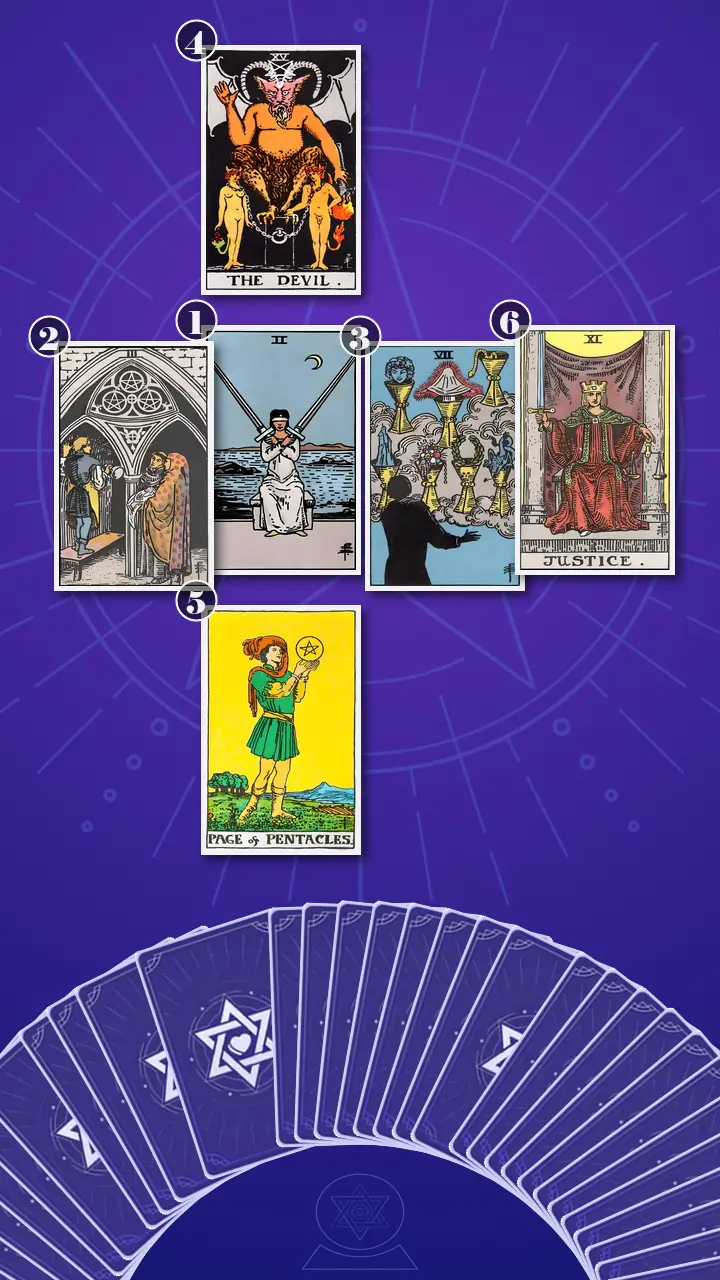
Reading the Map: Card Meanings in Context (Internal vs External)
Position 1: The current dilemma as it shows up behaviorally
“Now flipped over,” I said, “is the card representing the current dilemma as it shows up behaviorally—stalling, splitting effort, holding both doors half-open.”
Two of Swords, upright.
“This is like when you have a perfectly reasonable reply drafted to your mentor—grateful, professional, clear—and you still won’t hit send,” I told them. “You keep LinkedIn and the internal posting open like two safety blankets. You call it strategy, but really it’s self-protection from the moment the choice becomes real.”
In terms of energy: this is blockage. Air energy (thinking) is present, but it’s crossed over the heart—too braced to move. The blindfold isn’t ignorance; it’s a choice not to look too closely because looking would require feeling.
Jordan gave a small laugh—sharp at the edges, like a spoon hitting glass. “Okay, that’s… mean. Accurate, but mean.” Their shoulders stayed tight, but their eyes softened with that particular relief of being seen in a way your own Notes app never manages.
“More tabs isn’t more clarity,” I said gently. “If we want to stop the decision fatigue, we need to name what the stillness is protecting you from.”
Position 2: Path A — moving internally via the mentor referral
“Now flipped over,” I said, “is the card representing what moving internally via the mentor referral realistically offers—skills, environment, momentum.”
Three of Pentacles, upright.
“This one is very literal,” I said. “The internal move looks like a team with an actual process: clear expectations, real collaboration, mentorship that’s not just vibes. The referral isn’t only access—it’s a signal you’ll be evaluated by people who can see your craft up close.”
The energy here is balance—Earth energy that can hold structure without suffocating you. It’s the opposite of floating possibilities. It’s “we have a blueprint, we build something, we get feedback.”
I watched Jordan’s face change almost imperceptibly: their jaw unclenched by a millimeter. “I keep forgetting to ask what the day-to-day would even be,” they admitted. “I’m obsessing over what it means.”
“Exactly,” I said. “This card is bringing you back to work-as-lived, not work-as-headline.”
Position 3: Path B — continuing the external job hunt
“Now flipped over,” I said, “is the card representing what continuing the external job hunt realistically offers—possibilities, risks, and energy demands.”
Seven of Cups, upright.
“External searching feels expansive until it doesn’t,” I told them. “You can picture five different futures from five different listings, and each one seems like it could ‘fix’ your story. You save roles, you tweak your resume in multiple directions, and you end the night more scattered—because the possibility high fades into decision fatigue.”
The energy here is excess: too many options, too many imagined selves competing for attention. The problem isn’t that external roles are bad. It’s that your attention gets diluted until no single application strategy receives enough conviction to become real.
Jordan stared at the card on my end of the table (I angled it toward the camera), then looked away toward their own window. “It’s like LinkedIn is an endless streaming menu,” they said. “Forty-five minutes choosing, zero minutes watching.”
“That’s the Seven of Cups in modern language,” I said. “And it’s not a moral failing. It’s just what happens when possibility becomes an emotional escape hatch.”
Position 4: The hidden fear/attachment distorting the decision
“Now flipped over,” I said, “is the card representing the hidden fear or attachment making this decision feel identity-defining and high-stakes.”
The Devil, upright.
I didn’t rush this one. Even through a screen, I could feel the room shift—like the air got denser.
“Here’s the split-voice I hear in your story,” I said, keeping it candid and kind.
Polished, LinkedIn-optimized voice: ‘Make the smart narrative move. Don’t look like you’re playing small. Don’t look like you’re drifting.’
Nervous body voice: ‘I just don’t want to be trapped. I don’t want to commit and realize I can’t get out.’
“The Devil is image pressure pretending to be logic,” I continued. “One voice says an internal move is ‘playing it safe.’ Another says refusing the referral is ‘reckless.’ And suddenly both options feel like cages because they’re being asked to prove your worth.”
On my old trading floor, we used to call this a ‘narrative position’—when you’re not managing risk anymore, you’re managing how the story will look to other people. It’s brutal because it feels like analysis, but it’s actually fear with a spreadsheet skin.
“If it’s about your worth, you’ll never get enough data,” I said quietly.
Jordan’s reaction came in a real three-beat chain: first, a tiny freeze—breath caught high in their chest. Then their gaze unfocused, like their brain replayed a Sunday night spiral and a TTC Line 1 scroll at the same time. Then a soft exhale: “Oh.” Their shoulders dropped just enough to look human again.
“The chains in this card are loose,” I added. “Meaning: internal moves and external searches are adjustable. But your mind is framing them as permanent identities.”
Position 5: A one-week grounded next step that creates evidence
“Now flipped over,” I said, “is the card representing a one-week grounded next step—evidence, agency, movement without forcing a premature forever-answer.”
Page of Pentacles, upright.
“This is the antidote,” I told them. “Instead of demanding certainty, you run a one-week plan: two conversations and three targeted applications that fit your criteria. You’re not deciding your whole future—you’re collecting evidence that rebuilds self-trust through action.”
The energy here is balance moving into growth: beginner’s mind, practical curiosity, measurable steps. The Page doesn’t need to feel confident first. The Page needs to show up and take notes.
Jordan’s hand moved—almost involuntarily—toward their phone. “I want to put something in my calendar,” they said.
“Good,” I said. “Run a one-week decision experiment—don’t audition a permanent identity.”
This is where my business brain always kicks in: I call it Transition Roadmapping. Think of this week like IPO prep, not a lifetime contract. One week of due diligence beats a month of vibes. We’re preparing your next move with clean inputs—so when it’s time to ‘price’ the decision, you’re not doing it in a panic.
When Justice Spoke: The Fair Process That Ends the Loop
I saved the final card for last, the way you save the line item that actually decides whether a deal makes sense. “This,” I said, “is the integration.”
Position 6: Integration — the decision rule
“Now flipped over,” I said, “is the card representing how to choose in a way you can respect later—values, criteria, boundaries, timeline.”
Justice, upright.
The moment the card appeared, the condo LEDs in Jordan’s background flickered—just once, like the environment itself agreed to stop being subtle.
Jordan was still stuck in the familiar mental trap: the blinking cursor on the mentor reply, the fear that ‘send’ locks a door, the need for a guarantee before touching the handle. It was the same high-stakes framing that turns a normal career choice into a referendum on your judgment.
Not “wait until you’re sure”—create a fair process, weigh it like scales, then let the sword make a clean cut.
For a beat, neither of us spoke.
Then Jordan’s body did the thing bodies do when truth lands cleanly. First: a visible pause—like their breath finally found the bottom of their lungs. Second: their eyes went glassy, not with drama but with recalibration, as if a hidden tab in their mind closed. Third: their shoulders sank, and their mouth opened on a quiet, almost surprised laugh. “That’s… what I’ve been missing,” they said. “I’ve been trying to pick the option that makes me feel confident. I don’t feel confident about either.”
“Exactly,” I said. “Confidence isn’t the prerequisite for a good decision—it’s often the byproduct of a fair process you can stand behind.”
I pulled my pen closer. “Here’s where I use something I call Human Capital Valuation,” I told them. “On Wall Street, you don’t buy a company because it makes you feel good. You buy because the fundamentals—skills, cash flow, execution, leadership—price out. In your case, we ‘price’ each path by what it grows in you: skills, scope, relationships, lifestyle. Not optics. Not fear.”
“Now,” I added, “use this new lens and think back: last week, was there a moment you could’ve felt different if you’d separated Evidence from Image?”
Jordan swallowed, eyes dropping to the corner of their desk. “Wednesday. My mentor pinged, ‘Any thoughts?’ and I… changed one word in the draft and went back to LinkedIn. I didn’t need more tabs. I needed a rule.”
That was the shift: from tight, image-driven indecision to values-based self-trust built through real-world evidence. Not a personality makeover—just a cleaner way of choosing.
The Justice Rubric: Actionable Advice and Next Steps You Can Do This Week
I threaded the whole spread back together for Jordan in plain language: the Two of Swords showed how non-choice was protecting them from the discomfort of commitment. The Three of Pentacles showed the internal referral wasn’t just “safe”—it could be a real craft-building environment if the team fit was genuine. The Seven of Cups showed external searching could be powerful, but only if it stopped being an identity buffet. The Devil revealed the real driver: status and resume-story pressure hijacking the steering wheel. The Page of Pentacles offered the cure: one week of grounded evidence. And Justice was the finale: a decision rule—values plus criteria plus timeline—so avoidance stops running the calendar.
“Here’s the cognitive blind spot,” I said. “You’ve been treating this like you need a perfect long-term answer. But the actual path forward is a time-boxed, values-based process with one concrete step on each path.”
Jordan nodded, then hesitated. “But what if I do the chat and it still doesn’t feel obvious?”
“Then you’ll still be ahead,” I said. “Because you’ll have evidence. And a clean process. Choose the process you’d respect later.”
Then I made it simple—because actionable advice only works if it survives a Tuesday night.
- Send the clean mentor message (15 minutes)Tonight or tomorrow morning, send a 4-sentence message: thank them, say you’re seriously considering it, and ask for a 15-minute chat to understand day-to-day scope and timeline.If your chest tightens, do the “short version.” A clean email is a boundary with your own anxiety—you don’t owe an immediate yes, only respectful communication and a clear next step.
- Walk into the chat with five real questionsBefore the call, write 5 questions in Notes: scope, manager style, success metrics, onboarding support, and what “good” looks like at 30/60/90 days. Ask them directly—no reading between the lines.If you’re worried about sounding “difficult,” frame it like you’re trying to set yourself up to execute well. That’s professional, not needy.
- Run the ‘Tabs-to-Template Week’ for external rolesFor the next 7 days, pick one job family and one seniority level. Apply to 3 roles max that meet your top 3 criteria—then stop. No mixing, no endless rewrites.This is your Seven of Cups filter. You’re allowed to keep hunting while exploring internally—as long as it’s time-boxed and evidence-based, not doomscroll-based.
As a final tool, I had Jordan do the simplest Justice exercise from the card’s imagery—scales and sword, modernized: a two-column note titled Evidence vs Image. “If the Image column is driving,” I told them, “you’ll never feel done. If the Evidence column is driving, you’ll feel steadier even when you’re not 100% sure.”

A Week Later: Ownership, Not Certainty
Six days later, Jordan emailed me a screenshot: a sent message thread with their mentor and a calendar invite titled “15-min role chat.” Under it, three external application confirmations—nothing dramatic, just done. Their caption read: “I didn’t magically feel brave. I just followed the process.”
They added one more line that felt quietly bittersweet and very real: “I slept through the night for the first time in weeks. I still woke up and thought, ‘What if I’m wrong?’—but this time I smiled a little, because I have a timeline and I’m not trapped.”
That’s the kind of clarity tarot is best at: not certainty. Ownership. A way to move at a career crossroads without letting LinkedIn optics write your life for you.
When a mentor offers a door and the internet offers a thousand more, it’s easy to hold your breath and freeze—because it feels like one email could decide whether you’re “ambitious” or “settling.”
If you trusted that you can iterate later, what’s one small piece of real-world evidence you’d want this week before you call anything a “final” decision?