From Slack-Ping Pressure to Calm Focus: Naming Two Managers’ Conflict

The 10:38 p.m. Double-Update
If you work a fast-moving ops/project role in a city like Toronto and you’ve ever sent two different status updates for the same work—one for each manager—you’re not disorganized. You’re being triangulated.
Taylor (name changed for privacy) met me over video from their condo in Liberty Village. It was the kind of late-night call where the light from the laptop makes everyone look a little underwater. Slack sat open on the left side of their screen, Teams on the right, and the same status update was being rewritten twice—one version that made Manager A the headline, another that made Manager B feel “covered.”
The fridge hummed like it had something to prove. Their phone kept vibrating on the coffee table, a small angry insect. I watched Taylor’s shoulders creep up toward their ears with each buzz, and their jaw lock so hard it changed the shape of their voice.
“Two managers, two priorities,” they said. “And somehow I’m the place where their conflict goes to hide. I say yes in DMs because… what else am I supposed to do? Then I spend the week context-switching, rewriting updates, making incompatible timelines look possible.”
Pressure, in their body, wasn’t a feeling. It was a clamp—like someone had tightened a zip tie around the base of their neck every time a notification hit.
I nodded, slow and plain. “We’re not here to make you a better juggler,” I said. “We’re here to find clarity—where the priorities can live in daylight, not just in your private messages. Let’s draw a map of what’s actually happening.”
Choosing the Compass: The Energy Diagnostic Map for Workplace Boundaries
I asked Taylor to take one breath that went all the way down—one hand on their sternum, just to notice what their body did when they pictured those two chat threads. While they exhaled, I shuffled slowly. Not for mystery, but for focus: a deliberate transition from reacting to looking.
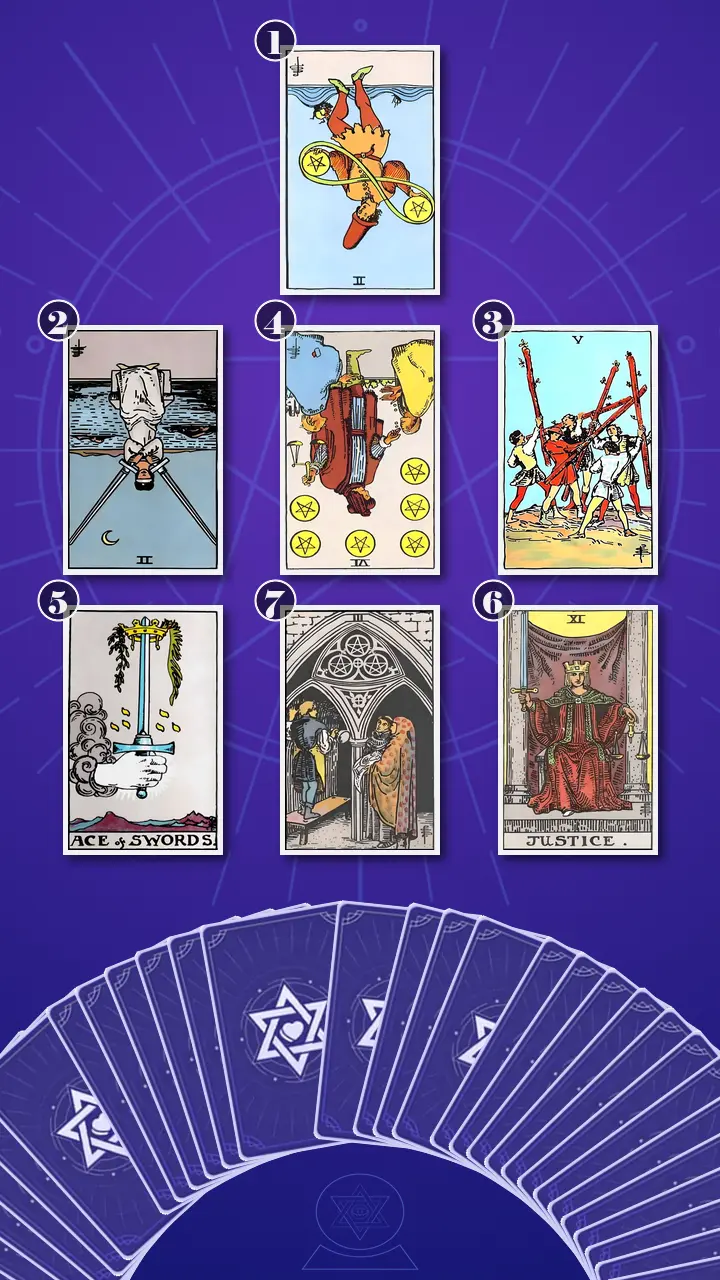
“Today,” I said, “we’ll use a spread I call the Energy Diagnostic Map (7) · Context Edition.”
For the reader: this isn’t a simple either/or problem—choose Manager A or Manager B. It’s a repeating loop: conflicting authority gets routed through one person, and that person starts doing unpaid alignment work in private. This spread is built to trace a chain—surface symptom → inner tug-of-war → external pressure → the core knot—then move into resources and next steps. It’s how tarot works best in workplace dynamics: not as a prediction about who “wins,” but as a framework for naming what’s real and choosing an actionable move.
I pointed to the layout on my desk: “We’ll start with what triangulation looks like on your screen and in your calendar. Then we’ll name the internal split that keeps you saying yes. Card 4 sits at the center as the knot—the power dynamic that makes this persist. Then we’ll look at what tool you can use immediately, the key transformation, and the next practical step.”
Reading the Map: When Two Bosses Pull You Into the Middle
Position 1 — Surface symptom: what triangulation looks like in your day-to-day behavior and workload
“Now we open the card that represents the surface symptom—what triangulation looks like in your day-to-day behavior and workload.”
The Two of Pentacles, reversed.
This card’s modern translation could have been pulled from Taylor’s Tuesday night: running two parallel ‘truths’ about the same week—one priority list for Manager A, one for Manager B—spending more time rebalancing the story than moving the work. The moment one “quick favor” lands, the whole schedule tilts, so you compensate by working later and telling yourself this is just normal ops chaos.
Reversed, the Two of Pentacles isn’t “busy.” It’s blocked Earth energy: capacity limits being treated like a negotiable concept. The juggler’s loop breaks. The sea gets choppier. The body pays.
I said it directly: “You’re not bad at time management—you’re doing unpaid alignment work.”
Taylor let out a short laugh that had no joy in it. They looked away from the camera like they couldn’t stand being seen that clearly. “That’s… yeah,” they said. “It’s true. And it’s kind of brutal hearing it out loud.”
“Brutal,” I agreed, “but also useful. Because if we mislabel triangulation as a personal productivity problem, your only solution becomes: work later, explain more, absorb it privately. And that’s how the loop keeps you.”
Position 2 — Inner tug-of-war: the internal stance that keeps you stuck between two leaders
“Now we open the card for the inner tug-of-war—the internal stance that keeps you stuck between two leaders.”
The Two of Swords, reversed.
In modern life, this is the draft message you never send. You write: “I’m receiving two priority streams that conflict—can we confirm priority #1?” Your chest tightens. You delete it. Then you send two separate updates that avoid the contradiction. It feels professional in the moment, but it locks you into paralysis where your silence becomes the decision—and your evenings become the payment.
Reversed, the energy isn’t balanced neutrality. It’s deficiency in Air: not enough truth spoken to keep your reality breathable. The blindfold slips; the swords wobble. You can’t hold this posture forever.
I leaned in a little. “Neutrality is still a decision—just one you pay for privately.”
Taylor’s reaction came in three beats: their breath stopped mid-inhale, their eyes unfocused as if replaying a week of deleted drafts, and then their shoulders dropped a fraction—like their body recognized the cost before their mind could argue with it.
“I keep thinking if I name it, I’ll look like I can’t handle my job,” they said, softer. “Like… it’ll prove I’m not valuable.”
“That fear makes sense,” I said. “But it’s also the exact hook that keeps you acting as the human router.”
Position 3 — External pressure: how the environment and other people’s agendas intensify the problem
“Now we open the card that represents external pressure—how the environment and other people’s agendas intensify the problem.”
The Five of Wands, upright.
This is the loud workplace: two managers pushing different agendas, both using urgency as leverage, and the conflict traveling through you via pings, standups, and last-minute “just one more thing” requests. Nobody is the clear owner of trade-offs, so the loudest message wins the hour even if it loses the week.
Upright, the Five of Wands is excess Fire: heat without coordination. It’s not evil. It’s uncontained. And in a matrix environment, it tends to pick a battleground. Right now, that battleground is Taylor’s calendar.
I named the math of it: “Two priority streams + one person = a built-in failure loop.”
Taylor nodded, fast. “Exactly. Like I’m the sprint backlog and also the scrum master and also… the punching bag.”
“And you have no formal authority,” I said, “which means the system quietly incentivizes everyone to route the clash through the most responsive person. That’s not a character flaw. That’s incentives behaving like incentives.”
Position 4 — Core blockage: the hidden power dynamic or belief that makes triangulation persist
“Now we open the card at the center—the core blockage. This is the knot.”
The Six of Pentacles, reversed.
Here’s the modern scenario: you’re being treated like a resource to allocate, not a person with finite capacity. You’re expected to absorb trade-offs without being given authority to set priorities or force a decision. Credit and urgency get handed down; the cost—late nights, quality risk, anxiety—stays with you.
Reversed, this is blocked giving-and-receiving. The scales exist, but they aren’t being used fairly. Someone is distributing “coins” (tasks, urgency, demands) from above, while you kneel beneath a workload you didn’t choose.
I kept my tone careful—no villains, just structure. “They distribute urgency; you pay in evenings.”
Taylor’s face tightened, then softened. A deep exhale left their chest like air escaping a sealed container. Under it, there was a quiet anger—cleaner than the earlier chaos. “That’s exactly it,” they said. “I feel… essential and replaceable at the same time.”
As an archaeologist, I’ve spent years looking at ancient distribution systems—grain, coinage, labor. The people who suffered most weren’t always the least skilled. They were the ones positioned where everyone else could offload costs without acknowledging them. Seeing this card, I had the same professional instinct I have at a dig: don’t argue with the topsoil. Follow the pressure down to the structure beneath.
Position 5 — Usable resource: what you can access right now to create clarity and reduce emotional load
“Now we open the card for your usable resource—what you can access right now to create clarity and reduce emotional load.”
The Ace of Swords, upright.
This is your leverage: clean, direct documentation. A crisp one-paragraph recap that names the trade-off and asks for a single confirmed priority owner. Instead of being the private translator, you become the person who creates one shared source of truth others have to respond to.
Upright, the Ace of Swords is balanced Air—not more words, but sharper edges. The sword doesn’t start a fight; it cuts through fog.
“Clarity isn’t escalation. It’s accountability,” I said. “In Teams or Slack, a short recap message can function like version control. One approved branch. Not two secret forks you’re maintaining alone.”
Taylor made a small sound—half surprise, half relief. “I could… write it like a decision needed, not like a confession,” they said. Their thumb hovered near the screenshot shortcut on their phone, as if their body already wanted to save the phrasing.
Position 6 — Key transformation: the mindset and practice that ends triangulation without escalating drama
“Now,” I said, and I let the room go a little quieter, “we’re turning over the most pivotal card in this reading—the key transformation.”
Justice, upright.
Justice is process, fairness, accountability, and clean boundaries through clear agreements. In workplace triangulation, it’s the shift from private buffering to visible prioritization: who decides, by what criteria, and what gets deprioritized.
And here is where my own “skill archaeology” lens matters. Taylor thinks their value is responsiveness—the ability to reroute requests and keep everyone calm. But buried under the people-pleasing soil is an overlooked talent: they can facilitate clarity. That’s a leadership skill, even without a title. Justice doesn’t ask them to become louder. It asks them to become the arbiter who brings the scales into the open.
First, the setup—because I could feel Taylor’s familiar loop tightening: 10:38 p.m., Slack on one side and Teams on the other, rewriting the same update twice, trying to make two timelines sound compatible so nobody notices the conflict. They were trapped in the belief that the only safe option was to keep both managers happy in private.
Not “I have to keep both managers happy in private,” but “I can ask for a fair, shared decision,” like Justice’s scales that put the priorities where everyone can see the weight.
The words landed in the silence like a gavel—soft sound, heavy meaning. Taylor froze for a beat: breath paused, lips parted, eyes fixed on a point just below my camera. Then I watched the reaction travel through them in layers. Their brow tightened as if the sentence offended the part of them trained to survive by smoothing things over. Their jaw flexed—one last reflexive clench—before it loosened in a slow, almost startled release. Their shoulders slid down as though someone had removed a backpack they’d forgotten they were wearing. And then there was a new vulnerability in their face: the dizzy feeling that comes after clarity, when you realize you can’t unsee what you’ve seen.
“But… if I ask for that,” they said, voice a little rough, “won’t they think I’m making it dramatic?”
“That’s the old contract speaking,” I replied. “Justice rewrites it. You’re not accusing anyone. You’re moving the trade-off to a place where it can be owned. Stop being the buffer. Put the trade-off where everyone can see it.”
I paused, then invited the practical memory test: “Now, with this lens—fair, shared decision—think back to last week. Was there a moment where this would have changed how your body felt? One ping, one meeting, one deleted draft?”
Taylor blinked fast. “Thursday,” they said immediately. “Manager A asked for a ‘quick question’ right after I committed to Manager B’s deadline. I felt my stomach drop. If I’d had a script… I could’ve asked which deliverable moves. Instead I said yes and paid for it at night.”
That was the emotional shift in real time: from pressure and reactivity toward steadier confidence in boundaries. Not perfect certainty—just a new center of gravity.
Position 7 — Next step: a practical move to establish shared priorities and protect your bandwidth
“Finally,” I said, “we open the card for the next step—the move that makes this real in your actual week.”
The Three of Pentacles, upright.
This card is the ‘third point’ that breaks the triangle: a short alignment touchpoint—meeting or shared thread—where both managers see the same plan, confirm the priority order, and leave with written action items and ownership. Your job shifts from secret diplomacy to visible coordination.
Upright, it’s balanced Earth: structure you can stand on. A shared blueprint. A container that keeps priorities from mutating in DMs.
Taylor’s posture changed as they pictured it. They sat back, like their spine remembered it could have space. “A 20-minute huddle,” they said, almost to themselves. “I could actually do that.”
The Visible Trade-Off Plan: Actionable Advice for Matrix Management Stress
I tied the reading together in the plainest story I could: you started with overloaded Earth—too many commitments and not enough capacity acknowledged (Two of Pentacles reversed). Then Air got stuck—truth held back to keep the peace (Two of Swords reversed)—so the conflict escaped as Fire outside you: competing agendas and vibe-based urgency (Five of Wands). The knot was always power: tasks distributed down without decision ownership (Six of Pentacles reversed). The way out is Air used cleanly—documentation as a single source of truth (Ace of Swords)—then Justice as the governing principle: visible accountability. And it lands back in Earth as a shared plan, co-owned (Three of Pentacles).
The cognitive blind spot I saw was this: Taylor treated alignment as a personal social risk—Will I look difficult?—instead of a delivery risk the system must own. The transformation direction is clear: shift from privately absorbing misalignment to making prioritization explicit in a shared forum with a clear decision owner and written criteria.
Then I offered what I call my Megalith Transport approach—because in archaeology, you don’t move a standing stone in one heroic heave. You move it with rollers, teams, and small repeatable steps. Here are Taylor’s rollers.
- The 10-minute pauseThis week, pick one active request and respond with a 10-minute delay, then ask: “If I take this on, which existing deliverable should move?” Use it in Slack/Teams the first time your body does the jaw-clench thing.If guilt spikes, label it “urgency discomfort.” You’re not ignoring them—you’re making room to answer with clarity instead of adrenaline.
- The tiny trade-off list (no aesthetic upgrades)Open Notes or Notion and make three columns: requestor / due date / impact. Update it for one week, especially when a “quick favor” arrives. This is your personal decision log—simple enough to maintain.Keep it ugly on purpose. If you start formatting, you’re soothing anxiety, not building evidence.
- The shared containerSchedule a 20-minute alignment touchpoint with both managers (or start a shared thread) titled: “This week’s priority order + trade-offs.” Bring a draft list of priority #1, what moves, and what’s at risk. Ask them to confirm the order and name who owns the call if priorities conflict.If a meeting feels like “too much,” start with a shared message: “Here’s the draft priority order—please confirm.” Frame it as protecting delivery, not making a point.
Before we ended, I added one last piece from my Relic Authentication strategy: “Not every urgent ping is a real artifact,” I told Taylor. “Some are modern replicas—pressure-shaped, not priority-shaped. Your job is to ask for provenance: What moves? Who decides? What’s the impact?”

A Week Later: Ownership, Not Certainty
Six days later, Taylor messaged me a screenshot. It was short, almost anticlimactically so:
“I sent the recap. I named the trade-off. I asked who owns the decision if priorities conflict. Manager A answered in the thread. Manager B reacted with a thumbs-up. No one yelled. I didn’t rewrite it twice.”
They added one more line: “I slept. Not perfectly. But I slept.”
Clear but vulnerable, in under 50 words: they woke up to the familiar first thought—What if I was ‘difficult’?—and then they saw the time-stamped thread, the written priority order, and felt their shoulders drop. Not joy. Proof.
That’s the Journey to Clarity I trust most: not a dramatic confrontation, but a quiet shift from being a human router to being a visible coordinator—someone who can say yes with conditions, or no with professionalism, without absorbing other people’s conflict.
When two managers want two different realities, your body ends up holding the collision—tight shoulders, a clenched jaw, and that quiet fear that asking for one clear priority will “prove” you’re not valuable enough.
If you didn’t have to be the buffer for one week, what would you want to make visible—one sentence, one trade-off, one ‘who decides this?’—so the priorities stop living only in your DMs?