Boss Praised Me in Slack—Why I Couldn’t Let It Count for 30 Minutes

Boss Praised Me in Slack—and My Stomach Dropped
You screenshot compliments like receipts, but somehow your brain still files them under “doesn’t count,” then makes you earn them again with more work.
Taylor (name changed for privacy) said that to me with the kind of flat, practiced laugh that’s almost a reflex—like they’d told the story so many times it had turned into a punchline.
They were 28, a mid-level product manager in New York, and when they showed up for our session they looked like someone who’d been running without noticing they were running. It was 8:47 PM on a Tuesday in their Brooklyn walk-up: laptop open on the couch, Slack glowing in dark mode. Their boss’s “Shout-out to Taylor” message was still pinned on-screen, but the cursor was already hovering over Jira. The radiator hissed like it had its own opinion. Their phone felt warm in their palm. And when that praise sat there—public, bright, undeniable—their chest tightened the way it does right before you get cold-called in class.
“I saw it pop up,” they told me, eyes not quite on the screen, not quite on me. “And for like… half a second, I felt good. Then it was like my stomach dropped. Like, now I have to be even better or they’ll realize it was a fluke.”
In other words: they wanted recognition to land and feel solid at work—yet feared that believing it would set them up to be exposed as not enough. The contradiction wasn’t philosophical. It lived in their body: tight chest, sinking stomach, then that restless energy that makes your legs bounce and your brain reach for the next task like it’s a life raft.
Doubt, in Taylor’s case, wasn’t a thought. It was like trying to hold a glass of water while someone keeps tapping the rim—never enough to spill, always enough to keep you braced.
I leaned forward slightly, keeping my voice simple. “That makes sense. A lot of people assume imposter syndrome looks like feeling small all the time. But for high performers, it often looks like sprinting the moment something good happens.” I nodded toward the laptop. “Let’s try to map what’s happening—so you’re not stuck living inside the reflex.”

Choosing the Compass: The Four-Layer Insight Ladder Spread
I’m Hilary Cromwell—archaeologist by training, professor by habit—and I’ve learned that most modern problems have ancient mechanics. Not because history repeats neatly, but because humans repeat neatly. We build the same defenses, just with better UI.
I asked Taylor to take one slow breath—not as a ritual, but as a reset—and to hold the question in a practical way: “Boss praised me in Slack—what old story makes me dismiss it?” While they breathed, I shuffled. The sound of the cards was soft and papery, like turning the pages of a field notebook.
“Today I’m going to use a spread I designed called the Four-Layer Insight Ladder · Context Edition,” I said. “It’s built for moments like this—when you’re not choosing between options as much as trying to understand an internal pattern.”
For readers who wonder how tarot works in a grounded, non-mystical way: I treat a spread like a structured interview with your own nervous system. The positions force specificity. The cards provide a symbolic language that bypasses your usual defenses—especially the ‘hyper-analytical self-editing’ that can keep you stuck in loops.
This ladder spread is the smallest structure that still covers the full chain: (1) your immediate, observable reaction; (2) the thought that locks in the reaction; (3) the deeper “old program” underneath; (4) the inner resource that helps you stay present; (5) the key reframe that revises the verdict; and (6) a one-week practice so the insight doesn’t evaporate the moment you open Jira again.
“We’ll climb it in order,” I told Taylor. “And we’ll keep it concrete: what you did, what you told yourself, and what it cost you.”
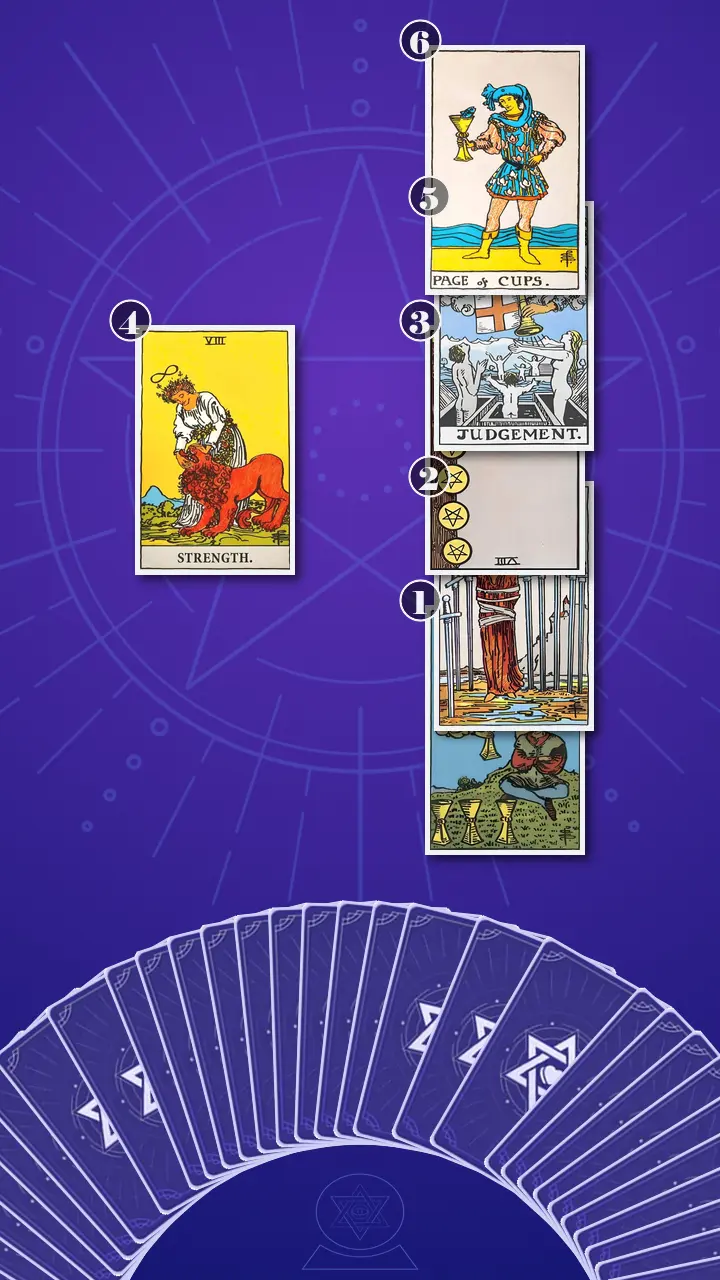
The First Rungs: The Swipe-Away and the Mind Trap
Position 1 — Surface reaction: what you do right after the Slack praise
“Now turning over,” I said, “is the card representing your surface reaction: what you do right after the Slack praise—the observable dismissal pattern.”
Four of Cups, upright.
In the most modern, workplace-specific translation, this is the compliment notification you swipe away like it’s an ad—even though it’s the thing you wanted. It’s your boss praising you in a public Slack channel, and you feel a tiny hit of relief—then emotionally close the pop-up. Deflect with “team effort,” react with a quick emoji and vanish, or alt-tab into Jira so you don’t have to sit in the sensation of being seen.
Energetically, the Four of Cups is a blockage of receptivity. Not because you don’t care—because part of you believes caring is dangerous. You want the recognition, and the moment it arrives you turn your face away so it can’t change anything inside you.
I added, gently wry, “If praise makes you speed up, it’s not motivation—it’s threat response.”
Taylor let out a half-laugh that sounded surprised and a little bitter. “That’s… annoyingly accurate,” they said. Then, quieter: “It’s like you’re watching my screen.” Their fingers tapped the trackpad twice, as if proving the point.
Position 2 — Immediate inner trigger: the thought that tightens the response
“Now turning over is the card representing your immediate inner trigger: the meaning your mind attaches to the praise—the sentence that makes your body tighten.”
Eight of Swords, upright.
The Eight of Swords is what I call the “spam filter” card in modern work life. You reread the Slack praise to find the catch that isn’t there. You decide it was “just being nice,” or that it’s secretly about raising expectations. The compliment becomes a mental maze—every exit feels risky—so you choose the safest-seeming move: don’t believe it.
Energetically, this is a self-imposed bind. The blindfold is the assumption. The loose ties are the part you could question. And the swords—those are the sharp, tidy thoughts that keep you “safe” by keeping you small.
I asked, “What’s your exact auto-generated sentence? Not the paragraph you’d write in therapy. The one-line push notification your brain sends.”
Taylor didn’t answer immediately. Their eyes drifted upward and left—the look of someone searching their own archive. “It’s… ‘Now they’ll expect more.’ Or ‘Don’t get cocky.’” They swallowed. “And—‘They probably didn’t look closely.’”
That last one landed with a familiar heaviness. I’d heard it in different accents across decades: from graduate students, junior analysts, museum curators. Same sentence, different costume.
Position 3 — The old story: the learned rule about worth that blocks recognition
“Now turning over is the card representing the old story—the learned rule about worth and safety that makes receiving recognition feel unsafe.”
Eight of Pentacles, reversed.
In the modern scene, this is the post-win compulsion: cursor blinking in Jira or Linear, reopening a shipped doc, adding scope no one asked for. It’s taking something that worked—and compulsively “improving” it so the compliment feels justified. You look reliable. Inside, you’re trying to purchase safety with effort because being done feels exposed.
Energetically, the reversed Eight of Pentacles is excess effort with zero embodied pride. Work without completion. Craft without permission to feel progress. It’s mastery blocked not by lack of skill, but by a rule that says: if I’m not producing right now, the praise was a fluke.
I described it the way it actually happens: “Slack praise hits. Dopamine blip. Then your system flips to, ‘Fix it. Add more. Polish. Suffer a little so it counts.’ Competence versus safety. Being done versus being protected by busyness.”
Taylor’s reaction was exactly the one I’d hoped for—not delight, but recognition. A quiet, uncomfortable nod. Their shoulders lifted, then dropped with a small exhale. “Wait…” they said, almost to themselves. “I do do that.” The admission hung there, vulnerable and plain.
As an archaeologist, I’ve excavated ancient workshops where craftspeople made the same object hundreds of times: coins, beads, tiles. Repetition builds skill—but it can also become compulsion when the worker believes their worth lives in the hammer swing, not in the finished thing. Taylor’s “old story” wasn’t laziness. It was a survival rule: Worth is safe only when I’m busy.
Position 4 — Inner resource: what helps you stay present with being seen
“Now turning over is the card representing your inner resource—what helps you stay in the room when attention lands on you.”
Strength, upright.
Strength is not hype. It’s regulated courage—the ability to stay present with intensity without self-attack. In modern terms: the ability to not open a new tab the second you feel exposed.
The card’s image is gentle hands on a lion. That’s you meeting your own adrenaline spike with steadiness rather than more pressure. It’s staying in the Slack thread for ten more seconds—jaw unclenching, shoulders lowering—before you sprint into productivity like you’re fleeing a spotlight.
Energetically, Strength is balance. Fire that warms, not fire that scorches. It introduces a buffer between trigger and action.
I offered a simple reframe: “You don’t need more drive. You need a small amount of room.”
Taylor’s body responded before their mind did. Their shoulders dropped a fraction. Their breathing slowed. They stared at the pinned Slack message and didn’t touch the trackpad. “I can feel the cringe of being seen,” they said, voice quieter, “and not sprint away.”
“Exactly,” I replied. “Let it land before you negotiate it away.”
When Judgement Sounded Like a Slack Notification
Position 5 — Key reframe: the perspective shift that revises the old verdict
I let the room go a little still before turning the next card. Even the radiator seemed to pause between hisses. “We’re flipping what I consider the turning point of the whole ladder,” I said. “The one that answers your question about the old story most directly.”
“Now turning over is the card representing your key reframe—the perspective shift that revises the old verdict and opens a new relationship to praise.”
Judgement, upright.
Judgement is a wake-up call: not to judge yourself harder, but to recognize that you’ve been living under a sentence—an old verdict—and you keep reissuing it every time something good happens.
Here’s the setup as it plays out in Taylor’s real life: you get the public Slack shout-out, your chest tightens for half a second… and before you can even feel good, you’re already alt-tabbing into Jira, rewriting your own tickets like praise is a deadline you now have to outrun.
Stop treating praise like a trap you must outrun, and start treating it like a trumpet call to revise the verdict you’ve been living under.
I let that line sit in the air. Not as motivation. As a diagnosis.
Then I brought in my own lens—what I call Skill Archaeology. “When I dig at a site,” I said, “I don’t argue with an artifact because it disrupts my theory. I log it. I date it. I place it in context. Your boss’s praise is an artifact from the present moment—evidence of competence as observed in real time. Your nervous system is treating it like counterfeit coin.”
“So we do what any careful archaeologist does,” I continued, “or any careful trader did at a medieval crossroads: we authenticate. Not with vibes—with method.”
Taylor’s reaction came in a three-part chain, so small you could miss it if you weren’t watching closely:
First, a physiological freeze—their breath caught, their fingers hovering above the keyboard as if they’d been about to type a deflection.
Second, cognition seeped in—their eyes lost focus for a moment, like they were replaying a memory of every time praise had turned into pressure.
Third, emotion arrived—not fireworks, but release. A long exhale from somewhere low in their chest. Their shoulders loosened. Their jaw unclenched as if it had been holding a secret.
“But if I change the verdict,” they said, and there was a flash of anger under the vulnerability, “doesn’t that mean I’ve been wrong this whole time?”
I nodded. “It means you’ve been protected this whole time. Big difference. This verdict kept you moving. It kept you safe from the feeling of being watched. But it also kept you from ever letting competence become yours.”
I said the central truth plainly—no mysticism, no toxic positivity: “Discounting praise isn’t humility—it’s an old verdict. And you’re allowed to overturn it.”
Then I invited the question that turns insight into lived reality. “Now, with this new lens,” I asked, “can you remember a moment from last week when the old verdict showed up? A specific Slack message, a meeting, a 1:1—where this would have changed how your body felt?”
Taylor looked down at their pinned message. “Tuesday,” they said. “6:18 PM. I literally—” they made a small gesture like swiping something away, “—closed it and opened Jira. I didn’t even let myself read it all the way through.”
“That’s the turning point,” I told them. “Not from self-doubt to perfect confidence. From reflexive deflection and fear-driven overworking to calm self-trust—the ability to record clean evidence without putting it on trial.”
Position 6 — One-week practice: the small way to receive and integrate praise
“Now turning over is the card representing your one-week practice—the behavior that lets the reframe become real.”
Page of Cups, upright.
The Page of Cups is emotional receptivity without performance. It’s the surprising tenderness that shows up when you stop deflecting and actually receive. In modern work terms: a clean, human reply to praise—no over-explaining, no disclaimers, no sprinting into extra tasks to earn it twice.
I watched Taylor’s face soften in that particular way people soften when they realize the “solution” isn’t bigger effort—it’s a smaller, braver honesty. “I hate how vulnerable ‘thank you’ feels,” they admitted.
“That’s the fish in the cup,” I said. “You expected nothing. You got tenderness. It feels odd because your system is used to treating praise as pressure.”
Then I gave them something copy-paste-friendly, because clarity that can’t be used is just poetry: “One sentence of thanks. One sentence of what you learned. That’s it.”
Proof Logs and Megalith Moves: Actionable Next Steps
I gathered the whole ladder into one story, so it would hold together outside this room.
“Here’s the sequence the cards showed,” I said. “First, the Four of Cups: praise arrives and you swipe it away—alt-tab, deflect, disappear. Then the Eight of Swords: your mind supplies the tightening sentence—‘they didn’t look closely,’ ‘now expectations rise’—and you treat that thought as fact. Then the reversed Eight of Pentacles: your hands respond by manufacturing more work, moving the goalposts, converting the compliment into a debt you must repay with effort. Strength is the handhold: the pause that proves you can stay present without losing momentum. And Judgement is the revision: the realization that your dismissal isn’t objectivity—it’s an old verdict you can update. The Page of Cups makes it behavioral: receive simply, without negotiating it away.”
“The blind spot,” I told Taylor, “is that you’ve been treating praise like a courtroom drama. You keep putting it on trial, hunting for subtext, trying to prove it wrong so you can feel safe. The transformation direction is the opposite: praise is data. Your nervous system decides whether it becomes truth—but data doesn’t need your permission to exist.”
Taylor frowned. “I get it. But the ‘no new tasks for 30 minutes’ thing—honestly, I can’t. My calendar is basically a hostage situation.”
“Good,” I said, and I meant it. “That’s not resistance—that’s operational reality. We’ll use what I call Megalith Transport: if ancient builders could move stones the size of small cars, it wasn’t by sheer willpower. It was by breaking the load into moves your body could actually complete.”
“So we scale it. Ten minutes counts. Five minutes counts. The point is the boundary.”
- Relic Authentication: Build a “Proof Log (No Debate)”Create a private note titled “Proof Log (No Debate)”. After any praise (Slack, email, 1:1), add one bullet that starts with: “Evidence I’m competent:” and only include observable facts your boss named (e.g., “unblocked launch by aligning X,” “made decision Y under ambiguity”).Expect your brain to call this “cringe.” Log it anyway. You’re not trying to feel convinced—you’re collecting clean artifacts from the present.
- The No-New-Tasks-After-Praise Timer (start small)Set a timer for 10 minutes (or 30 if you can). During that window, do not add scope, do not rewrite tickets, and do not volunteer for bonus deliverables. If your brain begs for “just one more subtask,” write it in a “Later” list without committing.Remember: you don’t have to earn a compliment twice. The boundary is the training rep.
- Page of Cups Reply: One clean Slack sentence + one learningOnce this week, reply to public praise with: “Thank you—appreciate you saying that. I learned ___ while working on it.” Then stop typing. Don’t add a paragraph. Don’t shift credit at speed.After you hit send, wait 5 minutes before opening Jira. Get water. Look out the window. Let the compliment exist in your system.
“This is Tool Evolution,” I added, naming another of my own strategies. “You’re not trying to install a whole new personality overnight. You’re upgrading one small behavior at a time—so the old verdict loses power through lack of repetition.”

A Week Later, the Compliment Finally Counted
Six days later, I got a message from Taylor.
“Got a shout-out in #wins,” they wrote. “Did the ten-minute timer. Didn’t open Jira. Logged one line. Replied: ‘Thank you—appreciate you saying that. I learned how to unblock by narrowing options faster.’ Felt weird. Didn’t die.”
I could picture it: the same dark-mode Slack glow, the same itch to sprint—except this time, a pause. A revised verdict in action.
The change wasn’t cinematic. It was quietly brave. They didn’t suddenly stop being ambitious or stop caring. They just stopped treating recognition like a threat they had to outrun.
And in a small, bittersweet kind of way—clear but still tender—they told me they slept through the night for the first time in weeks. In the morning, the first thought was still, “What if I mess up?” They paused, then added, “But I reread the proof log and… I smiled. Like, okay. Data exists.”
That’s the Journey to Clarity I trust: not certainty, but ownership. Not hype, but a steadier relationship to evidence.
When praise lands and your body tightens like it’s bracing for impact, it’s not because you’re ungrateful—it’s because part of you still believes that letting it count will make the next stumble feel like a conviction.
If you treated the next compliment as simple data—just one clean line of evidence—what would it be like to let it sit in your system for five minutes before you try to earn your way out of it?