Stuck Writing for an Old Boss Voice—And How to Document Impact Instead
The 8:57 p.m. Google Doc That Starts Talking Back
If you’re a NYC tech worker who opens your self-review at night and suddenly starts writing like your old manager is still redlining every sentence—this is that feeling.
Jordan showed up on my screen from a walk-up kitchen in Brooklyn at 8:57 p.m., laptop open beside a half-eaten takeout container. The radiator did that rhythmic click… click… click that makes a room feel too quiet. The self-review template glowed an aggressive white, and her fingers hovered like they were waiting for permission.
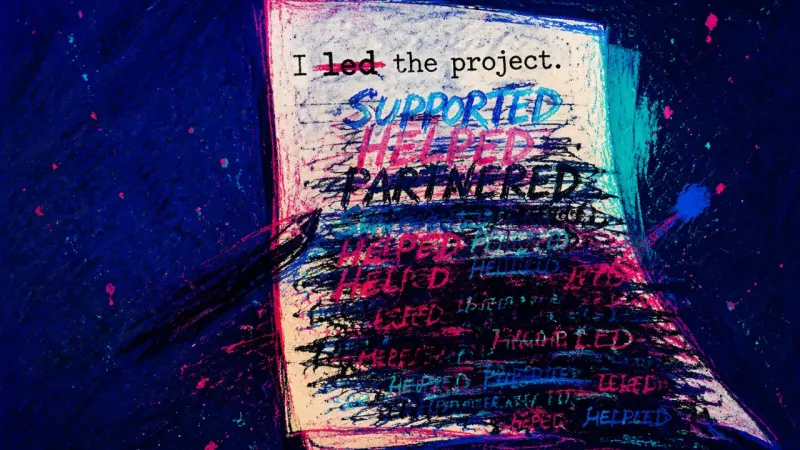
“I keep rereading the same bullet,” she said, eyes flicking between the doc and the ceiling like the criticism might be hiding there. “I change led to supported. I add ‘in collaboration with.’ I delete the metric because it feels… loud.”
I watched her shoulders inch upward with every scroll. The tightness wasn’t abstract—it sat in her chest like a seatbelt locked mid-brake, and it pulled her posture smaller each time she hit backspace.
“I want my self-review to sound like me now,” she said, voice careful. “But my hands keep translating me into the old template. I’m not even sure who I’m trying to convince anymore.”
I nodded, because I’ve seen this exact loop in a hundred different careers, in a hundred different cities. “You’re not ‘bad at self-promo.’ You’re writing for a ghost audience.”
And I told her what I tell anyone who comes to me with that tight-chest, tense-shoulders rewrite spiral: “Let’s make this a Journey to Clarity. Not to force confidence—but to figure out what’s true, what’s useful, and whose voice gets to be in the room while you write.”

Choosing the Compass: The Celtic Cross · Context Edition
I asked Jordan to take one slow breath and hold the exact question in mind—In my self-review, how do I stop writing for my old boss?—not as a mystical ritual, but as a nervous-system handoff: from spiraling to observing.
I shuffled with the steady rhythm I’ve learned both as a tarot reader and as a planetarium guide: people relax when the process has a pace. In my day job in Tokyo, I teach visitors how the sky changes because of motion you can trust—Earth rotates, seasons shift, planets keep their paths. In a reading, I’m looking for that same kind of reliable motion: what keeps repeating, and what can be re-timed.
“We’re going to use the Celtic Cross · Context Edition,” I said.
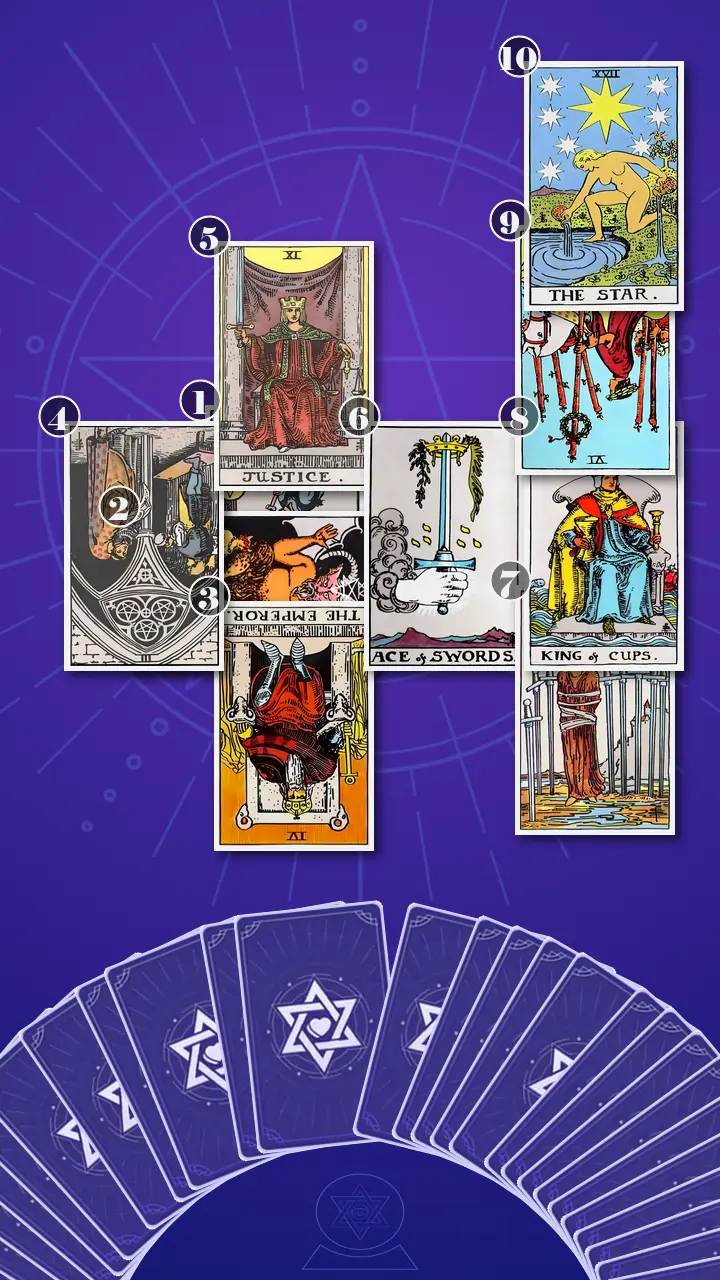
For you, the reader: this version keeps the classic diagnostic power of the Celtic Cross—present symptoms, crossing pressure, root imprint, past pattern, conscious aim—but it adjusts the last stretch so it’s ethical for performance review season. Instead of predicting a fixed outcome like a verdict, Position 6 becomes your next practical writing move, and Position 10 becomes an integration potential: what gets possible if you practice a current-voice, truth-forward review.
I previewed the map for Jordan. “Card 1 will show what your draft feels like in practice—what’s happening on your screen. Card 3 will point to the deeper rule that keeps the old standards alive. And Card 6”—I tapped the table once—“will be the move you can make this week to shift the draft from defensive to direct.”
Reading the Map: Card Meanings in Context for a Performance Review Spiral
Position 1: What your self-review draft currently looks/feels like in practice
“Now flipping is the card that represents what your self-review draft currently looks and feels like in practice.”
Eight of Pentacles, in reversed position.
This is the card version of a perfectly formatted, endlessly revised Google Doc—hours spent polishing verbs, bullet alignment, and tone—while your actual impact stays buried. It feels like you’re working, but not communicating. The effort is real; the progress is not.
Reversed, the Eight of Pentacles isn’t “lazy.” It’s misdirected craft. The energy is there, but it’s being spent on sanding the same coin until the details disappear.
Jordan made a small sound—half laugh, half wince. “That’s… brutal,” she said, and her smile had that bitter edge of recognition. “I have an Apple Notes file titled ‘SELF REVIEW v7 FINAL_final2.’ Like, I know it’s ridiculous.”
“Not ridiculous,” I said. “Protective.”
Position 2: The main friction point that keeps you writing for an old audience
“Now flipping is the card for the main friction point that keeps you writing for an old audience—what crosses the draft.”
The Devil, upright.
The friction isn’t your writing skill. It’s the internalized old-boss reviewer sitting in the room like an invisible Google Doc commenter—comments turned off, but the voice still typing.
I watched Jordan’s eyes narrow at the card, not at me. Like she was staring at a person who used to have access to her nervous system.
I used the “ghost editor” format because that’s exactly what The Devil does in modern work life:
Jordan’s draft sentence: “I led the Q3 launch messaging strategy.”
Ghost editor: “Prove it.”
Micro-action: she changes led to partnered on.
Draft: “I partnered on the Q3 launch messaging strategy.”
Ghost editor: “Don’t overstate.”
Micro-action: she adds, “in collaboration with cross-functional stakeholders,” then deletes the metric because it feels like bragging.
That’s The Devil’s chain: not a literal person in your current org chart, but a habit of writing like you’re drafting a defense brief. It gives short-term relief—harder to attack—and costs you long-term clarity—harder to advocate for.
I said it plainly. “Stop trying to be un-criticizable. Start being advocatable.”
Jordan exhaled like she’d been holding air behind her teeth. Her shoulders dropped a millimeter, then tensed again—like her body didn’t trust the room to stay safe.
Position 3: The deeper root—what internal rule keeps the old boss’s standards alive
“Now flipping is the card for the deeper root: the internal rulebook that keeps the old standards running your document.”
The Emperor, in reversed position.
Underneath The Devil’s shame-chain is structure—old governance policy, old tone rules, old permission slips. This card shows a rigid internal rulebook: what counts as “acceptable,” how confident you’re allowed to sound, how much proof you must provide before you can state a fact.
Reversed, the Emperor’s authority isn’t leadership—it’s surveillance. Armor under a robe. A stone throne in your chest.
Jordan rubbed her collarbone without realizing it. “It’s like… I can’t say ‘I’ twice in a row,” she admitted. “I hear ‘tighten this up’ before anyone even reads it.”
“That’s the Emperor reversed,” I said. “It’s not that you don’t have standards. It’s that they’re not yours anymore—they’re inherited.”
Position 4: What you’re still carrying from the previous dynamic
“Now flipping is the card for what you’re still carrying from the previous dynamic.”
Three of Pentacles, in reversed position.
This maps to a past team where recognition felt inconsistent or overly policed—good work still got questioned, standards shifted, and feedback came with a vibe of appraisal instead of partnership. It trains you to write like you have to prove you belong in the room, even when your current role expects clear ownership and outcomes.
Reversed, it’s a deficit of being seen accurately. So you compensate with more context, more disclaimers, more explaining—until your ownership becomes harder to find.
Jordan’s face tightened, then softened. “She used to ask for proof in a way that felt like… she wanted to catch me,” she said. “Even when I had the proof.”
That’s a wound that doesn’t show up on LinkedIn, but it shows up in verbs.
Position 5: What you’re trying to do consciously (your healthier intention)
“Now flipping is the card for what you’re trying to do consciously—the healthier intention you want this review to embody.”
Justice, upright.
Jordan’s shoulders were still tense, but her eyes focused in a different way when Justice appeared—like the part of her that actually likes being competent finally got a seat at the table.
Justice in context is not “be perfect.” It’s be fair. Fair to your team, fair to your scope, fair to your effort, fair to your results. Evidence-based fairness: a balanced scorecard—impact, collaboration, growth—without self-punishment baked into the metrics.
I gave her the modern version of the scales test: “Claim versus proof. If you can back a claim with receipts—metrics, a launch doc, a customer quote, a Slack thank-you—then accuracy is allowed to be simple.”
Jordan nodded, small and slow. “Okay,” she said, like someone picking up a tool they actually know how to use. “I can work with that.”
When the Ace of Swords Cut the Ghost Out of the Doc
Position 6 (Key Card): Your next practical move in the writing process
Right before I turned the sixth card, my tiny studio got quieter—the kind of quiet I know from the planetarium right after the lights drop, when everyone realizes the ceiling is about to become a sky. Even through Zoom, Jordan went still.
“Now flipping is the card for your next practical move—a shift you can enact, not a fixed future.”
Ace of Swords, upright.
This is the clarity practice: one clean sentence that starts with “I,” one result, one proof point. No defensive footnotes. The moment you stop editing for a ghost and write for your current manager’s actual rubric—impact, direction, specifics.
I showed her the “before vs after” the way I would in a writing workshop:
Before (ghost-safe): “I supported the Q3 launch, partnering with cross-functional stakeholders to help drive alignment, given resourcing constraints…”
After (sword-clean): “I led Q3 launch messaging, which increased trial-to-paid conversion by 12%. Proof: launch dashboard + post-launch readout.”
“Clarity isn’t aggression—it’s authorship,” I said.
And then I brought in my signature lens—the one I’ve used for years watching planets hold their courses. “Jordan, I want to name what I’m seeing through something I call Orbital Resonance,” I told her. “In astronomy, resonance is when two bodies fall into a repeating rhythm because of gravity. In workplaces, it’s when your energy syncs with the evaluator who has the most pull—sometimes even after they’re gone.”
I pointed gently: “Your self-review is still orbiting your old boss’s standards. That’s why every sentence gets tugged into disclaimers. The Ace of Swords is you choosing a new orbit—your current manager’s rubric, your current role, your current voice. Same talent. Different gravity.”
The Aha Moment (Setup → Delivery → Reinforcement)
It matched her reality perfectly: it was late, she was rereading the same bullet, shoulders tense, and she could practically hear her old boss saying, “That’s not specific enough.” She was stuck trying to write the correct sentence instead of the true one.
Stop editing for a ghost and pick up the sword of clarity—state what happened, what you owned, and what you learned.
Jordan’s reaction came in layers—the way real insight does. First: a tiny freeze, breath caught high in her chest. Second: her eyes went unfocused for a beat, like her brain was replaying a dozen old feedback moments at 2x speed. Third: she let out a slow, shaky exhale, and her shoulders dropped like she’d set down a bag she forgot she was carrying.
“But… if I write it like that,” she said, and there was a flash of heat under the fear, “it feels like I’m inviting someone to tear it down.”
“That makes sense,” I said immediately. “Your body learned that directness was punished. But the sword here isn’t a weapon. It’s a boundary. It cuts you free from writing your review as a courtroom defense.”
I asked the question that anchors the insight into her real week: “Now, with this new lens—can you remember a moment last week where you deleted a strong sentence, and this would have let you let it stay?”
Jordan swallowed. “Friday,” she said. “HR pinged. I wrote ‘I led messaging strategy.’ Then I deleted it and wrote three cautious sentences. My chest did the elevator-drop thing.”
“That’s the shift,” I said. “This isn’t just a decision about wording. It’s a move from self-doubt to grounded self-trust—one sentence at a time.”
Position 7: How you are positioned internally while writing
“Now flipping is the card for how you’re positioned internally while you write—your stance.”
Eight of Swords, upright.
This is what it feels like when your language is bound by fear more than by the actual stakes of the review. Like there’s only one safe tone, one safe phrasing, one safe level of visibility.
Upright, the Eight of Swords is a blockage: restriction maintained by assumptions. The key symbol here is the gap between the swords—there is room to move, even if the blindfold makes it hard to feel.
Jordan’s hand went to her jaw. “I wake up with my teeth clenched,” she admitted. “Like I’m bracing for… feedback that hasn’t happened.”
“Your nervous system is writing, not just your fingers,” I said. “So we’ll give it a smaller, safer task.”
Position 8: What your current environment is actually asking for
“Now flipping is the card for what your current environment is actually asking for—signals from your manager and culture.”
King of Cups, upright.
This is steady leadership energy: a manager who can hear a straightforward achievement without turning it into a power game. Calm containment. Nuance without punishment.
I said the line Jordan needed to hear without being shamed by it: “Your body is time-traveling; your workplace isn’t.”
She blinked hard, like she was trying not to cry and also trying not to make it a big deal. “My manager literally wrote last week, ‘This is helpful—keep it specific,’” she said. “He wasn’t… hunting.”
“Exactly,” I said. “This card is your reality check.”
Position 9: Hopes and fears if you write in your own voice
“Now flipping is the card for what you hope will happen and what you fear will happen if you write in your own voice.”
Six of Wands, in reversed position.
This is conflicted visibility: wanting recognition, fearing the vulnerability of being seen. The energy isn’t a lack of ambition—it’s a fear that legibility equals exposure.
Reversed, it can create a loop: you shrink your wins so you can’t be accused of exaggeration… and then no one has enough clarity to advocate for you.
Jordan’s laugh this time was softer. “LinkedIn makes me want to disappear,” she said. “But also… prove myself.”
“That’s human,” I said. “And it’s why we’ll practice visibility in contained doses, with receipts—not vibes.”
Position 10: Integration potential if you practice a current-voice, truth-forward review
“Now flipping is the card for integration potential—what becomes possible if you keep practicing this kind of authorship.”
The Star, upright.
The Star isn’t a promise of a specific review outcome. It’s a description of what your inner weather becomes when you stop writing under a threat you no longer live under.
In modern terms: you read your review and recognize your own voice—still nuanced, still thoughtful, but no longer apologizing for existing. Honest wins. Honest growth. A calm flow backed by proof.
I thought of the planetarium again—how people look up and finally breathe when they can find the brightest star and orient. “The Star is your narrative identity,” I said. “Not loud. Not small. Aligned.”
The One-Page Clarity Plan for Your Self-Review (Actionable Advice, Not Vibes)
I threaded the whole spread into one story, so Jordan could feel it as a single mechanism instead of ten separate meanings.
“Here’s why this has been happening,” I said. “You start with real effort, but it turns into grinding edits (Eight of Pentacles reversed) because an internalized evaluator tightens the chain (The Devil). That evaluator is powered by an old rulebook you didn’t choose (Emperor reversed), built in a past environment where recognition felt inconsistent (Three of Pentacles reversed). Your healthier intention is already correct—fairness and evidence (Justice). The breakthrough is operational: one clean, truth-forward sentence (Ace of Swords). Your inner stance is still braced (Eight of Swords), but your current environment is steadier than your body expects (King of Cups). Visibility still feels risky (Six of Wands reversed), and the integration is a calmer, self-trusting authorship practice (The Star).”
“The cognitive blind spot,” I added gently, “is thinking the way to feel safe is to be harder to criticize. But in performance reviews, safety comes from being easy to advocate for—specific, legible, and supported.”
“The transformation direction is simple,” I said. “Shift from writing to prevent criticism to writing to document impact and direction in your own words.”
Then I gave her next steps she could actually do—even with Sunday Scaries energy and a deadline.
- 20-Minute Action → Result → Proof SprintSet a timer on your phone for 20 minutes. Pick one section (Impact or Collaboration). Write one example using only: Action → Result → Proof. No verb swaps, no formatting, no “just to clarify” paragraphs. Save and stop.When the timer ends, close the doc even if it feels unfinished. Editing is allowed tomorrow; spiraling tonight isn’t required.
- The Two-Line “Headline + Receipt” RuleFor each win, you get two lines only. Line 1: “I led/owned X.” Line 2: “Result: Y (metric/link/feedback).” No third line tonight.If “I led” feels too activating, start with “I owned” or “I drove.” Still direct—slightly softer.
- Elevator Visualization: Change the Floor You’re Writing FromBefore you write, close your eyes for 10 seconds and picture an elevator. Basement floor = old boss voice. Your floor = current manager + future you. Press your floor. Then write one two-line win from that floor.If a “ghost edit” shows up, paste the defensive sentence into a comment at the top labeled “Ghost edit,” instead of inserting it into the body.
Jordan stared at the list like it was a relief to be given constraints. “The two-line thing… I hate how much I need that,” she said.
“You don’t ‘need’ it forever,” I replied. “You’re borrowing structure until your voice feels safe again. Solar sails work the same way—you don’t fight the pressure; you use it to change direction.”

A Week Later: The Quiet Proof of Finding Clarity
Six days later, Jordan DM’d me a screenshot of her 1:1 agenda doc. One bullet was new. Two lines. No apology.
“I did it,” her message said. “I pasted one win in. My manager replied: ‘Great—add the metric to the review too.’ That was it. No teardown.”
She told me she submitted the review on a Tuesday afternoon, then sat alone in a coffee shop for twenty minutes—still a little shaky, but lighter. The doc wasn’t perfect. It was hers.
In the language of this Journey to Clarity, that’s the whole point: not instant fearlessness, but steadiness. A shift from writing to survive an old standard to writing what’s true—cleanly, with receipts, in your own orbit.
When you’re staring at the same paragraph with a tight chest, rewriting it to survive a standard that isn’t even in the room anymore, it makes sense that your real voice starts to feel ‘unsafe.’
If you didn’t have to write to prevent criticism—only to document what’s true—what’s one sentence you’d let stay direct for the next 24 hours?