'Be Strategic' Wasn't a Verdict: How I Practiced Testable Recommendations

When “Be Strategic” Makes Your Brain Go Blank
Jordan (name changed for privacy) sat down and said, “I’m a mid-level PM in London. I can run a programme smoothly—until my boss says be more strategic, and suddenly my brain goes blank like it’s a high-stakes oral exam.”
They didn’t say it dramatically. They said it the way people do when they’ve repeated the story to themselves so many times it starts to sound normal—like it’s just another Tuesday. But their body didn’t sound casual at all. Their jaw looked like it was holding a secret. Their throat moved like swallowing was work.
They described 11:33 p.m. in their Zone 2 flat: radiator clicking, laptop fan doing that thin, constant whirr, the whole room lit by a harsh rectangle of blue-white screen glow. They were reformatting the same slide for the fifth time—adding one more chart “just in case”—while Slack sat open with a half-written message to their boss. Cursor blinking. Not sending. Not deciding.
“It’s like,” Jordan said, staring at the coffee cup between their hands, “I can explain every detail. But when someone asks for the recommendation, my voice disappears.”
I’ve guided thousands of people through star shows at the Tokyo planetarium—watched them go quiet when the dome lights dim and the sky appears. Shame has a similar physics: it narrows your field of view. For Jordan, it wasn’t just stress. It was the feeling of being shrink-wrapped from the inside—like their thoughts were still there, but their mouth couldn’t access them. A tight-throat, sinking-stomach drop that turned “be strategic” into “you’re about to be exposed.”
“We’re not going to treat this like a personality flaw,” I told them. “We’re going to treat it like a pattern—with a shape. And once we can see the shape, we can find the exit.”

Choosing the Compass: The Five-Card Cross · Context Edition
I asked Jordan to take one slow breath—not as a ritual for luck, but as a clean transition. A way to tell the nervous system: we’re switching from panic-replay to observation. Then I shuffled, steady and unshowy, the way you’d handle a tool you respect.
“Today we’ll use a spread called the Five-Card Cross · Context Edition,” I said.
For readers who wonder how tarot works in a practical, non-fortune-telling way: I use spreads like I use star maps. A map doesn’t force you to go anywhere. It shows you what’s already there—relationships, pressure points, timing, and options. This particular cross is ideal for workplace stress and vague performance feedback because it separates five things that usually blur together: what you do in the moment, what the environment is actually asking, what’s driving the reaction underneath, what the skillful reframe is, and what one realistic next step looks like.
In this reading, Card 1 would show Jordan’s shutdown pattern right after hearing “be strategic”. Card 3 would drop underneath it to reveal the belief that turns feedback into a threat. And Card 4—the support position—would show the reframe: the usable definition of “strategic” that doesn’t require Jordan to become a different person overnight.
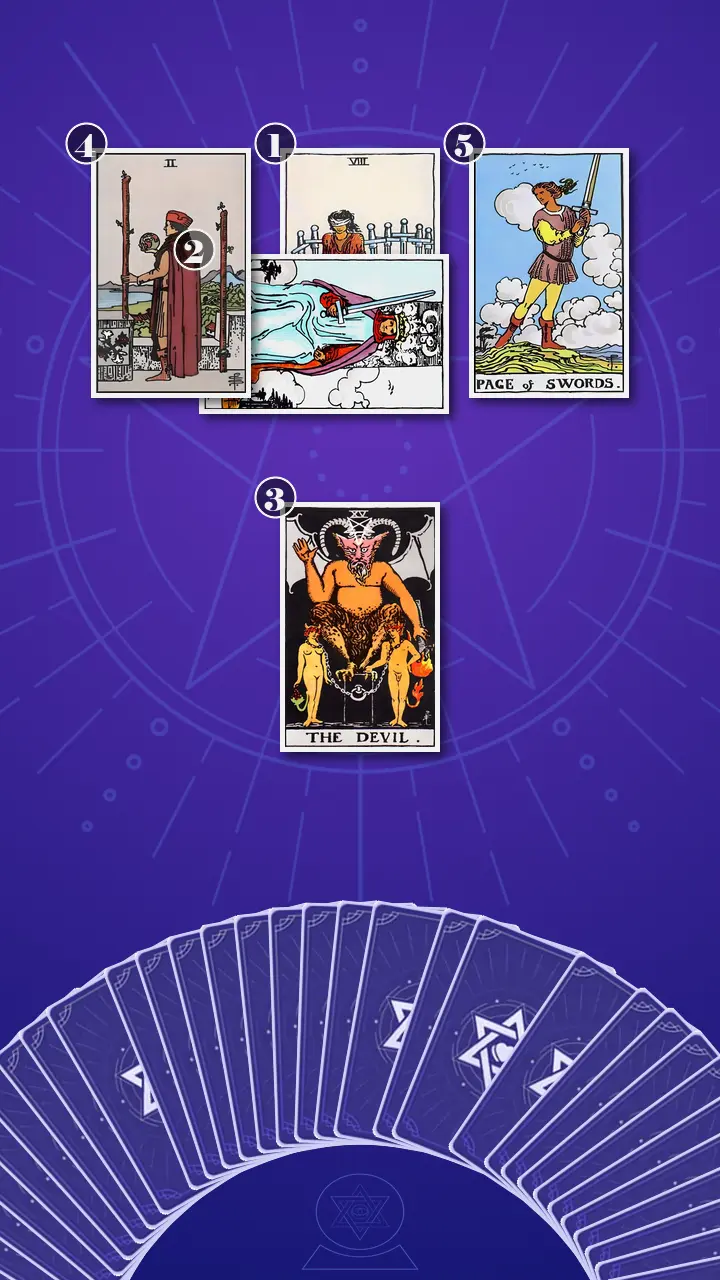
Reading the Map: The Moment You Go Quiet
Position 1 — The shutdown pattern in the moment
“Now we turn over the card that represents the shutdown pattern in the moment: what you do and feel right after hearing ‘be strategic.’”
Eight of Swords, upright.
I didn’t need to dramatize it. The image does its own work: a blindfold, a narrow corridor of swords, bindings that look tighter than they really are.
And the modern translation landed immediately: Right after the words “be more strategic,” you stop offering opinions in the meeting. You nod, take more notes than anyone, and tell yourself you’ll ‘send something later.’ Back at your desk you open a doc, stare at the word “Recommendation,” and suddenly can’t write a sentence—so you add context, alternatives, and disclaimers until the decision disappears.
That’s Air energy—thinking, framing, speaking—gone into a kind of internal airplane mode. Not a lack of intelligence. A blockage: perception narrowing until it feels safer to be invisible than to be specific.
Jordan made a small, dry sound that was half laugh, half flinch. “That’s… wow. Yeah. That’s exactly it. It’s so accurate it’s kind of cruel.”
I watched the micro-sequence: their breath paused, fingers hovered near the mug, then their shoulders loosened by a millimeter—as if being seen precisely was safer than being seen generally. “It’s not cruel,” I said gently. “It’s specific. And specific means workable.”
“An unsent message is still a choice—just a hidden one,” I added, because Eight of Swords loves hidden choices.
Position 2 — The immediate pressure
“Now we turn over the card that represents the immediate pressure: what the workplace is asking for, and how it clashes with your coping style.”
King of Swords, upright.
The modern scenario was almost too on the nose: Your manager is asking for executive-style clarity: a frame, a priority, and a decision they can repeat to someone else. In practice, it’s the moment they want you to say, ‘Given our goal is X, I recommend Y, and the tradeoff is Z,’ even if you can’t answer every edge-case live.
This card isn’t “be more strategic” as a vibe. It’s “be more strategic” as a format. The King is balanced Air: decisive communication, clean structure, judgment that doesn’t apologize for existing.
My mind flashed to my work at the planetarium—the way a constellation looks like random dots until you draw the line that matters. Strategy is that line. Not more stars. Not more slides. The line.
“Here’s the reframe,” I told Jordan. “Your boss isn’t necessarily asking you to become omniscient. They’re asking you to be repeatable. A clear frame, a call, a rationale. So instead of absorbing ‘be strategic’ like a foggy insult, translate it into something verifiable you can ask: ‘Which metric or tradeoff should I optimize for in my recommendation?’”
Jordan nodded slowly, like the word verifiable gave them something solid to hold.
Position 3 — The underlying driver
“Now we turn over the card that represents the underlying driver: the belief and fear that turns feedback into threat and causes silence or over-prep.”
The Devil, upright.
The modern scenario arrived with a sting: One subjective comment becomes a full identity verdict in your head. You hear ‘be strategic’ and instantly translate it into ‘you’re not leadership material,’ so you try to outwork the shame: more research, more slides, more caveats, less voice. The trap isn’t your capability—it’s the rule that being challenged equals being exposed.
In a London corporate context, the Devil doesn’t show up with horns. It shows up as calendar blocks you keep accepting. Comment notifications you can’t ignore. Revision loops that feel like “being responsible” while they quietly keep you from being seen choosing.
Jordan’s eyes dropped to the table. Their mouth tightened, then loosened. A three-beat reaction chain: (1) a brief freeze in the face, (2) a distant look like they were replaying a meeting in their head, (3) a long exhale that finally made sound.
“It really does feel like a verdict,” they said. “Like… if I’m challenged, I’m done.”
I kept my voice steady. “Clarity isn’t arrogance. It’s a hypothesis you’re willing to test out loud.”
And because I study celestial mechanics as much as symbols, I named the physics of it: “This is shame-driven gravity. It pulls your worth into the moment. Suddenly one sentence from your manager feels like it outweighs ten months of competence.”
Jordan swallowed. “Yeah.”
When the Two of Wands Held the Globe
Position 4 — The strategic reframe (Key Card)
“Now we turn over the card that represents the strategic reframe: the skillful way to relate to ‘be strategic’ without collapsing or overcompensating.”
The room felt quieter as I flipped it—like the air itself wanted to listen.
Two of Wands, upright.
The life translation was a window shot: Instead of trying to pre-answer every objection, you choose a lens and own a tradeoff. You draft two options, then write the sentence you’ve been avoiding: ‘If we optimise for speed, we accept X risk; if we optimise for quality, we accept Y delay—my recommendation is A because our priority is B.’ You’re not proving you’re right forever—you’re making a clear move that can be refined.
Setup: I could feel exactly where Jordan lived: late at night, laptop fan loud, reformatting the same slide again while a half-written Slack to their boss sat there unsent—because choosing one clean recommendation felt like stepping into exposure.
Delivery:
Stop treating “strategic” like a hidden exam and start holding the globe—pick a direction, name the tradeoff, and let the plan be something you refine in motion.
Reinforcement: Jordan’s reaction wasn’t cinematic. It was human. First, their breath caught high in the chest—as if the sentence had briefly removed the floor. Then their eyes went slightly unfocused, like they were watching themselves in that glass meeting room, hearing “So what’s the recommendation?” and feeling their throat lock. Then—slowly—their shoulders dropped, and something in their face softened, not into confidence, but into permission.
“But if I pick,” Jordan said, and there was a flash of irritation, “doesn’t that mean I can be wrong?”
“Yes,” I said, without flinching. “And that’s the point. Strategy is not a courtroom confession. It’s a navigation decision.”
This is where I used my signature diagnostic lens—Orbital Resonance. “In work systems, every stakeholder has a gravitational pull: speed, risk, cost, quality, reputation. When you try to satisfy every orbit at once, you get dragged into the centre and freeze. The Two of Wands is you stepping back far enough to see the orbit you’re in and choosing the resonance you want: ‘Today, we optimize for speed.’ That’s not arrogance. That’s alignment.”
I let that sit, then asked the question the card always demands: “Now, with this new lens, can you think of one moment last week when you could’ve said a 70% recommendation out loud—before your throat locked?”
Jordan blinked twice, as if coming back from far away. “In steerco. I started with ‘It depends…’ and then I hid in the background.” They exhaled again, smaller this time. “I could’ve said: ‘Given our goal is speed, I recommend A. The tradeoff is risk.’ Even if it wasn’t perfect.”
That was the visible pivot—from shame-driven shutdown and self-censoring to calm ownership of a clear, testable recommendation. Not a personality transplant. A directional choice.
Position 5 — Integration and next step
“Now we turn over the card that represents integration and next step: one practical communication move to practice strategic presence this week.”
Page of Swords, upright.
The Page doesn’t wait until the wind stops. The Page speaks while the trees are still moving.
And the modern scenario made it behavioural: You practise strategic presence through conversation, not private perfection. In your next 1:1 you say, ‘Here’s my current recommendation and tradeoff—when you say strategic, do you want more prioritisation, clearer tradeoffs, or a crisper recommendation?’ Then you reflect back the criteria you heard, so you can iterate in public instead of hiding until it’s ‘perfect.’
This is balanced Air again, but younger: curiosity as credibility. A “v0” shipped with a clean question.
Jordan’s mouth twitched into the first real smile of the session—small, but there. “I can do a small version of that,” they said. “Like… say it before my throat locks.”
“Exactly,” I replied. “Ask for criteria like you belong in the room—because you do your best work when the goal is defined.”
The One-Page Path: Actionable Advice for Strategic Clarity
I pulled the whole cross together for Jordan in plain language. Here’s the story the cards told:
You’re not freezing because you’re incapable. You’re freezing because a vague comment (“be strategic”) triggers a learned protection: don’t risk being pinned to one opinion. That protection looks like Eight of Swords silence. Your workplace, however, is asking for King of Swords structure: a frame, a call, a tradeoff. The Devil underneath turns that reasonable request into a survival trial—so you over-prepare to earn safety. Two of Wands breaks the spell by making “strategic” a doable move: choose one lens, name one tradeoff. Page of Swords makes it visible: speak early, ask clean questions, iterate in public.
The cognitive blind spot was sharp: Jordan was treating clarifying as “looking junior,” when in reality, clarifying is a leadership behaviour. The transformation direction was equally clear: from trying to sound flawless to making one clear, testable recommendation and treating feedback as iteration—not a verdict.
Then I gave them three small, realistic moves—designed for a real London week, not an imaginary one with unlimited bandwidth:
- The 3-Line “Lens + Call + Tradeoff” Note (10 minutes)Before your next meeting, write three lines on paper: (1) “Goal: we’re optimising for ___ (speed/risk/cost/quality).” (2) “Recommendation: we should ___.” (3) “Tradeoff: this means we accept ___.” Keep it beside your notebook so you’re not hunting for words on-screen.If your body tenses, stop at 70%. Label the remaining 30% as “open questions,” not “proof I’m unready.”
- The Definition Request Script (one sentence in your next 1:1)Ask verbatim: “When you say ‘more strategic,’ what do you want to hear more of from me—priorities, tradeoffs, or a clearer recommendation?” Then repeat back what you heard in one line: “Got it—so for you, strategic means ___.”No apology preface. Treat it like clarifying acceptance criteria on an ambiguous Jira ticket.
- The Curiosity Buffer Draft (send earlier than you want)Send one early draft where the first paragraph includes: “My current recommendation is A because we’re optimising for B; the tradeoff is C. Which constraint matters most to you?” This turns challenge into collaboration instead of ambush.If sending feels too exposed, paste it into a private Slack DM to yourself first. Let it exist in daylight before it goes to anyone else.
To make the next morning easier, I added one of my own grounding tools—what I call an Earth-rotation perspective. “Before a high-visibility 9 a.m. meeting,” I told Jordan, “take ten seconds and remember the planet is literally rotating under your feet. This room is not a tribunal. It’s a moving system. Your job is to make a call that can be updated as the system moves.”

A Week Later: Ownership, Not Certainty
Six days later, Jordan messaged me. Not a paragraph. One line: “I asked the question in my 1:1. They said they want tradeoffs and a clearer call. I wrote the three lines on paper and actually said my recommendation out loud.”
They added, after a minute: “I still felt my throat tighten. But it didn’t stop me.”
That’s what a real Journey to Clarity looks like. Not a permanent glow-up. A quieter, steadier ownership: choosing a lens, naming a tradeoff, and letting your recommendation be testable—alive—rather than hidden and untouchable.
They didn’t celebrate with fireworks. They told me they sent the draft, then sat alone in a Pret for an hour, staring out at the rain and letting their nervous system catch up to the fact that nothing terrible happened.
When someone says “be strategic” and your chest drops, it’s not because you lack a point of view—it’s because you’ve learned to treat being clear as being exposed.
If you let “strategic” be one small choice instead of a full-body test, what’s the gentlest version of a recommendation you could try saying out loud this week—just once?