From Screen Time Guilt to Neutral Feedback: A One-Week Experiment

Finding Clarity in the Sunday-Night Screen Time Verdict
You’re a late-20s hybrid-office person in a big city, and Apple’s Screen Time summary hits like a weekly performance review—hello, productivity guilt.
Jordan said that to me with a half-laugh that didn’t quite land. We were on a Sunday-night Zoom call—me at a hotel desk in Toronto for a lecture, them in their condo bedroom near King West. Their face was lit from below by that familiar phone glow, and a streetlight leaked through the blinds in thin, pale stripes like prison bars nobody asked for.
“It popped up at 9:52,” they told me, thumb already hovering over the screen like it had its own gravity. “Weekly summary. I didn’t even think. I tapped it. Then I did the math and it was like… that’s basically a part-time job.”
I watched their shoulders inch up as if bracing for impact. Their stomach dropped—Jordan actually pressed a palm to their abdomen while they spoke—and their chest looked tight, as though the number had a hand around it. The room was quiet, but their body was loud: fidgety energy in the fingers, the jaw set, the eyes too bright for bedtime.
“I want to unwind,” they said, voice flattening. “I want to stay connected. But when I see the report, it feels like proof I’m wasting time and falling behind.”
That contradiction—the need for relief versus the fear that relief is a moral failure—was sitting between us like a third participant. And guilt was doing what guilt does best: turning a tool into a courtroom.
“I hear how heavy that notification feels,” I said. “Not abstractly—physically. Let’s try something different tonight. Not to ‘fix’ you. To map what’s happening, so you can stop getting ambushed by it and start choosing what’s next with a bit more respect for yourself.”
Choosing the Compass: How the Celtic Cross Spread Works for a Habit Loop
I asked Jordan to put their phone face down for one minute—just long enough to let their nervous system realize the room wasn’t on trial. “One slow inhale,” I said. “One slow exhale. We’re not summoning anything. We’re just changing gears—from reaction to reflection.”
I shuffled my well-worn Rider-Waite-Smith deck the way I used to brush soil off a coin at a dig site: patiently, not because the object was sacred, but because attention makes meaning visible.
“Tonight, we’ll use the Celtic Cross spread,” I told them. “It’s a classic for a reason. Your question isn’t about predicting an event. It’s about tracing a repeating trigger-response loop back to the belief underneath it—and then integrating a sustainable next step.”
For you reading this: that’s why the Celtic Cross is such a fit for productivity guilt and phone habits. It naturally separates the immediate trigger (what happens when the alert hits), the crossing tension (what makes it sticky), the unconscious root (why it feels personal), and the practical path forward (what changes when you stop punishing yourself and start experimenting). In other words: it’s built for finding clarity without oversimplifying the emotional messiness.
“The first card will show the immediate moment—what your Screen Time alert is actually doing to your mood and behavior,” I said. “The crossing card will show the tension that turns neutral data into guilt. And the outcome card will show what ‘what’s next’ looks like if you shift the stance you’re holding yourself with.”
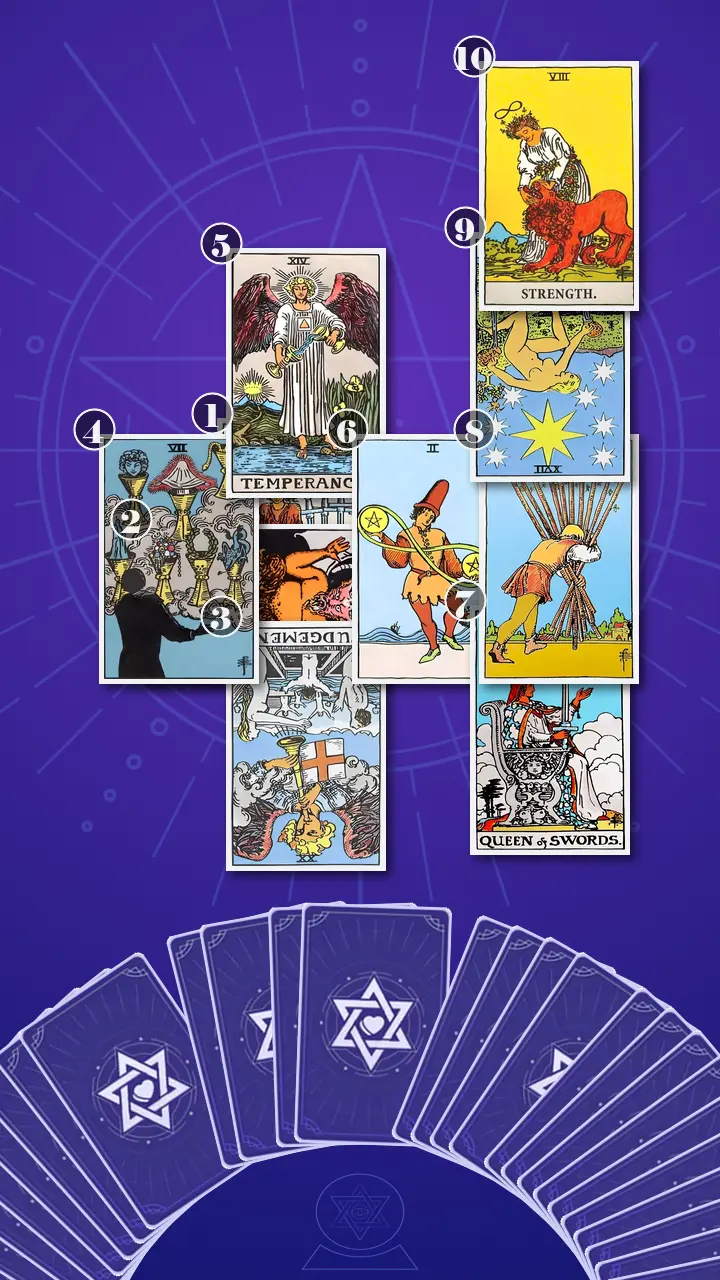
Reading the Map: Card Meanings in Context, Not in Theory
Position 1: The immediate moment — Eight of Swords (upright)
Now we turn over the card representing The immediate moment: what your Screen Time alert is actually showing you in behavior and mood.
Eight of Swords, upright.
I said it plainly, because this card doesn’t need theatrics. “You see the Screen Time alert, and it’s like your brain gets blindfolded: you stop seeing options and only see ‘I’m trapped / I’m failing.’ You open the report and freeze in self-auditing mode, even though the ‘bindings’ (your choices) aren’t actually locked—you could respond with curiosity, rest, or one workable boundary instead of a crackdown.”
The energy here isn’t that you lack discipline. It’s blockage: mental movement stops, and the only available action feels like self-correction. The blindfold on the figure in the card is the moment your body reacts before your mind has a say—the sinking stomach, the tight chest. You’re not choosing yet; you’re bracing.
Jordan gave a short, bitter laugh. “That’s… too accurate. Like, kind of brutal.” Their eyes flicked away from the screen, as if the card had looked back at them.
“It’s accurate,” I said gently, “but it’s not a sentence. The Eight of Swords is famous for one detail: the bindings are loose. The cage looks complete until you notice it isn’t. Screen Time is feedback, not a character assessment.”
Position 2: The main tension — The Devil (upright)
Now we turn over the card representing The main tension: what complicates your relationship with screen time and turns data into guilt.
The Devil, upright.
I didn’t flinch, and neither did Jordan—which told me they’d been expecting this one. “Your phone is the fastest relief button after stress—until it becomes a loop. You tell yourself ‘just one thing,’ and the feed hands you novelty on a conveyor belt. Then guilt tightens the chain: you try to control harder, which makes the urge feel stronger, which makes the rebound worse.”
The Devil’s energy is excess: too much pull, too little pause. Not because you’re weak, but because the system is built like a casino floor—autoplay, infinite scroll, the little ‘next hit’ of novelty. Your brain didn’t invent this. It got recruited by it.
“The urge isn’t the enemy; the shame spiral is,” I said. “The chains in this card are rarely locked tight. The pull feels fated, but it’s often just unexamined discomfort plus a very well-designed app.”
Jordan nodded once, sharply, like someone recognizing an old enemy in better lighting.
Position 3: The root driver — Judgement (reversed)
Now we turn over the card representing The root driver: the deeper belief that makes the notification feel personal and moral.
Judgement, reversed.
I felt the room change—not mystically, simply psychologically. The way it does when you finally name the real thing. “The Screen Time notification functions like a trumpet blast that calls you to ‘accountability’—but reversed, it becomes condemnation. You run a mental court case: tally hours, replay what you ‘should’ve’ done, and keep checking the dashboard like it’ll grant absolution. The root issue isn’t time; it’s self-worth fused to the metric.”
And because I’m who I am—a professor who has spent decades reading inscriptions that were literally meant to outlast a lifetime—I added my own frame. “In archaeology, numbers are evidence, not morality. A layer of ash doesn’t mean a city was ‘bad.’ It means something happened. When you treat data like a verdict, you stop learning from it.”
I leaned into the echo technique that always lands here: the courtroom. “In your mental courtroom,” I told Jordan, “the Screen Time report is Exhibit A. You reopen it like you’re refreshing analytics, waiting for a different verdict. Your inner voice plays prosecutor: ‘You should’ve read instead. You should’ve worked out. You should’ve meal-prepped. You should’ve…’”
Jordan’s breath caught—just for a beat. Then their gaze unfocused, as if they were watching the replay. Finally, a small exhale left their chest like something unhooking. “Oh,” they said quietly. “That’s exactly it.”
Judgement reversed is distortion of inner authority: review turns into punishment. The invitation isn’t to stop noticing the data; it’s to repair the voice interpreting it.
Position 4: What led here — Seven of Cups (upright)
Now we turn over the card representing What led here: the recent habit loop or context that intensified the pattern.
Seven of Cups, upright.
“Recent context: your phone became an endless menu—news, short videos, messages, productivity tips—so you never fully choose, you just reach. Time disappears because overstimulation makes ‘one more scroll’ feel like a solution, even when it leaves you emptier.”
This card’s energy is diffusion: attention scattered across a buffet of half-choices. It’s decision fatigue dressed up as freedom. And later, when the number arrives, it feels like you’ve been caught doing something you didn’t even enjoy.
Jordan rubbed their eyes. “That ‘candy for dinner’ thing,” they said. “Yes. That.”
Position 5: What you think you should do — Temperance (upright)
Now we turn over the card representing What you think you should do: your conscious goal or ideal that shapes the guilt narrative.
Temperance, upright.
I smiled a little, because this is the card people secretly want when they say they want control. “What you consciously want (even if guilt talks louder): a sustainable mix. Not ‘zero screen time,’ but a rhythm where decompression, connection, and focus can all exist. You’re trying to pour between cups—adjusting the blend—so your habits fit your actual life instead of an idealized routine.”
Temperance is balance energy, but not the Pinterest version. It’s the ordinary, repeatable kind: one foot on land, one in water, adjusting in motion. It’s the opposite of the Sunday-night crackdown.
“I want balance,” Jordan said, almost annoyed at how vulnerable it sounded. “Not another rule I’ll break.”
Position 6: The next developmental step — Two of Pentacles (upright)
Now we turn over the card representing The next developmental step: what changes when you stop punishing yourself and start experimenting.
Two of Pentacles, upright.
“The next step looks like real-life juggling, not a dramatic reset. You pick one boundary with high impact (morning or bedtime), keep everything else flexible, and treat the week like budgeting: review, adjust, repeat. The goal is stability inside a busy life, not perfection outside of it.”
This card is adaptation—and it’s the first breath of relief in the spread. The infinity loop around the pentacles is the point: iteration. Not one grand, morally purifying ‘life reset.’
I used the montage the card demanded. “Line 1 in the morning. Back-to-back meetings. Grocery run. The PATH at rush hour. Late-night wired-tired brain. Your week is already moving like waves behind that juggler in the card,” I said. “So we don’t design a plan that only works on your best Saturday. We design a plan that holds on your messiest Wednesday.”
Jordan’s shoulders dropped a fraction. Their hands stopped fiddling with the charger cable. “Okay,” they said, surprised at their own voice. “I can try one thing without turning it into a whole personality test.”
Position 7: Your role — Queen of Swords (upright)
Now we turn over the card representing Your role: how you’re currently holding yourself and what inner stance is available.
Queen of Swords, upright.
“Your strongest stance isn’t guilt—it’s clarity. You can tell the truth without cruelty: ‘This app ramps me up,’ ‘This is how I cope when I’m overloaded,’ ‘My attention matters.’ You set one clean boundary and you don’t need to insult yourself to enforce it.”
The Queen’s energy is precision. Not harshness—precision. She doesn’t need to shout to be firm.
I offered Jordan a line they could borrow, the way I’ve seen students borrow a clean thesis statement when their draft turns into a panic spiral. “If the notification hits,” I said, “try: ‘This is information, and I decide what it means.’ And remember: If you can’t say, “I’m choosing this,” you’re probably coping—so pause first.”
Position 8: External pressures — Ten of Wands (upright)
Now we turn over the card representing External pressures: the environment that keeps the phone loop alive (workload, social comparison, expectations).
Ten of Wands, upright.
“The environment isn’t neutral: you’re carrying a lot—meetings, messages, commuting, expectations—so the phone becomes the quickest escape hatch. Then Screen Time reports the escape as if it happened in a vacuum, which feeds the guilt loop. The ‘solution’ includes offloading a small piece of the burden, not just restricting the coping tool.”
This is overload energy—too much carried, too little seen. The figure’s view is blocked by the wands, and that’s exactly what happens in a week packed with context-switching: perspective narrows until the fastest off-switch looks inevitable.
Jordan’s eyes softened. “It’s not even when I’m lazy,” they said. “It’s when I’m done.”
“Exactly,” I said. “Your worst doomscrolling isn’t a character flaw. It’s a pressure valve.”
Position 9: The guilt knot — The Star (reversed)
Now we turn over the card representing The guilt knot: what you secretly hope will be true, and what you fear the data means about you.
The Star, reversed.
“Under the guilt is a quieter fear: ‘What if I can’t change?’ You want the report to prove you’re improving so you can finally feel hopeful. When it doesn’t, you chase ‘life reset’ content or stricter plans, then feel more discouraged. Hope returns when you track one gentle, behavior-based boundary—not your total hours.”
Reversed Star is deficiency of hope—not drama, just dimness. The kind where you save a Huberman Lab episode about habits and never finish it, and then somehow feel guilty about that too. The way you can scroll “Sunday reset” TikToks like penance and still feel empty.
Jordan swallowed. “I keep wanting the number to make me feel… redeemed.”
“And it can’t,” I said softly. “Because redemption isn’t a metric. It’s a relationship—with yourself.”
When Strength Spoke: Calm Courage, Not Harsher Control
Position 10: Integration — Strength (upright)
The room felt suddenly quieter, the way a lecture hall goes quiet when the real question finally appears. On Jordan’s side of the call, I heard a faint street sound—maybe a passing streetcar bell—thin and bright against the night.
Now we turn over the card representing Integration: what ‘what’s next’ looks like as a mindset shift and a sustainable relationship to limits.
Strength, upright.
“Integration looks like holding your urges the way you’d hold a strong animal: steady, calm, not violent. You feel the pull to scroll, you name the need (relief/connection/numbing), and you choose a kind limit you can keep even on a hard day. The number stops being a moral grade because you’re practicing self-respect in real time.”
Here, the energy is balanced power. Not deficiency. Not excess. Not blockage. Power expressed as kindness.
And I could feel Jordan’s old reflex rising—the one that wants to slam the door, delete the app, set five limits, prove seriousness immediately. It’s a reflex I’ve seen in excavation teams too: when the trench gets messy, someone wants to scrape hard and fast, as if force creates clarity. It doesn’t. It destroys context.
So I set the key message down like an artifact on clean paper.
Stop treating the number like a verdict; start holding your habits with calm courage—like Strength closing the lion’s jaws without violence.
Jordan went still in a three-step sequence I’ve come to trust as the body’s truth arriving.
First: a freeze. Their breath paused, and their thumb—mid-hover over the phone—stopped as if the air itself had thickened.
Second: the mind letting the idea through. Their eyes lost focus, not in zoning out, but in searching—like replaying the last time the Screen Time alert hit and watching their own reaction from a distance for the first time.
Third: the release. Their shoulders sank, slowly, as if they’d been wearing a backpack they forgot was there. Their mouth opened on a quiet, shaky exhale. “But… if I’m not harsh,” they said, and there was a flash of anger under it, “doesn’t that mean I was wrong? Like I bullied myself for nothing?”
That was the moment I wanted to answer as both historian and human. “In every era,” I said, “people confuse cruelty with authority. It’s a very old mistake. Being harsh never proved you were serious. It only proved you were scared.”
I kept my voice steady—firm boundary, soft tone. “Strength isn’t ‘letting yourself off the hook.’ It’s choosing leadership over punishment. It’s the calm bouncer, not the cop.”
I let the silence work for a second, then invited the question that turns insight into something you can actually use. “Now,” I said, “with this new lens—calm courage instead of a verdict—think back over the last week. Was there a moment when the alert hit, and this could’ve changed how you felt in your body in the first ten seconds?”
Jordan blinked, eyes wet but not falling apart. “Tuesday,” they said. “Between meetings. I checked the dashboard like it was a KPI. If I’d done… this… I think my chest wouldn’t have locked up. I could’ve taken a real break instead of trying to ‘fix’ the feeling by changing settings.”
That’s the shift the whole spread was aiming at: from contracted self-auditing to steadier self-trust. Not perfection. Not a cure. A move from guilt-as-control to curiosity-as-guidance.
The One-Week Experiment: Actionable Advice Without the Shame Spiral
I gathered the spread into a single story for Jordan, because integration is where tarot stops being interesting and starts being useful.
“Here’s what I see,” I said. “The Eight of Swords shows the moment you get mentally trapped by the notification. The Devil shows the attention-hook loop that makes willpower-only rules backfire. Judgement reversed is the engine—your inner court turning a number into identity. But Temperance tells me your real goal isn’t punishment; it’s balance. Two of Pentacles says the path is iterative, like budgeting in a messy week. The Queen of Swords gives you a clean, non-dramatic voice. Ten of Wands validates the context—you’re overloaded. Star reversed admits the fear: ‘What if I can’t change?’ And Strength answers: you don’t need to bully yourself into better habits. You need steady, self-respecting boundaries.”
The cognitive blind spot was clear: Jordan had been using the data to punish themselves, then wondering why their body rebelled. The transformation direction was equally clear: from verdict to experiment. Don’t punish the data—run a one-week experiment.
I offered next steps that were small enough to start, and specific enough to work in real life.
- The 60-Second “Neutral Data” PauseNext time the Screen Time notification hits, do one slow inhale and one slow exhale. Then say (out loud or in your head): “This is information, not a grade.” Only after that do you decide whether to open the report.If you feel the urge to tighten limits immediately, postpone any settings changes for 10 minutes. Tiny delay = choice restored. (This is my “Clay Disc” calibration: a small, grounding pause that stops you from acting like you’re in a crisis.)
- One Boundary, One Week (Not Five)Pick a single boundary for seven days: “Phone-free first 15 minutes after waking.” Track it with one daily checkmark (Notes app or a sticky note). For one week, ignore total hours.Choose a boundary that still works on your worst weekday, not your best Saturday. Think “Celestial Tracking”: one North Star you can actually orient to, even in clouds.
- Offload One Wand for 72 HoursMute one non-essential notification stream (one group chat, one promo email, or one app’s push notifications) and keep it muted for 72 hours as an experiment.Treat it like an archaeological test trench: small, controlled, informative. You’re not deleting your social life—you’re seeing what changes when one pressure source stops poking you all day.
Before we ended, I gave Jordan one “Inscription Affirmation”—not because I like slogans, but because carved words change how you move through a space. “Write this on a sticky note and put it by your charger,” I said. “Not as motivation. As an instruction from your calmer self: Firm boundary. Soft tone.”

A Week Later: The Quiet Proof of Self-Trust
Six days later, I got a message from Jordan while I was back home, grading essays with the same mug of tea I’d had on that Sunday call.
“Okay,” they wrote. “I did the phone-free 15 minutes. Not every day. Four out of six. But—here’s the weird part—I didn’t do the Sunday-night crackdown. I saw the summary and I literally heard you saying ‘neutral data.’ My stomach still dipped, but it didn’t take over my whole chest. I went to sleep.”
It was exactly the kind of change I trust: small, specific, and real. Not a transformed life. A different first ten seconds.
That’s what this journey to clarity is, more often than not. Not deleting the lion. Not pretending you don’t want relief. Just learning to hold your habits with steadier hands—so a number can go back to being a number.
When a notification makes your stomach drop, it’s not because you’re ‘bad at discipline’—it’s because a neutral number just got forced to carry your whole fear of falling behind and not being someone you can respect.
If you treated your next Screen Time alert as a cue to try one small, kind boundary—just for a week—what would you want that boundary to protect in your life?