Stuck in the one-last-tweak loop—and how I rehearsed on purpose

Finding Clarity in the 11:47 p.m. Slide Deck Loop
You tell yourself the deck is “basically done,” but it’s 11:47 p.m. and you’re still rewriting the same headline because the pitch feels like a credibility test (hello, Sunday Scaries—on a Tuesday).
That’s how Jordan showed up on my screen—New York night pressed against their windows, a dim little apartment lit mostly by laptop glow. I could hear the faint click of a radiator cycling on and off like an impatient metronome.
“I have five tabs open,” they said, not proudly. “Slides, a competitor’s site, a ‘how to sound confident’ thread, LinkedIn, and Notes.”
On the camera, I watched their shoulders hover just below their ears. Their throat looked dry in that way you can almost feel through a screen—like the body is already preparing to be judged. Wired-but-tired. The kind of tired that doesn’t let you sleep because your brain keeps handing you imaginary objections like a deck of cards you didn’t ask to shuffle.
Jordan swallowed. “It’s tomorrow. And I keep telling myself I’m not nervous—I’m just not done yet.”
I let that land, because it’s the line so many high-achievers use right before visibility: a protective translation. If I keep working, I don’t have to be seen yet.
“Okay,” I said gently. “We’re not going to argue with your standards. We’re just going to get honest about what your standards are doing for you right now. Tonight isn’t about becoming fearless. Tonight is about finding clarity—so you can stop gripping the deck like a life raft and start using it like a map.”

Choosing the Compass: The Celtic Cross · Context Edition
I asked Jordan to put both feet on the floor and take one breath that was a little slower than their mind wanted—nothing mystical, just a clean handoff from “panic-thinking” to “present-seeing.” While they did that, I shuffled slowly, the way I do when someone’s nervous system is already sprinting. The shuffling becomes a cue: We’re pausing. We’re focusing. We’re choosing the question on purpose.
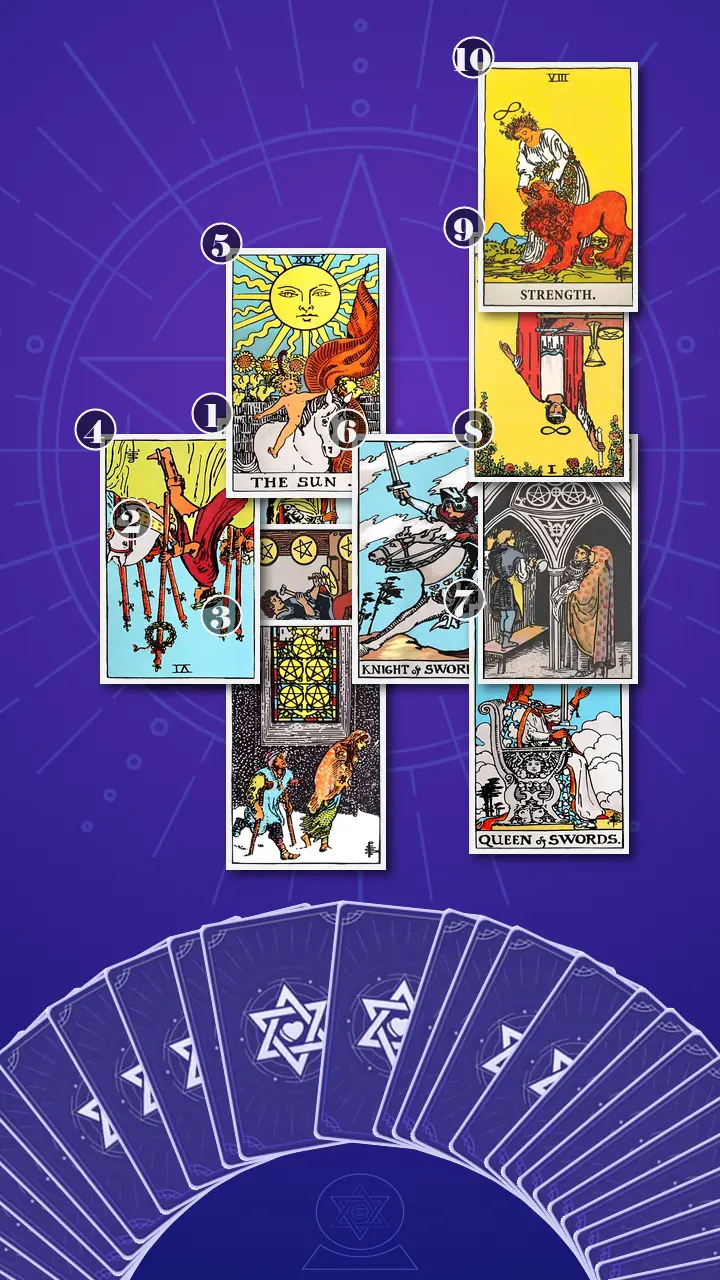
“For this,” I said, “I’m using the Celtic Cross · Context Edition—it’s the classic Celtic Cross spread, just tuned for career questions like yours.”
To the reader: this is why it works so well when you’re stuck in pre-pitch decision fatigue. You don’t just need a vibe-check. You need the full chain—what’s happening right now, what specifically blocks you, what’s underneath it, and what past pattern keeps reappearing. Then you need the bridge: the next practical shift and the integration point that’s actually empowering, not predictive.
In this layout, the center cards show the immediate pitch moment and the main obstacle. The card below exposes the deeper driver—what you’re protecting when you over-prepare. The card to the left names the repeating past career pattern. And the final card at the top of the “ladder” is the integration: the most useful trajectory if you apply what you learn.
“Think of it like a crossroads,” I told Jordan, “with a ladder next to it. We’re not here to guess your future. We’re here to climb toward a steadier stance.”
Reading the Map: Card Meanings in a Real NYC Pre‑Pitch Night
Position 1 — Current pitch moment: your present mindset and how you’re approaching visibility right now.
“Now we’re turning over the card that represents your current pitch moment: your present mindset and how you’re approaching visibility right now,” I said.
Page of Wands, upright.
Right away, this card tells me something important: you’re not empty. You’re not out of ideas. The Page is the spark—the part of you that actually wants to step forward. In Jordan’s language: the pitch has a strong core, but the environment feels exposed and high-contrast, so they second-guess whether they’re allowed to be “new” at something while still being credible.
Energy-wise, this is Fire in balance—momentum, curiosity, a bold idea that wants to be shared. The risk with this kind of Fire isn’t that it disappears; it’s that it flips into self-consciousness the moment you realize you’re being watched.
Jordan’s eyes flicked down to the card and back up to me. “That’s… annoying,” they said, and a tiny smile tugged at one corner of their mouth. “Because I do actually like the idea.”
“Exactly,” I said. “So the question becomes: what is the simplest version of your message you’d still feel proud to say out loud?”
Position 2 — The primary block before the pitch: the habit or friction that derails clarity and delivery.
“Now we’re turning over the card that represents the primary block before the pitch—the habit that derails clarity and delivery,” I said.
Eight of Pentacles, reversed.
Jordan let out a tight laugh—half recognition, half a wince. “Oh wow,” they said. “That’s… that’s the whole night.”
This is the card I see constantly when people ask, “Why do I keep tweaking my slides instead of practicing?” Upright, it’s craft and mastery through practice. Reversed, it’s craft that becomes camouflage: perfectionism, diminishing returns, effort used as emotional armor.
In modern terms, this is like when Jordan keeps polishing the deck because the work itself feels measurable, while the human moment of pitching feels unpredictable. The workbench is safe. The mic is not.
I leaned in a little. “Listen to the internal monologue this card creates,” I said, and I kept it specific, because vague advice is useless at 11:47 p.m.
‘If I just fix the headline, then I can finally practice.’
‘If I just align the icons, then I’ll feel ready.’
‘If I just add one more proof point, then no one can challenge me.’
Control—kerning, alignment, citations—replaces exposure: timed delivery, being interrupted, being questioned.
“Polish is control,” I said. “Practice is courage.”
Jordan’s shoulders rose again like they were bracing for impact. Their hand hovered near the trackpad—an almost unconscious reach. The card wasn’t accusing them. It was naming a nervous-system strategy that had worked before.
Position 3 — The deeper driver beneath the block: what you’re protecting when you over-prepare.
“Now we’re turning over the card that represents the deeper driver beneath the block—what you’re protecting when you over-prepare,” I said.
Five of Pentacles, upright.
The air in the room felt different as soon as it hit the table—like a draft under a door you didn’t know was cracked.
This card speaks the language of belonging. Scarcity. The fear of being outside the warm room looking in.
In Jordan’s world, that looks like this: one skeptical stakeholder face and your stomach drops. A neutral Slack reaction and your chest tightens. A terse calendar invite and your brain decides it means you’re already behind. Not because you’re fragile—because your body has learned to treat visibility like a gate you have to earn access to.
I said it plainly: “A deck can’t save you from being human in the room.”
Jordan didn’t laugh this time. They went still.
It was a small, three-step reaction chain I’ve come to trust: first, the freeze—breath pausing mid-chest, eyes holding too steady. Then the cognitive seep—focus drifting like they’re replaying a moment they didn’t want to admit mattered. And then, quietly, the release: a long exhale that sounded like, yeah… that’s it.
“If it doesn’t land,” Jordan said, voice lower, “it feels like it says something about my place. Like I’m… not actually solid.”
“That,” I said softly, “is the root. The pitch is carrying more than an idea. It’s carrying a belonging story.”
Position 4 — Past career pattern that keeps repeating: the learned strategy that once helped but now limits you.
“Now we’re turning over the card that represents the past career pattern that keeps repeating—the learned strategy that once helped but now limits you at high-stakes moments,” I said.
Six of Wands, reversed.
This is the applause trap. Upright, it’s recognition. Reversed, it’s fragile confidence—confidence that depends on the room acting like a cheering crowd immediately.
Here’s the split-screen version I gave Jordan, because this card is easiest to interrupt when you can picture it in real time:
(A) The moment the room looks neutral, your voice speeds up. You start adding caveats. You over-explain. You stack proof on proof like you’re trying to build a wall before anyone can throw a question over it.
(B) The room looks neutral, and you still hold one clean claim. You deliver the ask. You pause. You let questions be normal—not an eviction notice from the warm room.
Reversed Six of Wands is also the LinkedIn algorithm at its worst: highlight reels served to you exactly when you’re most vulnerable. Refreshing analytics in real time and letting the graph decide your self-worth. Slack reactions as a micro-dopamine meter. A thumbs-up becomes oxygen; silence becomes catastrophe.
Jordan nodded once—quick, like they didn’t want to dignify it too much. “I read faces,” they admitted. “Like… instantly. Like it’s a dashboard.”
“That pattern probably earned you trust early,” I said. “It made you responsive. It made you high-output. But right before a pitch, it turns you into a weather vane. And a pitch needs a spine.”
Position 5 — What you’re aiming for in the pitch: the ideal state you want to embody.
“Now we’re turning over the card that represents what you’re aiming for—the ideal state you want to embody,” I said.
The Sun, upright.
Jordan blinked like someone had turned on a brighter overhead light.
The Sun isn’t about being impressive. It’s about being unmistakably clear. It’s the permission to be simple and fully seen. In modern translation: when Jordan stops trying to earn permission through perfect formatting and instead leads with a clear claim, a clear rationale, and a clear ask.
Energy-wise, this is clarity as warmth, not clarity as aggression. Your goal isn’t to sound complex; it’s to be present.
I asked, “If someone only remembers one sentence from your pitch, what do you want it to be?”
Jordan stared at the ceiling for a second, like the sentence was up there. “I… want it to be clean,” they said. “Like: ‘Here’s what we should do, here’s why, and here’s what I need from you.’”
“That’s Sun,” I said. “That’s leadership.”
Position 6 — The next practical shift as the pitch approaches: how to move from preparation into delivery.
“Now we’re turning over the card that represents the next practical shift—how to move from preparation into delivery,” I said.
Knight of Swords, upright.
This is Air with momentum. The moment you stop optimizing and start saying the thing.
In modern terms: when Jordan stops optimizing the deck and instead practices the opening minute until it feels clean and repeatable. Not perfect. Repeatable.
Energy-wise, it’s Air in excess if it becomes frantic or defensive—but here it’s what you need: decisive communication, a clean argument, crisp phrasing you can stand behind when adrenaline spikes.
“Write one objection-response sentence,” I said. “One sentence—not a paragraph. Something you can return to if you feel pulled off-course.”
Jordan’s jaw unclenched a fraction. “That feels… doable,” they said, surprised by their own relief.
Position 7 — Your personal resource: the mindset and skill you can lean on to stay clear under pressure.
“Now we’re turning over the card that represents your personal resource—the mindset you can lean on to stay clear under pressure,” I said.
Queen of Swords, upright.
I love seeing this in a pitch reading. This is the mature editor—not the panicked one. The Queen doesn’t cut things because she’s scared. She cuts things because she respects the message.
In modern translation: when Jordan decides on one narrative thread and politely declines extra last-minute feedback that would derail the structure.
This card is Air in balance: boundaries, standards, and the ability to say what you mean without apologizing for existing. And yes—this is where I said it, because they needed the sentence like a door they could close:
“Clarity is a boundary you set with your own mind.”
Jordan’s eyes watered a little, unexpectedly. Not a breakdown—more like the body recognizing a tool it forgot it owned.
Position 8 — Context around the pitch: people, expectations, and supports you can engage without outsourcing your confidence.
“Now we’re turning over the card that represents the context around the pitch—the external influences you can engage without outsourcing confidence,” I said.
Three of Pentacles, upright.
This is healthy collaboration. Shared standards. A build review with a spec—rather than a solo open-mic night where your worth gets voted on by the crowd.
In modern translation: when Jordan stops asking five people for broad opinions and instead uses one focused review to strengthen the core argument.
Energy-wise, this is Earth in balance: structure. It’s the antidote to the Eight of Pentacles reversed. Same element, different use. Craft with limits instead of craft as self-punishment.
Jordan’s shoulders dropped a notch. Relief moved across their face like a small weather shift. “I can book a 15-minute run-through,” they said. “Like… actually put it on the calendar. Not a vague ‘can you look’ at 9:34 p.m.”
“Exactly,” I said. “A bounded collaboration. Two questions. One standard.”
Position 9 — Hopes and fears about being evaluated: what you’re afraid the pitch might ‘prove’ about you.
“Now we’re turning over the card that represents your hopes and fears about being evaluated,” I said.
The Magician, reversed.
This card always feels like someone’s browser with twenty tabs open. The tools are on the table—wand, cup, sword, pentacle—and yet the mind insists, I still don’t have what I need.
In modern translation: Jordan believes confidence must arrive first, so they keep collecting tools, while the real shift is using the tools they already have with focus.
Energy-wise, it’s power scattered. Not because you lack skill—but because self-doubt makes you treat skill like it doesn’t count until it gets validated.
I said, “This is where jargon and extra frameworks sneak in. Not because the pitch needs them—because you’re trying to perform competence instead of embodying it.”
Jordan’s face tightened. “But if I don’t have the right stat, they’ll ask and I’ll look stupid.”
“That’s a fear,” I said, steady. “Not a forecast.”
When Strength Spoke: The Moment Credibility Became a Nervous‑System Skill
Position 10 — Integration: the most empowering trajectory if you apply the guidance (inner stance and learning), not a fixed prediction.
I paused before turning the last card. Even through Zoom, I felt the shift—the way the room gets quiet right before the scene that changes the whole movie.
“We’re turning over the integration card,” I said. “Not ‘will they like it,’ not ‘will you win.’ The question is: what stance makes you most powerful in this moment of being seen?”
Strength, upright.
Jordan made a small sound—almost a scoff, almost relief. “That feels… too simple,” they said, and then the resistance came in sharp. “But if I need to regulate my pressure, doesn’t that mean I’ve been doing it wrong? Like this whole time?”
There it was: the protective anger that sometimes guards the doorway to self-respect.
“No,” I said. “It means you’ve been surviving with the tools you had. Strength isn’t a punishment. It’s an upgrade.”
Setup (the moment before the aha): Jordan was trapped in the late-night loop—headline → font size → headline again—because committing to one clear message felt like stepping onto a stage without armor. The deck became a place to hide. Not because they were undisciplined, but because being heard felt like the actual cliff edge.
Delivery (the sentence that changes the frame):
Not ‘earn confidence by polishing harder,’ but ‘tame the inner lion with steady breath and simple words’—that’s how Strength turns pressure into presence.
I let the silence do its job for a beat.
Reinforcement (the body learning it’s safe to be clear): Jordan’s eyes unfocused for a second, like they were watching a memory play back—maybe a past meeting where one neutral face made them spiral. Their fingers, which had been gripping the edge of the laptop, slowly released. I watched their throat move as they swallowed, and then their shoulders dropped, not dramatically, but in that unmistakable way the body does when it stops bracing for a hit. Their exhale came out shaky, followed by a softer one. It wasn’t “I’m cured.” It was “I can work with this.”
I said, “Strength is credibility as pacing. Breath. Steadiness under evaluation.”
And this is where my own lens comes in—my signature way of translating pressure into something usable. I’m a New York artist; I live inside performances that look effortless and are anything but. When I read Strength for a pitch, I don’t think ‘be brave’—I think of jazz improvisation, Louis Armstrong-level adaptability: you don’t control the whole room; you control your next phrase. You return to the theme. You breathe. You don’t speed up just because the audience is quiet.
“A pitch,” I told Jordan, “is like a jazz solo more than a TED Talk. Your job isn’t to hit every note. Your job is to stay in tempo when the room goes blank. Steadiness is what people remember when the slides are gone.”
Then I asked the question that turns insight into a lived rep: “Now, with this new lens—can you think of a moment last week when this would have helped? A moment where you tried to earn safety through extra work instead of guiding your body back to steady?”
Jordan blinked, then nodded slowly. “Yesterday,” they said. “I saw a peer post a win on LinkedIn and I felt… hot. Like admiration and anger at the same time. I closed the app and opened my deck like it would fix it.”
“That’s the loop,” I said. “And now you have a different move.”
This was the shift in front of me in real time: from tight, contracted control-seeking toward grounded self-trust. Not a personality makeover—an internal stance change. A small but real step on the journey from “perfect preparation to earn approval” to “clear message + practiced delivery to earn self-trust.”
The One‑Page Boundary: Edit Cutoff, Mondrian Clarity, and a 2‑Minute Run‑Through
I pulled the whole spread into one story for Jordan, because tarot is only useful if it becomes coherent.
“Here’s the pattern,” I said. “Page of Wands says the idea is alive—you’re ready to speak. Eight of Pentacles reversed says you try to earn safety through endless refinement. Five of Pentacles says the real fear is belonging—being outside the warm room. Six of Wands reversed says you keep checking for applause too early, so neutrality feels like rejection. The Sun is what you want: simple visibility. Knight and Queen of Swords say the path is clean phrasing and boundaries. Three of Pentacles says: one structured collaborator, not five late-night opinions. Magician reversed says: stop collecting tools to feel legitimate. Strength says: regulate the pressure so your message can land.”
“Your cognitive blind spot,” I added, “is thinking the deck can solve the human part. It can’t. The transformation direction is: stop outsourcing confidence to reactions in the room. Build self-trust through reps you can control.”
Then I gave them actionable advice—small steps, time-based, practical. Not a life overhaul. A next 48 hours plan.
And I used one of my favorite frameworks to make it feel concrete: my Mondrian Grid Method. Mondrian didn’t paint by endlessly shading one corner until it was perfect; he built a structure, committed to clean lines, and let clarity be the art. For Jordan, that meant: a simple grid that tells you what’s in and what’s out for tonight.
- The Edit Cutoff Rule (Tonight)Pick a hard stop time for deck edits (e.g., 9:30 p.m. tomorrow, or midnight tonight if you’re already here). After that time, you’re not allowed to change content—only practice delivery. Close Slides. Hands off the trackpad.If you catch yourself editing past the cutoff, make it physically harder: close the laptop, disable Wi‑Fi, or switch to printed speaker notes. Your brain will call this “irresponsible.” That’s the pattern talking—lower the difficulty by keeping the rule tiny and time-based.
- Your One‑Line “Definition of Done” (Mondrian Grid)Write this at the top of your notes: “10 slides, one core claim, one proof point per slide, one clear ask.” If a change doesn’t serve that line, it’s not allowed tonight.This is Queen of Swords energy: clarity as a boundary. You’re not lowering standards—you’re choosing standards that protect the message instead of protecting your anxiety.
- A Timed Out‑Loud Run‑Through (60 seconds + 60 seconds)Do one timed, out-loud run-through of only your opening minute and your ask slide. Set a timer. Speak it once. No edits in between.If it feels cringe, start smaller: whisper it, or record just the opening sentence. Make it a rep, not a performance. Don’t practice by editing; practice by speaking.
- One‑Sentence Objection ResponseWrite one clean sentence you can return to in Q&A when you feel pulled off-course. Example structure: “That’s a fair question—here’s the principle, and here’s the proof point.”Keep it one sentence on purpose. If you make it a paragraph, it becomes another hiding place.
- The Two‑Point Feedback Protocol (15 minutes)Pick one trusted person. Book a 15-minute calendar hold called “Pitch run-through”. Ask for feedback on exactly two things: (1) clarity of the ask, (2) strength of evidence.If they start giving broad opinions, redirect: “Totally hear you—can you tell me if the ask is clear, and which proof point feels strongest?” Bounded collaboration supports you without hijacking you.
Before we ended, I layered in my most pragmatic communication tool—because Jordan’s question wasn’t just “why am I like this?” It was “what do I do tomorrow when I’m in the room?”
“One more thing,” I said. “Use Oscars Speech Training for your opening. Not ‘be inspirational.’ Just: two minutes, clean arc. If you can accept an award with shaking hands and still hit your sentence, you can pitch with adrenaline and still hit yours.”
Jordan laughed—this time not tight. Real.

A Week Later: The Quiet Proof of Self‑Trust
Six days later, I got a message from Jordan while I was in my studio, paint water turning cloudy in a jar and a draft from the fire escape nudging the curtains.
They wrote: “Did the 10-minute thing. Put the sticky note on my laptop—‘My job is clarity, not mind-reading.’ I wanted to rip it off at first. Then I did the opening out loud once. The pitch wasn’t perfect. But I didn’t speed up when the room went blank.”
They added, after a pause: “Also… I stopped DMing five people at night. I booked one 15-min run-through. It was way less chaotic.”
The bittersweet part came in the last line: “Afterward I went to a coffee shop alone and just sat there. I wasn’t euphoric. But my chest wasn’t buzzing either.”
That’s the kind of change I trust: not a dramatic makeover, but a nervous system learning a new script. A presenter who can stand behind one clear point of view, deliver it simply, and stay steady when questions come. Still caring about quality—without renting confidence from the room.
This is what I mean by a Journey to Clarity. Not certainty. Ownership. A steadier hand on the mic. Less white-knuckle grip, more breath, more choice.
When the pitch gets close, it’s easy to grip the deck like a life raft—because part of you believes one imperfect moment could cost you your seat in the room.
If you didn’t need the room’s first reaction to ‘prove’ you’re credible, what would your simplest, clearest opening sentence sound like—said slowly, on purpose?
Every reading at AceTarot is a Journey to connect with inner wisdom and empower next step.
Learn more about our Journey to Clarity.