From Slack-Checking Compulsion to Self-Trust: A Light-Week Reset
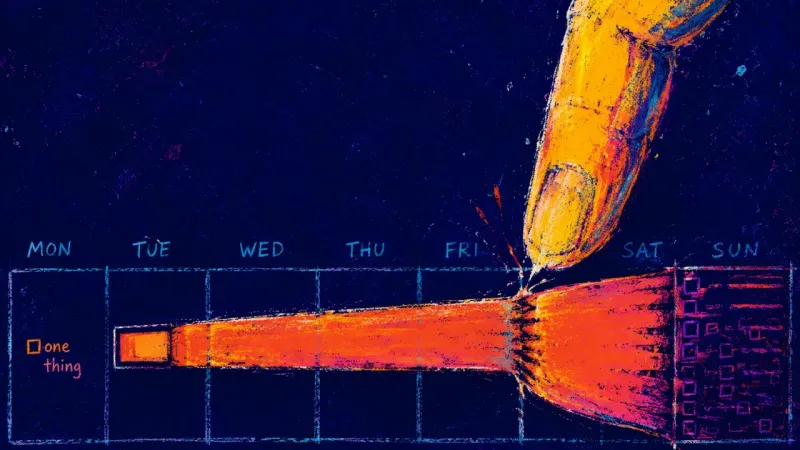
The Week That Looked Too Empty
You see a surprisingly empty week in Google Calendar and feel more uneasy than relieved—like you missed a hidden assignment.
Jordan said it the moment we sat down on Zoom, camera angled toward their Toronto condo kitchen table: “It’s… quiet. And my brain treats quiet like evidence.”
It was 9:08 a.m. on a Wednesday for them. Their laptop was open beside a half-cold coffee. The fridge hum sounded louder than it had any right to, like the room itself was waiting for something to go wrong. On-screen, their calendar looked strangely pale—too much white space, not enough colored blocks. I watched their shoulders inch upward as their cursor “accidentally” drifted to Slack. Not to respond. Just to see. Their jaw worked once, as if chewing an invisible problem.
What they were describing wasn’t laziness. It was a particular kind of guilt—thick and sticky—like trying to walk through an office hallway that’s suddenly turned into airport security: you’re allowed to pass, but you feel like you need paperwork proving you deserve to be there.
And there it was, the contradiction driving the whole thing: Jordan wanted real rest and spaciousness, but feared that being less busy would expose them as replaceable.
I kept my voice gentle and plain. “An open calendar isn’t a moral test. Let’s treat today like a map-making session—so we can get you from ‘I keep trying to earn permission to breathe’ to something closer to clarity.”

Choosing the Compass: Celtic Cross · Context Edition
I asked Jordan to take one slow breath—not as a mystical ritual, just a clean transition. The kind you do before you hit ‘Send’ on a message that matters. While I shuffled, I invited them to hold a single question: When my schedule clears, why does my body panic—and what’s a kinder, practical next step?
For this, I chose the Celtic Cross · Context Edition.
To a reader who’s wondered how tarot works in real life: this spread is useful when the problem is a loop. It doesn’t just describe the present—it traces the chain from visible behavior to root belief to the exact leverage point where a small experiment can change the pattern. And because Jordan wasn’t asking me to predict layoffs or a promotion, we aimed positions 6 and 10 toward something more grounded: a near-term boundary test and a realistic integrated rhythm.
I told Jordan—and, quietly, the part of them that didn’t trust good news—what to expect. “The first card shows the pattern you’re living. The next one shows what crosses it—the engine that keeps it running. The root card shows the belief underneath. And the final card shows the healthiest way through—what ‘integration’ actually looks like, not as a vibe, but as a practice.”
Reading the Map: Busywork, Chains, and the Scarcity Winter
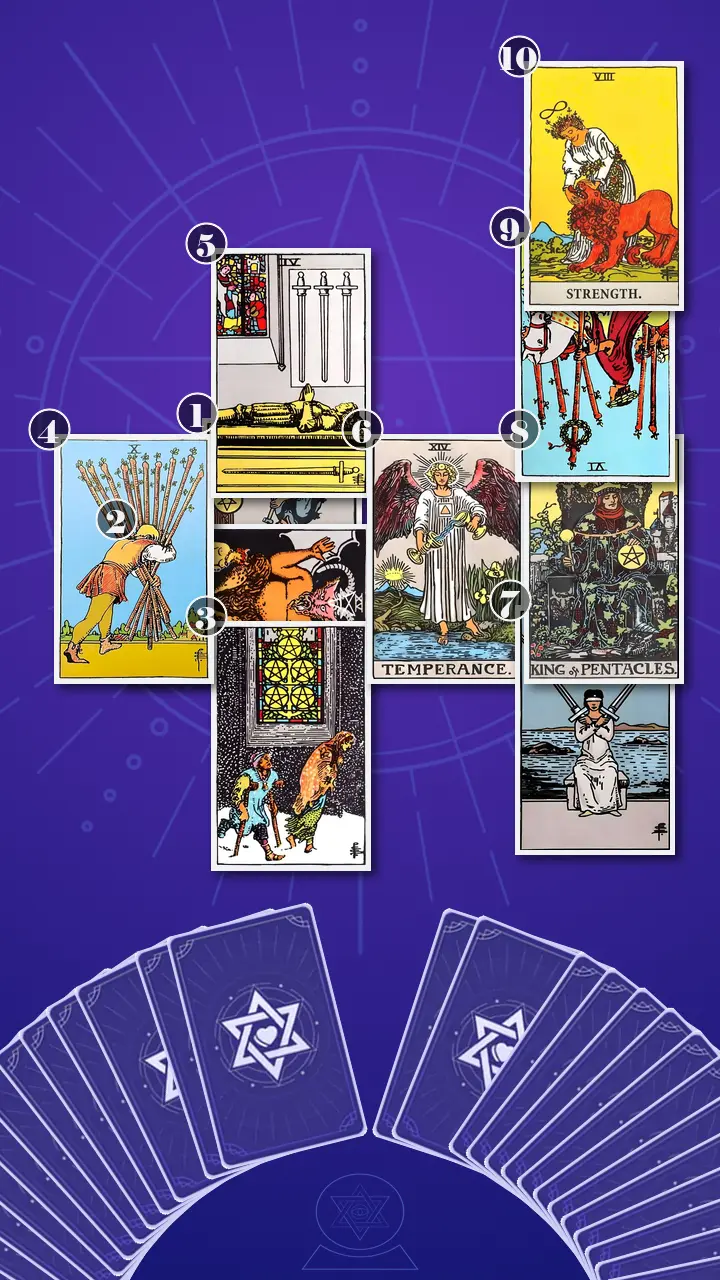
Position 1: The visible pattern right now
“Now flipped,” I said, “is the card representing the visible pattern right now: how productivity guilt shows up in your day-to-day behavior when the calendar clears.”
Eight of Pentacles, reversed.
“This is like when you block off ‘focus time’ and then spend it perfecting formatting, rechecking messages, and refining minor details because finishing feels risky if it isn’t flawless,” I said. “A craftsman’s bench turned upside down—skill-building becomes endless tweaking. Not progress. Proof.”
In energy terms, it’s excess effort in the wrong places: motion as a safety behavior. The body gets a small hit of relief when the fingers are typing, even if the work doesn’t meaningfully move anything forward.
Jordan’s reaction came in a three-beat chain: their breathing paused for half a second, then their eyes flicked away from the camera like they’d just seen themselves in an unflattering reflection, and then they let out a short laugh—sharp at the edges. “That’s… too accurate,” they said. “Like, borderline rude.”
I nodded. “Tarot can be like that—an uncomfortably good mirror. The question this card asks is: if nobody could see you working, what would still be worth doing?”
Position 2: The core block
“Now flipped is the card representing the core block: what keeps the guilt loop running even when there’s objectively more space.”
The Devil, upright.
I didn’t soften it. I clarified it. “This isn’t ‘you’re bad.’ This is attachment. Worth and safety chained to constant productivity and visibility.”
“Modern translation?” I continued. “It’s treating your Slack green dot like a heart monitor. You keep checking it to confirm you’re still ‘alive’ at work—even when nothing is happening. If you stop moving, you’ll be found out. So you manufacture motion. And then you can breathe for three seconds.”
Energetically, this is blockage: the chains are loose enough to slip off, but familiar enough that you keep choosing them. And guilt—here’s the key—becomes loud, not wise.
Jordan winced, then gave me the exact response this card often pulls from smart, exhausted people: a tense laugh, a second of discomfort, then a small exhale. “Oh,” they said quietly. “That’s exactly the loop.”
Position 3: The root driver
“Now flipped is the card representing the root driver: the scarcity or security belief underneath the guilt reaction.”
Five of Pentacles, upright.
“This is the cold that starts the whole fire,” I said. “The snow. The feeling of being outside the warm window.”
In Jordan’s life, it looked like this: the calendar opens, and their mind jumps straight to worst-case—layoffs, performance doubts, being forgotten. Not because it’s true, but because quiet is unmeasured time, and unmeasured time feels like risk.
Energetically, this is deficiency: not a lack of competence, but a lack of felt security. It’s the story that says support can be withdrawn at any moment, so you’d better keep earning your place.
Jordan’s hands, resting around their mug, tightened once. “I don’t even tell anyone I’m thinking that,” they admitted. “I just… start producing.”
“Of course you do,” I said. “When the nervous system thinks it’s winter, it tries to gather firewood.”
Position 4: What conditioned the pattern
“Now flipped is the card representing what conditioned the pattern: the recent workload story that made constant motion feel necessary.”
Ten of Wands, upright.
“This is the last few months,” I said. “Carrying too much until ‘overload’ felt normal.”
Energetically it’s excess responsibility—so much that you stop seeing the horizon. The body learns: pressure equals safety. No wonder a light week doesn’t feel like relief. You’re not lazy. You’re deconditioning.
I felt my own archaeologist’s memory rise—an internal flashback I didn’t quite expect: a field season years ago, dawn light over a trench, everyone moving fast because the schedule was brutal. When the day off finally came, half of us wandered the camp like we’d lost our purpose. The body doesn’t instantly trust permission.
“Your system is still braced for the bundle,” I told Jordan. “Even if the meetings disappeared.”
Position 5: What you consciously want
“Now flipped is the card representing what you consciously want: the intention you’re trying to reach—rest, clarity, a new rhythm.”
Four of Swords, upright.
Jordan’s face changed at the image—so subtle it would be easy to miss if you weren’t watching for it. Their shoulders lowered a fraction. Their eyes softened. Not joy. Something closer to permission.
“This is strategic rest,” I said. “Not collapse. Not quitting. A protected block the way you’d protect a client meeting.”
And I made it sensory, because guilt lives in the body: the hush after closing a laptop, the fluorescent buzz in a hybrid office, the tiny spike when you don’t respond instantly. This card draws a line between rest as maintenance and rest as reward. You don’t have to earn maintenance. You schedule it because it keeps the whole system running.
Jordan swallowed. “I want that,” they said. “I just don’t trust it.”
Position 6: What becomes possible next
“Now flipped is the card representing what becomes possible next if you experiment with one boundary and a clearer definition of ‘done’.”
Temperance, upright.
“This is calibration,” I said. “The slow pour between cups. Not swinging from overwork to shutdown.”
In modern terms: a simple cadence—deep work first, messages later—and discovering that structure can feel safer than frantic availability. Energetically, Temperance is balance, but not the Instagram kind. The kind you can repeat on a Tuesday.
My professor’s mind reached for a historical analogy that’s never failed me: “Merchants on the old trade routes survived by pacing,” I said. “They didn’t sprint the whole Silk Road. They set check-in points, water points, rest points. That wasn’t indulgence. That was how the journey stayed possible.”
Jordan nodded once, slow. “So… batching messages isn’t ‘slacking,’” they said, testing the phrase.
“It’s logistics,” I replied. “And it’s how you stop your attention from being colonized.”
Position 7: Your self-position
“Now flipped is the card representing your current self-position: the inner stance and decision dynamic that keeps you stuck.”
Two of Swords, upright.
“This is the half-rest,” I said gently. “Lunch with one eye on Slack. Coffee that goes cold because you refreshed your inbox again. You don’t choose rest or work—you choose both halfway, and it never works.”
Energetically, it’s blockage: you’re holding the swords at your own chest, keeping the peace by not making a clean decision. I invited Jordan to name the two voices, out loud.
They surprised themselves. “The Protector says: stay visible,” they said. “The Human says: please pause.”
“Good,” I replied. “That’s not weakness—that’s self-awareness. The pivot is a both/and: one defined deliverable and one defined pause. Clean edges.”
Position 8: Workplace context
“Now flipped is the card representing your workplace context: the cultural cues and external expectations you’re responding to.”
King of Pentacles, upright.
“This is a culture that respects reliability,” I said. “Steady outcomes. Predictable updates. People who look grounded.”
Energetically, it’s balance in the environment—yet it can feel like pressure if you translate it into ‘I must be constantly online.’ The King doesn’t flap. He doesn’t perform. He delivers, consistently.
“If your manager values outcomes,” I told Jordan, “you can make your value legible without living inside Slack. Busy is an aesthetic. Outcomes are the job.”
Position 9: Hopes and fears
“Now flipped is the card representing the emotional hook: what recognition/failure story you secretly hope for or fear at work.”
Six of Wands, reversed.
Jordan’s cheeks flushed—fast, human, unmistakable. “I draft updates,” they admitted, “and then I delete them. And then I rewrite them. And then I watch the channel like… like reactions are a verdict.”
“That’s this card,” I said. “Fear of invisible effort. The part of you that needs applause to feel safe.”
Energetically, it’s deficiency of inner recognition, which makes external validation do too much work. And when work is quiet, there’s nothing to clap—so the nervous system panics and tries to manufacture a stage.
I kept it non-moralizing. “Wanting to be seen is normal. The trap is believing you only exist if you’re witnessed.”
When Strength Spoke: The Antidote to Productivity Guilt
Position 10: Integration outcome
When I turned the final card, the air in my office felt noticeably still—as if even the radiator decided to stop talking for a moment. “We’ve come to the integration point,” I said. “The healthiest long-term relationship to productivity and self-worth if you practice the key shift.”
Strength, upright.
Jordan had been caught in the exact scene I see so often in Slack culture: you finally see an empty week in Google Calendar—no back-to-backs, no fires. Instead of relief, your stomach does that little flutter, your jaw tightens, and your hand opens Slack again, like quiet time is a trap you have to outsmart.
Stop treating guilt like a boss you must obey, and start leading it with gentle strength—like closing the lion’s mouth with steady hands.
Jordan’s reaction arrived in layers. First: a freeze—their mouth parted slightly, breath held high in the chest. Second: recognition—their eyes unfocused for a beat, like an internal replay started running: late-night “just checking,” the green dot, the performative deck-polishing marathons. Third: release—a long exhale that softened their shoulders, followed immediately by a blink that made their eyes shine. Then, unexpectedly, a flicker of anger. “But if that’s true,” they said, voice tight, “doesn’t it mean I’ve been… obeying the wrong thing for years?”
I didn’t rush to soothe it away. “It means you were doing what worked to survive,” I said. “And now we’re doing what works to live.”
This is where my own Skill Archaeology comes in—the way I’m trained to look at a site and see not just what’s obvious, but what’s been buried by habit. “Strength isn’t about forcing yourself to relax,” I told them. “It’s about unearthing an overlooked talent: you can regulate. You can lead your attention. You’ve just been using that leadership to stay on-call to anxiety.”
I offered a single, contained practice—what I called a Quiet Tolerance Rep, not to ‘fix’ them, but to give their nervous system evidence. “Once this week,” I said, “set a 10-minute timer. Close Slack and email—Do Not Disturb if you can. Phone face-down. Write one sentence: ‘Today’s outcome that matters is ____.’ Choose one next action that supports it—15 minutes or less. When the timer ends, you can reopen Slack… unless you notice your body already de-escalated, and then you can extend by five minutes. If anxiety spikes hard, stop early. The point is practice, not white-knuckling.”
Then I asked the question that makes the insight land in real life: “Now, with this new lens—when, last week, did guilt act like a boss? Is there a moment you can replay where leading it gently would have changed how your body felt?”
Jordan looked down and nodded once. “Yesterday,” they said. “5:41 on the TTC. I refreshed email with no notifications. I could’ve… just let the quiet happen.”
That was the shift in miniature: from guilty vigilance toward calmer self-trust. Not because they ‘did more,’ but because they began to believe they could be valuable without being visibly busy.
The Megalith Plan: Actionable Next Steps Without the Self-Punishment
I pulled the whole spread into a single, coherent story—because clarity is often just the end of confusion-by-fragmentation.
“Here’s the arc,” I said. “You came out of overload (Ten of Wands), so your body learned that pressure equals safety. When the calendar opens, misdirected effort appears (Eight of Pentacles reversed) because motion feels like protection. The Devil shows why the loop is sticky: you’ve been living under an always-on identity contract, where being busy equals being safe. Under that contract is the Five of Pentacles fear—scarcity, replaceability, being outside the warm room. You consciously want recovery (Four of Swords), and Temperance shows the practical bridge: a repeatable cadence. Strength is the antidote: compassionate self-mastery—leading the urge instead of obeying it.”
The cognitive blind spot was clean once spoken: Jordan had been treating visibility as the only proof of value. The transformation direction was equally clear: shift from “my worth is measured by visible busyness” to “my value is measured by intentional outcomes and healthy pacing,” and prove it with one small boundary.
Jordan raised a practical obstacle right on time. “But I can’t just disappear for 30 minutes,” they said. “If someone pings me, I feel like I’ll look… unhelpful.”
“That’s a fair constraint,” I replied. “So we’ll do what archaeologists have always done when moving something too heavy: Megalith Transport—we break it into manageable hauls. We don’t drag the whole stone in one go.”
Then I gave them three small, work-legible experiments—Relic Authentication first (what’s actually expected), then Tool Evolution (upgrade your habits gradually), then the step-by-step carry.
- Defined Done Rule (15 minutes to start)Pick one deliverable for today and write a one-line “done rule” (e.g., “One review pass, then send”). Set a 25-minute timer and work only on what moves that deliverable forward—save formatting tweaks for the final 5 minutes.Expect your brain to call this “unprofessional.” Preempt it by putting the done rule on a sticky note or at the top of the doc so you can follow it like a spec, not a mood.
- Sanctuary Block (10–30 minutes, work-legible)Schedule one protected block this week labeled something neutral like “Planning / Deep Work.” Before it starts, post one sentence in Slack: “Heads down for 20—back at 11:10.” Close Slack/email during the block. Use the first 3 minutes to reset your body (water, stretch shoulders, unclench jaw) before thinking work.If 30 minutes feels impossible, do a 10-minute version. The goal is evidence that nothing breaks when you’re briefly unreachable.
- Two-Check Cadence (one light day experiment)Choose two message windows for one day (e.g., 11:30 a.m. and 4:00 p.m.). Between checks, keep Slack closed or minimized. If the urge to check hits early, write one sentence: “I’m afraid I’ll look idle,” then return to your task for five more minutes.Reduce the fear factor by keeping notifications only for DMs/mentions for a week—not every channel.

A Week Later: Ownership, Not Certainty
Six days later, Jordan emailed me a screenshot. It wasn’t dramatic. It was almost boring—which is exactly why it mattered: a calendar block labeled “Docs & Decisioning,” a Slack status reading “Heads down—back at 2:40,” and one line beneath it: “Outcome that matters today: send the stakeholder summary.”
They wrote, “I did the 10-minute Quiet Tolerance Rep. My chest did the flutter thing, and I still didn’t open Slack. After eight minutes my shoulders dropped without me trying. It felt… weirdly kind.”
Clear, but not perfect—just real: they slept a full night, then woke up and still had the first thought, What if I’m wrong? They paused, breathed once, and opened the document anyway—without opening Slack first.
That’s what a Journey to Clarity often looks like in modern work culture: not a personality transplant, not a rebellion, but a small boundary that teaches your body you’re safe. Strength isn’t loud. It’s steady.
When your calendar finally opens up, it can feel less like freedom and more like standing under a spotlight—your body wants real rest, but your mind panics that quiet will prove you’re replaceable.
If you didn’t have to earn permission to breathe this week, what’s one small boundary you’d try—just once—to let your value come from an outcome, not from staying visibly busy?
Author Profile