From Workplace Identity Freeze to a Steady Voice: The One-Line Reset

Finding Clarity in the 11:47 p.m. Kitchen Glow
If you’ve rewritten the same Slack message five times because you’re terrified one word will make you sound ‘immature’—welcome to workplace identity freeze.
Alex (name changed for privacy) appeared on my screen from a Toronto condo kitchen that looked like it had been designed for daylight and then betrayed at night. The only light came from a range-hood glow and the cold rectangle of a laptop. Their cursor blinked over a Slack draft like it was waiting to judge them. In a half-hidden browser tab, a yearbook quote screenshot sat there—small, stupid, and somehow loud.
“I can do the job,” Alex said, voice low, like the walls might be listening. “I just don’t want to be the joke.”
I watched their jaw work—tight, controlled—then the swallow that followed, as if their stomach had tied a knot and refused to loosen. Embarrassment, when it hits at work, can feel like trying to speak with a mouth full of dry sand: you know the words are in there, but everything in you is bracing for a verdict.
“You’re not overreacting,” I told them. “You’re having a very human response to being reduced. Let’s treat tonight like a Journey to Clarity—less about fixing your reputation in one perfect moment, more about understanding what this trigger is doing to your body and your voice, and what you can do next.”

Choosing the Compass: The Four-Layer Insight Ladder
I asked Alex to take one slow breath in, one out, and to hold the question in plain language—no speeches, no self-defense. Then I shuffled, not as theatre, but as a way to let their mind step out of the late-night spiral and into something structured.
“We’ll use a spread I rely on when the issue is identity under pressure,” I said. “It’s called the Four-Layer Insight Ladder · Context Edition.”
For anyone reading who’s curious about how tarot works in a situation like this: I’m not trying to predict whether Alex’s coworkers will keep joking. I’m mapping a psychological mechanism—present reaction, the past hook, the fear underneath, the grounded resource that’s already real, the turning-point mindset, and the next practical move. It’s a ladder because it takes us down from mental noise into embodied action, rung by rung, with the kind of clarity you can actually use on a Monday.
“Card one will show the surface symptom—what the quote is doing to your voice at work right now,” I explained. “Card three goes deeper: the underlying fear, the internal courtroom. And card five is the key transformation—the inner posture that lets you retire a label without shrinking or overcorrecting.”
Reading the Map: The Blindfold, the Cringe-Loop, and the Internal Courtroom
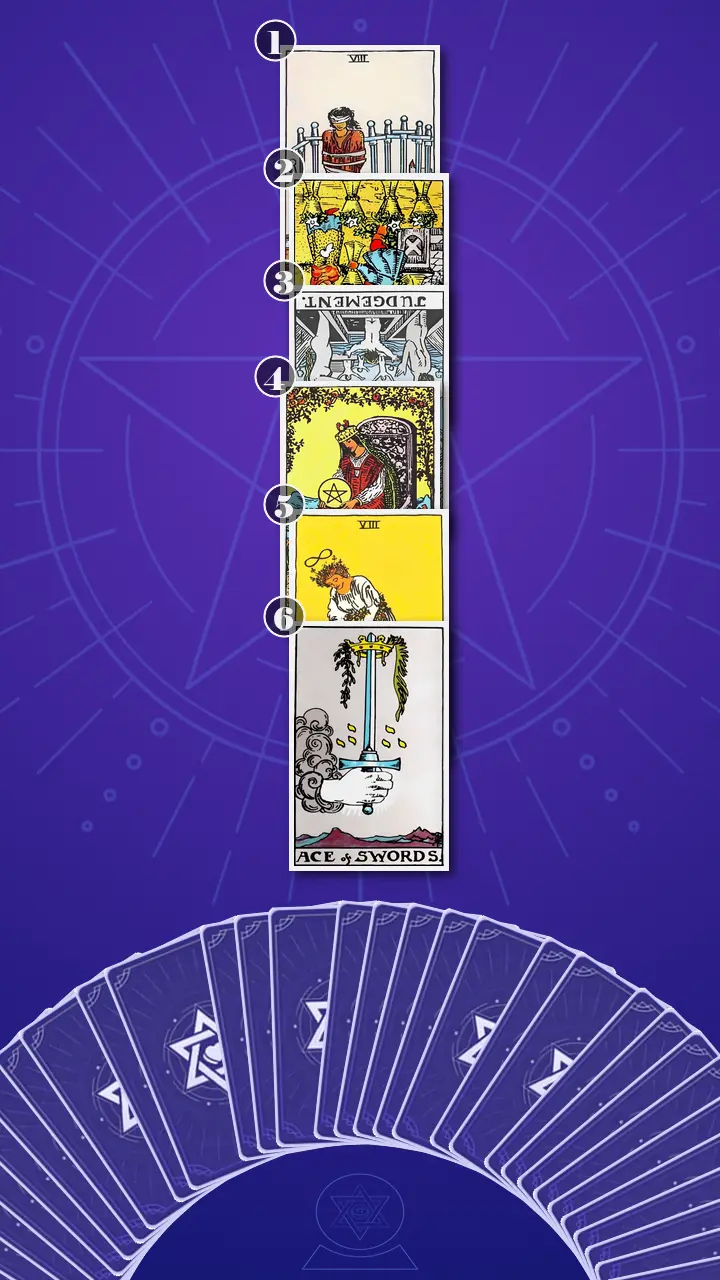
Position 1 — Surface symptom at work
“Now turning over is the card that represents the surface symptom at work: the specific way the resurfaced quote is affecting your behavior and voice right now.”
The Eight of Swords, upright.
“It’s 9:58 a.m. in a Toronto hybrid-office Monday standup,” I said, using the image the card offered with an almost uncomfortable precision. “Your idea is ready, you even have a clean bullet point in your Notes app, but the second you unmute you feel your jaw clamp. You start doing mental editing in real time—‘Is this too eager? Too jokey? Too defensive?’—and you decide to stay quiet. After the call, you send a ‘perfect’ Slack follow-up that’s so polished it barely sounds like you. The resurfaced yearbook quote isn’t just embarrassing; it’s turning every sentence into a risk assessment.”
In tarot terms, this is Air energy that’s become a cage—thoughts circling like swords, cutting off motion. Not because the bind is truly tight, but because the fear makes it feel non-negotiable. The blindfold matters. The bindings are loose. That’s the most brutal kindness of the card: your constraints feel external, yet your day-to-day restriction is being enforced internally—through silence and hyper-editing.
Alex let out a short laugh, bitter at the edges. “That’s… yeah. That’s too accurate. It’s almost mean.” Their shoulders lifted, then sank an inch, like their body had been caught and was deciding whether it was safe to stop performing.
I nodded. “If you need ten disclaimers, you’re not communicating—you’re self-protecting. And protection makes sense when you think you’re on trial.”
Position 2 — The past label’s hook
“Now turning over is the card that represents the past label’s hook: what part of the old story still has emotional leverage over you in workplace settings.”
Six of Cups, reversed.
“A coworker drops the yearbook quote screenshot into a group chat with a ‘LOL this is so you’ vibe,” I said. “You laugh-react because it’s low-key safer than explaining why it stings. Then, later that night, you keep reopening the screenshot like it’s a tab you can’t close, rewriting the moment and imagining the one ‘perfect comeback’ that would have stopped the label from sticking.”
Reversed, this isn’t nostalgia. It’s a cringe-loop. A memory treated like a brand tagline. The past gets passed around as if it’s your current job title—like an old bio pinned to your forehead.
“The hook isn’t the quote itself,” I told Alex. “It’s the old social reward attached to it—the belonging, the ‘I’m easygoing’ safety. Part of you learned, a long time ago, that being funny and agreeable keeps you included. Now your workplace is asking for a different currency—credibility, steadiness, clean decisions—and the old currency is still jangling in your pocket.”
Alex’s eyes flicked away from the camera. Their thumb rubbed the edge of their mug, slow and repetitive. “I hate that I care,” they said. “But I really care.”
Position 3 — Underlying fear
“Now turning over is the card that represents the underlying fear: what you’re afraid the label will ‘prove’ about you in terms of worth, belonging, or respect.”
Judgement, reversed.
“LinkedIn brain,” I said—because that phrase lands where a lecture won’t. “You read a short ‘k’ reply to your Slack update and your stomach drops like you just got graded. You interpret laughter in a side thread as ‘they’re laughing at me,’ even though it could be anything. You start writing long justifications for tiny choices—‘for context…’—to preempt an invisible jury.”
Here the energy isn’t just thought. It’s evaluation. Judgement reversed is what I call the permanent record mindset: living like every meeting is a trial and one awkward moment becomes the verdict on your competence.
“It’s not the quote—it’s the internal courtroom it switches on,” I said, letting the sentence sit between us. “And in that courtroom, the old version of you is always being called as a witness.”
There was a pause where Alex went very still—breath held, eyes fixed on some point beyond their screen—then a slow exhale, like they’d been bracing for impact and finally recognized the shape of the thing they were bracing against.
“Yeah,” they said. “I’m acting like I’m one weird sentence away from… being demoted as a person.”
My mind, uninvited, flashed back to excavations—how a single shard can be misfiled and then mislead an entire interpretation of a site. It’s an archaeologist’s cautionary tale: context is everything, yet humans love a shortcut story.
Position 4 — Grounded resource
“Now turning over is the card that represents the grounded resource: what is already true about you that counters the label in real life.”
Queen of Pentacles, upright.
“This is Notion/Asana receipts energy,” I said, and I watched Alex’s face soften because it was finally something they could do. “You pull up your shipped work: the ticket you closed that unblocked two teams, the doc you wrote that everyone still links, the time you handled a client escalation calmly, the teammate who DMed you ‘thanks for making that easier.’ You remember you’re not just a personality in a chat—you’re a reliable operator.”
Earth energy arrived. Tangible, weighty, calm. The Queen holds the pentacle like it’s not up for debate. That’s her authority: quiet, practical, lived.
Alex’s shoulders dropped—an involuntary correction toward gravity. Their jaw unclenched just enough that I could see the shift in the muscles near their cheek.
“Receipts beat vibes,” I said. “When your brain won’t stop litigating, evidence is how you call reality back into the room.”
When Strength Held the Lion: Retiring the Label Without Shrinking
Position 5 — Key transformation
I slowed my hands before turning the next card. Even through a screen, the atmosphere changes at a turning point—like the room remembers to go quiet.
“Now turning over is the card that represents the key transformation: the mindset and inner posture that lets you retire the label without overcorrecting or shrinking yourself.”
Strength, upright.
“In the next meeting, the embarrassment spike hits—heat in your face, tight jaw, that ‘don’t give them evidence’ instinct,” I said, following the card into Alex’s real life. “Instead of overcorrecting—going ice-cold serious—or disappearing—staying silent—you do something quieter and harder: you breathe, let the discomfort exist, and speak once. You don’t try to win the room. You don’t try to erase your past. You act like your present self is already credible—and you let that be enough.”
Setup. I leaned in slightly. “You know that moment on the TTC or late at night when you’re replaying the screenshot and rewriting your Slack for the fifth time—like the past version of you is about to walk into the meeting instead of you. That’s the trap: you’re trying to time-travel your way into safety.”
Delivery.
Stop trying to ‘prove you’ve changed’ and start practicing steady Strength—hold the lion gently, and your present self will speak louder than the old quote.
I let the silence do its work.
Reinforcement. Alex reacted in a three-part cascade I’ve come to trust as real: first a tiny freeze—breath caught, eyes widening, fingers hovering above their mug as if they’d forgotten what they were holding. Then the cognitive shift—focus drifting, like their mind was replaying last week’s standup with a different ending. Finally, the release—an exhale that sounded almost like a laugh, except it carried relief instead of humor.
Then, unexpectedly, their expression sharpened. “But if I stop proving it,” they said, a quick flash of anger in the voice, “doesn’t that mean… I was wrong for trying so hard? Like I wasted all that energy?”
I didn’t rush to soothe. “That’s a fair reaction,” I said. “And it’s exactly why Strength is the right card. Strength doesn’t shame the lion for roaring. It acknowledges the roar—and still keeps a gentle hand on the mouth. You did what you could with the tools you had. Now we upgrade the tools.”
This is where my own framework—what I call Skill Archaeology—becomes more than a metaphor. “In archaeology,” I told Alex, “we don’t excavate a site to prove the top layer was ‘stupid.’ We excavate because the top layer is incomplete. A yearbook quote is a shard. Useful for context, but absurd as a whole identity. Your present competence is the entire dig site.”
I asked them, “Now, with this new lens—steady Strength—think back to last week. Was there one moment where, if you’d taken two breaths and spoken one clean sentence, you would’ve felt different afterward?”
Alex blinked hard, eyes briefly glossy. “Tuesday,” they said. “Someone asked what I thought, and I had an answer. I just… didn’t want my voice to sound like the quote.”
“That right there,” I said gently, “is the shift from internal courtroom panic and overexplaining to steady self-trust and one clear, present-focused voice. Not overnight. Not perfectly. But directionally.”
Position 6 — Next step at work
“Now turning over is the card that represents the next step at work: an actionable way to communicate, set boundaries, or reframe your identity narrative this week.”
Ace of Swords, upright.
“One upright blade is one clean sentence,” I said. “Not ten disclaimers. Not a redemption essay.”
“You draft a single line you can use if the quote comes up again—calm, short, present-focused,” I continued. “In a group chat, if someone posts the screenshot, you respond without self-roasting and without overexplaining: ‘Iconic throwback. I was a different person then—these days I’m focused on X.’ Or, in-person: ‘That’s an old snapshot. Anyway—here’s where I’m at now.’ You use clarity as a boundary. You don’t debate your identity; you steer the conversation back to current reality.”
Alex nodded—small, but real. “I can say one sentence,” they murmured. “I can do one sentence.”
From Insight to Action: The Receipts Folder and the One-Clean-Sentence Reset
I gathered the reading into a single storyline so Alex could carry it into an actual workweek: the Eight of Swords showed the present—self-censorship and message hyper-editing. The Six of Cups reversed explained the hook—the past being treated like a brand exchange, a cringe-loop tab you can’t close. Judgement reversed named the engine underneath—fear of evaluation, the internal courtroom where visibility equals a verdict. Then the Queen of Pentacles grounded us in reality—evidence-based self-trust, the receipts that outvote anxious thoughts. Strength was the bridge—staying steady with embarrassment instead of fighting it louder. And the Ace of Swords was the tool—clear language as a boundary, a clean redirect back to the present.
The cognitive blind spot I named for Alex was simple and painful: they were treating perception as more real than evidence. The transformation direction was equally simple: shift from trying to control how you’re perceived to practicing steady self-trust and one clear, present-focused response.
I offered the next steps using what I call Megalith Transport—the ancient truth that you don’t move something massive by heroics; you move it by manageable stones, placed in sequence.
- Build a “Receipts (Last 90 Days)” noteSet a 7-minute timer. In Notion/Notes, create a page titled “Receipts (Last 90 Days).” Paste 5 items: one doc link, one shipped ticket, one compliment DM, one metric, and one example of handling something calmly under pressure.Treat it like documentation, not self-praise. If writing feels like too much, only collect links—no polishing.
- Do the two-breath, one-sentence practice (Strength)In one low-stakes meeting this week, take two slow breaths before speaking. Then say your point once—in one sentence—and stop unless someone asks for more.If the pause feels scary, remember: two seconds reads as thoughtfulness. Name the body cue privately—“This is embarrassment”—and proceed anyway.
- Save your one-sentence redirect (Ace of Swords)Write and save one line you can use if the yearbook quote resurfaces: “That’s an old snapshot—these days I’m focused on X.” If it happens, use the line once, then ask a present-focused work question: “Anyway—are we aligned on next steps for X?”Expect the urge to overexplain. Decide in advance: no extra context unless someone asks a real question.
A Week Later: Ownership, Not Certainty
A week later, Alex sent me a message that was almost annoyingly small: “Made the receipts note. Used the redirect line once in a thread. My hands were shaking a bit, but I didn’t add disclaimers.”
They told me they celebrated in the quietest way—by taking their laptop to a coffee shop and sitting there, alone, for an hour with a normal heartbeat. The first thought the next morning was still, “What if they think I’m unserious?”—but this time, they recognized it as a courtroom script, not a prophecy.
That’s the real Journey to Clarity I see, again and again: not a dramatic reinvention, but a shift from bracing for a verdict to standing in present evidence—then speaking in one clean line.
When an old label resurfaces, it can feel like your body is bracing for a verdict—jaw tight, stomach clenched—while you’re trying to hold two truths at once: you’ve grown, and you’re still scared someone will only see the screenshot.
If you let your present competence speak first this week, what’s the smallest, clearest sentence you’d want to land—just once—without adding a single disclaimer?