From Being Talked Over to Holding the Floor: A Standup Boundary Arc

Finding Clarity in the 10:03 Zoom Cut-Off
If you get talked over in daily standup and your coping strategy is a post-meeting Slack add-on—“Also, to clarify…”—because it feels safer than correcting someone live, this is for you.
Jordan (name changed for privacy) showed up on my screen from their London flat with that particular 9:58 a.m. lighting—the grey, watery kind that makes your laptop glare feel like it’s personal. I could hear a kettle click off somewhere off-camera, and the faint hum of a laptop fan doing its best. They had Apple Notes open in another window; I could tell because their eyes kept flicking to the same spot, like they were rereading two “perfect” lines they’d already rewritten five times.
“It’s daily standup,” they said, and their mouth tightened the way it does when you’re trying to sound chill about something that’s been slowly eroding you. “I’m not trying to win the meeting, I just want to finish my sentence. But one teammate—every time I start, they jump in. And I just… stop. Then afterward I post a Slack clarification so my update exists somewhere. I hate that I do that.”
As they spoke, I watched their throat work around the words. Their jaw held itself like a clamp, and when they mentioned the teammate’s usual “Quick thing—” their cheeks flushed with a fast spike of heat. Frustration, yes—but the kind that comes packaged with embarrassment, like anger wrapped in thin paper.
Underneath it was the real bind: wanting to be respected and heard in standup, while fearing you’ll be seen as confrontational—or “difficult”—if you set a boundary.
The feeling had a texture to it: like trying to deliver a 30-second update while someone keeps grabbing the mic, and your own hand starts loosening its grip before they even touch it.
“I get it,” I told them. “And we’re not here to script you into some new personality. We’re here to find one clean, repeatable way to hold your place—so you can keep your voice without turning the vibe into a fight. Let’s try to turn this fog into a map.”

Choosing the Compass: The Relationship Spread · Context Edition
I asked Jordan to take one slow inhale—not as a ritual for the universe, just as a quick nervous-system handbrake. While they exhaled, I shuffled, the soft snap of cards a steady metronome against the London morning.
“Today I’m using something I call the Relationship Spread · Context Edition,” I said. “It’s built for situations where the problem isn’t a yes/no decision—it’s a repeating interaction loop between two people inside a bigger system. Which is exactly what standup is: two humans, plus meeting physics.”
For readers who’ve ever Googled how tarot works and bounced off the mysticism: this is one of the cleanest ways to use tarot as a practical tool. You’re not asking the cards to ‘predict’ your teammate. You’re using the spread like a diagram—showing your default response, their observable style, the pattern you co-create, and then the boundary language that actually changes the outcome.
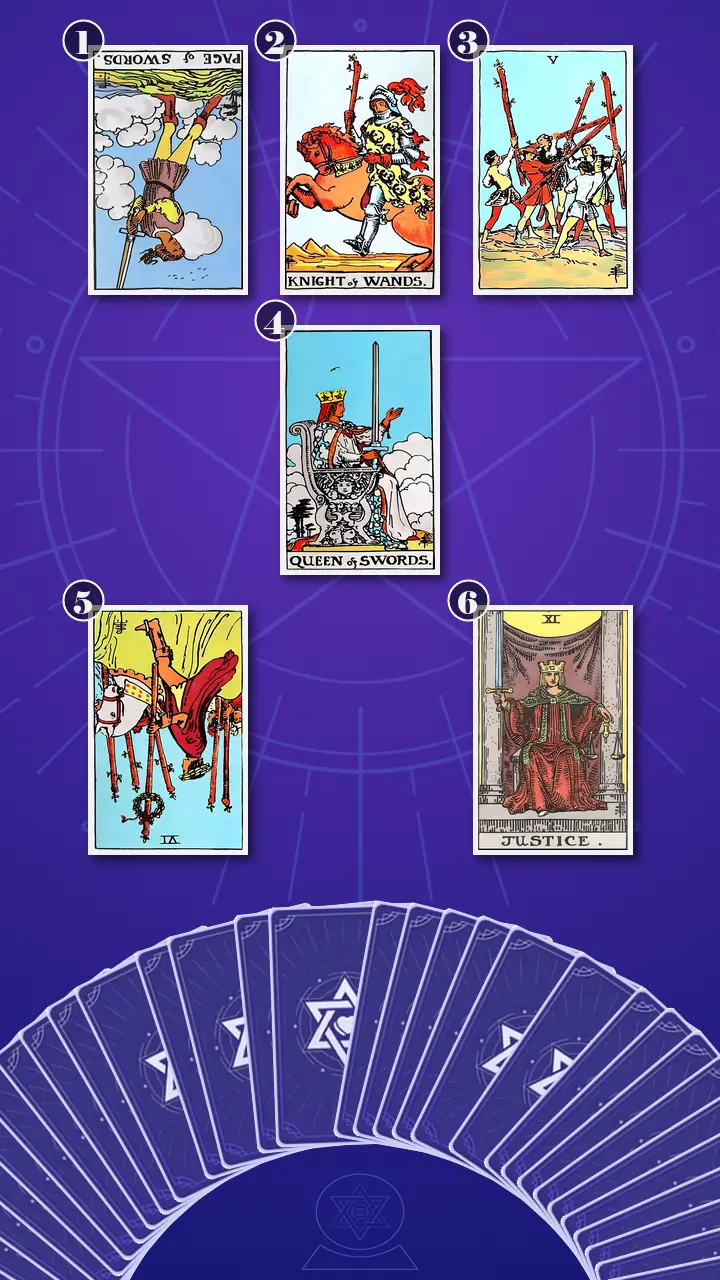
“Here’s what we’re looking at,” I continued. “Card one is how you show up in the interruption moment—your micro-response in your body and voice. Card two is how they show up—observable, no mind-reading. Card three is the standup dynamic that keeps it repeating. Then the center card is your boundary need—the one line you must hold. And the last card lands us on a professional next step that restores fairness and flow.”
As I laid the cards in their funnel shape, it reminded me of a Mondrian grid—blocks of color turned into structure. In my studio, a grid isn’t restrictive; it’s how you stop the whole canvas from becoming noise. Meetings aren’t that different.
Reading the Room Like a System Bug (Not a Personality Flaw)
Position 1: How you show up in the standup interruption moment
“Now flipped over,” I said, “is the card representing how you show up in the standup interruption moment—your immediate behavior and self-talk.”
Page of Swords, reversed.
The image always hits me like a snapshot: a young messenger with a raised sword, wind everywhere, clouds moving fast. Upright, it’s emerging voice. Reversed, it’s the moment alertness becomes self-censorship.
I grounded it in the most modern translation possible, because Jordan didn’t need poetry—they needed accuracy: Ten minutes before standup, you’ve rewritten your update into two perfect lines in Notes. On the call, you’re not just speaking—you’re monitoring: who’s unmuting, who’s about to jump in, whether your manager’s camera is on. When the interruption hits, your throat tightens, you stop mid-sentence, and your brain starts editing in real time: “Don’t be dramatic. Don’t make it awkward.”
“This is Air energy,” I told them, keeping it simple. “But it’s Air that’s blocked. Your mind is fast—too fast. Instead of supporting your words, it turns your own sword inward: ‘Say it perfectly or don’t say it at all.’”
Jordan let out a small laugh—one of those quick, bitter ones that’s half relief and half, please don’t look at me this closely. “That’s… yeah,” they said. “It’s so accurate it’s kind of rude.”
“Accurate, not rude,” I said gently. “And notice how your body already knows the pattern. Tight throat. Clenched jaw. You’re bracing before anyone actually touches you.”
Position 2: How your teammate is showing up
“Now we look at the card representing how your teammate is showing up—their observable style in meetings, not a moral judgment,” I said.
Knight of Wands, upright.
This one is pure momentum: a rider charging across a hot landscape, wand lifted like a baton. In real life: Your teammate treats standup like a sprint. They hear one keyword in your update and jump straight to a solution out loud, finishing your sentence or redirecting the discussion mid-stream. It’s not subtle: they talk like they’re holding a baton, trying to keep the pace high—especially when a lead is listening.
“Fire energy,” I explained. “Not evil Fire. Just loud, fast, ‘I’ve got this’ Fire. The problem is that Fire doesn’t naturally do turn-taking—especially in time-boxed meetings. It acts first and reflects later.”
I watched Jordan’s shoulders lift a millimeter, like their body was preparing to defend themselves against the idea that the teammate might not be consciously targeting them. “So I’m not imagining it,” they said. “They really do do it.”
“You’re not imagining it,” I agreed. “But we’re going to treat it like a predictable communication style you can boundary around—not a mystery you have to solve.”
Position 3: The repeating interaction pattern
“Now flipped over,” I said, “is the card representing the repeating standup pattern that keeps the interruption cycle going.”
Five of Wands, upright.
The visual is immediate: five wands crossing mid-air in a tangled mess. Nobody’s facing the same direction. No single villain—just collision.
And the modern translation landed like a screen recording Jordan had lived too many times: Standup stops being round-robin and becomes live commentary. People jump in with “quick questions,” side debates start, someone’s mic picks up typing, and updates turn into a scramble for airtime. Your teammate’s interruption doesn’t land as one moment—it lands as part of a loud, normalised cross-talk culture that keeps swallowing your sentences.
“This is the key system piece,” I told them. “You’re not just dealing with one person. You’re dealing with a meeting culture where speed wins, overlap gets rewarded, and the quietest person pays the bill.”
Then I used the echo technique I’d promised myself I would: a Zoom-body close-up, because that’s where this shame hides.
“I can see it,” I said. “Your cursor hovering near mute. Your eyes flicking to the participant list like it’s a weather map—who’s about to unmute, who’s about to thunder in. Notes app open with two perfect lines. And the loop underneath it: If I push back, I’m difficult. If I don’t, I disappear.”
Jordan went still in a three-beat sequence I’ve learned to respect: first a tiny breath pause (freeze), then their gaze went slightly unfocused (memory replay), then a quiet nod that looked almost involuntary (release). “Yeah,” they said, softer. “And it’s ridiculous because… I can explain a whole system design in a 1:1. But in the group call I can’t say one sentence.”
“That contrast is the Page reversed,” I said. “Competence is there. Authority-in-the-room is the muscle we’re rebuilding.”
When the Queen Lifted Her Sword: The Boundary That Isn’t a Speech
Position 4: Your boundary need
I let my hand hover for half a second over the next card. “This,” I said, “is the visual anchor of the reading—the spine.” The room seemed to quiet, even through Wi‑Fi; outside Jordan’s window, a bus hissed past on wet pavement like someone drawing a long line under a sentence.
“Now flipped over is the card representing your boundary need: the clearest line you must hold to protect your voice and focus.”
Queen of Swords, upright.
I love her for how unromantic she is. No extra drama. No begging. No performance. Just a raised sword and a direct gaze—clarity with self-respect.
I brought it straight into Jordan’s actual life: You get interrupted mid-update and you don’t shrink, rush, or explain. You say, evenly: “I’m going to finish my update, then happy to take that.” And you continue at the same pace. No extra justification. No tone-policing yourself. Just one calm sentence that protects your speaking turn and keeps the meeting moving.
“Think of it like replacing a messy Slack thread with one crisp Jira ticket title,” I said. “Same work, less chaos. Same point, fewer opportunities for your point to be rewritten by the room.”
Jordan’s mouth twitched like they wanted to smile and didn’t trust it yet. “But what if it comes out… sharp?”
“Here’s the Queen’s secret,” I said. “Clarity isn’t confrontation.”
The Setup
Jordan nodded, but I could tell they were still caught in that familiar standup moment: you’ve finally found your opening, you start your first sentence, and you can already see someone unmuting—so your voice gets tighter before you even get interrupted. They were trying to solve it by finding the perfect wording, the perfect tone, the perfect timing… which is like trying to debug a recurring error by rewriting the same line of code from scratch every morning.
The Delivery
Stop shrinking to keep the peace; start holding the floor with the Queen’s upright sword—one clear line, delivered calmly, then keep speaking.
I let that sit in the air for a beat, the way a single clean note hangs after the rest of the band drops out.
The Reinforcement
Jordan’s reaction came in layers—exactly the way real insight lands when it’s not just “nice advice,” but a new option their body can believe.
First, their face went blank for a second, like a browser tab freezing mid-load. Their eyes widened a fraction. Their lips parted, then pressed together again.
Then their shoulders dropped—not dramatically, but with the unmistakable weight shift of someone putting a bag down they didn’t realize they’d been gripping. Their jaw unclenched, and they took one deeper breath that sounded like relief trying to be quiet.
And then—complicated emotion. A flicker of grief, almost. “So it’s not about… winning them over,” they said, voice a little rough. “It’s about not handing the mic away.”
“Exactly,” I said. “You don’t need a perfect comeback—you need one calm sentence you’re willing to repeat, and then you keep going.”
As an artist, I’ve learned something from jazz—especially Louis Armstrong’s kind of adaptability. In a solo, you don’t invent a whole new identity mid-song. You pick a motif you can return to. You repeat it until it becomes yours. The Queen of Swords is that motif: one line you can play under pressure without speeding up, without apologizing, without turning your boundary into a debate.
“Now,” I added, “use this new lens and rewind to last week. Was there a moment where, if you’d had one calm line, you would’ve felt different?”
Jordan stared slightly to the left, like they were watching the memory on a second monitor. “Thursday,” they said. “Manager present. They finished my sentence. I laughed so it wouldn’t be awkward. And then I hated myself on the Northern line afterward.”
“That’s the shift right there,” I told them. “Not from timid to fearless—just from throat-tight, heat-faced self-silencing to calm, brief, repeatable boundary confidence. From trying to be liked in the moment… to trusting that your update gets to exist.”
Position 5: Their underlying driver
“Next,” I said, “is the card representing their underlying driver—what they may be optimizing for that influences the interrupting behavior.”
Six of Wands, reversed.
Upright, it’s recognition. Reversed, it’s recognition that doesn’t feel stable—so someone chases it harder.
I translated it carefully, without pretending I could diagnose someone Jordan worked with: Your teammate interrupts most when the room feels performative—when a manager is present or when there’s pressure to look decisive. They jump in with “Actually—” or “Quick thing—” as if they’re grabbing a moment of recognition. The key is: you can hold your boundary without stepping into a status battle for who sounds smartest in 30 seconds.
“This is why trying to out-talk them tends to backfire,” I said. “You’ll be tempted to compete for airtime. To sound louder. To pack your update with achievements. That’s just feeding a status contest.”
Jordan’s eyes narrowed with a new kind of clarity. “So if I keep it boring—”
“—you keep it professional,” I finished. “Boring is your friend here.”
Position 6: Actionable boundary path
“Last card,” I said, “represents the actionable boundary path—a realistic next step that restores fairness and meeting flow.”
Justice, upright.
Scales in one hand, sword in the other. Not feelings—standards. Not a vibe—an agreement.
I grounded it in the workplace language Jordan could actually use: Instead of making it personal, you bring it back to the rules of the room: “Let’s keep standup round-robin—questions at the end so everyone can get through updates.” If interruptions continue, you ask for facilitation support (Scrum Master/lead) to reinforce the format. It’s about flow and fairness, not calling someone a bad teammate.
“Justice is the grown-up version of what you already want,” I said. “Make it about the format, not their personality.”
It reminded me—cinematically—of those scenes in All the President’s Men where the power isn’t in who talks loudest. It’s in who holds to procedure when the room gets noisy. Jordan didn’t need to become sharper. They needed to become steadier.
“So we build a micro ladder,” I said. “In-the-moment norm statement. If needed, a short DM. If it continues, involve the facilitator or bring it to retro as a process tweak. That’s not drama. That’s maintenance.”
From Chaos to Standards: Actionable Advice for Standup Interruptions
When I pulled the whole spread together, the story was clean: you (Page of Swords reversed) come into standup hyper-prepared and hyper-monitoring, bracing for social risk. Your teammate (Knight of Wands) brings fast, momentum-driven Fire. The room itself (Five of Wands) is a cross-talk machine—multiple talk tracks colliding inside a time box. Underneath, there’s a visibility/stage dynamic (Six of Wands reversed), especially when a manager is present. The way through isn’t more Fire—arguing louder, performing harder, over-explaining in Slack. The way through is mature Air: the Queen’s one-line boundary, then Justice’s shared standard.
The cognitive blind spot—the thing you couldn’t see while you were living inside it—was the trade you’ve been making in real time: you’ve been swapping your voice for belonging. You’ve been trying to stay “easy to work with” by shrinking. And the meeting interprets shrinking as consent.
The transformation direction was equally simple: move from silently accommodating interruptions to using one short, repeatable boundary sentence in the moment, then calmly continuing your update. One calm line. Then keep talking. And if it keeps happening, anchor it in a process boundary: format over personality.
I gave Jordan a set of next steps they could start immediately—low-drama, high-repeatability:
- Paste the Queen SentenceBefore your next standup, choose ONE neutral boundary line and paste it at the top of your Notes: “I’ll finish my update, then happy to take that.” Keep it visible like a subtitle you can glance at mid-scene.Your brain may scream “This sounds rude.” Treat that as old protection, not truth. Commit to the exact same wording for one week—no upgrades.
- The One-Breath Reset (In the Moment)When you get interrupted: take one inhale, deliver the line, then continue your original sentence at the same pace—no justification, no apology, no extra context dumping.If your voice shakes, that’s not failure. That’s your nervous system learning something new in public. Keep going anyway.
- Justice the Room: Format-First BoundaryUse a process boundary once in standup: “Can we keep standup round-robin? I’ll finish, then we can take questions after.” If you have a Scrum Master/facilitator, DM them a short note asking to hold questions until the end.Make it boring. Boring is professional. If you feel adrenalised, drink water first, then send the shortest possible message.
And because Jordan specifically feared the sound of their own boundary—whether it would come out too sharp—I pulled in one of my private tools, the one I use when I have to speak about my work in rooms that feel too important: Oscars Speech Training.
“Two minutes,” I said. “Not forever. Two minutes.”
“Tonight or tomorrow morning, set a timer for two minutes and practice saying your boundary line out loud five times, normal pace. No acting. No ‘nice voice.’ Think of it like an acceptance speech for your own speaking turn: short, clear, and you don’t apologise for being there.”
That’s how you turn the Queen from an idea into a reflex.

A Week Later: Ownership, Not Certainty
Eight days later, Jordan messaged me: “Used the line. Heart pounding. But I finished my update.”
They told me the teammate had still tried to jump in—because Knight of Wands energy doesn’t vanish overnight—but when Jordan said, evenly, “I’ll finish my update, then happy to take that,” something subtle shifted. Not a miracle. Not a personality rewrite. Just a clean new rule in the air. The manager nodded once and moved on. The meeting kept flowing.
Jordan didn’t sound euphoric. They sounded… steadier. “I still felt weird after,” they admitted. “Like—what if I sounded rude?”
“That’s normal,” I said. “You’re building a new association: boundary doesn’t equal danger. You’re not aiming for zero discomfort. You’re aiming for self-trust through repetition.”
Clear but vulnerable, in under 50 words: Jordan slept a full night after that standup. In the morning, their first thought was still, What if I did it wrong?—but this time they exhaled, opened Notes, and saw the line waiting at the top like a small, bright underline.
That’s the whole Journey to Clarity, really: not a dramatic transformation, but a quiet reclaiming. A voice that stops asking permission to exist.
When you’re trying to stay ‘easy to work with’ while your throat tightens and your sentence gets taken mid-air, it’s not that you’re bad at standup—it’s that you’ve been trading your voice for belonging in real time.
If you trusted that one calm sentence—the Queen sentence—was enough, what would you want your voice to sound like the next time you don’t hand the mic away?