From Reactive Onboarding to Legible Leadership: Building Receipts

The 10:33 p.m. Slack Ping and the Invisible Glue Work
Jordan didn’t start our call by saying hello. She started by reading me a Slack message out loud, like it was evidence in a trial.
“Can you onboard the new hire?” she said. “And it’s not even a question. It’s like… a weather event.”
She was 29, a product manager in Toronto, and the way she described her week sounded like trying to run two full-time jobs in the same browser window—constant alt-tabbing, nothing ever getting a clean done. She’d been asked to onboard someone new while her roadmap work stayed fully alive, fully urgent, fully judged.
I could picture the scene before she even painted it, because it’s become a modern city ritual: 10:33 p.m. on a Tuesday in a condo with the overhead lights off. Laptop fan loud enough to feel personal. Room lit only by the screen. Phone warm from nonstop Slack like a tiny heating pad for stress. Tabs open: half-finished onboarding doc, a drafted weekly check-in invite, and a DM thread she kept replying to instantly.
Jordan rolled her shoulders once—like she was trying to unstick them from her ears—and then gave a small, tight laugh. “I’m happy to do it,” she said, and I heard the second sentence hiding inside that first one: I just don’t want it to disappear into the background.
Her jaw looked like it had been holding a secret all day. The pressure in her body wasn’t abstract; it was mechanical—tight shoulders, a buzzy chest flutter before check-ins, restless energy that kept her “on” after hours even when she’d closed the laptop.
And then she said the contradiction that brings so many high-performing people to my table—whether the table is physical or a screen between Tokyo and Toronto:
“I want this to count. Like… promotion-ready leadership. But I’m terrified that if I claim it or set boundaries, I’ll look political. Or worse—like I’m not in control.”
I let that land without rushing to fix it. “Okay,” I said softly. “Then our goal tonight isn’t to hype you up. It’s to get you clear. We’re going to turn this fog into a map—and figure out what would change if onboarding became a scoped project with receipts.”

Choosing the Compass: A Celtic Cross for Career Visibility
I’m Laila Hoshino. By day, I’m a veteran tour guide at a Tokyo planetarium; for ten years I’ve watched people tilt their heads back and go quiet when the stars come on. By night—more truthfully, by the same night—I read tarot the way I teach astronomy: not as fate, but as pattern recognition across time.
I asked Jordan to take one slow breath and hold the question in a single sentence: “I’m onboarding a new hire—how do I turn it into a promo case without sounding self-promotional?”
As I shuffled, I kept it practical. No mystique. The shuffle is just a nervous system bridge: from spinning thoughts to one focal point.
“Today we’ll use the Celtic Cross spread,” I told her. “It fits because this isn’t only a tactical problem—this is a surface situation (tasks, pings, docs) with a deeper engine (credit, evaluation anxiety, and the story your manager can actually repeat back).”
To the reader: this is part of how tarot works when it’s used for real-life decision-making. A spread like the Celtic Cross doesn’t predict a promotion. It organizes what’s happening—internally and externally—so you can see your next steps in context.
“Card 1 will show what your day-to-day reality looks like while onboarding,” I said. “Card 2 will show the main blocker to making it promotable—usually visibility or credit friction. And Card 6, near future, will show what opens up if you choose to lead this intentionally.”
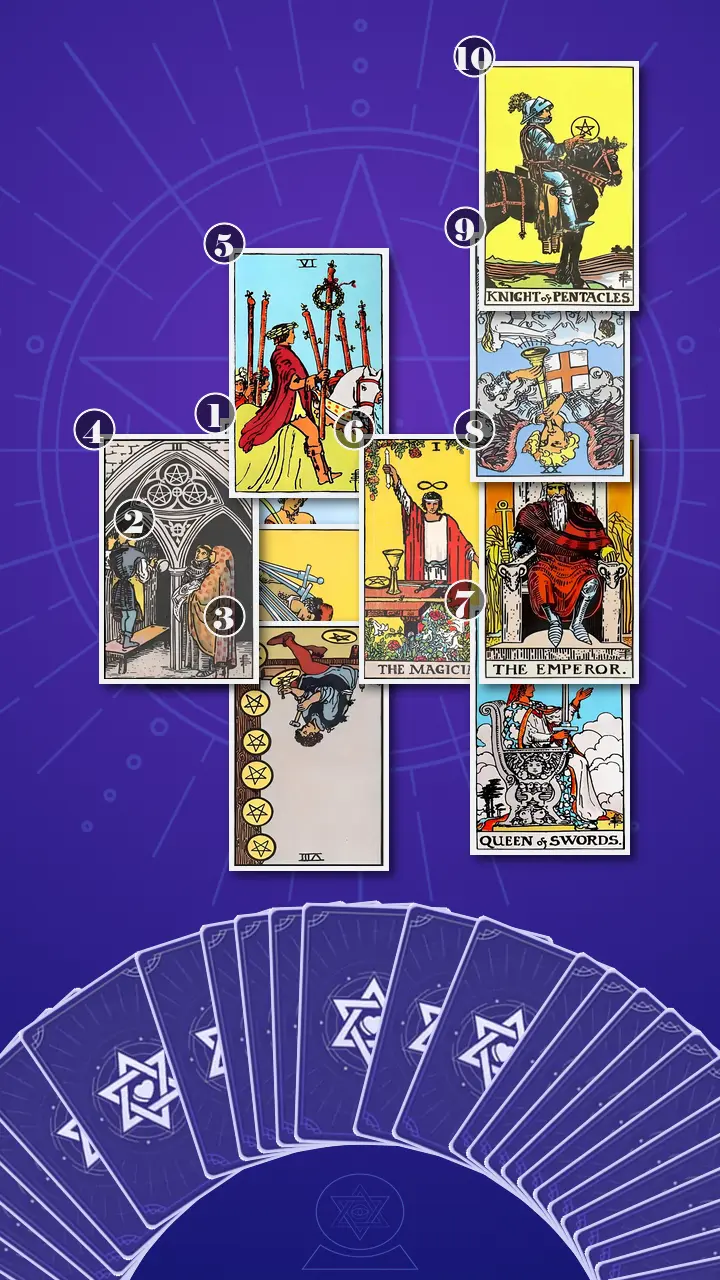
Reading the Map: Card Meanings in Context
Position 1: The Concrete Workload Pattern
“Now flipped over,” I said, “is the card that represents what your day-to-day reality looks like while onboarding—the concrete workload pattern and how your attention is split.”
Two of Pentacles, upright.
I showed her the image: a figure dancing while juggling two coins wrapped in an infinity ribbon, ships rising and dipping behind him in a choppy sea.
“This is like you simultaneously answering the new hire’s questions, keeping your roadmap moving, and trying to look calm in meetings—while the week’s priorities keep shifting like waves,” I said, using the most literal modern translation of the card.
Energetically, the Two of Pentacles is balance under motion. Not peace. Not completion. It’s that ‘always on’ rhythm where you get good at reacting—so good that it starts to look like your personality. In your case, it’s creating a leadership optical illusion: from the outside, it can read as reactive multitasking instead of a defined program you’re leading.
Jordan exhaled through her nose and did that unexpected reaction I’ve come to trust more than nodding: she gave a small laugh that carried a bit of salt. “That’s… too accurate,” she said. “Like, it’s kind of rude.”
I nodded. “It’s not rude. It’s just specific. And specificity is how we find clarity.”
Position 2: The Visibility / Credit Friction
“Now flipped over is the card that represents the main blocker to making this onboarding promotable—the visibility, credit, or narrative friction.”
Seven of Swords, upright.
The figure in the card carries swords away while glancing back over his shoulder, like he’s checking whether anyone noticed what left the camp.
“This is the credit diffusion scene,” I said plainly. “You spend hours smoothing the new hire’s ramp-up, then in a recap meeting someone says, ‘the team supported onboarding,’ and your specific leadership evaporates into a group noun.”
This is not about manipulation. It’s about information management in a system that forgets quickly. In this position, the Seven of Swords is a blockage—the work can quietly walk away without your name attached unless you document, update, and frame it.
I watched Jordan’s eyes shift down and right—where people go when they’re replaying a moment. “Yeah,” she said. “I can hear that sentence in my head. ‘The team supported.’ And I smiled anyway.”
“That smile is you trying not to look political,” I said. “But here’s the reframe: don’t hope they notice—make it legible.”
Position 3: The Hidden Mechanism Underneath the Stress
“Now flipped over is the card that represents the hidden mechanism underneath the stress—the pattern that keeps you executing without packaging impact.”
Eight of Pentacles, reversed.
In the upright card, the craftsperson works steadily, carving pentacles in a row like a clean performance tally. Reversed, the energy gets stuck in the workshop.
“This is the late-night cursor blink,” I said, and I could see her recognize it before I finished. “The wiki page you keep rewriting. The glow of your laptop on your hands. That tiny ache in your neck. The inner monologue goes: ‘If I just make this cleaner, no one can critique it’—and then, ‘If I send the update, they’ll judge it.’”
It’s diminishing returns disguised as responsibility. Real effort, but it’s not translating cleanly into recognized value because it’s not connected to a visible outcome loop.
Jordan’s reaction came in a three-beat chain that I’ve learned to honor: first, her breath paused—just a small freeze. Then her gaze went slightly unfocused, like she’d hit rewind on the last two weeks. Then she nodded once, slow. “Yeah,” she whispered. “I’ve been doing the same ‘responsible’ thing on loop.”
“That loop makes sense,” I told her. “You’re trying to control the risk of being evaluated by polishing the artifact. But promotion cases aren’t built by artifacts alone. They’re built by outcomes people can point to.”
Position 4: The Recent Past Context
“Now flipped over is the card that represents what you’ve recently done that sets the context—prior collaboration patterns and how you’ve been perceived.”
Three of Pentacles, upright.
The scene is a structured workplace—people in different roles oriented around a visible plan.
“This tells me you already have cross-functional credibility,” I said. “Your best work shows up when coordination becomes legible—shared documents, aligned expectations, a plan other people can point to and say, ‘This is how we do it.’”
Energetically, this is balance—not because you’re doing less, but because you’re building something inside a system. It’s a reminder that your promotable layer is not just doing the work. It’s making the work shared enough to be seen.
Position 5: The Conscious Goal (What You Want Others to Say About You)
“Now flipped over is the card that represents what you consciously want from this—the promotion-ready outcome you want to be recognized for.”
Six of Wands, upright.
Laurel wreath. Crowd. Forward motion.
“This is you wanting your manager to be able to say one sentence that sticks,” I said. “Not ‘Jordan was helpful.’ More like: ‘Jordan led a two-week onboarding plan, and the new hire shipped independently by week three.’”
Energetically, this is recognition—not vanity, not bragging, but public association with a win. This card doesn’t ask you to be louder. It asks you to design proof that’s repeatable.
When The Magician Put the Tools on the Table
Position 6 (Key Card): The Opening If You Choose to Lead Intentionally
I paused before turning the next card. The way I do when the room—even a room split by time zones—starts to feel quieter.
“We’re flipping the card that represents what’s opening up if you choose to lead this intentionally—the next actionable window for shaping the situation,” I said.
The Magician, upright.
In the image, the Magician stands with one hand raised and one hand grounded, the four tools laid out on the table: wand, cup, sword, pentacle. It’s agency made visible.
Setup (30–50 words): Jordan was living in that 10:30 p.m. moment—Slack still open, onboarding doc half-finished, a calendar invite draft hovering, her real roadmap work untouched in another tab. She was trying to earn promotion-ready trust through flawless execution while avoiding the discomfort of being seen.
Delivery:
Not “I hope they notice,” but “I’ll make the work legible”—put your tools on the table like The Magician and turn effort into an outcome others can clearly name.
I let the sentence sit between us. In the planetarium, there’s a moment when the dome goes dark and you can hear 200 people stop moving at once. This felt like that—an internal darkness where a new constellation starts to appear.
Reinforcement (100–200 words): Jordan’s body answered before her words did. First, her shoulders dropped a fraction, like a backpack strap finally slid off bone. Then her fingers—she’d been gripping her mug—loosened, and I saw the white return to her knuckles. Her eyes got glossy, not dramatic, just honest; the kind of near-tear that shows up when someone realizes they’ve been working twice as hard to avoid one simple conversation. She inhaled, stopped halfway, then exhaled fully, a long breath that sounded like relief and responsibility arriving in the same package.
I said, “Set a 10-minute timer. Open a blank doc titled ‘Onboarding Charter — [New Hire Name]’. Write only three lines: (1) Goal in one sentence—like ‘Ship independently by week 3 on X surface.’ (2) Two to three milestones with dates. (3) One metric you can actually track. Stop at 10 minutes even if it’s messy. If your chest gets buzzy and you start over-editing, that’s your cue to save and close. This is a draft for alignment, not a masterpiece.”
Then I asked, “Now, with this lens—making it legible—think back to last week. Was there a moment when a simple one-paragraph plan or a quick update would have changed how it felt in your body?”
Jordan blinked once, slow. “Thursday recap,” she said. “I could’ve… I could’ve forwarded a plan in-thread before that meeting. Then it wouldn’t have been ‘the team supported.’ It would’ve been… my program.”
That’s the shift right there: from tight urgency to grounded clarity. From self-doubt to a first taste of earned self-trust.
And because I work with celestial rhythms, I added my own diagnostic lens—my Orbital Resonance. “Jordan,” I said, “right now you’re orbiting everyone else’s needs—new hire, stakeholder pings, manager expectations—so you keep accelerating to stay in motion. The Magician changes the orbit. You don’t need more speed. You need a stable cadence that other people can sync to. That’s how workplace energy synergies form: predictable check-ins, a shared charter, and a metric. That’s resonance.”
Climbing the Staff: From Stance to Proof
Position 7: How You Need to Show Up (Boundaries + Communication Posture)
“Now flipped over is the card that represents how you need to show up internally to lead onboarding well—mindset, boundaries, and communication posture.”
Queen of Swords, upright.
Her sword is upright and visible. Her gaze is clean. No apologizing for reality.
“This is you speaking in outcomes, not effort,” I said. “Short sentences. No extra paragraph to pre-defend yourself. The energy here is balance through clarity.”
I watched Jordan swallow and then nod—like she could feel the difference between people-pleasing and precision. “I always over-explain,” she admitted.
“Then the practice is physical,” I said. “When you feel your jaw clench before hitting send, take one breath and delete the extra paragraph. That unclench is the Queen of Swords in your body.”
Position 8: The Organizational Rules of the System
“Now flipped over is the card that represents the external environment—what your manager and org will actually reward.”
The Emperor, upright.
Stone throne. Armor under the robes. Structure that outlives mood.
“Your org doesn’t reward heroic hustle as reliably as it rewards architecture,” I told her. “This is the system saying: scope, cadence, ownership, and measurable outcomes. If it isn’t scoped, it’s just ‘help.’”
Energetically, the Emperor is structure. And here’s where my other lens—my Solar Sail Principle—matters: “A solar sail uses resistance as propulsion. In your world, the ‘resistance’ is the org’s preference for metrics and predictability. Don’t fight that. Let it pull you forward. Translate onboarding into system language and it becomes promotable by default.”
Position 9: The Hope-and-Fear Loop Around Evaluation
“Now flipped over is the card that represents your hopes and fears—the loop around visibility and scrutiny.”
Judgement, reversed.
Trumpet, rising figures—then reversed: the urge to stay under the waterline so no one can call your name.
“This is the performance review tab open,” I said. “You draft an accomplishments bullet, delete it because it feels cringe, refresh LinkedIn, see someone else’s promotion post, and your body responds by planning more work instead of planning your narrative.”
Jordan’s mouth tightened at that, and I saw her jaw do the thing again—clamp, hold, brace. “That is… literally me,” she said. “I delete it because it sounds like I’m trying too hard.”
I kept my tone firm but kind. “You’re not avoiding visibility because you’re humble. You’re avoiding being evaluated. And I’m not saying that to shame you. I’m saying it so you can stop treating ‘being seen’ like a verdict.”
Then I gave her the line I use when someone’s nervous system thinks documentation equals ego: “A status update isn’t a spotlight. It’s a receipt.”
Energetically, Judgement reversed is a blockage—not of talent, but of willingness to let your growth be measured. The fix is not louder self-promotion. It’s factual artifacts: plan, metric, cadence, update.
Position 10: The Most Credible Direction If You Follow Through
“Now flipped over is the card that represents the probable outcome—the most credible direction your promo case can take if you follow through.”
Knight of Pentacles, upright.
Still horse. Pentacle held carefully at chest level. The builder, not the sprinter.
“This says your promo case isn’t one heroic onboarding week,” I said. “It’s a repeatable onboarding system plus a track record of measurable outcomes. Steady. Documented. Review-ready.”
Energetically, this is grounded progress. Evidence accumulating like deposits, not fireworks.
From Insight to Action: Making Onboarding Legible
I leaned back and let the whole spread become one story.
“Here’s the arc,” I said. “You’re juggling onboarding and your core PM job in reactive slices (Two of Pentacles), in an environment where impact can vanish into ‘the team’ unless it’s intentionally recorded (Seven of Swords). Underneath, you’re stuck in a perfection loop—polishing docs because it feels safer than being evaluated (Eight of Pentacles reversed + Judgement reversed). But you already have the collaboration skill set to make work visible inside a structure (Three of Pentacles), and you’re explicitly aiming for credible recognition (Six of Wands). The path forward is The Magician into The Emperor into Knight of Pentacles: tools → structure → receipts.”
“Your cognitive blind spot,” I added gently, “is thinking that if you execute flawlessly, people will automatically understand the leadership story. In fast-moving tech, that story doesn’t surface by itself. It has to be made legible.”
“And the transformation direction is clear: shift from helping with onboarding to owning onboarding as a scoped leadership project with outcomes, metrics, and predictable stakeholder communication.”
I could hear Jordan’s practical brain gearing up. Then she hit the real-world obstacle, right on time: “But I don’t have time for a whole process,” she said. “I’m already drowning.”
“Good,” I said, not harshly—like a coach who respects reality. “Then we design a system that saves you time. The point is not more work. The point is less chaos.”
- The 10-Minute Onboarding CharterOpen a blank Google Doc titled “Onboarding Charter — [New Hire Name].” In 10 minutes, write: (1) one-sentence goal (“Ship independently by week 3 on X”), (2) 2–3 milestones with dates, (3) one metric (time-to-first-ship, fewer repeat questions, first independent demo). Save and stop—messy is fine.If you feel the urge to keep polishing, that’s Eight of Pentacles (reversed). Treat it as a cue to close the doc and use it for alignment, not perfection.
- The Magician Slack: “Tools on the Table”Send your manager a short Slack message with the doc link: “I’m treating onboarding as a mini-program. Here’s the plan + how we’ll measure ramp. Quick thumbs-up async works, or we can spend 5 minutes at the top of our 1:1.”If your draft is long, delete 30% before you hit send. Queen of Swords energy: outcome-first, no apology.
- The 3-Column Receipts TrackerCreate a tiny tracker in Notion/Sheet/Jira with only three columns: Milestone, Date hit, Evidence link (PR/ticket/doc). Update it once a week after your onboarding check-in.Keep it almost boring. Knight of Pentacles wins by being queryable in 30 seconds during review season.
Before we wrapped, I offered one of my planetarium-born strategies for the anxiety spike before meetings: “Tomorrow morning, before your first standup, take 30 seconds for what I call an Earth-rotation perspective. Feel your feet. Imagine the day turning under you like the planet—meetings will pass whether you grip them or not. Then choose one north star sentence: ‘Success for onboarding looks like…’ and carry only that into the room.”

A Week Later: The Quiet Proof
Six days later, Jordan messaged me at an hour that made me smile: 4:12 p.m. Toronto time. Not midnight. Not in the glow of a laptop confession.
“I did the 10-minute charter,” she wrote. “It was ugly. I sent it anyway. My manager replied with a thumbs-up and one comment: ‘Love the week-3 metric—keep me posted.’ I also sent a three-bullet update after our first check-in. No one died. And… the new hire stopped DM’ing me for every question because we now have a weekly cadence.”
She added one last line: “It feels weirdly calm. Like I’m not hiding leadership work in the margins.”
That’s the Journey to Clarity in real life: not certainty, but ownership. Not a personality makeover, but a structure that lets your real leadership be seen.
When you want to be seen as promotion-ready but you’re terrified that asking for scope, credit, or boundaries will expose you as ‘not in control,’ you end up doing leadership work like it’s a secret—exhausting, real, and somehow still easy to overlook.
If you let visibility be factual instead of performative, what’s the smallest “receipt” you’d feel okay making legible this week—one sentence, one metric, or one three-bullet update?