From Prestige Shame to a No-Disclaimer Intro About Your Major

The 8:41 p.m. Mixer Question
If you’re a student in a city like Toronto who can talk to literally anyone until somebody at a mixer asks, “So what do you study?” and suddenly your answer turns into a joke, a disclaimer, and a whole case for why it still counts—this reading is for you.
Jordan (name changed for privacy) came to me with a question that sounded small and felt anything but. She told me about 8:41 p.m. on a Thursday at a student mixer near St. George station: bass a little too loud, a paper cup of flat soda sweating into her palm, the room smelling like fries and citrus cleaner. Two people ahead of her said “econ” and “CS” like they were stating the weather. Then someone turned to her and asked the question. Her throat pinched, her shoulders lifted, and her fingers hooked into the cuff of her sweater before the major had fully left her mouth.
“I want to own it,” she told me over our call, giving a laugh that arrived half a beat too early. “But I hear myself shrinking in real time. I say it, then I add a joke or some explanation before anyone has even reacted. Like I’m bracing for the follow-up question before it exists.”
I know that contraction. It is not just awkwardness. It is shame wearing a fake helpful smile—like a collar stitched out of imagined opinions, tightening right at the base of the throat when you need air. The contradiction was clear: she wanted to say her major with confidence, but she feared what it might say about her worth if somebody silently ranked it as less impressive, less practical, less respectable. I let that settle for a second and then said the line I most wanted her to hear: “Your major is not a confession.”
“We’re not here to make you louder,” I told her. “We’re here to find the exact moment your voice starts apologizing for you. Then we can give that moment a different ending. Let’s make a map and see where the clarity actually lives.”

Choosing the Compass: The Shadow Spread
I asked Jordan to take one slower breath and hold the question in her mind—not as a mystical performance, just as a way to gather the scattered tabs in her head into one window. I shuffled slowly, the way I do when I want a reading to become less foggy and more precise.
For a question like why do I sound embarrassed saying my major, I reached for The Shadow Spread tarot reading for prestige shame around academic identity. It is compact and exact. This was not a sprawling career crossroads with ten variables fighting for airtime. It was one repeated self-presentation pattern—how to answer “What do you study?” without overexplaining—driven by a hidden belief about worth and status.
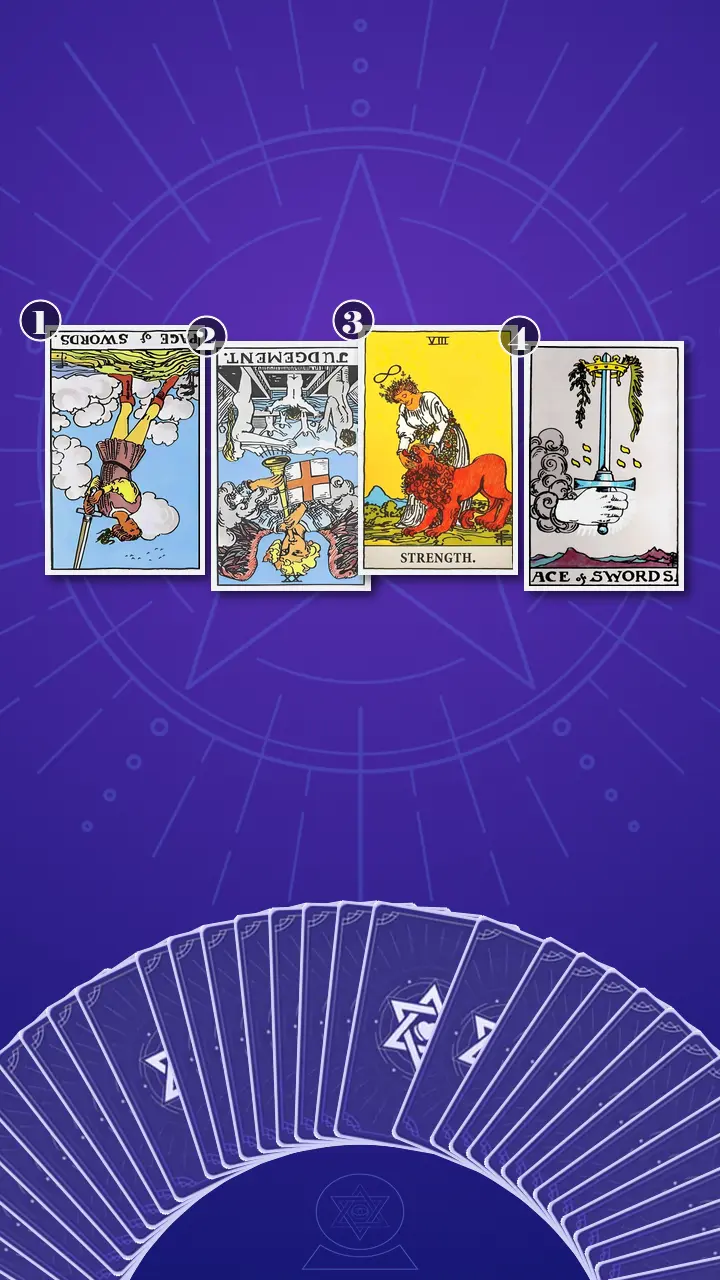
The first card would show the visible coping style: the apologetic tone, the hedging, the self-editing. The second would reveal the shadow driver underneath it—the private ranking system that makes a neutral question feel like an evaluation. The third, the hinge of the whole reading, would point to the inner resource that could interrupt the pattern. The fourth would translate insight into behavior: what a clear, embodied answer actually sounds like when apology is no longer doing the talking.
I laid the four cards in a straight line from left to right. I often think of this spread as a sentence being revised. We begin with the version written under pressure, move through the hidden assumption inside it, and end with language that finally belongs to the speaker.
Reading the Fake Tribunal
Position 1: The Comment Section Before the Conversation
Now I turned the card representing her visible coping style—the surface pattern that shows up in introductions. The Page of Swords, reversed.
In real life, this is the first-week class intro, the student mixer, the casual coffee chat where somebody asks a basic question and your brain opens twelve tabs just to answer it. You say the major quickly, laugh a little, then tack on something like “but it’s kind of niche” or “I’m still figuring it out” while scanning the other person’s face for danger. The energy here is blocked Air with a streak of excess: too much mental monitoring, not enough trust in the sentence itself. It is half communication, half defense.
The image mattered. The sideways stance, the wind-whipped clouds, the raised but unsettled sword—this is what it looks like when one part of you is speaking and another part is already editing mid-send. I told her, “This isn’t really about your major being weak. It’s about the habit of trying to soften the impact before there has even been one.”
Jordan gave a short laugh, the kind with a little sting in it. “That’s literally me editing mid-sentence,” she said. “Wow. Okay. That’s accurate to the point of being rude.” I smiled. “Good,” I told her. “Specific means it’s a pattern, not your personality. Patterns can be interrupted.”
Position 2: The Verdict That Gets There First
Then I turned the card showing the hidden driver beneath that behavior—the belief doing the real work in the background. Judgement, reversed.
This is the private tribunal. The other person may be neutral. The pressure is that you are already hearing an imagined verdict: not impressive enough, not serious enough, not practical enough. A normal introduction starts feeling like a performance review you can fail in one sentence. The energy here is compressed and inward-pulling. No wonder the voice comes out apologetic; it has already been sentenced.
I told her, “Shame is loudest when it borrows your voice first.” Then I asked the question this card always asks in moments like this: “Whose definition of impressive are you obeying when a basic introduction feels like it came stamped with a ranking?”
She went quiet. Her breath paused; her gaze slid off the screen and lost focus for a second, as if she were replaying a TTC ride home with her own voice echoing back at her from the dark window. In the planetarium, I spend a lot of time explaining that apparent magnitude is not the same as true size; the brightest thing in the sky is not always the biggest, and brightness is never the same as value. I thought of that here. Jordan wasn’t really reacting to the person in front of her. She was reacting to an inner ranking system that had started wearing other people’s faces.
“So it’s not even about the major alone,” she said finally, very quiet. “It’s that I already think I have to defend what it says about me.” I nodded. “Exactly. What if the problem isn’t that your major sounds weak—but that shame keeps borrowing your voice before you speak?”
When Strength Placed a Hand on the Lion
Position 3: The Antidote in the Half-Second Before “But”
When I turned the third card, the atmosphere changed in the quiet way important readings do. The lamplight on my desk caught the lion first, and even through the screen the traffic hiss beyond Jordan’s Toronto window seemed to recede a little. This was the heart of the reading: the position of the medicine, the inner quality that could actually interrupt the pattern. The card was Strength, upright.
I asked her to think about that exact split second in a tutorial intro or campus mixer when the question sounds simple, but her throat tightens anyway and her mind starts building an explanation before she has even named the major. That is the hinge. That is where the old script normally grabs the microphone.
You do not need to shrink your words before anyone else can judge them; you need to place a steady hand on the lion of self-doubt and speak from self-respect.
The fix is not a better defense brief for your major. It’s refusing to let imagined judgment speak in your voice before you do.
Jordan went still in three visible stages. First came the physical freeze: her breath caught mid-inhale, and her fingers stopped against the side of her mug as if the whole call had paused for one frame. Then came the recognition: her eyes shifted away from me and slightly upward, unfocused, replaying something old and painfully familiar. When she looked back, there was heat in it. “But if that’s true,” she said, sharper now, “then I’ve been helping the judgment.” It wasn’t relief yet. It was the sting right before relief. I nodded. “Yes,” I said softly, “but only because that strategy once felt protective. We’re not here to shame the shield. We’re here to notice when you don’t need it.” Her jaw loosened. One shoulder dropped. Then came the release—a long, shaky exhale from deeper in her chest than the earlier breaths, followed by a tiny, disbelieving laugh. I asked, “Now, with this new lens, was there a moment last week when this would have changed how you felt?” She told me about a coffee chat where she had started listing classes, skills, and career paths before she said what she actually cared about. That memory landed hard. So did the truth underneath it: confidence here was not louder. It was less self-betrayal.
This is where I brought in a framework I use often, one shaped by years of explaining celestial motion under a dark dome: Black Hole Focus. In astronomy, an event horizon is the boundary where gravity starts deciding the route. Jordan had one too. Her event horizon was the half-second after “What do you study?” landed. Once her attention crossed into imagined judgment, everything got pulled inward—laugh, disclaimer, backup paragraph, emergency career narrative. Strength asked her to hold her focus outside that pull. Not on the room. Not on the silent ranking. On the breath, the jaw, the feet on the floor, and the one sentence that was actually hers. That is the move from prestige shame and pre-emptive self-protection to calm self-respect and direct self-definition.
I had her open her Notes app right there. “Write one plain answer,” I said. “I study ____, and I’m especially interested in ____.” She typed. “Now read it once with your shoulders dropped.” She did. “If that feels too exposed, whisper it,” I told her. “You can stop after one read. This is an experiment, not a performance test.”
One Clean Sentence for “What Do You Study?”
Position 4: The Voice That Does Not Flinch
Then I turned the final card, the position of integrated expression and next-step behavior. The Ace of Swords, upright.
In ordinary life, this card is wonderfully unglamorous. It is a coffee chat, a tutorial intro, a new-person conversation where you answer in one clear sentence and let it end there. No brackets. No apology. No rescue clause sprinting in behind it. The energy here is balanced Air: the same intelligence Jordan already had, but no longer fragmented into crowd control. It becomes direct, clean, and usable.
I pointed to the single upright sword and said, “This is speech without anxious detours. Like a Notes app sentence with no backup paragraph. Like an email subject line that says exactly what it means.” A clean sentence can be a boundary. It stops imagined critics from speaking through you. And the pause after your answer is not proof you said it wrong.
Jordan nodded this time without the bitter laugh. “So the goal isn’t to sound impressive,” she said. “It’s to stop treating my own answer like it needs permission.” “Exactly,” I told her. “You’re not trying to win over a fake LinkedIn comments section in your head. You’re trying to answer the question that was actually asked.”
From Prestige Shame to a No-Disclaimer Intro
When I looked across the whole line of cards, the reading felt beautifully honest. The Page of Swords reversed showed the visible habit of editing in real time. Judgement reversed showed the hidden engine: living under an inner ranking system that makes a basic introduction feel like a hearing. Strength interrupted that loop by regulating the body enough for self-respect to stay in the room. The Ace of Swords completed the revision with clear expression. The spread really did read like a sentence being rewritten—from shaky footnotes to a clean line.
The blind spot was understandable but costly. Jordan had been treating the problem like a branding problem. She thought she needed a smarter explanation, more polished career language, or a better joke to make the major sound legitimate. But every time she turned identity into a defense brief, her own voice framed the subject as second-rate before anyone else had the chance. Her major did not need a better publicist. It needed a steadier relationship with her worth.
So I gave her small, testable next steps—practical enough for real life, because actionable advice is what matters when you’re trying to stop downplaying what you study in actual conversations.
- Prestige Shame PauseBefore one low-stakes introduction this week—a tutorial round, a club event, or coffee with a friend of a friend—plant both feet, drop your shoulders once, and exhale longer than you inhale before answering what you study.If a full breath feels too visible, just unclench your jaw. Tiny counts still count.
- Shooting Star Notes: The One-Clean-Sentence PracticeOpen your Notes app for thirty seconds and write one version only: “I study ____, and I’m especially interested in ____.” Use that exact sentence once this week with no “but,” “just,” “kind of,” or rescue line afterward.The hard part is the silence after. Give yourself one silent count of one before deciding whether more actually needs to be said.
- Inner Tribunal RewriteWrite the exact verdict you imagine people make—“not serious enough,” “not practical enough,” or your real version—then answer it with one honest reason you chose the field that has nothing to do with prestige, salary optics, or sounding strategic.Keep it to one sentence each. This is a noticing exercise, not a self-attack. If one account fuels the ranking spiral, mute it for a week.
I told her the second step mattered most. Shooting Star Notes is what I call that thirty-second capture: brief enough to outrun overthinking, bright enough to reveal the real sentence before prestige shame starts dressing it up. That is how the no-disclaimer intro begins.

A Week Later: The Quiet Proof
A week later, Jordan sent me a message after a tutorial intro. “I did it,” she wrote. “I said my major in one sentence and didn’t add ‘but.’ My body still did the throat thing, and I still wanted to rescue it. But I let the pause happen. Nothing bad happened. We just kept talking.”
Then she sent one more line I loved because it was so honest: she rode the TTC home staring at her reflection in the dark window for two stops, shaky and proud at the same time.
That is how clarity often arrives. Not as a perfect personality transplant. Not as instant freedom from comparison. As one small proof that your voice can stay with you through the exposed moment. In this shadow-work spread for self-judgment, Jordan did not become someone else. She simply stopped lending her tone to imagined critics.
There is a very specific kind of loneliness in feeling your throat tighten during a basic introduction because one honest sentence about what you study suddenly feels like a verdict on whether you deserve respect. If one conversation this week let your major be said in a plain, full voice—no joke, no rescue line—what tiny shift would tell you that self-respect got there first?
Every reading at AceTarot is a Journey to connect with inner wisdom and empower next step.
Learn more about our Journey to Clarity.