Cold Tea, One Bullet, and When the Resume Stopped Being a Verdict

The 10:43 p.m. Edit Spiral
If the hardest part of the application is not writing the resume but being seen through it, I usually know exactly what kind of reading I am walking into.
When Maya (name changed for privacy) appeared on my screen, she was still at the small condo kitchen table where the spiral usually happened. It was 10:43 p.m. in downtown Toronto. Her tea had gone cold beside the laptop, the fan pushed warm air against her wrists, and a streetcar hummed past the window while one bullet point glowed on the screen like it had become the only sentence in the world.
She told me she had promised herself two applications before bed. Instead, she had changed one line from supported to led, pulled the top margin tighter by a hair, reopened the same posting three times, and then closed the tab without submitting. That was the perfectionism-procrastination loop in plain sight: a resume kept in endless edits instead of actual applications getting sent. Her shoulders were nearly level with her ears. She leaned toward the screen as if the PDF might decide whether she deserved a better role.
'I know it is good,' she said, rubbing one thumb against the edge of her trackpad, 'but I do not know if it is good enough. Other people seem to hit submit so easily.' The anxiety around her felt like trying to get through a TTC turnstile while carrying a sheet of glass: one wrong angle, and everything would clang. She wanted to apply for new roles, but feared that an imperfect resume would expose her as not good enough.
I nodded. 'That makes sense to me. Your nervous system can call it danger when it is really visibility. And a lot of smart people hide inside edits because edits feel safer than being seen. So let us not shame the pattern. Let us map it. Tonight is not about forcing confidence; it is about finding clarity.'

Choosing the Corridor: A Situation-Obstacle-Advice-Outcome Spread
I asked her to put both feet on the floor, turn her phone face down, and take one unhurried breath before I shuffled. I do this not for theatrical mystery, but because the body needs a threshold when the mind has been sprinting in circles.
For resume perfectionism before hitting submit, I often use a Situation-Obstacle-Advice-Outcome spread. If you have ever wondered how tarot works with something as specific as job application anxiety, this is one of my favorite examples: I use the cards less as fortune-telling and more as a clean pattern map.
This four-card structure suits the question because it does not waste motion. It tracks the whole logic chain with almost archaeological economy: what is happening on the surface, what pressure is hidden underneath it, what inner shift interrupts the loop, and what grounded action looks like once that shift is real. The point here is not to predict whether a recruiter replies. The point is to understand why movement stalls right at the threshold.
I told Maya exactly what I would be looking for. The first card would show the visible symptom: the over-editing loop itself. The second would reveal the main obstacle: the fear and self-judgment beneath it. The third would hold the antidote: the wiser stance that restores self-trust. The fourth would show the likely outcome when she acts from practice rather than self-trial. Laid in a straight line, the spread forms a narrowed corridor opening into a path.
Reading the Narrow Corridor
Position 1: Work That Looks Like Progress
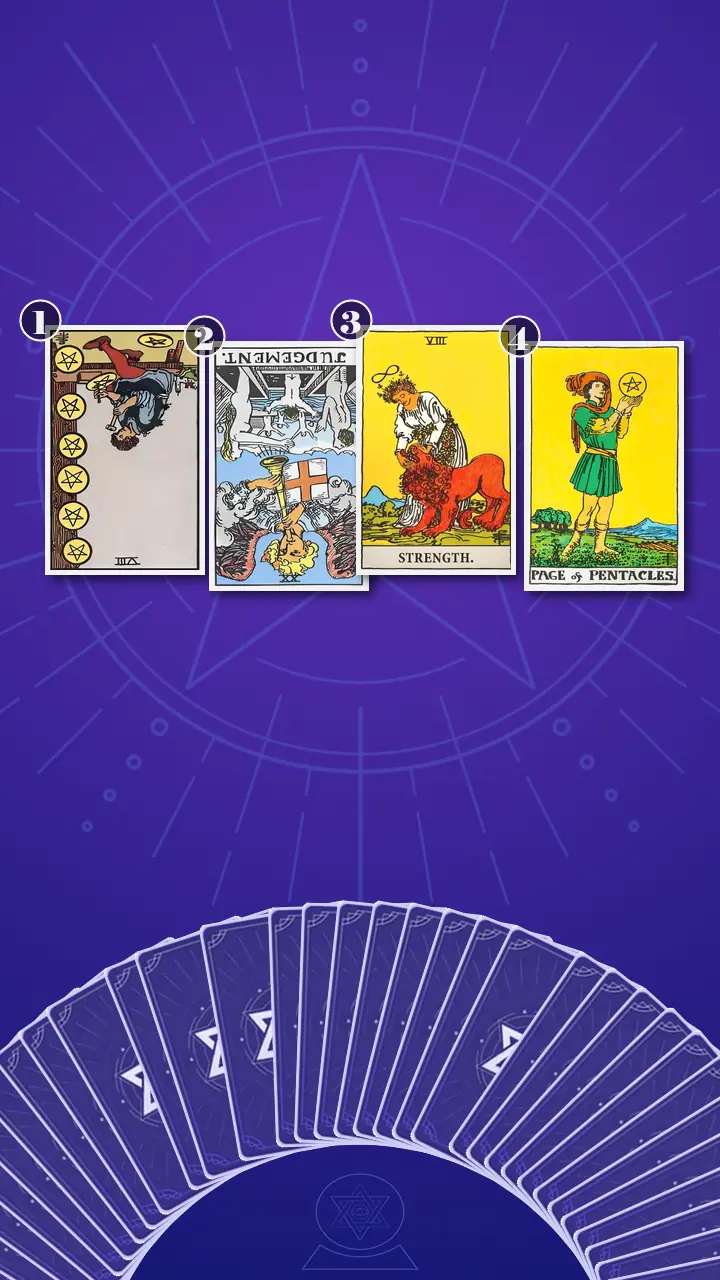
I turned the first card and said, 'Now I am opening the position that presents the visible symptom: the concrete over-editing loop that keeps the application from being sent.' The card was the Eight of Pentacles, reversed.
In an upright state, this is skill, repetition, craft, and honest work. Reversed, that same work energy tips into excess and loses proportion. In modern life, it looks exactly like Maya at 10:30 p.m. with a solid-enough resume open, changing the same bullet three different ways, nudging spacing, renaming files, and telling herself it still counts as progress while the application tab sits there untouched. It is like color-coding a Notion job tracker for an hour instead of sending one application from it.
I explained that the Earth energy here was blocked by too much labor on the wrong layer. The worker in the card is bent over one pentacle while the town remains in the distance. That image fit her night routine perfectly: productive-looking edits replacing actual career movement. 'The real question,' I told her, 'is not whether the change improves clarity. It is whether the change gives relief for five minutes.'
She gave a short, bitter laugh. 'That is painfully accurate.' Her fingers tapped once against the table and then stopped. I smiled. 'Good. Then we are looking at a ritual, not a character flaw.'
Position 2: When Review Becomes Self-Trial
I turned the second card. 'This position reveals the main psychological obstacle: the underlying fear and self-judgment that make the resume feel like a test of worth.' The card was Judgement, reversed.
This is where the reading went from recognizable to precise. In modern terms, this card is the moment the submit button stops meaning send and starts meaning present your worth for inspection. No recruiter has opened the file yet, but in Maya's mind the jury is already seated. It has the private logic of a tiny Black Mirror episode: a normal interaction gets mistaken for a score on your value.
When I see Judgement reversed, I often think back to my archaeological work with small civic shards from the ancient world—fragments used in public decisions, objects no larger than a palm that still carried the force of a verdict. Humans have always had a talent for loading small things with enormous judgment. That was the sensation in this card. Maya was no longer treating her resume as a tool for opportunity. She was treating it like courtroom evidence.
'If they can see the weak line,' I said, 'then in your mind they can see the weak you. That is why this feels so personal.' The energy here was contracted and prosecutorial. Review had become self-trial. A normal hiring process had turned into an imagined referendum on whether she deserved more.
Her hand froze halfway to the cold mug. Then her gaze slipped off to the side, unfocused, as if a dozen late-night tabs were replaying behind her eyes. When she finally looked back, her voice had gone small. 'That is exactly it. I read the post again and again like there is going to be one hidden line that says I am allowed.'
'Yes,' I said. 'And that is why more editing never settles it. The document is being asked to do something no document can do. A resume is an introduction, not a verdict.'
When Strength Took the Mouse Back
Position 3: The Antidote
When I reached the third card, even through a screen I felt the atmosphere change. A streetcar rattled by outside her window, then the kitchen fell briefly still. This was the hinge of the entire reading: the position that identifies the core antidote, the inner attitude that loosens perfectionism and restores self-trust. I turned the card over. Strength, upright.
This card does not promise fearlessness. It offers regulated courage. In daily life, it looks exactly like Maya feeling the adrenaline spike before clicking apply, noticing the urge to reopen the file, and choosing not to let that body alarm make the decision for her. The energy here is balanced rather than blocked: fear is present, but it is no longer in charge.
I told her I was going to use a lens I call Emotional Historiography. In archaeology, the crucial question is rarely just what an object is; it is which layer it belongs to, and what older world it was built for. This habit of over-editing belonged to an older inner era of self-protection, one in which being reviewed felt dangerously close to being reduced. Strength marks the historical turning point. It is not a coup. It is a constitutional change inside the self. The inner prosecutor stops ruling alone.
Late at night, with cold tea beside the keyboard and the same bullet point open again, it can honestly feel like one imperfect line might tell the truth about your whole career.
Stop fighting the lion of self-doubt by polishing one more line; meet it with gentle courage, then let the document go.
I let the sentence sit between us for a beat.
The resume does not need to prove who you are. It only needs to be clear enough to leave your hands.
For a moment, Maya did not relax at all. First came the freeze: her breath paused and her fingers hovered over the trackpad without moving. Then came the mental replay: her eyes lost focus, not on me, not on the cards, but somewhere just beyond the laptop, as if Tuesday night had come back in full detail. Then the emotion finally broke through—but not as relief. 'But does that mean I have been doing this wrong the whole time?' she asked, a little angry, a little embarrassed, and very human.
'No,' I said. 'It means you have been using editing as armor. Armor is not stupidity. It is protection. But it is heavy, and it cannot walk into the room for you.' I watched her jaw loosen by degrees. One shoulder dropped, then the other. She drew in two slower breaths, and with them came that strange, slightly dizzy softness that arrives when someone realizes the burden they were carrying may not actually be part of their identity.
'Now,' I asked her, 'with this new angle, think back to last week. Was there a moment when this would have changed the feeling?' She gave a softer laugh. 'Tuesday. Exactly Tuesday. Nothing about the resume was changing anymore. I just wanted certainty.'
'Exactly,' I said. 'Strength does not give certainty. It gives steadiness before certainty arrives. Clarity beats self-proof.'
Position 4: Practice Over Proof
I turned the last card. 'This position shows the grounded direction forward: how the energy looks when you act from practice rather than self-trial.' The card was the Page of Pentacles, upright.
This is Earth returned to health. The same work energy that was distorted in the first card comes back in a simpler, more useful form. In modern life, it looks like Maya sending one thoughtful application, logging it in a Notes app or spreadsheet, and treating the response as data rather than destiny. It is like shipping version one and learning from real feedback instead of rewriting in private forever.
I pointed out the visual dialogue across the spread: many pentacles fussed over in the first card, one pentacle held clearly in the last. 'That is the whole story,' I told her. 'You are moving from scattered proof-gathering to focused enoughness. One real application teaches more than ten private rewrites.'
She nodded, slower now. The heat had gone out of her face. 'So the goal this week is not the perfect resume,' she said, trying the sentence on. 'It is one solid send.'
'Yes,' I told her. 'That is the real movement here—from harsh self-editing and fear of judgment to clear-enough action and steadier self-trust under visibility.'
From Private Polishing to the Clear-Enough Send
When I stood the four cards together, the story became almost elegantly simple. First came the visible loop: blocked work masquerading as diligence, the resume edited past usefulness. Beneath it sat the real knot: fear of being judged so intensely that an ordinary application felt like a public review of worth. Strength changed the emotional logic of the whole spread. The answer was not more discipline, more advice threads, or another midnight pass through the bullet points. The answer was compassionate courage strong enough to let vulnerability exist without obeying it. From there, the Page of Pentacles returned the matter to earth: one application, one lesson, one next step.
The blind spot was subtle but decisive. Maya had been measuring progress by how polished the document looked, not by how many applications actually left her hands. She thought more editing created more safety. In fact, it preserved the fear by keeping her hidden from real-world feedback. The transformation direction was clear: move from trying to prove your worth through a flawless document to sending a clear, honest application that is allowed to be good enough.
Because I have spent much of my life studying old civilizations, I do not like merely telling people to stop a ritual. Rituals endure because they give fear a container. So I suggested what I call an Ancient Ritual Conversion: keep the structure, but change what it serves. Instead of the old rite of avoidance, we build a small modern rite of release.
- The 25-Minute Edit CapPick one saved role this week and create a comparison blackout window by closing LinkedIn, Reddit, and every extra tab. Leave only the resume and the job description open. Set a 25-minute timer for one edit pass only. When the timer ends, submit immediately or stop for the night without opening a second pass.The mind will insist that 25 minutes is not enough. That is exactly why it works. The goal is not a flawless resume; it is interrupting the ritual. No revenge-editing after midnight.
- The No-Courtroom Resume RulePut a sticky note on your laptop that says, 'This document introduces me. It does not grade my worth.' Right before you apply, take a body-before-submit pause and name what is actually present: anxiety, shame, hope, or fear of being ignored. Then list only three factual matches from your real experience. If your mind jumps to what rejection would mean about you, say out loud, 'Not hearing back is information, not identity.'If talking back to the inner prosecutor feels awkward, read the line silently in your Notes app. You do not need to feel profound. You only need to interrupt the script.
- The One-Application Learning LoopCreate a tiny log in Notes, Notion, or a spreadsheet with four columns: date, role, sent yes or no, one thing learned. Aim for one to three solid applications this week rather than one mythical flawless one. At the end of the week, review the pattern before making one small resume tweak.Lower the bar until it is almost boring. The log is for observation, not self-surveillance. One real application teaches more than ten private rewrites.

A Week Later: The Quiet Proof
Six days later, I received a message from Maya just after lunch. 'Used the timer. Closed LinkedIn. Sent one before I could make final_v9. Then sat alone in a coffee shop for twenty minutes feeling proud and slightly sick.' I smiled when I read it. That was exactly the kind of evidence I hoped for: not a transformed life, not a dream offer by Friday, just one honest act completed while still feeling vulnerable.
To me, that was the real proof. This Situation-Obstacle-Advice-Outcome tarot spread had not removed uncertainty from her career. It had done something better. It had helped her stop turning the application into a verdict on worth and start treating it as an introduction strong enough to travel without her standing guard over it.
Sometimes the tightest part of the job search is not the work itself but that sharp, chest-braced moment when one unfinished PDF starts to feel like proof of whether you deserve more. If that is where you are tonight, I want to say this gently: noticing the loop is already a form of movement.
If your resume only had to introduce you, not defend you, what would clear enough to send look like for you this week—the version before the extra midnight pass, the one your hovering hand almost trusts?