Blank-Page Paralysis Under 'Gifted Kid' Pressure: Practice Over Proof

When Blank-Page Paralysis Wears the 'Gifted Kid' Label
When Jordan (name changed for privacy) appeared on my screen from Toronto, I recognized a pattern I hear from junior creatives more often than most people expect: if you were the smart kid in school and now every blank document feels like a quiet referendum on whether that was ever real, former gifted kid perfectionism can hide in very polished office-casual clothes.
She described a Tuesday at 9:18 p.m., alone at her small apartment table after work. A half-finished takeout container sat beside the laptop; the room smelled faintly of cold soy sauce; the radiator kept ticking in the background while the fan in her computer ran warm against her wrists. She opened Google Docs, typed a smart working title, wrote one line, deleted it before it had properly landed, then flipped to competitor articles and her notes app instead. It looked like she was getting organized. Her body knew she was bracing for a test.
“I can edit a bad draft,” she told me, “but I still act like the first sentence has to prove something.” That was the contradiction in full view: she wanted to write freely and make progress, but she feared an ordinary first draft would expose her as not truly gifted. The feeling had a body to it. Her chest went tight, her jaw locked, and her hands hovered over the keyboard like birds over water they no longer trusted. The dread she described was not abstract; it sounded like a seatbelt ratcheted one click too tight across the ribs.
I nodded. “I know this kind of blank doc freeze,” I said. “It often looks like writer’s block, but it’s really a courtroom set up inside the act of starting. Let’s make a map of it together. Our journey today is not to force brilliance. It’s to find clarity about what the page has been made to mean.”
Choosing the Compass: The Shadow Spread · Context Edition
I asked Jordan to put one hand on the desk and take one slower breath before I shuffled. I use that pause less as mystique than as a handbrake; it helps the nervous system stop sprinting long enough for the real pattern to come into view.
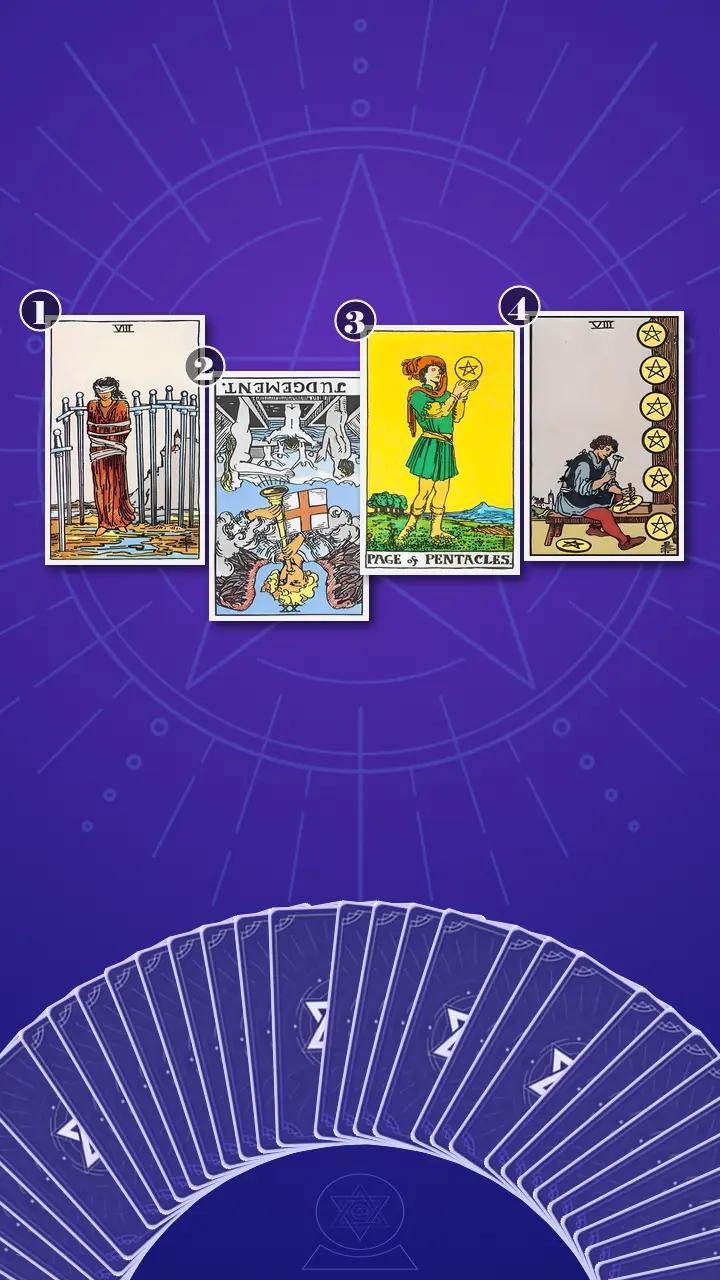
For her question, I chose The Shadow Spread · Context Edition. It is one of my preferred spreads for blank-page anxiety and former gifted kid perfectionism because it does not stay at the surface symptom. It moves, step by step, from the visible freeze to the hidden identity wound, then toward the exact shift and practice that can loosen it. Four cards are enough here. Overthinking is already part of the problem; the spread must clarify, not add more mental furniture.
This is how tarot works best in my practice: not as vague prediction, but as structured pattern recognition. The first position would show the blank-page paralysis itself. The second would reveal the deeper scorecard underneath it. The third—our bridge card—would name the shift from proving talent to practicing craft. The fourth would turn that insight into grounded, actionable next steps for the week ahead.
The Courtroom Under the Blinking Cursor
Position 1: The Loop That Looks Like Prep
I turned the first card. “This position presents the blank-page freeze itself,” I said, “the visible loop: open the doc, delete the start, substitute prep for writing.” The card was the Eight of Swords, upright.
I told Jordan this was almost painfully literal. In modern life, the Eight of Swords looks exactly like her opening a blank Google Doc after work, typing a promising title, deleting the first line, and then spending the next half hour tab-switching, outline-tweaking, and renaming folders because the draft feels dangerous before it is even real. The energy here is blocked Air: too much self-monitoring, not enough motion. The blindfold is imagined consequence crowding out the actual task. The loose bindings are the freedom she forgets she still has—to write badly, revise later, and continue breathing. The ring of swords is every strict rule about good writing she obeys before any sentence exists.
“It’s like having twenty browser tabs open and mistaking tab-switching for progress,” I said. “Research can be care, but it can also be camouflage.”
Jordan gave a short laugh with a bitter edge. “That’s so accurate it’s almost rude,” she said. Then she pressed her thumb into the side of her mug, looked down, and let out the smallest breath through her nose. I watched the recognition land. The mind in this card moves fast; the body goes still. That is exactly why it feels so baffling from the inside.
I asked her the simplest question in the spread: “In the first three minutes of the last blank document, what did you actually do?” She didn’t need to think long. “Type, delete, rename, compare,” she said. “In that order.”
Position 2: The Old Verdict Behind the Cursor
I turned the second card. “This position reveals the deeper identity wound under the freeze,” I said, “including the fear that ordinary work will disprove the old ‘gifted kid’ label.” The card was Judgement, reversed.
Whenever Judgement appears reversed in a reading like this, I know I am looking at an inner tribunal. I told Jordan that this card was not about a lack of ability. It was about an overactive scorecard. Before the draft exists, the reviewers arrive: old teacher praise, a manager saying ‘just send me a rough draft,’ a friend’s polished Substack screenshot, LinkedIn promotion posts that somehow hit harder on the commute than they do at a desk. In modern terms, this card is an old report-card pop-up appearing over a new file. It has that eerie fused-identity pressure of Severance: work output and self-worth suddenly feel like the same thing.
The trumpet in the card becomes old praise turned alarm bell. The rising figures become every version of herself summoned for evaluation. The distant mountains become the impossible standard she feels she must reach before she is allowed to relax. This is blocked fire wrapped inside a judgment loop: not a clean call to create, but a verdict delivered in advance. Since when did a first paragraph become a courtroom?
Jordan went very still. First her breath paused. Then her eyes lost focus for a second, as if she were back in a glass meeting room hearing the phrase rough draft land like a trap. Then came a slow exhale from deep in her chest. “That’s exactly it,” she said. “Feedback on a draft never feels like feedback on a draft. It feels like feedback on whether I’m still… good, fundamentally.”
“Yes,” I said gently. “You are not only trying to write. You are trying to be re-approved. That is why everyone saying ‘just start’ makes you feel worse. They are talking to the task. Your body thinks it is being marched into judgment.”
When the Page of Pentacles Opened the Workshop Door
Position 3: One Real Pentacle at a Time
When I turned the third card, the light from my desk lamp caught the gold circle in the image and, for a moment, even the room seemed to quiet itself around it. “This position identifies the direct antidote,” I said, “the mindset shift from proving talent to practicing craft.” The card was the Page of Pentacles, upright.
The Page of Pentacles is one of the most practical cards in the deck. In Jordan’s life, it looks like one plain document titled Practice Draft, one concrete paragraph goal, one short timer, and one better question: not ‘Does this prove anything?’ but ‘What can this paragraph teach me today?’ The energy here is balanced Earth—grounded, teachable, unglamorous in the healthiest way. The Page does not audition. The Page studies.
When this card appears for a client trapped by old labels, I use a lens I call Skill Archaeology. Years ago, on a dig, I remember kneeling over what looked like an utterly unimpressive shard of pottery. No one would have mistaken it for treasure. Yet that modest fragment told us exactly where the wall line ran. Since then, I have never trusted shiny stories more than durable evidence. So I looked at Jordan the same way: beneath the ‘gifted kid’ label, what overlooked tools were still intact? I did not find a lack of talent. I found buried craft assets—editorial sensitivity, patience with nuance, and a genuine instinct for audience pain. None of those require brilliance on command. They require contact with real material.
Late at night, with the doc open, the title already typed, the bullets reorganized twice, and the cursor blinking while the jaw hardens, it can feel as if the page is judging identity instead of waiting for thought.
You are not here to pass the old test again; you are here to hold one real pentacle at a time and let practice teach you.
Jordan did not relax immediately. First, her fingers froze around the mug. Then her gaze slipped away from the camera, unfocused, as though she were replaying a dozen late-night writing sessions at once. Then a flash of anger crossed her face—not at me, but at the old arrangement. “But if that’s true,” she said, “then I’ve been treating every document like a report card for years.”
“Yes,” I said. “And that doesn’t mean you were foolish. It means you built a protection system around shame. But page one does not need to prove you are gifted; it only needs to give your craft something real to work with. A first draft is information, not a verdict. The blank page is not asking if you’re gifted. It’s asking if you’re willing to practice.”
I watched the insight move through her in layers. Her mouth parted slightly. Her shoulders dropped, not dramatically, but enough to show the pressure had shifted one notch. Then came the strange secondary feeling I often see after a real breakthrough: not pure relief, but that small dizzy emptiness people feel when a burden they have balanced for years is suddenly set down. I gave the moment room. “Now,” I asked, “with this new lens, think back to last week. Was there a moment when this would have changed how you felt?”
She nodded almost at once. “When I deleted the first sentence,” she said quietly. “I could have just let it be ugly. I didn’t need it to mean anything yet.” That was the bridge card doing its work. Not grand confidence. Not instant ease. Just the first real step from self-conscious dread and courtroom-style self-judgment toward grounded curiosity.
Position 4: The Bench, the Folder, the Quiet Reps
I turned the final card. “This position translates the insight into a writing rhythm you can actually live with,” I said. The card was the Eight of Pentacles, upright.
I told Jordan I loved the structural honesty of this spread: it begins and ends with an Eight. The first Eight is repetition as imprisonment—looping in the mind, deleting, renaming, comparing, over-preparing. The last Eight is repetition as craft—same chair, same folder, one more saved draft, one more ordinary rep. The problem was never repetition itself. The problem was the kind of repetition she had been practicing. This card brings balanced Earth again: bench work, accumulated skill, and trust built not by one cinematic breakthrough but by visible contact with the task.
“So,” Jordan said, a tired smile pulling at one corner of her mouth, “the answer is basically to get a little boring on purpose?”
“Exactly,” I said. “Boring enough that your nervous system stops reading the page like a public trial. What changes when the page stops being a mirror and starts being a workbench? Quite a lot, actually.”
Finding Clarity at the Workbench
When I drew the story of the spread together for her, it was plain. The Eight of Swords showed the visible symptom: blank-page paralysis, the kind that deletes the opening line and hides in competitor tabs. Judgement reversed showed the hidden driver: an old smart-kid scorecard that turns every first pass into a referendum on worth. The Page of Pentacles showed the key shift: move from using each draft to prove giftedness to using each draft to practice craft. The Eight of Pentacles showed the integration: not a personality transplant, but a repeatable writing rhythm. Her cognitive blind spot was this—she had been treating effort as incriminating evidence, when in real craft it is simply how skill is made.
“So what do I actually do tonight?” she asked.
I smiled, because this is the part I care about most. “I use a strategy I call Megalith Transport,” I told her. “No one moves a standing stone in one heroic lift. You break the impossible weight into grounded stages, put rollers underneath it, and move it a little at a time. Drafting works the same way. You do not need a better identity before you start. You need a smaller next step.”
She grimaced. “But after work I’m fried. Even seven minutes can feel fake-small.”
“That,” I said, “is the old tribunal talking. Small is not fake. Small is what gets past the guard.”
- Name the Inner PanelBefore your next after-work writing session or rough-draft request, put a sticky note on the desk or a header in the doc that says: ‘Old approval voice’ or ‘School voice.’ Under it, add one sentence: ‘This draft is allowed to be information, not a verdict.’ It takes under 30 seconds and it separates the task from the tribunal.If the wording feels cheesy, make it neutral. The point is one inch of distance, not a performance of healing.
- Open a Practice DraftThis week, create one document literally titled ‘Practice Draft’ or ‘First Pass.’ At your kitchen table or desk, set a 7-minute timer and write six plain lines or one messy paragraph on one very small prompt—something like ‘explain the audience problem’ or ‘draft the opening in ordinary language.’ No deleting until the timer ends.If resistance spikes, type badly on purpose for the first two lines. You are allowed to stop after 7 minutes. You are allowed to keep the file private.
- Build a Bench Reps FolderChoose two nights this week after dinner. Sit in the same chair, open the same folder, and do one 12- to 25-minute writing rep. Save each session without renaming it into something more impressive, and add one line at the top before closing the file: ‘Today this draft taught me…’Keep it ordinary. Same chair, same folder, same short window is enough. If you miss a day, do not compensate with a marathon. Just return to the bench.
These were not tricks to make her feel confident before starting. They were ways to make starting small enough that confidence no longer had to go first. Make one pentacle, not a masterpiece.
A Week Later, the Quiet Proof
A week later, Jordan sent me a screenshot from her phone. In the folder were four bluntly named files: Practice Draft, First Pass Tuesday, Audience Paragraph, and Rough Opener. Her message was only one line long: “Still hated sentence one, but I got to sentence ten before panic got a vote.”
She added another note a moment later. She had slept properly after one of those sessions, though the next morning her first thought was still, What if it’s mediocre? This time, she told me, she laughed, opened the same folder, and wrote anyway.
That is what finding clarity usually looks like in my practice. Not certainty. Not the return of childhood ease. A workable relationship with practice. This is why I return to The Shadow Spread · Context Edition whenever someone asks me, “Why do I freeze when I open a blank document?” The cards do not shame the freeze. They show where the old verdict lives, and they turn it into actionable advice and next steps.
I know there is a particular loneliness in wanting to make progress while your chest tightens around the fear that one ordinary paragraph could undo the version of you who was once praised for making it look easy.
So when the cursor starts blinking like a judge again this week, what one small pentacle—six plain lines, one messy paragraph, a 7-minute first pass—would you be willing to let exist as practice?