All-Week Presentation Dread—and Choosing While Still Nervous
Finding Clarity in the 8:41 Streetcar Spiral
If you're an early-career office person in a city job and you keep checking the shared agenda to see whether someone else took the first presentation slot, I can usually name the pattern before the first card is even down. When Maya (name changed for privacy) sat across from me, I recognized it immediately: anticipatory performance dread around choosing a presentation slot at work, the kind that makes people search how to stop overthinking a work presentation at 11:48 p.m. and still refresh the agenda again in the morning.
As she talked, I could almost ride the 8:41 a.m. 504 King streetcar with her into downtown Toronto: speaker notes open on her phone, the screen warm in her palm, the rattle of the tracks under everything, somebody's coffee smelling a touch too burnt, her mouth shaping the first line so quietly nobody could hear. Her Slack status might have been green; her inner life absolutely was not. She wanted the relief of grabbing the first slot and being done with it. She was equally convinced that if the opening came out shaky, the whole room would clock something unflattering she was trying to keep private. She looked at me and said, 'I just want to get it over with, but I also want to do it perfectly.'
I have learned to listen for the body's truth before the mind pretties it up. Maya's dread felt like a swallowed battery: buzzing in the stomach, caught in the throat, making the shoulders rise as if her body were bracing for weather. Sometimes the dread is bigger than the task because the decision keeps feeding it. So I told her, as gently as I could, 'Let's stop treating this like a verdict and start treating it like a map. Our job today is finding clarity, not manufacturing fearlessness.'

Choosing the Compass: The Decision Cross for Presentation Anxiety at Work
I asked Maya to place both feet on the floor and take one slow breath while I shuffled. I do not use that moment as mystical theater. I use it as a reset—a way to stop feeding ten imaginary outcomes and hand the nervous system one honest question.
Maya had not come to me expecting a magical yes-or-no answer. She wanted to know whether tarot could help with presentation anxiety at work by showing what this choice was really about. For that, I chose the Decision Cross tarot spread. I love this spread for a go-first-or-wait question because it compares the lived energy of both options, reveals the hidden factor underneath the choice, and ends with grounded guidance instead of a command. That is how tarot works when it is useful: not vague prediction, but card meanings in context.
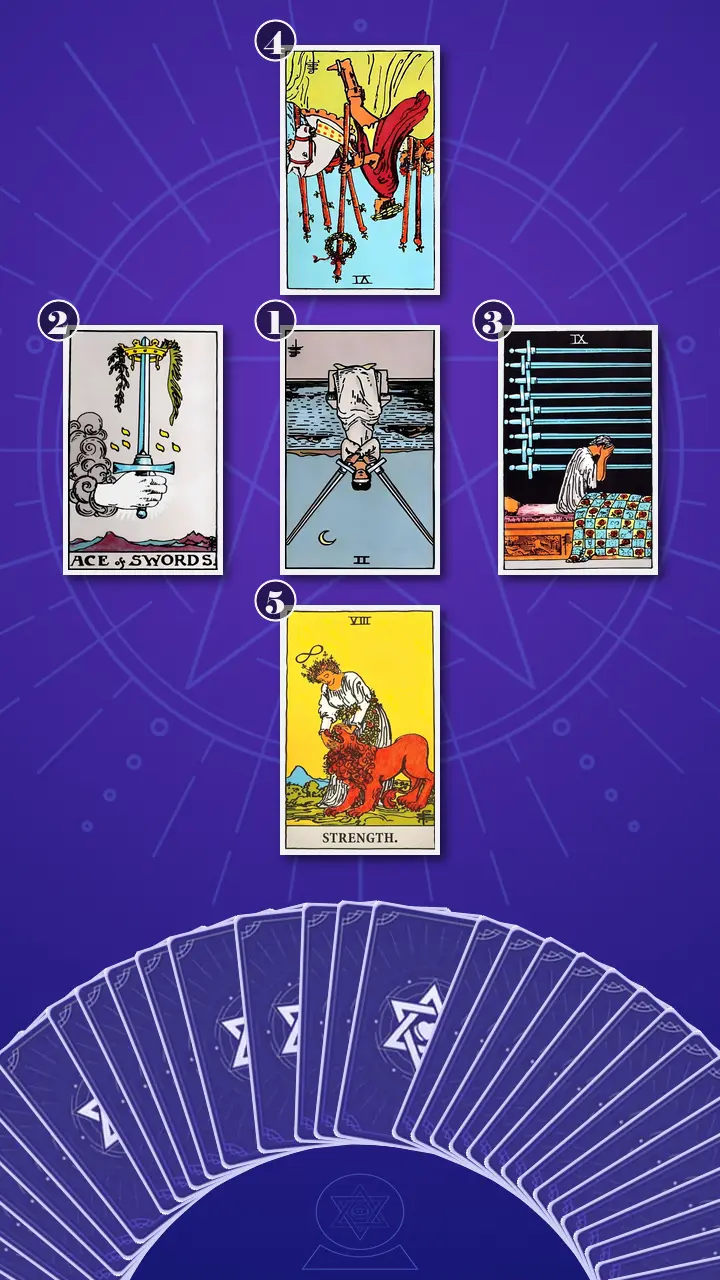
I told her how I would read it. The center card would show the present knot—the hovering, opener-tweaking paralysis itself. The upper card would reveal the hidden fear shaping the whole decision. The left and right cards would compare what going first versus waiting would actually create in real life. The final card at the base would show the wisest orientation forward: not what she had to do, but how to meet the moment without turning it into a referendum on her worth.
The Crossroads Under Fluorescent Light
Position 1: The Tab That Wouldn't Close
Now I turned over the card representing the present knot: the specific stuck behavior of hovering over the open slot and letting the decision expand into dread. The card was the Two of Swords, reversed.
I told Maya exactly what I saw. This was the Google Doc open on one screen, speaker notes open on another, the mind calling it thinking it through while the body cycled between dread and delay. The blindfold in the card felt like selective avoidance—not looking directly at the fact that the real fear was visibility. The crossed swords over the chest looked like her jaw, shoulders, and ribcage locking down to avoid the first hit of exposure. Reversed, the energy was blockage tipping into overload: too much Air, too many internal tabs, not enough actual decision. I could hear the loop in the card before she even confirmed it: I just need a little more time. I just need the opener cleaner. I just need someone else to go first. Every one of those thoughts promised relief, and every one of them gave the fear more square footage.
Maya let out a short laugh that had more bite than humor in it. 'Wow,' she said, looking at the card and then away from it. 'That is accurate enough to be rude.' Her fingers rubbed the edge of her sleeve. Her shoulders, which had been nearly touching her ears when she arrived, dropped maybe half an inch. Same-frequency recognition had landed; she did not feel dramatic anymore, only named.
Position 2: One Real Window
Then I turned over the card for what choosing to go first activates, including the immediate discomfort and the potential for faster clarity and relief. It was the Ace of Swords, upright.
I love this card in a reading like this because it is not flashy. It is clean. I told her this looked like typing her name into the sign-up doc or sending the Slack reply, closing the agenda, and feeling the week shift from ten imagined futures to one actual moment she could prepare for. The energy here was focused balance, not fake confidence. The sword rises straight out of the cloud because one decisive action cuts through noise better than another hour of rehearsal. I said it plainly: going first is not always a confidence move. Sometimes it's a clarity move.
I watched that sentence land with a small exhale. In practical terms, I explained, the discomfort would show up fast—tight throat, buzzy stomach, maybe a spike of oh, it's real now. But the mental fog would also start thinning just as fast. Waiting was asking her to keep living inside theory. Claiming the slot would move her into reality, which is often kinder than the rehearsal loop.
Position 3: The Week That Follows You Home
Next came the card showing what choosing to wait feeds, especially the loop and body tension that build across the week. The card was the Nine of Swords, upright.
I did not have to translate this one very far. It was almost literal: the figure upright in bed, the room dark, the mind loud. I told her this was what happened when a short presentation quietly colonized the whole week—shower rehearsals, 10:30 p.m. opener edits, the hollow-buzzy stomach before sleep, waking already tired. Upright, this was Air in excess: thought no longer serving preparation, only multiplying threat. 'You're not weak for feeling exposed,' I told her. 'You're tired from carrying the exposure for days before it happens.'
She went very still. First her breathing paused. Then her eyes unfocused like she was replaying a Wednesday night in bed with the charger light on the wall. Then she pressed her lips together and nodded once. I asked, 'If waiting doesn't actually make you calmer, what is it buying you besides more rehearsal time for fear?' She answered in a voice so quiet I almost missed it: 'Honestly? Not much.'
Position 4: The Imaginary Comment Section
The next card was the hidden factor shaping the whole decision—the link between visible performance and self-worth. Here I found the Six of Wands, reversed.
This was the real engine. I told Maya that underneath the timing question was a social-image question: she was not only trying to present information, she was trying to control how competent, polished, and composed she looked while presenting it. The conference room had turned into a scorecard. Neutral coworker faces had started behaving, in her mind, like a live comment section on her competence. Reversed, the card showed Fire distorted by self-consciousness: public energy collapsing inward into image-management. Her hot chest, damp palms, locked jaw—those were not signs she lacked skill. They were the cost of trying not to look human in real time.
Whenever I see Six of Wands reversed in a work reading, my mind flashes to old Hitchcock camera work: the hallway does not become dangerous on its own; the lens makes it feel accusatory. That was exactly what had happened here. Nothing in the meeting room had actually become a tribunal, but Maya's inner lens was filming it like one. 'Visible is not the same thing as failing,' I told her. At that, her jaw tightened first, then loosened. 'So I'm not really scared of the talk,' she said slowly. 'I'm scared of what I think the talk would prove.'
When Strength Put Her Hand on the Lion
Position 5: Stay-With-Yourself Speaking
When I turned over the final card—the one identifying the key shift and the most grounded way forward—the room changed. The radiator clicked once. The late light caught the gold on the card. We had reached the antidote. It was Strength, upright.
I told Maya that this card did not promise the absence of nerves. It offered embodied courage, self-regulation, and self-trust under visibility. In real life, it looked almost boring from the outside: feet planted, jaw softer, notes available, first sentence spoken while the heart was still thudding. That is why Strength is so powerful. It does not ask the lion to disappear. It teaches the woman to stay in contact with it.
When a client brings me a problem that seems to live entirely in the mind, I often use one of my Da Vinci Notes frames. I sketch the issue across disciplines the way Leonardo sketched flying machines: body, story, and movement. With Maya, the sketch was brutally clear. Body: tight throat, tense shoulders, buzzy stomach. Story: if I stumble, they will see I'm less capable. Movement: delay, refresh, rewrite, repeat. Strength was the first card in the spread that interrupted all three at once. It moved her from living inside the audience's imagined gaze back into her own body.
I asked her to picture that moment on the streetcar or at her desk when she rehearsed the first line again, not because the line still needed work, but because deciding would make the visibility real. Then I said, quietly, 'Your nerves are not the final obstacle. Abandoning yourself until you feel perfect is.'
Stop trying to wrestle your nerves into silence, and start placing a steady hand on them so you can speak anyway, just as Strength calms the lion instead of running from it.
Her reaction came in three waves, and I watched all of them. First, a freeze: her breath caught high in her chest and her fingers stopped moving on the paper cup. Then the thought broke through: her eyes drifted past me, as if she were back on the 504 King, mouthing the opener while the tracks rattled under her feet. Then the release: her shoulders dropped, her jaw unclenched, and she let out a long breath that sounded half relieved, half annoyed. 'But if I stop trying to control it completely,' she said, 'won't I look worse?' I shook my head. 'No. You'll look more present. And if you need to pause, you can recover in real time. That's different from failing.'
Right there, I invited her into a tiny visible-action drill. I had her stand up, plant both feet, soften her jaw, and say only her first sentence out loud once. Just once. Adrenaline still present. Voice not perfectly smooth. Human, though. Very human. Then I asked, 'Using this new lens, can you see a moment last week when this would have changed how you felt?' She laughed softly and nodded. 'Wednesday. I kept editing slide one like it was going to save me.' That was the shift I wanted for her: from all-week dread and image-management to steadier self-trust during visibility. Not certainty. Self-trust.
The Clarity Move: Actionable Advice for the Next 48 Hours
By this point the spread had told one clean story. What looked like indecision was really a loop. Two of Swords reversed showed the stuck behavior: hovering, refreshing, postponing. Nine of Swords showed the cost: the presentation leaking into sleep, commute, appetite, and focus. Six of Wands reversed named the blind spot: Maya kept treating a room full of coworkers like a public referendum on competence. That was why more polishing never felt like enough. The transformation direction was simple, but not easy: make one clear choice while nerves are still present, then stop managing the image of yourself and start staying with yourself through the actual moment.
Maya gave me the most normal objection in the world. 'Okay, but tomorrow is packed. I do not have time for some elaborate ritual before a three-minute update.' I smiled because perfectionism loves to make the solution feel too big to use. 'Good,' I said. 'We are not building a ritual. We are building three small interruptions.'
- Claim the slot on a timerBefore lunch tomorrow, set a 10-minute timer and choose your presentation slot once in the shared agenda, Slack thread, or sign-up doc. Then close the tab and remove the agenda from your browser favorites for the rest of the day.If your mind says decide when you feel sure, answer it with: I am choosing the end of indecision, not the perfect slot. If posting publicly feels intense, draft the message first, breathe once, then send it.
- Practice the doorway, not the whole performanceOnce—only once—say your first sentence and the transition to sentence two out loud in an empty meeting pod, stairwell, or on the walk home. I had her borrow my Gallery Walk Revision trick: doorway equals opening line, screen equals main point, chair back equals recovery line, so the room becomes a sequence rather than a jury. Write one recovery line in your notes, such as Let me rephrase that or Give me a second—what matters here is...Let one ordinary imperfection happen on purpose, like glancing at your notes. Then keep going so your nervous system learns that credibility survives visible humanity.
- Use a Strength cue in the roomRight before you present, do a 60-second grounding sequence: unclench jaw, drop shoulders, feel both feet, and exhale longer than you inhale once or twice. Put a tiny dot on your notes or first slide corner and let it remind you: first sentence, not whole performance.If breathwork makes you too aware of the nerves, skip the deep inhale and just soften your jaw and press your feet into the floor. Small counts. The goal is not zero nerves; the goal is staying with yourself through the first sentence.
I told her these steps were not meant to erase the fear. They were meant to keep the fear from renting the whole week.
A Week Later, the Quiet Proof
Four days later, a message from Maya lit up my phone: she had claimed the early slot before lunch, used the grounding cue in the hallway, and still felt the adrenaline hit when her name was called. But she had also started speaking before the panic got to turn itself into philosophy. The line I loved most was this: 'I was still nervous, but by the time I sat down, I felt more relieved than judged.'
She added one detail that stayed with me. She had slept a full night, then woken with the old thought—what if I blank?—and smiled at it before getting dressed. That is the kind of proof I trust: not that fear never returns, but that it no longer runs the whole system.
That is what a Journey to Clarity usually looks like in real life. Not a flawless performance. Not instant confidence. Just a cleaner choice, a steadier body, and the beginning of a different relationship with being seen. That is what this Decision Cross tarot spread for the go-first-or-wait presentation question gave her.
If one small speaking moment has started living in your throat, your commute, and your sleep because you are working so hard to protect your competence, I want you to know that naming the loop is already a form of relief. You are not failing at confidence. You are tired from carrying visibility before it happens.
So when the open slot appears again and your inner live comment section starts up, what would make the next visible moment a little more doable for you: one clarity move, one recovery line, or one steady hand on the lion?