When Packing Feels Like a Competence Test: Trading Control for Closure

Finding Clarity When Packing a Suitcase Triggers Control Anxiety
If packing the night before a trip turns into you rewriting checklists in your Notes app at 1 AM like it’s a performance review for being a “normal adult,” you’re not alone.
Alex (name changed for privacy) sat down across from me with the specific tiredness that isn’t sleep-deprivation so much as decision-deprivation. They’d come straight from their London flat, where—by their description—the suitcase was still open on the carpet “like a rectangle of responsibility.”
“It’s embarrassing,” they said, and their laugh landed sharp and thin. “I can handle a hectic week at work. I can run meetings. But the second I open an empty suitcase, my brain turns into… twenty browser tabs screaming at once.”
I could almost hear it: the bright-blue phone glow, the zipper teeth clicking, the radiator ticking in the background. The way your hands keep lifting the same t-shirt to confirm it’s still real. The way your jaw clamps like you’re about to bite through a thought.
Alex looked down at their own hands as if they’d betrayed them. “I keep repacking. I keep checking the same pocket. I’m not even excited about the trip until the suitcase is perfect. And I hate how packing turns into a whole personality test for me.”
What they were describing wasn’t “being prepared.” It was the contradiction that traps so many capable people: wanting to feel prepared and safe versus fearing that one missing detail will prove you’re not in control. And it lives in the body—tight shoulders, a clenched stomach, restless hands that can’t leave the zips alone—like anxiety has found a very specific address.
I leaned in, keeping my voice simple and human. “I believe you. And I don’t think you’re bad at packing. I think your nervous system has learned that ‘done’ is the dangerous option. Let’s try something different today—let’s make a map for this fog. We’re aiming for clarity, not a personality overhaul.”

Choosing the Compass: The Transformation Path Grid (6)
I asked Alex to take one slow breath—not as a mystical ritual, just as a gear-change. Then I shuffled while they held the question in plain language: Why does packing a suitcase trigger control anxiety—what pattern?
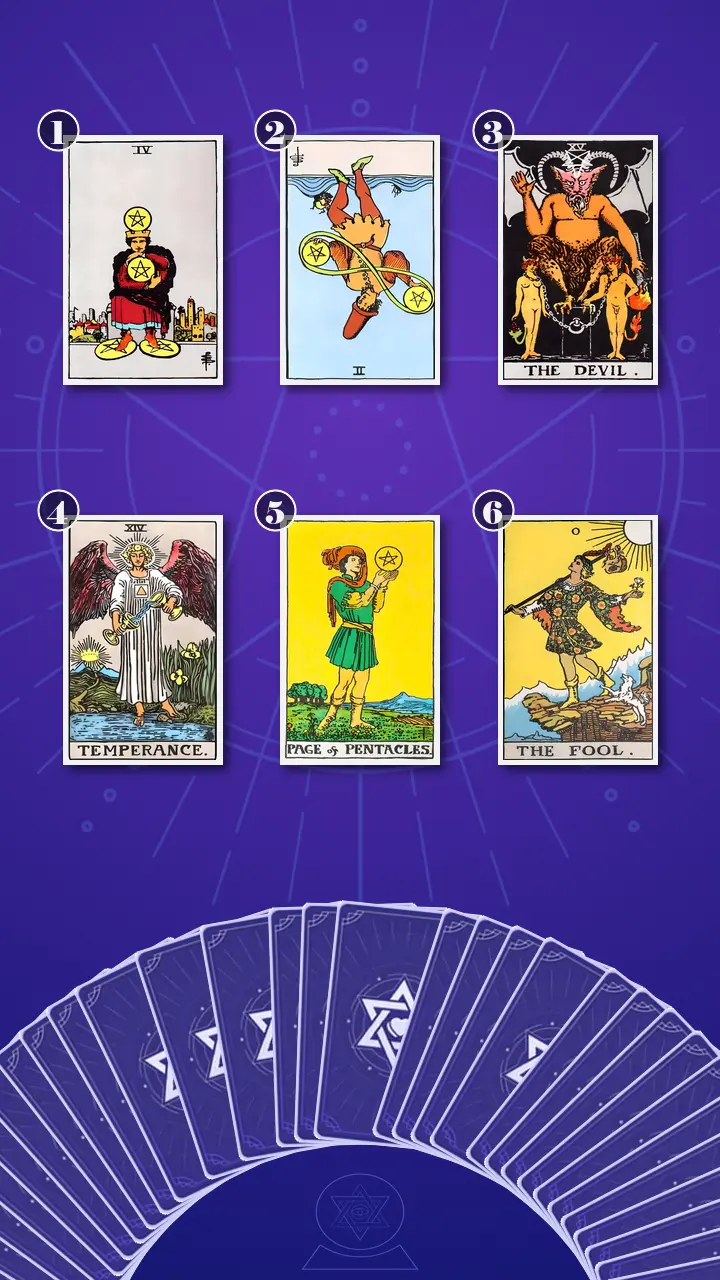
“Today we’ll use a spread I like for situations exactly like this,” I told them. “It’s called the Transformation Path Grid (6) · Context Edition.”
For anyone reading along who’s curious about how tarot works in a practical, non-fortune-telling way: this spread is built to decode an internal loop rather than predict external events. It keeps the card count minimal, but it still separates the parts that matter—surface behavior, the exact blockage, the deeper root, the regulating catalyst, a one-week experiment, and the integration (what this can become).
I laid the cards into a 2x3 grid like a small control panel. “Top row is what spikes,” I said, tapping the space above. “Bottom row is how it shifts. We’ll read left to right across the top—what you can see, what jams, what’s underneath—then we drop down like a staircase into change.”
I also flagged three positions so Alex wouldn’t feel lost in the process: “The first card names what packing is trying to do for you emotionally. The middle card shows the mechanism that keeps reopening decisions. And the fourth card—down here—will show the turning point energy, the thing that can regulate your system enough for closure.”
Reading the Map: Card Meanings in Context
Position 1: The Control Grip You Can See — Four of Pentacles (upright)
“Now we’re opening the card that represents the surface pattern: what your packing behavior is trying to accomplish emotionally.”
Four of Pentacles, upright.
On the table, the image felt almost too on-the-nose: holding, guarding, closing in. I watched Alex’s shoulders rise a millimeter, as if their body recognized itself before their mind did.
“This is the suitcase-as-vault,” I said. “In modern life terms: you stand over an open suitcase like it’s a vault. You place items in neat rows, then hover your hands like removing one thing could trigger a collapse. Even when it’s heavy, you add duplicates—not because you need them, but because the goal is that momentary feeling of: nothing can get me.”
In terms of energy dynamics, the Four of Pentacles is Earth energy in excess: security turning into a white-knuckle grip. It’s the nervous system trying to manufacture safety by making the tangible world airtight.
Alex gave a half-laugh that sounded like it had been practicing for months. “Yes. That’s me. And it’s—ugh—kind of brutal to see it like that.” Their fingers pinched the cuff of their sleeve, then released, then pinched again: a tiny, restless metronome.
“Brutal, but also compassionate,” I replied. “This card isn’t mocking you. It’s showing you a strategy your psyche uses to cope. The question is: what is your grip trying to prevent?”
Position 2: The Wobble Loop That Reopens Decisions — Two of Pentacles (reversed)
“Now we’re opening the card that represents the primary blockage: the mechanism that keeps you from feeling done.”
Two of Pentacles, reversed.
“This one,” I said, “is decision overload. The juggling collapses.”
I brought it straight into Alex’s lived scene: “You’re juggling five versions of the trip at once—rain scenario, work dinner scenario, delays scenario, ‘what if I forget meds’ scenario. You open and close the suitcase, then open and close Notes, then open and close the airline baggage policy page. The more you try to manage every variable, the more unstable it feels—so ‘done’ becomes impossible.”
This is Earth energy in blockage: the practical mind losing rhythm. Reversed, the Two of Pentacles isn’t “multitasking”—it’s the wobble. And your body knows it: pacing, tapping, re-zipping, reaching for your phone like it’s a life support button.
To make it land, I used the metaphor Alex had already handed me. “It’s like having twenty browser tabs open. The intention is safety—‘I might need this.’ But the effect is your whole system running slower and louder.”
Alex winced, then laughed again, this time warmer. “Yes. That’s the loop. That’s exactly the loop. If I keep everything in motion, I can’t be wrong… but I also can’t finish.”
I nodded. “And here’s the hard truth the Two of Pentacles reversed points to: If your system requires perfection to feel safe, it will never let you be done.”
Position 3: The False Safety Contract Underneath It — The Devil (upright)
“Now we’re opening the card that represents the root driver: the deeper fear-based attachment or belief making packing feel high-stakes.”
The Devil, upright.
The room went quieter. Outside my window, the day had that London-grey softness—light without warmth. It matched the card’s sticky gravity.
“This isn’t ‘you’re doing something wrong’ energy,” I said, careful and direct. “This is compulsion. Attachment. A hook.”
I translated it into the modern life scenario: “The suitcase turns into a silent courtroom. You’re not just packing—you’re trying to avoid a verdict: ‘careless,’ ‘not reliable,’ ‘not in control.’ A forgotten charger becomes a character judgement, so the checking escalates. It’s not that you think disaster will happen; it’s that you fear what it would mean about you if something went wrong and you didn’t prevent it.”
In energy terms, The Devil is a pattern that feels mandatory even when no one is enforcing it. The chains are loose—and that’s what makes it so infuriating. You could step out. But your body behaves like the contract is binding.
Alex went still in a three-step sequence I’ve come to recognize: first a small freeze (breath caught, eyes fixed on the card), then a cognitive drift (their gaze unfocused as if replaying old scenes), then the emotional release (a slow swallow, a whisper of air through their nose). “I… don’t even think I’m scared of forgetting,” they said. “I’m scared of… being that person. The one who can’t manage basic things.”
“Exactly,” I said, and let the words be kind but sharp. “Packing isn’t the problem—it’s what ‘forgetting’ has been trained to mean.”
This is where my Jungian training always wants to step forward. “In shadow terms,” I continued, “there’s a part of you that doesn’t believe you get to be imperfect and still be worthy. So it makes a deal: If I control everything, nothing can shame me. That’s the false safety contract.”
Alex’s mouth tightened, then softened. “That… feels uncomfortably accurate.”
When Temperance Poured Between Two Cups
Position 4 (Key Card): The Catalyst That Regulates the Nervous System — Temperance (upright)
I touched the fourth card without flipping it immediately. “We’ve named the grip, the wobble, and the contract. Now we open the helper—the thing that interrupts the compulsion loop.”
The air in the room felt like it shifted—less heavy, more breathable—like someone cracked a window you didn’t realize was sealed.
“Now we’re opening the card that represents the catalyst for change: the internal quality that can regulate you enough to close decisions.”
Temperance, upright.
Setup: I could feel how Alex lived on the edge of that night-before moment: suitcase open, Notes app open, five tabs of packing advice, hands doing the zip–unzip–check loop like “done” would be the dangerous option. Their mind wasn’t asking, “What do I need?” It was asking, “How do I eliminate uncertainty so I can finally relax?”
Stop treating the suitcase like a locked vault, and start using Temperance’s steady pour to create an “enough” packing rhythm you can trust.
Reinforcement: Alex blinked hard, like their eyes had been dry for hours. Their jaw unclenched in a way you could almost hear—teeth separating, tongue resting. Their shoulders dropped a fraction, then another fraction, as if their body was testing whether it was allowed. They exhaled, long and shaky, and in the pause that followed, I watched their hands stop performing readiness. They just lay there, palms open on the table, empty of zips and pockets and proof.
“A rhythm,” they said quietly, almost surprised by the word. “Not… a perfect list.”
“Yes,” I replied. “Relief comes from a rhythm you trust, not a list you can’t stop editing.”
This is where I used one of my core tools—the one I’ve relied on since my years guiding thousands of travelers across restless oceans. “I call it Energy State Diagnosis,” I said. “We locate energy leaks in three dimensions: environment, relationships, and self.”
“Environment: the bright phone glow, the open tabs, the suitcase spread across the floor—your space becomes a command centre. Relationships: even if no one is in the room, you’re imagining judgement—colleagues, friends, the ‘effortless traveler’ on TikTok. Self: your body bracing—tight jaw, shoulders up, stomach clenched. Temperance doesn’t argue with any of that. It regulates it. It teaches your system a new pace.”
Alex swallowed again, softer this time. Then I invited them into the real-world bridge: “Now, with this new lens—process over perfection—can you think of a moment last week when this insight would’ve changed how you felt? A time you were rechecking something not because it was truly missing, but because ‘done’ felt unsafe?”
They didn’t answer immediately. They stared past the cards, eyes slightly glassy. “Yesterday,” they admitted. “I checked my wallet three times before leaving for the office. Nothing changed between checks.”
“That,” I said gently, “is the shift beginning. This isn’t about becoming carefree. It’s about moving from hyper-vigilant control-checking—‘done feels unsafe’—to calm self-trust and closure. Temperance is the bridge.”
The Middle Way: Actionable Advice You Can Try This Week
Position 5: The Practical Experiment — Page of Pentacles (upright)
“Now we’re opening the card that represents the action step: a practical one-week experiment that reduces decision load while building self-trust.”
Page of Pentacles, upright.
“I love this card for anxious systems,” I said. “Because it doesn’t ask for vibes. It asks for practice.”
In modern terms, it was exactly this: Alex makes a short ‘Always Pack’ list—bare-bones, realistic, reusable. They pack by category (docs, tech, meds, underwear) and tick boxes instead of spiraling. It feels almost too simple, which is the point: they’re training trust through consistency, not trying to outthink uncertainty.
“Closure is a skill,” I reminded them. “You can practice it with a zipper.”
Position 6: The Integration — The Fool (upright)
“Now we’re opening the card that represents integration: what packing can become when the pattern softens.”
The Fool, upright.
“This doesn’t mean reckless,” I said. “It means you stop treating travel prep like you’re trying to ship a whole backup version of yourself in carry-on form—so nothing can surprise you.”
The modern-life scene here is subtle but radical: Alex zips the suitcase with a little empty space left on purpose. They choose not to pack a duplicate ‘just in case.’ The shift is psychological weight coming off first, then physical weight second.
“Leave a little space,” I told them, “so you don’t have to carry a whole alternate timeline with you.”
The Whole Story the Cards Told (And Why It Makes Sense)
I slid the grid a little closer and stitched it together, so Alex could feel it as one coherent mechanism rather than six separate messages.
“Here’s the narrative,” I said. “The Four of Pentacles shows you gripping the packing process to manufacture safety—if everything is contained, you can breathe. The Two of Pentacles reversed shows why it turns into chaos: too many micro-decisions, too many versions of the future, too many tabs open, so closure never arrives. The Devil reveals the engine underneath: a false safety contract that says you must control every detail to avoid being judged as careless. Temperance is the turning point—your system doesn’t need perfect certainty; it needs a balanced, repeatable rhythm that regulates you. The Page of Pentacles makes it practical—small steps, categories, a reusable checklist. And The Fool shows the destination: essentials plus adaptability, leaving space on purpose, trusting you can handle small unknowns.”
“Your cognitive blind spot,” I added, “is thinking the anxiety is solved by adding more coverage. But the cards show the opposite: the more your system tries to eliminate uncertainty, the more it trains itself to distrust closure.”
“The transformation direction is clear,” I said, and I meant it. “Shift from packing to eliminate uncertainty to packing essentials plus adaptability, then practicing self-trust.”
Alex nodded, then hesitated—an honest, real-world obstacle rising. “But what if I literally can’t stop? Like… I’ll set a rule and then at midnight my brain will be like, ‘Open it. Open it right now.’”
“That’s not failure,” I said. “That’s the alarm system doing what it’s been trained to do. We’re not silencing it with force. We’re giving it a new channel.”
In Venice, you don’t fight the water; you regulate the flow. I brought in my Venetian Wisdom Integration strategy because it fits Temperance perfectly. “We’re going to work with your currents,” I said. “Small gates, predictable timing, less turbulence.”
- The 20-Minute Two-Pass TimerSet a timer for 20 minutes. Do Pass 1: 15 minutes essentials-only by category (documents/ID, tech, meds, underwear). Then Pass 2: 5 minutes to choose exactly ONE comfort item (a book, a hoodie, whatever actually soothes you). Zip the suitcase.Expect resistance. When your brain says “This is too casual,” label it: alarm, not instruction. No reopening unless it’s a true essential (passport/ID, meds, wallet).
- The 12-Item “Always Pack” Core ListIn your Notes app, write a 12-item core list you reuse every trip (not a new masterpiece each time). Pin it. Pack from that list without editing mid-pack. Treat it like your default settings.If you want to optimize, do it after the trip in a calm moment—one tweak only—so packing night doesn’t become a referendum on your competence.
- Zip-and-Photo Closure CheckAfter you zip the suitcase, take one photo of the contents (or the key packed sections). If anxiety spikes later, look at the photo instead of reopening the bag.This is one of my “Instant Adjustment Techniques”: a coffee-break-level tweak that interrupts the compulsion loop without requiring you to become a different person.
- Leave 10% Empty: Your Adaptability SpaceDeliberately leave a small gap—one corner, one pocket, roughly 10% of the suitcase. Name it: “adaptability space.” It’s not emptiness; it’s a decision to trust future-you.If 10% feels like too much, start with one pocket only. The goal is tolerating a small unknown, not forcing minimalism.
I watched Alex’s posture as we talked through it—still cautious, but less clenched. Like someone who’s been gripping a rail on a boat and is realizing the sea will keep moving even if their hand relaxes.

A Week Later: Ownership, Not Certainty
A week after our session, I got a message from Alex while I was walking along a canal-side path, the water doing its usual quiet work of carrying reflections.
“I did the timer,” they wrote. “I hated it for the first five minutes. Then I packed essentials, chose one comfort thing, zipped it… and I didn’t reopen it. I took a photo instead. I still felt twitchy, but I slept.”
It wasn’t a movie ending. It was better: a small, real proof. Clear but a little tender. They didn’t become a different person; they practiced closure.
That’s the Journey to Clarity this spread offered—moving from hyper-vigilant control-checking and “done feels unsafe” anxiety toward calm self-trust, closure, and lighter preparation. Not by predicting the trip, but by changing the relationship to not knowing.
And if you need one sentence to keep: When the suitcase is basically ready but your hands still won’t stop rechecking zips and pockets, it’s not because you’re “bad at packing”—it’s because ‘done’ feels like leaving your safety unattended.
So I’ll leave you with the gentlest version of the real question: if you let packing be “essentials plus adaptability” just for this one trip, what tiny moment of closure would you want to practice—zipping the bag once, leaving a pocket empty, or choosing one rule and letting it stand?