Why Panic Feels Productive Before Exams—and How Steady Effort Begins

The 11:47 p.m. Spiral of Panic-Driven Productivity
If you can build a beautiful Notion study dashboard at 4 p.m. but only touch practice questions at 11:52 p.m., you are not alone in panic productivity.
When Emma (name changed for privacy) said that to me, I could see the whole scene at once: 4:07 p.m. at Robarts Library, iced coffee sweating onto the desk, fluorescent lights buzzing overhead, Quercus open in one tab and YouTube study clips in another. Her fingers kept color-coding a fresh Google Doc called Exam Plan while the real material sat untouched like a door she wanted to open but could not quite make herself walk through.
By 11:47 p.m., the mood flipped. Blue laptop light. Six tabs. Dry contact lenses beginning to sting. An energy drink ring on the desk. The radiator clicking while her chest tightened and her brain did ugly countdown math: three chapters, one formula sheet, maybe four usable hours. All week she circled the exam; the night before, she slammed into it.
She looked at me through the screen and said, “Why am I only productive when I panic? I want to prepare in a steady way, but if I start calmly, I just drift.” Panic sat in her body like she had swallowed a fistful of static—tight chest, jittery stomach, dry eyes, a wired body that refused to settle. I told her what I tell a lot of students who type things like why can I only study when I panic the night before an exam into a search bar: this is not laziness. It is a study loop that waits for fear to press Start. I said we were not here to shame the loop. We were here to map it, and maybe, by the end, find some clarity.

A Four-Card Runway Out of Emergency Mode
I asked her to take one slow breath, name the question exactly as it felt in her body, and shuffle until the sentence in her head matched the one in her chest. No incense-cloud mysticism. Just a pause long enough for the nervous system to stop sprinting in place.
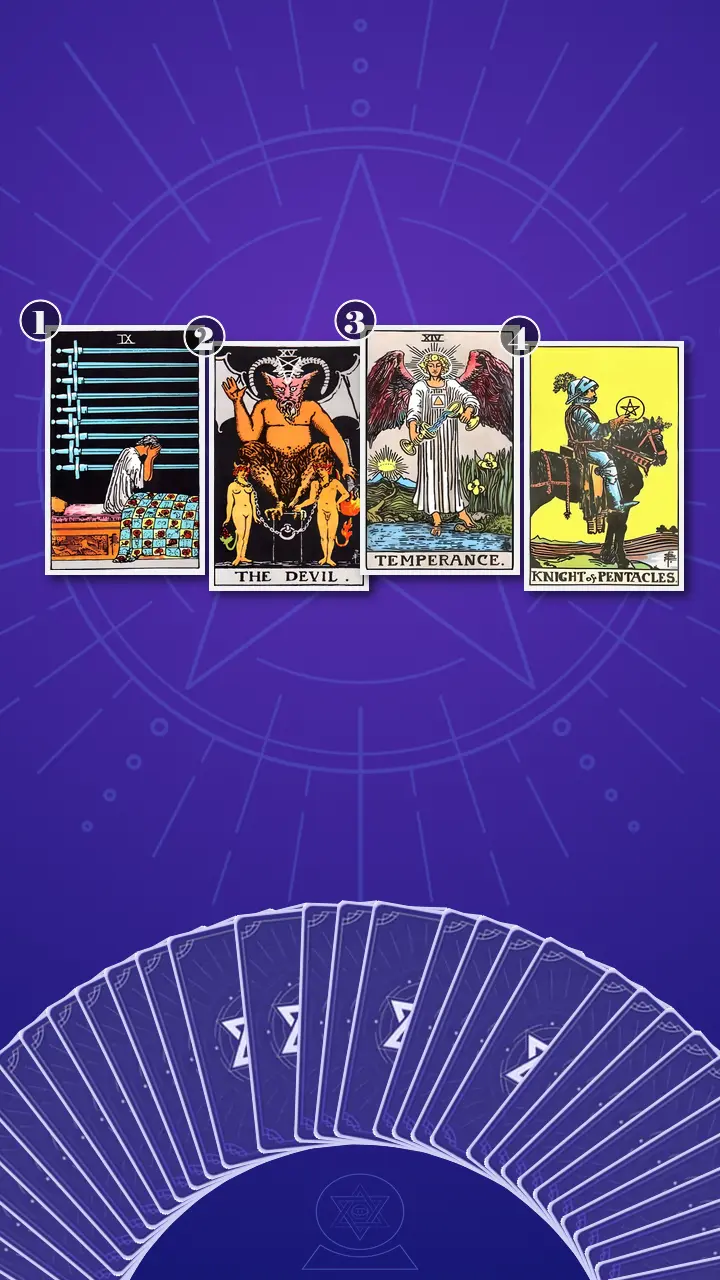
For this session, I chose the Situation-Obstacle-Advice-Outcome spread. When someone asks me about exam procrastination, panic productivity, and why calm study feels impossible, I do not need a dramatic prediction. I need a clean map. This spread shows the visible symptom, the hidden mechanism keeping it alive, the corrective shift, and the grounded direction that becomes possible once the pattern is interrupted.
I told her—and, honestly, any reader following along—that this is one of the clearest ways to understand how tarot works in context. The first card would show the surface reality: the cram spiral, the insomnia, the deadline tunnel vision. The second would reveal the blockage underneath. The third, our key card, would show the antidote. The fourth would show what sustainable studying looks like when work is no longer chained to panic.
Reading the Pressure Cluster
Position 1: The Night Everything Finally Feels Real
I turned the card that shows the visible symptom cluster from her diagnosis—the exam-eve cram, the sleeplessness, and the panic spike that finally forces action. It was Nine of Swords, upright.
In real life, this card looked exactly like her 11:47 p.m. scene: laptop half-charged on the bed, lecture slides in six tabs, Quizlet open, the course group chat muted, and that sick mental inventory running in the background—three chapters, one formula sheet, five hours until sleep should have happened. She was technically studying, yes. But the engine was dread, not clarity. It was the anti-aesthetic version of StudyTok finals week: same glow, none of the calm.
Energetically, I read this as excess Air—too much mental noise, too much self-scolding, too much alarm in the system. The card did not tell me she lacked intelligence or discipline. It told me her mind had learned to wait until fear became loud enough to override hesitation, and then mistake that state for effective studying.
When I said that, she gave a short laugh that carried more ache than humor. “Wow,” she said. “That’s… painfully accurate. Kind of mean, actually.”
I smiled. “Only because it’s clear. The all-nighter looks productive from the inside because panic narrows the frame. But it costs you sleep, retention, and peace.” Her thumb kept rubbing the ridged side of her water bottle. Then she went still, looking at the card instead of me. That little stillness was recognition.
Position 2: The App That Auto-Launches Fear
Next I turned the card revealing the mechanism that maintains the loop: the fear that calm effort will expose not-enoughness, and the reliance on urgency as a starter motor. It was The Devil, upright.
This card can look dramatic in theory, but in student life it often hides in ordinary rituals. For Emma, it was 4:08 p.m. in the library: opening Notion, renaming files, checking Quercus twice, watching “how I revised for finals” clips, cleaning the desk, promising herself she would start properly after dinner. Everything looked responsible from a distance. None of it required facing a real question she might not know.
I told her the loose chains on The Devil mattered more to me than the torch. This was compulsion, yes, but not destiny. The pattern was binding because it felt protective. If real practice questions might reveal uncertainty, then planning became a safer substitute. Panic became the app that auto-launched when she would not hit Start herself. Very Severance-meets-finals-week: planning-self and doing-self split apart, and only crisis-self got access to the real work.
As I looked at the card, my artist brain did what it always does: it cut to an old black-and-white close-up, the kind where the actor is barely moving but the room feels like it is tightening around them. That is this loop. Ordinary time gets recast as threat, and then the threat gets renamed motivation.
“So I’m doing this to myself?” she asked, and her shoulders rose fast, almost defensively.
“Not consciously,” I said. “Protectively. The all-nighter feels productive because panic removes choice, not because it is your best method. If you start calmly and still do badly, there’s no excuse buffer. Leaving it late gives fear an alibi.”
She looked down at the spread, then back at me. No dramatic reaction. Just that very specific kind of silence people go into when a sentence has found the exact hinge of the problem.
When Temperance Poured Between Two Cups
Position 3: The Antidote in Plain Sight
When I turned the third card, the atmosphere changed. On my side of the screen, rain kept tapping the fire escape outside my studio window; on hers, the cold light from her desk lamp softened against the wall. This was the most important card in the reading—the guidance, the corrective orientation, the antidote. It was Temperance, upright.
First, I gave her the grounded version. This card was not asking for a new personality, a 14-hour library marathon, or some pristine finals-week reinvention. It looked like one table, one resource, one glass of water, one 12-minute timer. A short practice set. A small reset. A recap from memory. Then stop before the spiral begins. Nothing dramatic, which is exactly why it starts to work.
Then I named the deeper trap underneath her panic-driven productivity. At 11:47 p.m., her brain feels brutally clear not because the work suddenly became easier, but because the deadline finally got loud enough to drown out self-doubt. She had been using panic as permission to begin.
You do not have to keep chaining yourself to last-minute fear. Start with one measured pour at a time and let Temperance teach your effort to flow before it burns.
I let the sentence hang there for a beat. Then I said, “Panic is not proof that you finally care. It is just the moment fear stops letting you negotiate. You are allowed to begin before that.”
This is where I brought in one of my own study metaphors—the one I call Symphonic Revision. I told her that Beethoven never throws the whole finale at you in bar one. He introduces a theme, returns to it, lets it gather meaning through measured movements. Temperance studies like that. One pass, then another. Not a midnight explosion of effort, but a sequence of repeatable returns. In other words: boring is not the same as useless.
Her reaction came in three small waves. First, her breath caught and her hand froze around the bottle cap. Then her gaze drifted past the camera, unfocused, as if she were replaying every 4 p.m. “I’ll start after dinner” moment from the last month. Then the emotion actually landed. Her jaw unclenched. Her shoulders dropped. And right in the middle of that release, she got angry.
“But if that’s true,” she said, voice suddenly sharper, “then panic isn’t my superpower. It’s just the point where I stop arguing with myself.”
“Exactly,” I said, as gently as I could. “And that does not mean you were doing it wrong on purpose. It means your nervous system learned a very expensive way to get moving.” Her eyes brightened for a second—not tears, exactly, more that dazed look people get when the burden shifts and their body has to catch up. “Now,” I asked her, “with this lens, think back to last week. Was there a moment when one calm, complete unit would have changed how the evening felt?”
She nodded slowly. “Tuesday. I had twenty minutes before class and skipped it because it felt too small to matter.”
That was the crossing point. Not from “bad student” to “good student,” but from shame-fueled deadline tunnel vision to regulated self-trust. From crisis-mode studying to the first believable version of steady exam prep.
Position 4: The Quiet Horse That Keeps Its Promises
Finally, I turned the card showing the integrated direction in behavior—the way this could look in real life if she practiced the advice. It was Knight of Pentacles, upright.
The whole visual palette changed here. Nine of Swords had trapped us in a dark room. The Devil kept us in psychological enclosure. But this card felt like actual ground: one recurring 7 p.m. review block in the library, one short question set before a café shift, a plain Notes-app done list with dated entries like chapter 4 formulas or 8 practice questions. From the outside, it would look almost boring. That was the medicine.
Energetically, I read this as balanced Earth—quiet, methodical, trustworthy. Appointment, not emergency. Streak, not sprint. Field, not fire. Boring work still counts, especially when your nervous system does not clap for it.
She gave me the smallest half-smile. “I hate how much I need to hear that.”
“Most students stuck in this loop do,” I told her. “Because the old story says work only counts if it hurts a little. This card says reliable effort can be quiet and still be real.”
From Fire Alarm Revision to a Steadier Rhythm
When I stepped back from the spread, the story was clean. Nine of Swords showed the surface: the midnight cram spiral, the insomnia, the all-nighter regret. The Devil showed the mechanism: planning rituals and low-stakes prep protecting her from the exposure of real recall. Temperance showed the turn: building small, repeatable study contact before urgency hits so calm effort counts as real work. The Knight of Pentacles showed the integrated direction: a study rhythm that becomes returnable instead of dramatic.
The blind spot was not intelligence. It was meaning. She had been confusing intensity with sincerity. If a study block did not feel dramatic, she dismissed it as fake. The transformation direction was much simpler and much harder: start before certainty, and let consistency count as effort even when it feels emotionally flat.
She exhaled and made a face. “Okay, but twelve minutes sounds fake. And some days I leave campus, go straight to my café shift, get home wrecked, and there is no cute before-dinner routine.”
“Then we work with Toronto reality, not fantasy,” I said. “No whole new personality. Just one complete unit, adapted to the life you actually have.”
- 12-Minute Calm First ContactOn two days this week, before dinner or before your café shift, set a 12-minute timer and do one closed task only: 5 flashcards from memory, 3 practice questions, or one lecture recap. Keep your phone face-down or in another pocket of your bag until the timer ends, and write one line before you stop: Next tiny step.If 12 minutes instantly feels too small to count, that is exactly why it works. The win is contact without needing fear first. Stop when the timer ends if you want.
- The 7-Minute Setup CapGive yourself exactly 7 minutes to open files, clear space, fill your water, and get seated. When the timer ends, you must either begin one real task or consciously stop. Put a sticky note on your laptop that asks: Organizing or studying?Treat the urge to rename files or open one more study-method video like a cue, not a command. Unclench your jaw, drink water, and redirect into one actual question.
- One Knight Block and a Done ListChoose one recurring review slot this week—same place, same start time—even if it is only 25 minutes. Do one question set at the same table each time, and keep a simple done list in Notes or Google Docs with dated entries so your effort becomes visible.Protect the block like a class, not a mood. If your shift or commute blows up the plan, use an 8-minute backup version instead of cancelling the whole system.
I summed it up for her in the plainest line I had: panic is a trigger, not a study plan. Start with one complete unit, not a whole new personality.

A Week Later, the Quiet Proof
A week later, I got a message from her. It was just a screenshot of a Notes app done list: 5 flashcards before shift, 7 p.m. Robarts, 6 practice questions, stopped at 11:15. Underneath it she wrote, “Still had the what if I bomb it thought this morning. I just didn’t turn it into a crisis first.”
That, to me, is what a real Journey to Clarity usually looks like. Not a personality transplant. Not the sudden death of self-doubt. A smaller flinch. An earlier start. A body learning that effort can begin before the internal alarm goes off. That is why I keep returning to a Situation-Obstacle-Advice-Outcome tarot spread for exam procrastination and panic productivity: it turns a shame loop into a readable loop, and once a pattern becomes readable, it becomes interruptible.
There is a very specific kind of exhaustion in needing the 1 a.m. panic to prove you care, because starting earlier can feel like risking the discovery that even your best steady effort might not be enough. If that exhaustion lives anywhere in you tonight, I want to say this plainly: calm is not empty here. Calm is what effort sounds like when it does not need a fire alarm.
So if fear did not have to give you permission first, what one measured pour—the five flashcards, the three questions, the one lecture recap—would feel okay to touch next?