Aid Form Open, Then Justice Turned a Verdict Back Into a Plan

When a Financial Aid Form Starts Feeling Like a Verdict
If you keep saying you’ll submit tonight and still go to sleep with the course-load tab open because full-time feels safer for your identity and part-time feels safer for your nervous system, I know exactly what kind of performance-driven choice paralysis this is.
When Maya (name changed for privacy) sat down with me, I could already picture the room she had described: 11:52 p.m. at a tiny desk in her Toronto apartment, the aid portal open beside Google Calendar and a Notes app budget list, radiator buzzing, stale iced coffee sweating near the laptop, blue light flattening everything into one tired shade. The trackpad felt warm under her hand. Click full-time. Click part-time. Click back again. Her shoulders stayed up by her ears like someone had shouted brace. It was just one form, except her body already knew it had stopped being just one form three tabs ago.
She looked at me and said, “I know it’s just one form, but it feels bigger than that. If I go part-time, I worry it will mean I can’t handle real life.”
I hear versions of that sentence all the time. Not because people are weak, and not because they need more discipline, but because practical decisions can get inflated into identity tests. What I saw in her was overwhelm in its most modern form: like a browser with too many tabs open, all buffering, while the chest tightens as if the whole semester is balanced on one checkbox. “A course load is a pace choice, not a character reference,” I told her. “We’re not here to force certainty. We’re here to make the fog visible, and find the choice that’s fair.”

Choosing the Compass: The Decision Cross for a Full-Time vs Part-Time Choice
I asked Maya to take one slow breath and picture both options without defending either of them. Then I shuffled the deck slowly. Not as theatre, and not as some dramatic mystical performance, but as a transition point for the mind: away from spiraling and toward observation.
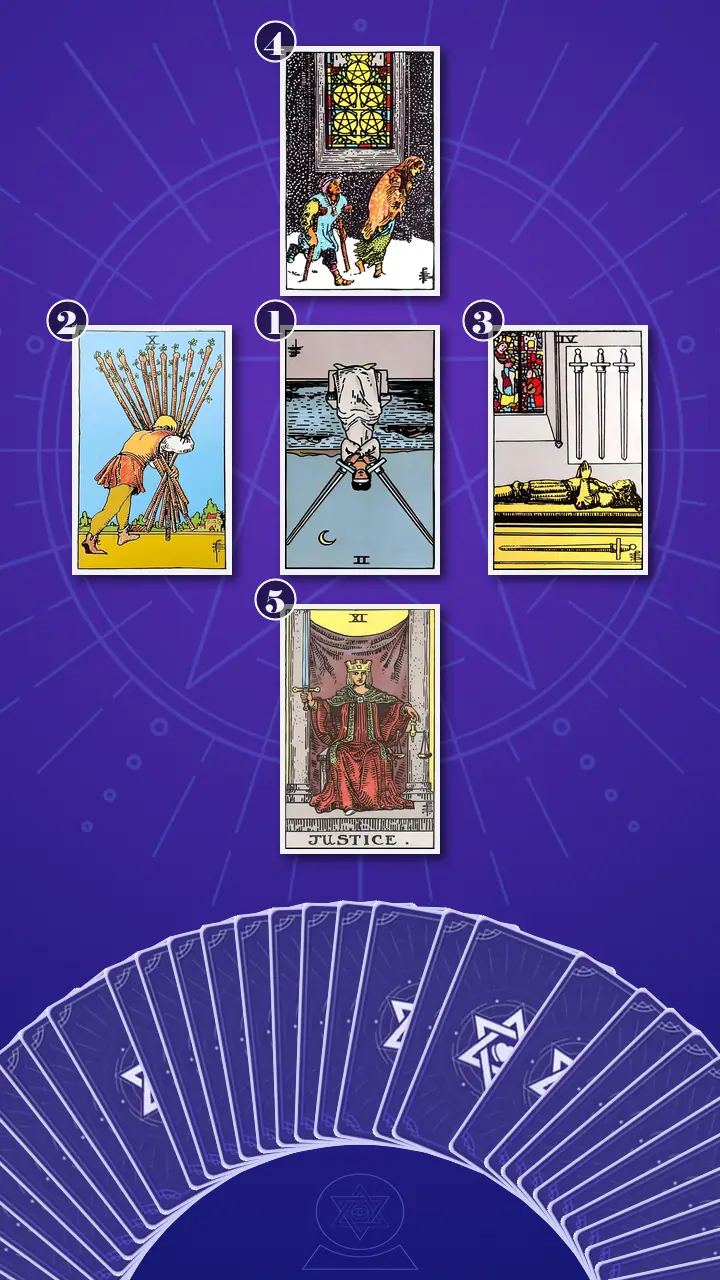
For this reading, I used the Decision Cross · Context Edition. I chose it because her question held two live options and a real administrative deadline. In situations like this, a clean comparison works better than an oversized spread. Five cards are enough to show the visible choice, the real cost of each path, the fear hanging over the decision, and the principle that can bring the whole thing back to solid ground. That, to me, is how tarot works when it is actually useful: not vague fortune-telling, but symbol-led pattern recognition that makes a complicated choice easier to see in context.
I told her where we were headed. The center card would show the immediate symptom cluster: the aid-form overwhelm, the delaying behavior, the breathless mental pressure. The left and right cards would compare what full-time and part-time were truly asking of her. The card above the center would reveal the hidden fear loading the decision with extra meaning. And the final card below would tell us the fairest basis for action, the one thing strong enough to support an honest next step.
Reading the Map Beneath the Aid Form
The Loop That Calls Itself Research
I turned over the card representing the immediate symptom cluster around the form and the paralysis itself. It was the Two of Swords, reversed.
I told her this was exactly the image of her at 11:52 p.m. with the aid portal open, clicking between full-time and part-time while four other tabs stayed open just in case. She kept rereading policy wording and budget notes because committing felt riskier than spiraling. The card did not show a lack of intelligence. It showed blocked Air: too much mental weighing, not enough inner stillness. The blindfold looked to me like over-relying on policy tabs and scenario-building so she would not have to feel the vulnerability of the choice yet. The crossed swords over the chest mirrored the way the decision was already living in her body.
“This is why more research isn’t helping,” I said. “Your mind keeps calling it preparation, but your nervous system is experiencing it like impact delay. It’s like having 14 browser tabs open and none of them answer the real question.”
Maya gave a short laugh with no real amusement in it. “That’s brutally accurate,” she said. “I literally tell myself, just five more minutes and I’ll know.” I watched the reaction move through her in three beats: her breath stalled, her eyes dropped to the card, then her shoulders lowered by the smallest amount, the way they do when someone feels a little too seen but also relieved they do not have to pretend anymore.
What Full-Time Is Really Asking You to Carry
Next I turned over the card representing what staying full-time was actually asking of her in workload, energy, and identity. It was the Ten of Wands, upright.
I told her this was not just about credits on paper. This was classes, café shifts, commuting across the city, readings, laundry, transit delays, low-grade admin, and the invisible stress of always being one email behind. The Ten of Wands is excess Fire: effort pushed so far that it stops being momentum and becomes pure load-bearing. It reminded me of a Google Calendar that looks like color-coded Tetris by Sunday night, no white space left anywhere, the week turned into a series of checkpoints rather than an actual life.
“Staying full-time may keep a certain kind of momentum,” I said, “but this card asks whether the load is sustainable, not whether it is admirable. More load is not the same thing as more worth.”
She pressed her lips together and looked off to one side. “Honestly,” she said after a moment, “if I stay full-time, I’m agreeing to a version of the term where I’m always catching up.” Her hand tightened around the cup again. Not defiance this time. Recognition.
The Suspicious Luxury of a Blank Square
Then I turned over the card representing what dropping to part-time would create or require, especially around recovery, pace, and stepping out of performance mode. It was the Four of Swords, upright.
I felt the whole reading cool by a degree. That happens sometimes. One card changes the temperature of the room. The Four of Swords is not collapse. It is structured recovery. I told her it looked like a term with actual sleep, quieter study blocks, and maybe even one protected hour a week that was not already spoken for by urgency. It looked like leaving one blank square in the calendar and not apologizing for it. In energy terms, this was balanced Air: a pause that lets thought come back into order instead of scattering further.
“Breathing room is not the same as falling behind,” I said. “This card asks a hard but honest question: what if a slower pace makes you steadier, not softer?”
Her reaction was almost imperceptible, but I caught it. First her jaw unclenched. Then she took the first full inhale I had seen from her since we started. Then she gave me a wary half-smile. “That sounds good,” she admitted, “until I imagine having to explain it.” That sentence mattered. It told me the real tension was no longer only about stamina. It was about image.
The Cold Story Under the Numbers
I turned over the card representing the hidden fear about safety, worth, and control that was silently loading the decision with extra meaning. It was the Five of Pentacles, upright.
Right as I said the name, a draft clicked softly against the window behind us, and the city outside looked colder. I have learned to trust those tiny moments when the environment starts echoing the cards. The Five of Pentacles was the exact image of Maya checking her bank app outside a campus building, cold air on her face, then opening Instagram and seeing classmates post internship updates, packed schedules, library stacks, momentum everywhere. Part-time did not just mean fewer credits in her mind. It meant becoming the one who fell behind, the one who missed out, the one who had to explain herself.
“This is the fear under the logistics,” I told her gently. “Not laziness versus discipline. Safety versus belonging. Money versus breathing room. And maybe most painfully, the fear that changing pace would prove something about your competence.”
I paused there, because one thing stood out to me sharply: not a single Cup had appeared in the spread. No emotional suit at all. That usually tells me feelings have not vanished; they’ve been outsourced into tabs, numbers, and admin. My old Wall Street brain still notices patterns like that fast. On a trading floor, risk denied does not disappear; it just reappears elsewhere on the sheet. Same with fear.
Maya went very still. Her thumb stopped tracing the rim of the cup. Her eyes unfocused like she was replaying a dozen separate moments at once. “Yeah,” she said quietly. “Part-time feels like becoming the girl who couldn’t keep up.” The defensiveness dropped out of her voice. What was left was heavier, but truer.
When Justice Spoke at the Desk
The Card That Turned the Form Back Into a Form
Then I turned over the final card, the one identifying the fairest decision principle and the most grounded next step. The room seemed to sharpen around it. This was the key card of the reading. Justice, upright.
Before I said anything else, I let her sit with the image: balanced scales, upright sword, red robe between stone pillars. The symmetry mattered. After the blindfolded stalemate of the Two of Swords reversed, Justice felt like open-eyed discernment.
By then, Maya was caught in the thought-loop I hear so often in course-load anxiety: if she chose the lighter load, did that mean she had misjudged herself from the beginning? In her body, it was nearly midnight again — shoulders high, chest tight, one checkbox turning into a verdict.
Do not use the scales to judge your worth; use them to weigh your real capacity, and let Justice’s sword cut through guilt.
I let the sentence land before I went on. Then I brought in something I use often in my practice, my Potential Mapping System. It helps me identify whether someone is in a Sprinter pattern or a Deep Thinker pattern through energy profiling. “Your spread does not read like someone who lacks discipline,” I told her. “It reads like a Deep Thinker trying to survive a Sprinter schedule. Full-time, as these cards show it, is asking for constant checkpoint energy. Justice is asking a better question: not what sounds impressive, but what your current system can actually sustain without turning learning into damage control.”
For a second, Maya did not react at all. Her inhale stopped halfway. Her fingers froze around the cup. Then her eyes lost focus, as if she were replaying the TTC ride, the late-night desk, the still-open portal, the whole private campaign to make her week look stronger than it felt. “But if I do that,” she said, and now there was a flash of anger under the fear, “doesn’t that mean I was wrong to push this hard?”
“No,” I said. “It means you have better data now. Justice is not punishment. Justice is accurate measurement.”
Something in her face softened and crumpled at the same time. Her jaw released. Her shoulders, which had stayed half-braced for most of the reading, finally dropped. She exhaled hard enough that I could hear the air shake on the way out. And then came the more vulnerable part of clarity — the slight dizziness that comes when you can no longer hide inside overthinking because the next step is suddenly visible. I asked her, “If you look back at last week with this frame, was there a moment when this would have changed how the decision felt?”
She nodded almost immediately. “On the subway after my shift,” she said. “I would’ve stopped asking what made me look capable. I would’ve asked what I could actually carry.”
That was the shift right there: from guilt-loaded overthinking to fair, capacity-based self-trust. Not total certainty. Something better. Honest ground.
Facts Before Shame: The Next 48 Hours
When I looked back at the full cross, the story was clean. The Two of Swords reversed showed the form inflated into a verdict on competence. The Ten of Wands showed that staying full-time preserved image but at the cost of perspective, energy, and learning quality. The Four of Swords showed that part-time was not failure but structured recovery, the kind that could restore steadier focus. The Five of Pentacles revealed the deeper driver: scarcity fear, comparison fatigue, and the belief that a pace adjustment might become a belonging crisis. And Justice answered all of it with one principle: choose from alignment, not from self-punishment.
I told her the blind spot was not lack of information. It was the habit of treating a resource decision like a character test. She had been trying to solve overwhelm with more overthinking, as if the right spreadsheet could make fear stop meaning what it meant. But if the form feels like a mirror, start with facts, not shame. Fair to your capacity is still a serious decision.
Then I gave her the most practical framework I could. This is where my business background always comes back online. Panic loves blur. Clear decisions need columns. So I translated Justice into a simple action plan — part tarot guidance, part stripped-back decision sheet, and very much designed for a real student life with a real deadline.
- Build the one-page Justice SheetTonight or tomorrow, set a 20-minute timer and make two columns in Notes or on paper: Full-time and Part-time. Under each, use my 5-Minute Decision Tool with three lenses — Advantage, Risk, and Breakthrough — across money, weekly energy, and study quality. Write only one concrete cost and one concrete benefit for each category. No extra tabs.If your brain says this is too simple for a serious decision, that is the loop talking. If 20 minutes feels like too much, do 10 and stop on purpose.
- Run the Blank-Square ExperimentFor one week in Google Calendar, leave one 45-minute block completely unscheduled and label it Protected Breathing Room. Use it for a low-stakes reset only — tea before coursework, a short walk without audio, or sitting in the library without multitasking.Do not earn this block first. Treat it like a class or a shift. If 45 minutes feels too exposed, begin with 15 and keep the permission structure intact.
- Send one support-widening emailBefore the week ends, send one practical email to financial aid, an academic advisor, or student services with three specific questions about how part-time status affects deadlines, funding, or future options. Use this template: Hi, I am comparing full-time and part-time for this term. I need clarification on A, B, and C so I can make an informed decision.You are asking for information, not permission to exist. Draft it in Notes first if sending feels activating, then send it later the same day.
I reminded her that none of these steps required solving her entire semester in one sitting. They were there to break the false drama of the moment. A sustainable choice rarely arrives as a lightning bolt. More often, it appears when the invisible column called what looks most impressive is finally removed from the sheet.

A Week Later: The Quiet Proof
Five days later, I got a message from Maya. It was not a grand transformation speech. It was a screenshot: one sent email to financial aid, one pale yellow block in Google Calendar labeled Protected Breathing Room, and beneath that, a second screenshot of the submitted form. She had chosen part-time for the term.
She added one line: she hit submit, then sat alone in a campus café with peppermint tea, relieved and slightly shaky, staring at the new white space she had just allowed herself.
I liked that message because it was honest. Finding clarity did not mean she suddenly loved every trade-off. It meant the choice stopped being a verdict and became a plan. That is often what a real Journey to Clarity looks like: not from confusion to perfection, but from proving to choosing.
Sometimes the hardest part is not the form itself, but the moment your chest tightens because one tiny checkbox starts feeling like proof of whether you can hold your own life together. If that is where you are tonight, notice this: the instant you see that pattern, you are already no longer trapped inside it.
So when the tab opens again this week, what would your own Justice Sheet say if you deleted the invisible column called what looks most impressive and asked only this — which option is fairest to your actual body, budget, and bandwidth this term?