Lease Renewal After a Breakup: Choosing by Healing, Not History

When the Renewal Email Landed Like a Verdict
When Jordan (name changed for privacy), a 29-year-old project coordinator in Toronto, sat across from me at her small kitchen table, I recognized the pattern immediately: she was exactly the kind of person who could run a project timeline at work and still go weirdly blank when the landlord texted, just checking in on the renewal. I see that competence dissonance a lot in post-breakup home limbo, and it is often the first sign that a lease can be admin on paper and grief in the body.
It was 9:18 on a Tuesday night. Her laptop was open to three tabs: Rentals.ca, a color-coded Google Sheet for rent and TTC time, and the landlord’s renewal email, still unanswered. The radiator ticked behind us. Leftover takeout had gone faintly sweet and stale. Her phone lay warm in her palm like she had been holding it too long, and her shoulders were pulled so high they looked almost pinned there.
“I know this is just an apartment,” she told me, staring at the starred email, “but it doesn’t feel like just an apartment. If I move, it feels like I’m admitting it’s really over. If I stay, I don’t know if I’m healing or just stalling.”
That was the whole contradiction, clean and painful: keep our old place, or move out to heal. On paper, it was a housing decision. In her throat, it felt like trying to swallow around a house key. The more she compared lease costs and saved listings, the more the decision paralysis over moving tightened its grip instead of easing.
I nodded and kept my voice soft. “That makes sense to me,” I said. “This isn’t you being flaky. This is lease renewal anxiety after a breakup. We’re not here to force a shiny answer out of you tonight. We’re here to make the fog visible, and then find the clearest conditions for healing.”

Choosing the Compass: A Decision Cross for a Breakup Housing Decision
I asked Jordan to put one hand lightly at the base of her throat and the other over her stomach, then take one slow breath while I shuffled. I never treat this part as theater. It is simply a way to move from spiraling into noticing, from browser tabs into signal.
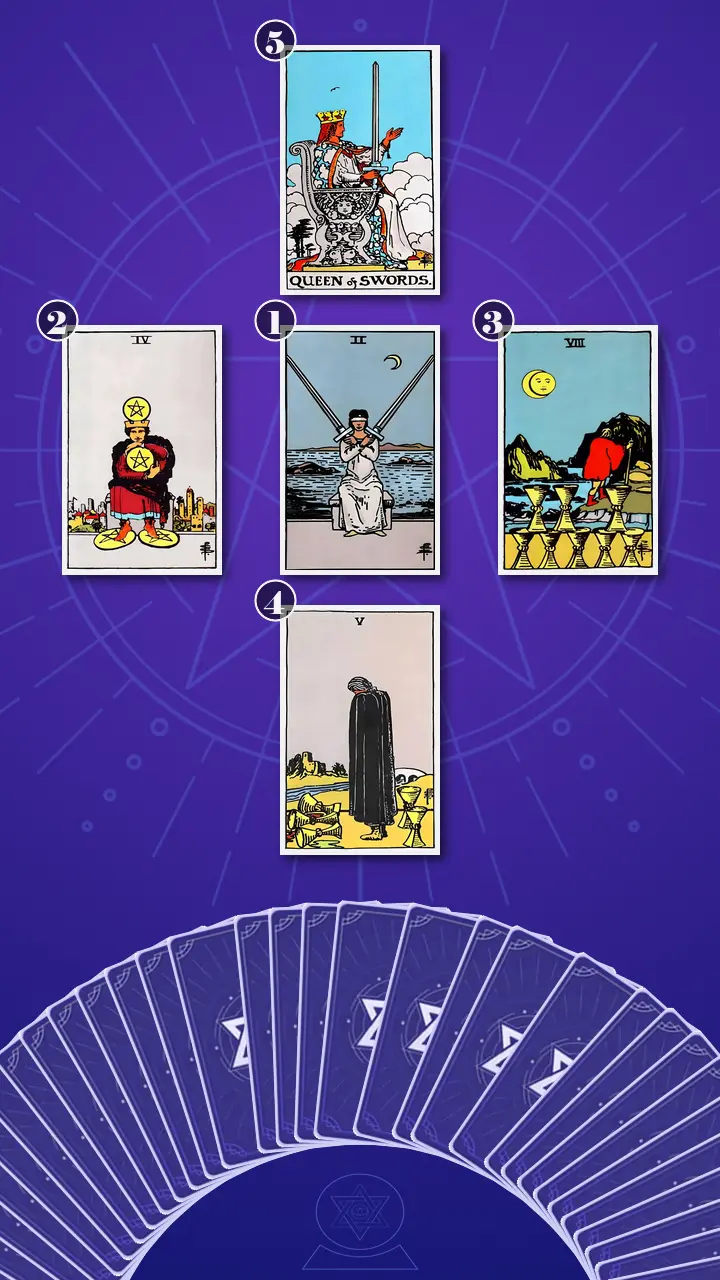
For her question, I chose a Decision Cross · Context Edition, a five-card tarot spread I use when someone is caught between two clear paths but the real work is emotional discernment, not prediction. In plain language: this is how tarot works best for a stay-or-move dilemma. The cards do not decide the apartment for us. They show what the freeze is made of, what each option activates, and what principle brings the clearest alignment.
I explained the structure as I laid the cards down. The center card would show the present stalemate. The root card below it would name the grief wound making the choice feel heavier than logistics. The left and right cards would compare what staying and moving each awaken. The top card would give us guidance: not which flat wins some cosmic contest, but what lens helps Jordan choose with more clarity and less emotional static.
I also told her I like to read this spread the way I once read risk charts on Wall Street: center first, then the underlying driver, then the two competing paths, and only after that the governing principle. The loudest numbers are not always the cleanest signal. Neither are the loudest feelings.
Reading the Pressure at the Center
Position 1: The Freeze That Looked Like Research
I turned over the card representing the present stalemate and the observable decision-freezing behavior we had already named: Two of Swords, upright.
I tapped the blindfold, then the crossed swords over the figure’s chest. “This is your kitchen table,” I said. “The renewal email open. Saved listings open. Budget sheet open. But the real move is not deciding. As long as the reply stays unsent, nothing becomes final tonight.”
Its modern life scenario was almost painfully exact: alternating between the landlord’s message, apartment tabs, and a spreadsheet, while the actual task becomes suspension itself. Upright here, the card was not balanced Air. It was blocked Air. Thought had become self-protection. Jordan’s mind kept asking for one more night, one more comparison, one more data point, because the moment she chose, the apartment would stop being ours and become mine or former.
It reminded me of the way some people keep a draft unsent because as long as it is still a draft, the timeline has not changed. This card carried that exact energy. Not confusion from lack of intelligence. Clarity interrupted by self-protection.
Jordan gave a short laugh that carried more ache than humor. “That is painfully accurate,” she said. “Like… weirdly rude, but accurate.” Her fingers hovered over the rim of her mug, then tapped it once.
“Not rude,” I said. “Protective. This card shows the strategy that bought you time when the breakup was fresher. It just can’t take you where you’re trying to go now.”
Position 4: The Grief Living Under the Floorboards
Then I dropped to the root card, the position sharpened to reveal the grief wound underneath the visible choice: Five of Cups, upright.
Before I could edit myself, I said the sentence exactly as it came to me. “You notice the absence first.”
She looked up at me immediately, and I knew it had landed. That was the apartment’s real pattern. Not just rent math. Not just whether Toronto was too expensive to start over. It was the bedroom doorway, the patch of winter light on the wall, the changed sound of the room, the missing second toothbrush. The home had started behaving like a memorial exhibit instead of a living space. Every object still held a caption from the relationship.
This was heavy Water: grief fixated on what had spilled. The card’s black-cloaked figure stared so hard at loss that the two upright cups behind them almost disappeared. In real life, those two cups were still there. Jordan’s agency. Her support system. A future not fully defined by one ending. But when grief attached itself to home after a breakup, the nervous system can start treating memory as the whole map.
She went through the reaction in three clear waves. First, her breath snagged and held. Then her eyes lost focus, as if she were replaying a room I couldn’t see. Finally, she swallowed hard and let out a quiet sound that was almost not a word at all. The knot in her stomach had arrived in the conversation.
“So this isn’t only about square footage,” I said gently. “It’s also about what feels like it disappears if you hand back the keys.”
Position 2: The Safety of Staying, and Its Cost
Next I turned over the card showing what staying in the old place was protecting, preserving, or prolonging inside the current emotional pattern: Four of Pentacles, upright.
“Same commute, same rent rhythm, same walls,” I said. “This is the practical case for staying, and part of it is real.” I pointed to the figure clutching the pentacle against the chest. “But this is also what it looks like when a home becomes emotional armor.”
The modern scenario was unmistakable: renewing because it seems efficient and stable, while part of the body is really clinging to the apartment as the last solid object from the relationship. The energy here was excess Earth. Stability had turned into grip. In business terms, the asset still looked safe on paper, but the carrying cost had changed. Familiar isn’t the same as healing.
Jordan lowered her gaze. Her shoulders dropped half an inch, the kind of movement people make when truth is not new so much as no longer deniable. “That’s the part I hate,” she said. “I keep calling it practical. But sometimes I know I’m really saying I don’t want the sharper goodbye.”
“Exactly,” I told her. “Staying might reduce immediate disruption. But it can also keep you braced. This card asks whether the apartment grounds you in the present, or simply delays the hardest feeling.”
Position 3: The First Honest Step Away
Then I turned to the moving path, the card showing what moving out would ask Jordan to release, confront, or grow into in service of healing: Eight of Cups, upright.
What I love about this card is that the cups are still standing. Nothing has been kicked over. Nothing is being denied. “Leaving a meaningful place doesn’t mean it meant less,” I said. “That is the whole medicine here.”
Its modern-life translation was clear: moving out would mean leaving a place that held real routines, real care, real meaning, not because those things were fake, but because they were no longer feeding the version of Jordan who had to recover there now. The energy here was moving Water. Not impulsive escape. Conscious departure. Like changing your commute route because the old one keeps dragging your nervous system through the same trigger points.
I watched her rub the edge of her sleeve between her fingers. “So moving wouldn’t be betrayal,” she said quietly, almost testing the sentence as she spoke it.
“No,” I said. “It might be the first boundary that creates room. A fresh address won’t erase what mattered. It may simply stop asking one apartment to carry the entire emotional archive.”
When the Queen of Swords Lifted the Blindfold
Position 5: The Guidance Card
When I reached for the final card, the radiator gave one last metallic tick and then fell still. Even the room seemed to stop bracing. This was the position focused on the clearest healing principle that should guide the decision, rather than predicting an external outcome. I turned it over: Queen of Swords, upright.
Her upright sword. Her direct gaze. Her open hand. The message came through immediately. This was not coldness. This was lucid, adult discernment. The healing move was the version of Jordan who could look at the apartment without romantic editing and ask a cleaner question: in this exact season, which home supports sleep, focus, budget, boundaries, and emotional oxygen?
One of the diagnostic lenses I use in my work is my Potential Mapping System. It helps me spot whether stress turns someone into a Sprinter or a Deep Thinker. Sprinters act before they feel. Deep Thinkers keep feeding the mind after the body has already sent the memo. Jordan was a textbook Deep Thinker under contracted grief. Years ago, on a trading floor, I watched brilliant people add model after model when what they really needed was one cleaner variable. The Queen of Swords always reminds me of that. She does not ask for more tabs. She asks for a better filter.
So I brought Jordan back to the live wire of the moment itself: 9:18 PM, the spreadsheet open, the landlord email still starred, standing in the bedroom doorway and waiting for her body to tell her whether the apartment was comfort, grief, or just a slower way of saying goodbye.
Your healing is not hiding inside four familiar walls; it begins when the Queen of Swords lifts the sword of truth and chooses the space that lets you breathe clearly.
The Clean Question
I let the sentence sit in the air for a beat before I spoke again. “The clean question isn’t ‘Which option honors the past best?’” I said. “It’s ‘Which space gives your current self the clearest conditions to heal?’”
Jordan’s reaction came in layers. First, she froze completely; her inhale stopped halfway, and her fingers hung above the trackpad as if even touching the laptop might crack something open. Then the thought visibly moved through her. Her eyes unfocused just enough that I knew she was back in the apartment’s charged spots — the doorway, the evening light, the rooms that kept making her throat close before her mind had a chance to explain. Finally, the recognition landed lower, in the body. She exhaled shakily. Her shoulders unclenched. One hand rose to her throat, and her eyes glossed with the kind of tears people get when relief and grief arrive at the same time.
“But if that’s the question,” she said, voice thinner now, “then I already know this place doesn’t let me breathe.” There was a flash of resistance inside the truth, a tiny sting of self-reproach. “So have I just been turning this into a memorial?”
“You’ve been trying to keep yourself safe,” I said. “That is different from doing it wrong. And now you know something more useful.”
I asked her, “With this lens, think back over the last week. Was there a moment when this question would have changed how you understood your reaction?”
She did not need long. “The bedroom doorway,” she said. “Every time. My whole body goes tight before my brain starts negotiating.”
That was the real threshold in the reading. Not from pain to painless. From grief-heavy lease paralysis to clear-eyed self-trust about where to heal. I watched her sit a little straighter — not suddenly certain, not theatrically transformed, but no longer asking the past to authorize the future. Choose for the self who has to live there now.
The Healing-First Housing Filter
By then the spread was telling one coherent story. The Two of Swords showed the freeze pattern: research and comparison replacing commitment because finality still hurt. The Five of Cups named the hidden engine beneath it: grief had turned the apartment into a place where absence arrived first. The Four of Pentacles explained why staying felt so seductive: it preserved routine and reduced immediate disruption, but it also risked confusing familiarity with true safety. The Eight of Cups reopened movement: leaving something meaningful because it no longer nourished the present self. And the Queen of Swords gave the deciding principle — choose housing by present support rather than nostalgia, by healing rather than emotional archaeology.
I told Jordan the blind spot was subtle but important. She had been treating pain as evidence. Because leaving hurt, part of her assumed leaving must be wrong. But grief can make an old room feel authoritative without making it restorative. The shift was exactly the one she needed: stop asking which option preserves the past best, and start asking which option supports your sleep, budget, boundaries, and nervous system now. You do not need a painless answer to make a clear one.
“What if the walk-through spikes me?” she asked. “What if even ten minutes is too much?”
“Then we use the smallest useful version,” I said. “Clarity doesn’t need drama. It needs signal.”
I gave her three actions — not a life overhaul, just a support-first move plan she could actually do this week.
- Present-Tense Home TestOpen a note titled “Present-Tense Home Test” and walk room by room for 10 minutes. Under each room, write only present-day evidence: “I sleep better here,” “I tense up here,” or “neutral.” No memory analysis, no breakup archaeology — just current impact.If ten minutes feels too intense, do one room only or record a quick voice note. Stop if you feel flooded; the goal is information, not endurance.
- Two Drafts + My 5-Minute Decision ToolWrite both landlord replies in full — one renewing, one declining. Then use my 5-Minute Decision Tool: under each draft, list one Advantage, one Risk, and one Breakthrough for your present life. Read the two drafts once, then step away. Come back for a brief weekly calibration instead of looping all night.Keep the tri-axis tied to real criteria: sleep, budget, commute, privacy, and nervous-system support. The winner is not the more sentimental draft; it is the one your current self can actually live inside.
- One-Viewing Data PointBefore the week ends, message one listing or book one viewing. If that still feels too big, walk one neighborhood you have been filtering for and notice your body there, not just the rent. Bring one trusted friend as a movement buddy on FaceTime or in person.Treat this as data-gathering, not a binding decision. One viewing does not commit you to moving; it simply breaks the freeze enough for reality to replace projection.

A Week Later, the Quiet Proof
A week later, Jordan sent me a photo from a coffee shop near St. Clair West after a viewing. “I didn’t suddenly become a different person,” her message said. “But I did the room-by-room body check, drafted both emails, and messaged a listing instead of just saving it. I still feel sad. I just don’t feel split in half anymore.” In the photo she was alone, coat folded over the chair beside her, an oat flat white cooling near the window. It was not a cinematic new-chapter post. But her jaw was no longer tight, and that mattered.
That is what a real Journey to Clarity looks like when I read tarot for a breakup housing decision. Not instant certainty. Not a tidy glow-up arc. Just a quieter, steadier return of authority: from grief-heavy lease paralysis to clear-eyed self-trust about where to heal. That is why I trust a Decision Cross tarot spread for a post-breakup stay-or-move housing decision. Used well, it does not predict the perfect apartment. It helps the truth stop hiding.
Sometimes the tightest grief is standing in a room that once felt like safety and not knowing whether staying is comfort or just a slower goodbye.
If tonight you lifted your own Queen of Swords and opened a note called “Present-Tense Home Test,” what starts to feel even a little clearer when the question becomes, “What helps me heal here and now?”