From Dish-Desk Overwhelm to Timed Study Sprints: Starting-Zone Method

The 8:47 p.m. Table That Tried to Be Everything
You’re a student with a part-time job, and your desk is also where you eat—so every study session starts by negotiating with yesterday’s dishes.
That was the first thing Taylor (name changed for privacy) said on our video call, like they were confessing to a crime instead of describing a Tuesday night in Toronto.
It was 8:47 PM on their end. They angled their laptop camera down at the dining table that doubled as a desk: Chapter 6 open, highlighter uncapped, and a crusted pasta bowl plus a cloudy glass sitting inches from their margin notes. The air, they told me, smelled faintly like old sauce and dish soap. Overhead light buzzing. Phone glow pooling cold-blue across the page like a second, harsher moon.
Taylor slid the dishes an inch away. Then an inch more. Then wiped one sticky spot with a paper towel. You clear a spot → you notice five more. You open the book → your brain says “not safe yet.” You reach for your phone → the night disappears.
“Dirty dishes by my textbook,” they said, rubbing the center of their chest with two fingers, “and I just… shut down. What’s my next step past total overwhelm?”
The overwhelm wasn’t a vague feeling in the room. It sat on them like wet winter clothes—heavy at the shoulders, tightening across the chest, making even the first paragraph feel like it weighed as much as a sink full of plates.
I kept my voice gentle and un-dramatic. “We’re not here to judge you or fix your entire life tonight. Let’s just make a map. Our whole journey is about finding clarity—one usable square of space, one workable next step.”

Choosing the Compass: The Transformation Path Grid (6)
I asked Taylor to take one slow breath and name the question again, exactly as it showed up in real life: “When the dishes and the textbook are touching my brain, what do I do next?”
As I shuffled, I explained what I was doing in plain terms: not summoning anything, just narrowing the signal. Shuffling is a focusing tool—like turning down background noise so you can hear the one conversation that matters.
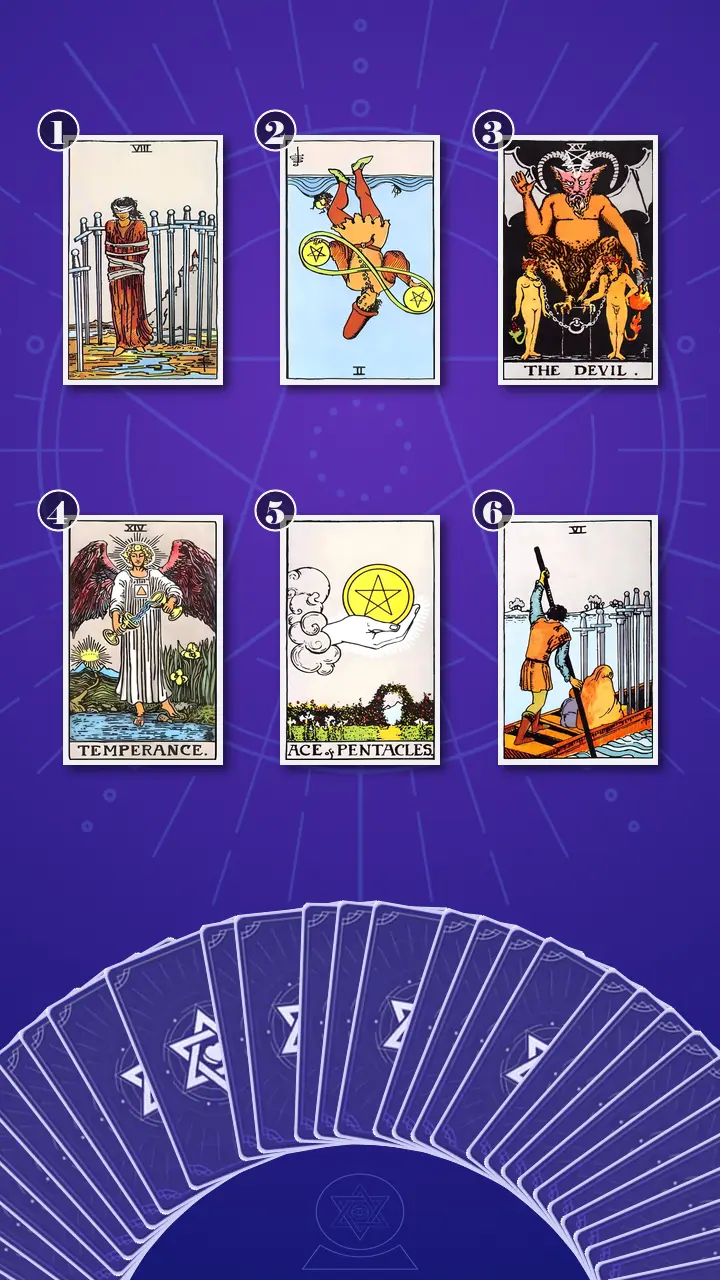
“Today I’m using my own spread,” I said. “It’s called the Transformation Path Grid (6) · Context Edition.”
For readers who wonder how tarot works in a situation this specific—mess plus studying plus shame—the rationale is simple: this grid is tight and practical. The top row diagnoses what’s visible (the desk moment), what jams the gears (the friction pattern), and what’s underneath (the deeper driver). The bottom row is the repair: the one mindset catalyst that changes your internal chemistry, the smallest grounded next step, and what integration actually feels like once motion returns.
“I’ll walk us through three key positions,” I told Taylor. “First, the day-to-day snapshot of overwhelm at the desk. Second, the exact mechanism that turns ‘I should start’ into switching tasks all night. And fourth—my favorite position—the turning point: what makes starting feel safe again.”
Reading the Map: The Desk Doorway Problem in Real Time
Position 1: The Most Visible Desk-Moment (Current Situation)
“Now we’re turning over the card that represents the most visible, day-to-day form of overwhelm at the desk—the dirty dishes by the textbook moment,” I said.
Eight of Swords, upright.
And immediately, the card translated itself into Taylor’s life with almost embarrassing accuracy: You sit at your Toronto apartment table that’s also your desk. Your textbook is open, but a stack of crusted plates is inches from the margin notes. You can physically start—nothing is stopping you—but your brain acts like there’s no safe entry point. You stare at the first paragraph, shoulders up by your ears, chest tight, and you keep thinking, “I can’t think in this.” The trap isn’t the dishes; it’s the feeling that you’re not allowed to begin unless the whole scene looks ‘right.’
In tarot terms, the Eight of Swords is mental restriction. In nervous-system terms, it’s a freeze response. The energy here is a blockage: not a lack of ability, but a lack of perceived “safe entry.” The blindfold is your brain insisting you can’t see a starting point. The bindings are loose—meaning a tiny change would create an exit.
Taylor let out a short laugh that had a little sting in it. “That’s… too accurate. Like, even a bit cruel.”
“I hear you,” I said. “But notice what the card is not saying. It’s not saying you’re lazy. It’s saying you feel trapped by conditions that aren’t actually absolute.”
Position 2: The Pattern That Jams the Gears (Main Obstacle)
“Now we’re turning over the card that represents the specific pattern that turns ‘I should start’ into switching tasks and losing momentum,” I said.
Two of Pentacles, reversed.
This is the infinity-loop card when it’s upright—juggling, balancing. Reversed, it’s the juggling that turns into dropping, the balance that turns into whiplash.
Here’s the lived translation, exactly as it happens: Your evening becomes an infinity loop: rinse one plate, open the textbook, remember you need to reply to a message, adjust your playlist, wipe one sticky spot, check the time, feel guilty, repeat. It looks like productivity from the outside, but it’s actually constant context-switching. You’re trying to be the ‘clean person’ and the ‘perfect student’ in the same 30 minutes, and the juggling makes both feel heavier—like you’re dropping everything even while your hands are full.
I watched Taylor’s eyes track left-right as if they were replaying browser tabs in their head. “It’s like my attention is an app that keeps crashing,” they murmured. “Too many background processes.”
“Exactly,” I said. “This card is telling me the obstacle isn’t motivation. It’s unstable prioritizing. The energy is excess in switching and deficiency in sustained focus. And here’s the reframe I want you to borrow: You’re not avoiding studying—you’re trying to make starting feel safe.”
Taylor’s shoulders dropped a millimeter, like their body recognized itself in that sentence. Then they exhaled—relief first, then a quieter sadness. “Okay. That explains why I lose the whole night.”
Position 3: The Root Driver Under the Mess (Deeper Cause)
“Now we’re turning over the card that represents the deeper attachment or self-worth story that makes the mess-study collision feel emotionally threatening,” I said.
The Devil, upright.
People expect this card to be dramatic. In real life, it’s often a subscription you didn’t realize you signed up for: short-term relief, long-term cost.
The modern scene came through cleanly: The dishes-textbook collision hits a deeper nerve: the mess stops being neutral and turns into a verdict. You reach for quick relief—scrolling, snacking, “I’ll reset later”—because the shame spike feels too sharp to sit with. Then the mess grows, the backlog grows, and the shame gets louder the next time you try to start. It’s not that you love the loop; it’s that the loop temporarily numbs the fear of proving you’re behind.
I leaned in a little. “Here’s the invisible agreement the Devil highlights: ‘If I’m not on top of everything, I don’t deserve to start.’ And I want to cut that contract up, gently.”
I said it slowly, so Taylor could feel it land instead of arguing with it: A messy desk isn’t a verdict. It’s a signal.
Taylor’s mouth pressed into a line, then softened. “Yeah. I treat it like… evidence.”
“That’s the root,” I said. “Neutral mess versus moralized mess. The Devil is the moralization.”
When Temperance Poured Between Two Cups
Position 4: The Catalyst That Changes the Chemistry (Turning Point)
“Now we’re turning over the card that represents the balancing shift that transforms overwhelm into a workable rhythm—the inner alchemy moment,” I said.
The room on my side was quiet, pre-dawn Tokyo stillness. In my mind I saw the planetarium dome—how, when the stars are overwhelming, I teach people to find one point first. Polaris. One anchor. The rest can come later.
Temperance, upright.
Instead of choosing between “deep clean” and “panic study,” you set a rhythm that blends care and focus on purpose. You clear one small zone (not the whole kitchen), then you do one timed study sprint, then you reassess—like adjusting the faucet, not trying to control the weather. One foot stays on land (a practical step you can touch), and one foot stays in water (your feelings are real, but they don’t get to steer the whole night). The win is not a spotless desk—it’s a calmer nervous system that can actually begin.
Setup: Taylor had been trying to earn studying by cleaning, like the dishes were a bouncer outside the club of Chapter 6. Every time they reached for the page, the crusted bowl stole their focus and their brain started bargaining: “Fix the desk first, then you’ll be safe.”
Stop waiting for your life to be spotless; start mixing ‘just enough clean’ with ‘just enough study’ like Temperance pouring one cup into the next.
There was a pause after I said it—one of those pauses that feels like a door unlocking.
Reinforcement: Taylor’s reaction came in layers. First, a physical freeze—their breath caught, and their hand stopped mid-gesture above the desk like it forgot what it was reaching for. Then the cognitive part: their gaze unfocused, like they were replaying a week of half-starts and “I’ll just do this first” loops. Finally the release: a shaky exhale that sounded like their lungs had been holding a receipt for hours and finally got permission to drop it.
“But if it’s not spotless…” they started, and I could hear the old rule trying to protect them.
“Then you’re at the event horizon,” I said, bringing in my own lens—my Black Hole Focus framework. “In astrophysics, the event horizon is the boundary where light can’t escape. In your desk life, it’s the boundary where attention can’t escape shame. Temperance doesn’t ask you to clean the galaxy. It asks you to draw one small boundary—a study zone—so your focus has somewhere to orbit without being swallowed.”
I kept it kitchen-simple, like the card asked: “You’re not deep-cleaning the whole apartment. You’re mixing two ingredients—care + focus—in measured amounts. That’s regulation. Balance isn’t a personality trait. It’s a practice.”
I asked the question Temperance always asks when it’s working: “Now, with this new perspective—can you think of a moment last week when this would’ve changed the night? When ‘good enough’ could’ve been the doorway?”
Taylor blinked hard, then nodded once. “Sunday. I watched a ‘weekly reset’ video and spiraled. If I’d done… literally one small zone and one timer, I might’ve actually started.”
Position 5: The Smallest Grounded Next Step (Practical Action)
“Now we’re turning over the card that represents one grounded, realistic action that creates immediate traction,” I said.
Ace of Pentacles, upright.
This card is a physical beginning. A seed. Something you can touch.
You pick one physical ‘seed’ that makes studying possible right now: a cleared square of desk, a rinsed plate stack moved to the sink, a water bottle, and your textbook placed in the cleared space. Then you commit to one small, measurable study chunk (one subsection, five flashcards, 15 minutes). It’s not a personality makeover—it’s a tangible foothold. You can point to it and say, “This is real. I started.”
The Ace’s energy is balance in Earth: simple, steady, doable. Not “transform your habits forever.” More like: build a minimum viable study zone and let consistency do the heavy lifting.
I saw Taylor’s face shift into something almost suspiciously practical. “Okay,” they said. “I can do that. Not the whole sink—just what’s in my way.”
“Exactly,” I replied. “One small clear zone beats a perfect reset you never start.”
Position 6: What It Feels Like Once Motion Returns (Integration)
“Now we’re turning over the card that represents what ‘past total overwhelm’ looks like emotionally and behaviorally once you commit,” I said.
Six of Swords, upright.
After a short reset + a short study sprint, the night feels navigable. The mess might still exist, but it stops shouting over the assignment. Your breathing steadies. You move from “I’m trapped” to “I’m crossing in stages.” Your thoughts come with you (you still care, you still have pressure), but they’re no longer capsizing the boat. You can do another small crossing tomorrow without needing a dramatic overnight transformation.
This is Air (thinking) no longer being a cage. It becomes movement. The energy is flow: staged transitions instead of all-or-nothing ultimatums.
“You don’t need to win the whole night,” I said. “Just make one crossing.”
The One-Square Reset: Actionable Advice for Studying in a Messy Apartment
I took a breath and stitched the whole spread into one coherent story, because integration is where tarot becomes usable.
“Here’s what I see,” I told Taylor. “Your current situation is the Eight of Swords: you sit down, and your mind convinces you there’s no safe entry point unless everything looks right. The main jam is the reversed Two of Pentacles: constant task-switching—clean a bit, study a bit, tweak Spotify, check notifications—so nothing gets traction. Underneath, the Devil is the shame-contract: ‘If I’m not on top of everything, I don’t deserve to start.’”
“Temperance is the turning point,” I continued. “It’s the key shift from ‘I need the whole space and plan under control before I start’ to ‘I only need one small clear zone and one timed study block to begin.’ The Ace gives you the seed-step, and the Six shows the outcome: calmer water—not perfect, just navigable.”
The cognitive blind spot here is sneaky: you’ve been treating spotless as the only form of safe. That’s why you keep paying for “safety” with your time.
So I gave Taylor a plan that could actually fit into a real Tuesday night—no Notion system overhaul, no aesthetic desk fantasy, no punishment.
- 9-minute One-Square Reset (dish triage)Set a timer for 9 minutes. Clear only what touches your study zone: plates/cups within arm’s reach of the textbook. Stack and rinse; move to sink. No scrubbing, no “while I’m here.”Hard stop when the timer ends. If your brain begs to keep cleaning, tell it: “We’re running an experiment, not proving a point.”
- Build the “starting rectangle” (minimum viable study zone)Make a literal rectangle on the table: placemat/notebook + textbook + pen + water. Everything else goes outside the rectangle—even if it’s just to a chair.This is my event-horizon boundary in real life: inside the rectangle is what gets your focus. Outside can exist without running the night.
- 12-minute Start Block + Shooting Star NotesSet a 12-minute timer and study one micro-target (one heading/subheading, two pages, or five practice questions). If a third task pops up (“reply to that chat,” “fix playlist,” “google a study method”), write it down in 30 seconds and return.That 30-second capture is my Shooting Star Notes strategy: you don’t follow the impulse across the sky—you just record it, then stay on your orbit.
“If you only do one thing,” I added, “do the rectangle and the 12 minutes. Make starting safe, not spotless.”

A Week Later: The Quiet Proof
Six days later, I got a message from Taylor. Not a paragraph—just a photo: a placemat-sized rectangle cleared on the table, textbook open, and a timer app paused at 00:00. Under it: “Did the 9 + 12. Not pretty. But I started. Chest didn’t do the thing.”
It wasn’t a movie ending. The sink still existed. Their roommate’s dishes still clinked sometimes. But Taylor had proof—small, physical, repeatable—that they could cross from stuck to motion without earning the right through perfection.
That’s the real Journey to Clarity I care about: not certainty, but traction. Not a spotless life, but a nervous system that can begin.
When the textbook and the dirty dishes share the same inch of space, it can feel like your chest tightens and the whole night turns into a trial you have to pass before you’re allowed to begin.
If you didn’t have to earn “the right to start” tonight, what would your smallest starting zone—and your smallest timed block—look like?