Mom Texts 'Family Meeting'—From Dread Spiral to Sleep-Protecting Boundaries

The 9:13 p.m. Laptop Lie
You open your laptop after dinner “for 20 minutes,” and somehow you’re rewriting an email at 11 p.m. because a vague “we need to talk” message is sitting in your body like caffeine.
Maya (name changed for privacy) said that to me like she was confessing a crime. She was 29, a project coordinator in Toronto, the kind of person who can turn chaos into a timeline—until her mom texts family meeting with zero context and her whole nervous system starts acting like it’s on-call.
She described a Monday night so precisely I could almost smell it: 9:13 p.m., condo living room, dishwasher humming behind her like white noise that isn’t soothing. The keyboard clicks are too loud in the quiet. The second monitor’s glow makes her face look washed-out, like she’s been up longer than she has. She rewrites an email subject line three times—then flicks to Messages again. No new text. Her jaw clamps so hard her molars feel like they’re bracing for impact.
“I can handle hard work,” she said, rubbing her temple with the heel of her hand. “I can’t handle vague.”
What sat under her words wasn’t just stress. It was dread with a thick, physical texture: tight jaw, shallow breathing, heavy eyelids with a wired mind—like trying to fall asleep while wearing a backpack you forgot to take off, straps digging in, even when you’re flat on the mattress.
Her question was simple and painfully modern: “Why does one text from my mom spill into everything? I start overworking, I can’t sleep, and then I’m useless at work the next day. I’m tired, and I’m mad that I’m tired.”
I nodded, letting the silence be kind instead of urgent. “We’re not going to moralize this. We’re going to map it. Let’s figure out why your body treats a ‘family meeting’ invite like a high-priority ticket you can’t close—and what your next step is for finding clarity without sacrificing sleep.”

Choosing the Compass: The Energy Diagnostic Map
I slid my deck across the table and asked Maya to take one slow breath—not as a mystical ritual, but as a clean handoff from spiraling to observing. “Just enough to bring you back into the room,” I said. “Your brain is very good at running simulations. Tonight, we’re going to look at the pattern instead of living inside it.”
“Okay,” she said, and even that word sounded like someone trying not to disappoint anyone.
For this reading, I chose a spread I use when a single trigger creates a whole-body chain reaction: the Energy Diagnostic Map (7) · Context Edition. I like it because it doesn’t try to predict what the family meeting will become. It tracks how the stress moves—surface symptoms, inner conflict, external pressure, the deeper hook underneath, and then the resource, the turning point, and the grounded next step.
If you’ve ever Googled “mom said we need to talk and now I can’t sleep,” you already know why a simple yes/no decision spread isn’t enough. This is a stress spillover loop: a relational trigger flips a switch, and suddenly work and sleep become collateral damage. This map keeps the reading in agency—what you can name, choose, and practice—rather than making you wait for other people to behave differently.
“The first card will show how the burnout shows up right after the invite,” I told her. “The center card will reveal the real hook—the belief that makes it feel high-stakes. And the last card will give us a concrete integration step for this week, especially for sleep.”
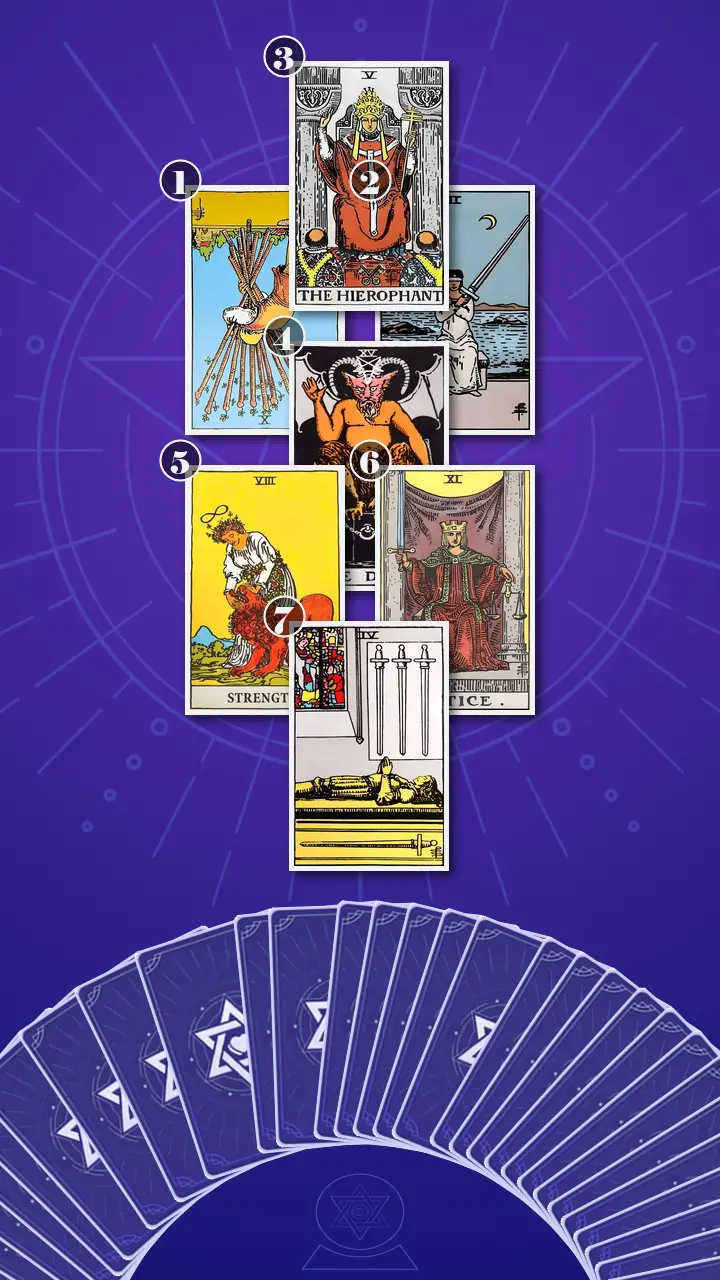
Reading the Map: The Spiral That Looks Like “Being Responsible”
Position 1: Surface symptom — Ten of Wands (reversed)
I turned over the first card. “Now we’re looking at the card that represents how burnout shows up immediately after the family meeting invite—what happens to work behavior and sleep.”
Ten of Wands, reversed.
“This is the image of carrying too much,” I said, “and reversed, it’s not even contained anymore. It’s spilling past your usual limits.” I tapped the bundled wands pressed tight to the figure’s chest. “The moment the ‘family meeting’ text lands, you treat it like another deliverable. You stay online late, clean up tasks no one asked for, tighten your grip on productivity because it gives you temporary control—then you crawl into bed exhausted with your mind still hauling the whole bundle.”
In my head, I saw it like an overheating laptop with every browser tab open: Slack, Google Calendar, the same email draft, and the Messages thread that keeps getting reopened like it’s going to reveal the hidden agenda if you stare hard enough.
“The energy here is excess,” I added. “Too much responsibility clamped too close to your body. It blocks your view of what’s actually in front of you: recovery. Tomorrow. The fact that you’re allowed to put something down.”
Maya let out a small laugh that had no humor in it—more like a wince. “That’s… so accurate it’s kind of rude.”
I smiled softly. “I’ll take ‘accurate.’ And I want to say this clearly: you’re not lazy. You’re overloaded. The question is: what are you trying to prevent by carrying it this hard?”
Her eyes flicked down to the card; her fingers worried the edge of her sleeve. That tiny movement told me her body recognized itself before her mind could argue.
Position 2: Inner tug-of-war — Two of Swords (upright)
“Now we’re looking at the card that represents the two opposing needs you’re trying to hold at once,” I said, and turned the next card.
Two of Swords, upright.
“This is the draft-delete loop,” I told her. “You type three versions of a reply, save none, and tell yourself you’ll decide tomorrow—while spending tonight mentally arguing both sides until your nervous system can’t power down.”
I pointed at the blindfold. “The energy is blockage. Not because you’re clueless—because looking directly at what you already know you need would mean tolerating someone else’s disappointment.”
Maya swallowed. I could almost hear the inner monologue clicking like a metronome:
“If I ask for context, I’m rude.”
“If I don’t, I’m unprepared.”
“If I set a boundary, I’m the problem.”
“If I don’t, I lose sleep and hate everyone.”
Her gaze went unfocused for a second, like she was watching herself on the TTC—phone warm from unlocking it every two minutes, jaw tight, body braced as if the meeting is already happening. Then she blinked and came back. “I keep thinking I’m preparing,” she said quietly, “but it’s like… I’m just holding myself hostage.”
“Exactly,” I said. “Preparation that never becomes a decision turns into insomnia.”
Position 3: External pressure — The Hierophant (upright)
“Now we’re looking at the card that represents external pressure—the family system, expectations, the context.”
The Hierophant, upright.
“This is the invisible rulebook,” I said. “The invite doesn’t just say ‘family meeting.’ It carries an inherited script: correct tone, correct availability, correct respect. Like a mandatory meeting with no agenda and a secret performance review baked in.”
I traced the keys at the Hierophant’s feet with my fingertip. “The keys are about permission. Who you believe is allowed to set the agenda. Who gets to decide what’s ‘respectful.’”
Maya’s shoulders rose a fraction—an old reflex. “In my family, being available equals being loving,” she said. “And asking for context feels like… challenging the authority.”
“That’s not you being dramatic,” I replied. “That’s a system. And systems don’t care that you have a job, a sleep schedule, and a life.”
As she spoke, I slipped into my own professional reflex: I’ve spent fifteen years training my nose to detect what people can’t name. In perfumery school in Paris, we’d stand over blotters and be asked to identify a note with almost no information—just a faint trace in the air. Families can feel like that: a trace of old expectation, and suddenly your body recognizes it before your adult brain gets a vote.
“Quick question,” I said, leaning in. “When you imagine that ‘family meeting’ vibe, what does it smell like in your memory? Laundry detergent? A specific perfume? A house smell?”
Maya’s eyes widened, then softened. “My mom’s perfume,” she admitted. “Like… something powdery. And the kitchen. Coffee. It’s not bad. It’s just—instant.”
“That’s useful,” I said. “It means your nervous system is getting a whole history in one inhale.”
Position 4: Core blockage — The Devil (upright)
I placed my palm lightly on the table before turning the center card. “Now we’re looking at the card that represents the core blockage—the deeper hook that makes the invite feel high-stakes and keeps the cycle running.”
The Devil, upright.
The room felt a shade quieter. Even the dishwasher-hum in her story seemed to fade behind this image: loose chains, fixation, a torch pointing downward like a light that doesn’t warm anything.
“This isn’t about you not knowing what to say,” I told her. “This is about your body reacting like you’re not allowed to choose. Even considering a time limit—‘I can do 30 minutes’—triggers guilt so fast it feels physical. Then the guilt drives compulsion: work harder, prepare more, rehearse more. Your system is trying to buy safety.”
“Guilt is convincing you this is mandatory when it’s actually just uncomfortable,” I said, letting the sentence land cleanly.
The Devil’s energy is attachment—not love, but the kind that confuses love with obligation. “Being loving” versus “being available at any cost.”
Maya’s breath caught, a brief freeze. Her fingers stopped moving. Then her eyes dropped to the loose chains. “They’re not even… tight,” she whispered, like she hated that it was true.
“Exactly,” I said. “The trap is real in your felt experience—but it may not be as locked as it seems. The slack is where agency starts.”
Here’s where my signature work matters: I do what I call a Family Energy Diagnosis, and I don’t do it by blaming anyone. I do it by tracking flow—where emotion is allowed to move, and where it gets forced to freeze. Maya’s “powdery perfume + kitchen coffee” memory wasn’t just nostalgia. It was a portal into an intergenerational communication pattern: her mom’s generation equating formality with care, Maya’s generation equating clarity with respect. Two different languages. Same love. Same friction.
“In your family,” I said gently, “vagueness keeps power with the person who called the meeting. And your body learned: ‘If I’m unclear, I’m at risk.’ So you try to control the risk with productivity. But productivity can’t solve a relational hook.”
Her jaw flexed; she pressed her tongue to the back of her teeth like she was holding words in. Resentment, guilt, and exhaustion all trying to share one body.
Position 5: Usable resource — Strength (upright)
“Now we’re looking at the card that represents your usable resource—what you can access to stay regulated and self-respecting.”
Strength, upright.
“This is calm firmness,” I said. “Not a dramatic confrontation. Not a perfect speech. Just regulated courage.” I pointed to the gentle hands on the lion. “Containment. You can hold intensity without storing it in your body overnight.”
The energy here is balance. “A boundary doesn’t have to be sharp to be real,” I told her. “You don’t need to win the moment. You need to stay steady inside it.”
Maya’s shoulders lowered a millimeter, like her body was testing what it would feel like to not brace. She exhaled slowly—her first real exhale of the session. “I’m scared it’ll escalate,” she admitted. “Like if I set a limit, it becomes a thing.”
“That fear makes sense,” I said. “But Strength says: you can tolerate awkwardness without sprinting away from it. You can say one boring sentence and let it be boring.”
When Justice Held the Scales
Position 6: Key transformation — Justice (upright)
I didn’t rush the next flip. “We’re turning over the most central transformation card,” I said, and I watched Maya’s hands—how they hovered near her phone even though she wasn’t holding it, like part of her still expected a notification to decide her fate.
“Now we’re looking at the card that represents the turning point—the boundary and clarity shift that breaks the loop.”
Justice, upright.
Immediately, the whole spread made a kind of structural sense: Two of Swords’ blindfold giving way to open-eyed clarity. The crossed swords replaced by one upright sword. Debate replaced by one clean line.
Setup. I said it plainly, because the moment deserved plainness. “It’s 10:05 p.m. and you’re in bed with your phone warm in your hand, rereading ‘family meeting’ like it’s going to explain itself. Your eyes are heavy, but your brain is sprinting. You’re trying to prevent everyone’s reactions by running every possible script.”
Delivery.
Stop negotiating with guilt and start choosing what’s fair—hold the scales steady, then speak one clear line with the sword.
I let the quiet hang there for a beat, the way a perfumer lets a note bloom before naming it.
Reinforcement. Maya’s reaction came in a chain—three small movements that told the truth more than any sentence could. First, a freeze: her breath paused and her eyes widened, like the idea of fairness for herself was a language she hadn’t practiced. Second, a cognitive shift: her gaze slid away from the cards to the window, unfocused, as if she were replaying every midnight email rewrite and every unsent draft like a montage. Third, an emotional release: her shoulders dropped with a soft, shaky exhale, and one corner of her mouth lifted in something between relief and grief.
“But if I do that,” she said, and there was a flash of anger under it, “doesn’t it mean I’ve been doing it wrong this whole time?”
“It means you’ve been surviving with the tools you had,” I answered. “Justice isn’t a verdict. It’s a redesign. You were trying to create safety by control. Now we’re choosing safety by fairness.”
I slid a small notepad toward her. “Open Notes and write your Two-Line Justice Script: (1) your time limit, (2) your topic limit or agenda question. Set a timer for three minutes only. When it goes off, stop—even if it’s imperfect.”
“If your body gets activated after you send it,” I added, “put your phone face-down and take five slow exhales. You’re allowed to pause at any point.”
Then I asked the question that makes Justice real. “Now, with this new lens, look back at last week—was there a moment when you were negotiating with guilt at midnight, and this could have been one clean line instead?”
Maya blinked fast. “Thursday,” she said. “I was brushing my teeth and rehearsing what I’d say if she got upset. I could’ve just… asked what she wanted to cover. In the morning.”
“That’s the shift,” I said. “This isn’t just about one family meeting. It’s a step from dread and tight control toward grounded, boundaried self-trust. Discomfort becomes temporary—not a 2 a.m. emergency.”
Position 7: Grounded next step — Four of Swords (upright)
“Now we’re looking at the card that represents your grounded next step—what supports sleep and steadier work this week.”
Four of Swords, upright.
“This is protected recovery,” I said. “Not collapsing after overwork. A deliberate container.”
“In real life,” I translated, “this looks like treating sleep as a protected appointment: laptop fully closed, phone charging outside the bedroom, and a short shutdown ritual that tells your brain, ‘This can wait.’”
I met her eyes. “Rest isn’t what happens after you solve it. Rest is what lets you respond like an adult.”
Maya gave a tiny nod—almost reluctant, like accepting rest felt too generous. But her eyelids softened, and for the first time she looked like someone who might actually sleep.
From Insight to Action: The Boundary-First Meeting Plan
I leaned back and threaded the story together for her—because clarity isn’t just insight, it’s coherence.
“Here’s what the map is saying,” I began. “A vague invite lands, and you clamp down (Ten of Wands reversed). Then your mind stalls in a holding pattern—drafting, deleting, rehearsing (Two of Swords). The pressure isn’t imaginary: your family has inherited rules about respect and availability (The Hierophant). That pressure hits a guilt hook that makes choice feel unsafe (The Devil). The way out isn’t a perfect script. It’s regulated presence (Strength) plus a fairness-based boundary you can follow (Justice). And the integration is rest-as-infrastructure (Four of Swords).”
“Your cognitive blind spot,” I said gently, “is believing you can prevent a reaction if you prepare hard enough. That belief turns uncertainty into an emergency. The transformation direction is different: choose one clear boundary and one simple intention, then let the rest be imperfect.”
Because scent is my native language, I offered her something I’ve seen work again and again for stressed, high-functioning people: a sensory cue that helps the body believe the new boundary is safe. Not magic—just nervous-system design.
“If you’re open to it,” I said, “we can also adjust the atmosphere. A calm boundary lands better when your body isn’t braced. I use a simple strategy: dialogue atmosphere enhancement with calming scents. Think: a light bergamot + lavender hand cream before you send the text, or even making Earl Grey and actually smelling it for ten seconds before you hit send. It’s a tiny signal to your system: ‘This is a normal adult message, not a threat.’”
- Write the Two-Line Justice Script (3 minutes)In your Notes app, draft two lines: (1) a time limit (“I can talk for 20 minutes.”), (2) a topic limit or agenda request (“What’s the main thing you want to cover?” / “I’m not available for a full debrief tonight.”). Optional first line: one warm sentence (“I care about this and I want to show up well.”) — then keep the two lines unchanged.Expect a guilt spike and an urge to over-explain. Label it: “This is the guilt hook, not a fact.” If 20 minutes feels too bold, start with 15.
- Send it in daylight, not from bedSend the message before 6 p.m. if you can, from your kitchen table or on a walk—anywhere except your bed—so your brain doesn’t pair boundaries with insomnia. After you send, step away from your phone for 10 minutes (no checking for a reaction).If your hands shake, that’s not a sign it’s wrong. It’s a sign you’re interrupting the old pattern.
- Build a Four of Swords shutdown container (one night)Pick a hard stop time (example: 10:30 p.m.) and set an alarm labeled “Put the backpack down.” Put your phone on charge outside the bedroom (or across the room) and close Messages. Then write a 2-minute shutdown note: (1) “What can wait until tomorrow,” (2) “One thing I did today,” (3) “One sentence I’m willing to let be unfinished.”If phone-outside-bedroom is too intense, start with phone face-down + Notifications off for 30 minutes. Sleep isn’t a reward; it’s infrastructure.
Maya frowned slightly, like a person who genuinely wanted this but had a real-life obstacle ready. “But what if she replies immediately and I… spiral again?”
“Then we use Strength,” I said. “Not to force calm—just to stay boring.” I offered her a micro-practice: “Read her reply once. Put the phone down. Take one long exhale. And ask yourself: am I trying to be understood, or am I trying to prevent a reaction?”
“And if you want a simple environmental assist,” I added, “use shared space optimization through citrus-based aromas—something clean and bright like a citrus candle in the living room during the call. Citrus tends to read as ‘daytime, functional, present.’ It’s not about making it pretty; it’s about helping your body remember you’re an adult in your own home, not a kid being summoned.”

A Week Later: Ownership, Not Certainty
Five days later, Maya sent me a screenshot.
Two lines. No paragraph. No apology tour.
“I can talk for 20 minutes. What’s the main thing you want to cover?”
Under it, another message: “I hit send at 3:40 p.m. and then I literally went outside. My chest was tight for like ten minutes. Then it dropped. I slept.”
Her follow-up wasn’t a victory speech. It was quieter than that—bittersweet in the way real growth is. “The meeting was still a little awkward,” she wrote. “I didn’t ‘fix’ anything. But I didn’t rewrite emails until midnight, and I didn’t wake up feeling like I got hit by a truck.”
I thought about what tarot is at its best: not fortune-telling, but pattern-telling. A way to translate a “family meeting text anxiety spiral” into something you can actually interrupt. A way to move from feeling stuck at a career crossroads of work performance and personal life to finding clarity in one fair sentence.
When the invite is vague, your body tries to earn safety by staying on call all night—so you show up to your own life exhausted, still bracing for a judgment you can’t control.
If you didn’t have to prevent anyone’s reaction—only choose one fair boundary you can keep—what would your one clean sentence be?