From Canvas 'Missing' Shame to Repair Mode: The Next 48 Hours

The 11:43 p.m. Canvas Glow
If you’ve ever drafted an email to a professor for 45 minutes, rewrote the subject line five times, and still couldn’t hit send—late-work paralysis is so real.
Jordan showed up on my screen from Toronto with that exact look I’ve learned to recognize in ten years of guiding people through dark planetarium domes: eyes locked on one bright point, body braced like the next sound will be a verdict.
“It happened again,” they said, laptop balanced on a tiny bedroom desk. In the background, their apartment was quiet in that Sunday-night way—no roommates moving, no street noise, just the laptop fan doing its little whir and the fluorescent-blue screen glow. Canvas was open. The red Missing label sat there like a tiny alarm light that wouldn’t stop blinking. Jordan’s phone was warm from refreshing. Their eyes kept stinging, like the screen was sandblasting them.
They clicked between tabs—rubric, syllabus, announcements—like the right move was hidden in the next refresh. Their jaw was clenched hard enough that I could see the muscle jump. “I want to fix it tonight,” Jordan whispered. “But if I email them the wrong way… it’ll look worse than being late.”
I didn’t call it procrastination. I called it what it was: shame, tightening around their chest like a too-small seatbelt—protective, but also cutting off air.
“Okay,” I said gently. “Let’s treat this like what it is: a repair moment. Not an identity moment. We’re going to make a map—something clear enough that you can take one honest step without needing a perfect explanation.”

Choosing the Compass: The Celtic Cross · Context Edition
I asked Jordan to put both feet on the floor and take one slow breath—nothing mystical, just a clean transition from spiraling to focusing. Then I shuffled while they held the question in mind: After Canvas flags a missing assignment, what’s my next step?
“We’re using a spread called the Celtic Cross · Context Edition,” I told them. “It’s based on the classic Celtic Cross, but it’s tuned for situations like this—when you’re not trying to predict an outcome, you’re trying to stop the ‘flag → shame spiral’ loop and switch into ‘flag → repair plan.’”
And for you reading this: this is a big part of how tarot works in real life. It’s not fortune-telling so much as pattern recognition—a way to separate the trigger, the real blocker, and the deeper setup, so you can stop guessing and start choosing.
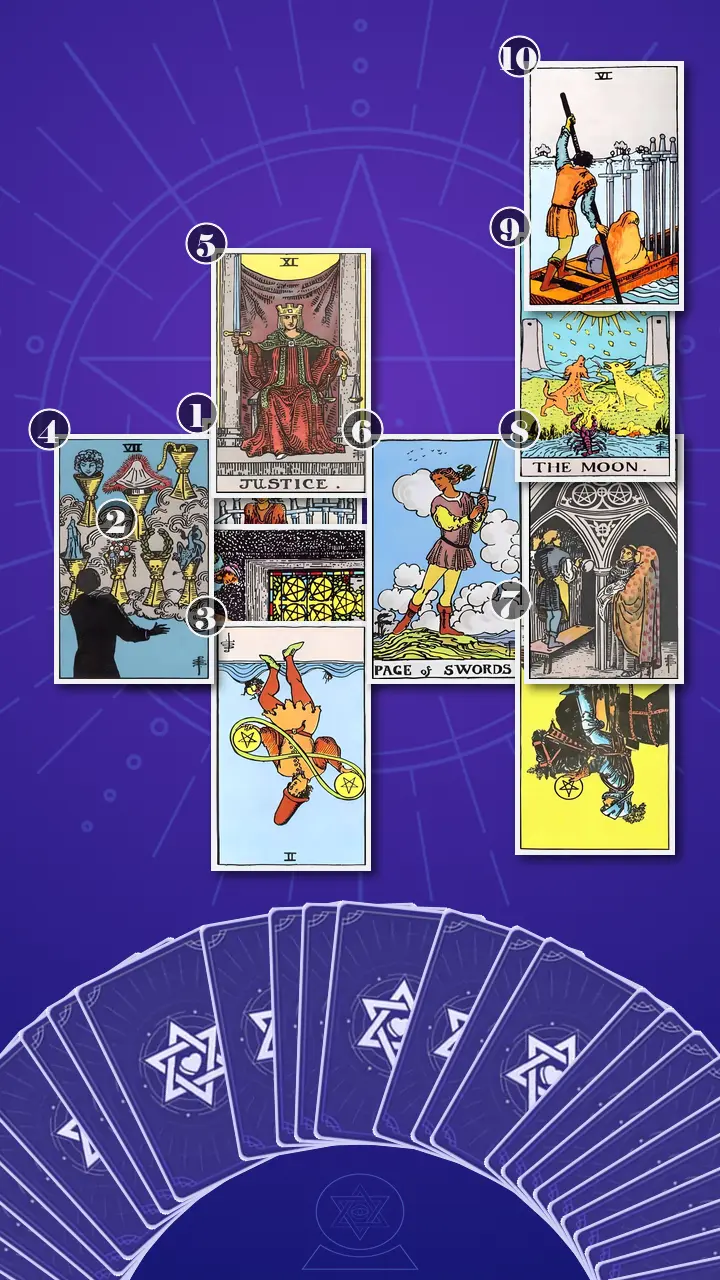
I previewed the backbone of the reading. “Card 1 will show the exact ‘Missing’ moment—what you do, what your body does. Card 2 crosses it: what turns a fixable task into paralysis. Card 6 is the one we’ll treat like your next 24–48 hour move. Then we’ll check your self-image, your support system, and what you hope and fear will happen once you act.”
When the Page of Swords Cut Through the Fog
Position 1: The exact moment of the “Missing” flag
“Now flipped over,” I said, “is the card that represents the exact moment of the ‘Missing’ flag: the most visible stuck behavior and the mental-emotional state it creates.”
Eight of Swords, upright.
I let Jordan take in the picture—blindfold, loose bindings, the narrow fence of swords. “This is like when you’re staring at Canvas with the ‘Missing’ flag up, bouncing between the rubric, the assignment page, and your half-started doc. You feel trapped like there’s no safe move—so you keep refreshing and rereading, even though the actual way out is small and available.”
“Energy-wise,” I continued, “this is Air-as-trap. Your mind is active, but it’s blocked—like ten browser tabs open and the belief that the solution is in the eleventh tab.”
Jordan gave a short laugh that sounded almost like a cough. “That’s… brutal,” they said, and then softer: “It’s exactly what I do.” Their fingers tapped the edge of the trackpad and stopped, like they’d been caught mid-refresh.
Position 2: What’s making this harder
“Now we’re looking at what’s making this harder: the immediate blocker that turns a fixable task into paralysis,” I said.
Five of Pentacles, upright.
“This card doesn’t feel like a task,” I told them. “It feels like exile. Like Canvas didn’t just mark an assignment—it marked you.”
I pointed to the warm window in the card. “Five of Pentacles is the energy of scarcity and shame. You’re standing outside a party you’re actually invited to, convincing yourself you’ll ruin the vibe if you walk in. In real life, that looks like: you assume you’re now ‘the problem student,’ so you avoid office hours, avoid sending a message, and try to fix it alone in the cold of your own anxiety.”
I mirrored the exact micro-scene I knew too well from students: “You open a Calendly link for office hours. Hover. Then close the tab. Inner voice: If I show up now, they’ll know I messed up.”
Then I gave one grounding fact—small, but firm. “Office hours exist for confusion and repair. They’re literally a warm window built into the system.”
Jordan swallowed. Their shoulders lifted toward their ears, then dropped a fraction. Their eyes stayed on the card, not the screen, like looking directly at shame was safer than looking at Canvas.
“And I want you to hear this,” I added, using the phrase I keep for moments like this. “A missing assignment is a problem to solve, not a verdict on your worth.”
Position 3: What set this up underneath
“Now we’re under the surface,” I said. “This card represents what set this up underneath: the hidden driver—time, bandwidth, beliefs—that led to the miss.”
Two of Pentacles, reversed.
“Underneath, your week is a juggling act,” I said, keeping my voice calm and practical. “Shifts, readings, life admin, multiple deadlines. You’re switching systems—Notes, Notion, Google Calendar, Canvas—so often that one due date quietly drops, and then Canvas becomes the alarm that makes it feel like you ‘failed.’”
This is Earth energy in deficiency: not lack of effort, but unstable structure. “Reversed Two of Pentacles says: you’ve been keeping everything in the air. Eventually something falls—not because you don’t care, but because gravity is real.”
Jordan nodded once, sharply, like the word gravity hit home. “I… have three to-do lists,” they admitted. “And somehow none of them are real until Canvas yells.”
I tucked that away. In my planetarium work, it’s the same every night: people don’t need more stars. They need constellations—structure.
Position 4: What just happened before
“Now we look at what just happened before: the recent pattern or context that explains why the system broke down this time,” I said.
Seven of Cups, upright.
“This is the options fog,” I told them. “Right before this, you lived in ‘maybe’ mode: do it perfectly, ask for an extension, disappear for a day, negotiate, check if Canvas is glitching, research the policy, watch one more ‘study with me’ video. Too many choices made it easier to imagine outcomes than to choose one concrete action.”
Seven of Cups is Air scattered into mist—not blocked, just everywhere. “It’s tab-switching as a lifestyle,” I said, and Jordan’s mouth twitched despite themself.
“Yeah,” they said. “I literally Googled ‘extension email subject line’ instead of writing the intro paragraph.”
Position 5: What you’re trying to restore
“This card represents what you’re trying to restore: the conscious goal driving your next move,” I said.
Justice, upright.
Justice always changes the air in the room. Even over Zoom, I felt Jordan sit a little straighter.
“You’re not trying to ‘get away with it,’” I told them. “You’re trying to make it right in a way that feels fair—to the course, to the instructor, and to yourself. Justice is balance: the facts and the decision. Accountability without self-punishment.”
I’ve spent a decade teaching visitors to track celestial motion—how something can be lawful without being cruel. Justice felt like that: cause and effect, but also the possibility of course-correction.
“Try this,” I said. “One sentence that states the facts. One sentence that states your plan. That’s Justice: scales + sword.”
Jordan exhaled through their nose, like their body wanted that simplicity but didn’t fully trust it yet.
Position 6 (Key Card): Your next practical step within 24–48 hours
I paused before turning the next card. “Okay,” I said quietly. “This is the one we treat like your next step. The most effective, integrity-aligned move you can take in the next 24–48 hours.”
The room felt oddly still—like that moment in a planetarium when the lights drop and everyone stops whispering because the dome is about to become a sky.
Page of Swords, upright.
“Within the next 24–48 hours,” I said, “you move by being brief and direct. You submit what you have—or you attach it—then you send a short message with one clear question about late options. You stop trying to write the perfect email and treat the reply as information you can work with.”
Then I watched Jordan’s familiar loop try to kick back in: their eyes flicked away from the camera toward the corner of their screen, like they were already rewriting an email in their head. Their mouth tightened, and I could almost hear the unsent drafts piling into the Gmail folder.
This was the setup of their stuckness, right on schedule: the refresh button as a time machine, the subject line as a protective spell. The belief that if they crafted it perfectly, the shame wouldn’t count.
Don’t hide behind silence or endless edits; send the clear message and make the first move like the Page of Swords stepping forward with an honest question.
I let the sentence sit in the air for a beat, the way I let silence sit after pointing out Saturn’s rings—because sometimes your brain needs time to rotate the image into place.
Jordan’s reaction came in a chain—tiny, unmistakable. First: their breath stopped mid-inhale, like their body froze at the idea of being visible. Second: their gaze went unfocused, not blank, but inward—like they were replaying every time they’d typed “Hi Professor—” and deleted it. Third: their shoulders lowered, slow and reluctant, and a shaky exhale left them like they’d been holding their breath since the moment Canvas turned red.
“But if I’m too short,” they said, and there it was—anger flickering under the shame, an unexpected edge—“won’t they think I don’t care? Like I’m making excuses?”
“That’s a smart fear,” I said, not dismissing it. “And it’s also The Moon fear—projection. The Page of Swords doesn’t do ‘convincing.’ It does clean data.”
This is where I brought in my own lens—my Black Hole Focus, the skill I use when people’s attention is getting pulled into a gravity well of overthinking. “In astrophysics, the event horizon is the line where, once you cross it, you can’t come back—not because you’re weak, but because the pull is that strong. Your Canvas spiral has an event horizon. Once you start rewriting the email for the tenth time, it eats the night.”
“So,” I said, “we draw an event horizon on purpose. We choose a boundary that protects your time.”
I leaned forward. “Set a timer for seven minutes. Draft a five-sentence message: facts + what you’re submitting + one question + your timeline. When the timer ends, you either send it, or you save it as a draft titled ‘SEND TOMORROW 9AM.’ That’s not avoidance. That’s steering.”
Jordan blinked hard. Their eyes shone a little, not dramatic-tears, just that watery edge people get when something finally becomes doable. “Okay,” they whispered. “That sounds… like a plan. Like a thing a person could actually do.”
“Exactly,” I said. “This is the shift from ‘I’m trying to protect my image’ to ‘I’m taking transparent, time-bound action.’ It’s not just about an assignment. It’s moving from shame to grounded accountability—repair mode.”
Then I asked the question that anchors the insight into real life: “Now, with this new lens—can you think of one moment last week when you were refreshing Canvas, and this could’ve changed how you felt?”
Jordan’s eyes went to the side again, but this time softer. “Tuesday morning,” they said. “On Line 1. I was at Bloor-Yonge and I deleted the email like… three times. If I’d sent the five sentences then, I would’ve at least known something.”
Position 7: Your role in the dynamic
“Now flipped over,” I said, “is your role in this: how your habits and self-image affect how you respond.”
Knight of Pentacles, reversed.
“This is the part of you that wants to be reliable,” I said. “But reversed, it stalls. It turns ‘being thorough’ into a hiding place—formatting, polishing, organizing, checking. Anything that looks responsible from the outside while keeping you from the one thing that creates a record: submitting.”
“Energy here is Earth in blockage,” I added. “Not laziness. Inertia.”
Jordan nodded slowly, like they were seeing their own pattern without the usual self-attack. “I wait until I feel ready,” they said. “And then ready never comes.”
“Right,” I said. “And here’s the reframe: ‘Reliable’ can mean consistent small progress, not flawless output.”
Position 8: What support and constraints are around you
“This card represents what support and constraints are around you—TAs, policies, peers, available help,” I said.
Three of Pentacles, upright.
Jordan’s face changed immediately, like the room got warmer by a degree.
“This is the antidote to that ‘outside the window’ feeling,” I told them. “Three of Pentacles says: support is real and it’s built into the environment. TAs, office hours, rubrics, discussion boards—this is a shared workspace, not a courtroom.”
I used the contrast the card demanded: “The policy you’re guessing about vs. the human who can confirm it in two minutes. The imagined answer vs. the real answer.”
Jordan’s jaw unclenched slightly. “My TA is actually nice,” they admitted, like it was a confession. “I just… didn’t want to show up messy.”
“Being a student is literally being an apprentice,” I said. “Three of Pentacles is permission to learn out loud.”
Position 9: What you secretly hope vs fear will happen
“Now we’re looking at hopes and fears,” I said.
The Moon, upright.
“In your head,” I said carefully, “the instructor’s response is already harsh and humiliating—before you’ve even asked. This is uncertainty turning into projection.”
The Moon is not a punishment card. It’s a visibility card. “It says: you can’t see the path yet, so your mind fills the gap with fear. That’s why the Page of Swords is so important: it trades guessing for one direct question.”
Jordan rubbed their thumb over their index finger—self-soothing, tiny. “I literally hear their reply,” they said. “Like it’s already happened.”
“That’s Moonlight,” I said. “Shadows feel like facts.”
Position 10: Integration outcome (not a predicted grade)
“This last card,” I said, “is integration—what stabilizes if you follow through. Not a predicted grade, not a fate sentence. A pattern.”
Six of Swords, upright.
“This is movement,” I said, and I felt my own shoulders drop. “You submit. You communicate. Then you build a simple catch-up plan. The panic fades because you’re navigating step-by-step instead of trying to erase the past.”
I tapped the image of the boat. “You don’t have to teleport back to where you ‘should’ve’ gotten off. You take the next stop. You move the boat forward.”
Jordan stared at the card for a long moment. Then they whispered, “That sounds… calmer.”
“It is,” I said. “It’s not perfect. It’s workable.”
From Insight to Action: The 48-Hour Repair Plan
I pulled the whole spread into one clean story—because Jordan didn’t need more insight; they needed a sequence.
“Here’s what the cards are saying,” I told them. “The trigger is the Eight of Swords: Canvas goes red and you feel trapped, so you refresh and reread. The real blockage is the Five of Pentacles: shame convinces you you’re ‘outside’ and not allowed to ask for help. Underneath, Two of Pentacles reversed shows overload—too many moving pieces and too many systems. Seven of Cups says you got lost in options fog. But Justice shows what you actually care about: doing the fair, factual thing. The Page of Swords is the bridge—direct communication plus one concrete action. Three of Pentacles confirms support exists. The Moon is your brain writing fanfiction about humiliation. Six of Swords is the outcome: a steady transition back on track.”
“Your blind spot,” I added, “is thinking that visibility equals danger. But in this spread, visibility is the exit.”
“And the transformation direction is simple,” I said, naming it clearly. “Stop trying to protect your image; start taking time-bound action.”
Then I gave Jordan the next steps—small enough to do, specific enough to stop decision fatigue.
- 10-Minute “Facts Only” CheckOpen Canvas once. Confirm whether anything uploaded (wrong file? wrong tab?). Screenshot the red “Missing” label and timestamp for your own record. Then close the tab.If your chest is tight, do a 30-second reset (feet on floor, exhale longer than inhale) only to make the click doable—not to feel perfect.
- “Ugly First Pass” Timer (30 Minutes)Set a timer. Write anything that could count as a draft: an outline + three bullet points + one paragraph. Stop when the timer ends. Save it with a clear filename (e.g., JORDAN_COURSE_Assignment1_partial.docx).This is Knight of Pentacles reversed medicine: movement over polishing. If 30 minutes feels impossible, do the 5-minute version: title + three bullets.
- The Page of Swords Message (Five Sentences)Send a short note to your TA/prof: (1) you noticed it’s marked Missing, (2) what you’ve done, (3) what you’re submitting/attaching now, (4) one direct question about late options or reopening, (5) your timeline for the next update (e.g., “revised by Friday 5pm”).Two edits max—then it’s ‘Send.’ If you’re on the TTC, use my “Shooting Star Notes” rule: capture the five sentences in 30 seconds in Notes, then stop touching it.
Jordan stared at the list like it was a life raft they didn’t fully trust yet—but they could see the handles.
“So I don’t have to… explain my whole life?” they asked.
“No,” I said. “Justice doesn’t require a memoir. It requires facts and a plan. And Three of Pentacles says you’re allowed to be an apprentice—messy in public sometimes.”
A Week Later: The Quiet Proof
Six days later, I got a message from Jordan. Just a screenshot and one line: “Sent Version B. Attached the partial. TA said late submission is accepted with a small penalty, and they reopened the link for 24 hours.”
Under it: “I slept a full night. I still woke up and thought ‘what if I screwed it up?’—but then I remembered the boat. I’m just taking the next stop.”
That’s what a real Journey to Clarity looks like in the wild. Not a perfect semester. Not a rewritten past. Just a nervous, honest click that turns guessing into reality—and shame into something workable.
When that red “Missing” label hits, it can feel like your chest tightens not because of the grade, but because you’re scared one late moment will “prove” you’re not reliable as a person.
If you let this be a repair moment instead of an identity moment, what’s the one honest action (a partial upload or a five-sentence message) you’d be willing to do in the next 24 hours?