'This Essay Argues' Kept Getting Deleted—and the Claim Went First
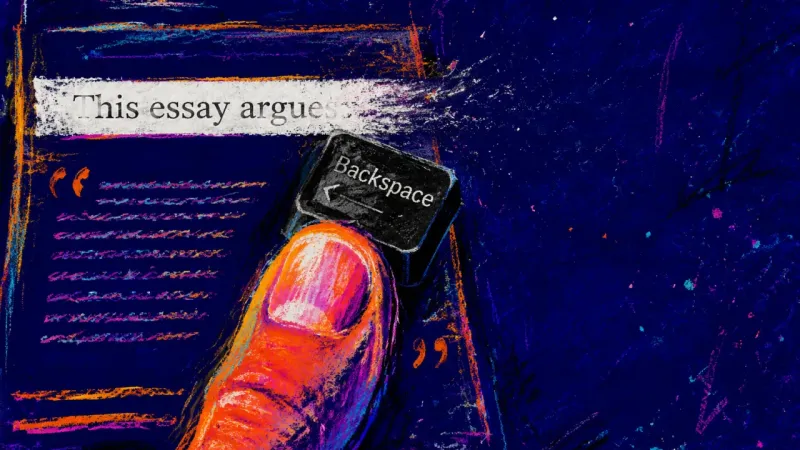
The 9:14 P.M. Thesis That Wouldn't Come Out
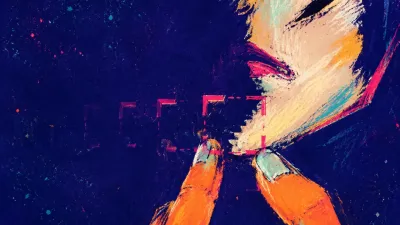
If you're a humanities undergrad in Toronto who can build a flawless Zotero folder but still freeze at the words 'This essay argues,' I know the kind of silence that usually enters a reading before the person does. When Maya (name changed for privacy), a 21-year-old humanities student from Toronto, sat across from me, she didn't begin with the assignment prompt. She began with a timestamp: 9:14 p.m., Tuesday, a cramped Robarts Library carrel, fluorescent light buzzing overhead, an oat latte gone cold beside her laptop.
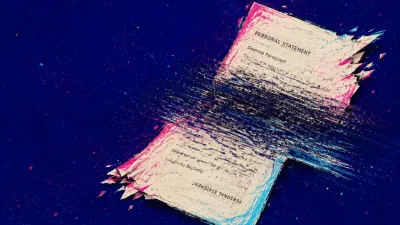
She told me the keyboard had felt warm under her palms. Her shoulders had climbed toward her ears. The second she typed 'This essay argues,' her throat tightened like someone had pressed a mute button from the inside. So she backspaced, changed it to 'It could perhaps be suggested,' and pasted in another quotation instead. By the time she looked up, the Google Doc had plenty of scholars, polished transitions, and almost no visible thesis of her own.
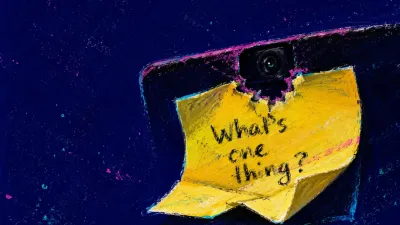
'I can explain everyone else's argument,' she said, staring at the edge of the table, 'but mine sounds fake the second I type it.'
I had heard versions of that sentence in different cities and different accents. The surface question was simple enough—why is my essay all quotes and no analysis, why do I hide my thesis in academic writing, how do I stop overquoting in essays without sounding unsupported?—but the emotional texture was not simple at all. She had already done the search-bar version of the crisis at 1 a.m., and none of it had touched the real knot. Her self-doubt wasn't abstract. It sat in her body like standing inside her own Google Doc in permanent suggestion mode, editing herself before anyone else even arrived.
I leaned in and answered her the way I always do when shame is trying to disguise itself as rigor. 'You're not lazy, and you're not under-researched. You're over-protected. Let's not force an answer tonight. Let's draw a map through the fog and see where your own voice keeps getting outsourced to authority.'
Choosing the Map: A Situation-Obstacle-Advice-Outcome Spread for Writing Clarity
I asked her to put both feet on the floor, take one slow breath, and hold the moment of the stuck sentence in mind while I shuffled. I treat that pause the way I treat any good ritual: not as theatre, but as a threshold. It helps the nervous system stop sprinting long enough for the pattern to become visible.
For her question, I chose the Situation-Obstacle-Advice-Outcome · Context Edition. This is how tarot works at its best for a problem like academic writing anxiety: not as prediction, but as a structured mirror. Her issue was psychologically concentrated rather than sprawling across every part of life, so four cards were enough. I wanted one card for the visible symptom on the page, one for the hidden authority script underneath it, one for the corrective insight, and one for the practical writing method that could make the insight usable by next week's deadline.
I told her where we would be looking. The first position would show the concrete pattern—quote blocks, over-citing, hedge words, the thesis disappearing in plain sight. The second would show the deeper blockage: the fear of being intellectually exposed and the habit of treating approved voices as safer than her own. The third would hold the turning point. The fourth would tell us what embodied practice would look like when clarity stopped being an idea and started becoming craft.
Reading the Draft That Sounds Smart but Has No Argument
Position 1: The Symptom on the Page
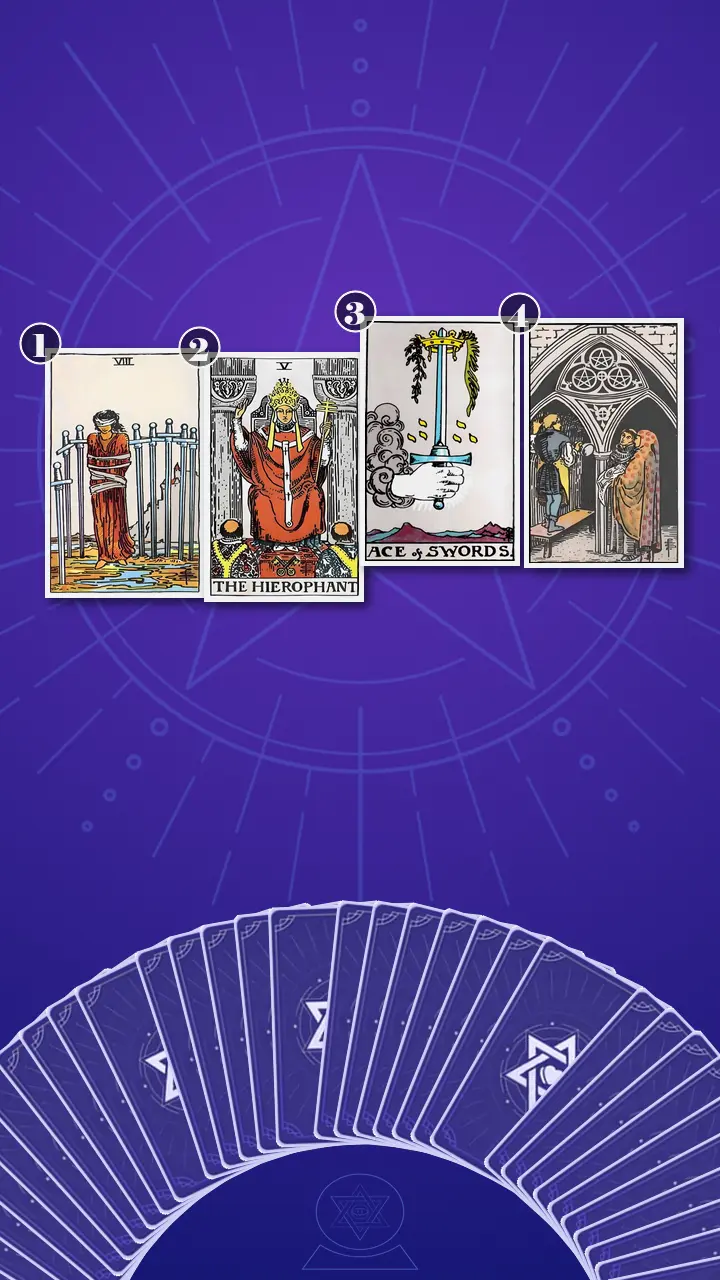
I turned over the first card. 'Now we're looking at the present symptom from the diagnosis,' I said. 'The concrete pattern of hiding a thesis inside quotations, summary, and hedging language.' The card was the Eight of Swords, upright.
I wasn't surprised. This card always makes me think of the mind under fluorescent pressure: active, sharp, and somehow unable to move. In Maya's case, it was the late-night draft where she already knew the paragraph's point, but the minute she tried to type it in her own words, she pasted in another quotation instead. The page sounded informed because it was full of safe voices, but direct language felt like standing in the open.
The energy here was blocked Air. Too much thought, not enough permission. The blindfold on the card told me she was drafting against imagined criticism rather than the actual prompt; the loose ropes told me the restriction felt absolute even though the sentence was already there. It was like having twenty-seven tabs open and still feeling like none of them gave her permission to type one honest line. I said it plainly: 'This isn't a lack of ideas. It's pre-emptive self-censorship. You're sitting in your own document in suggestion mode with yourself.'
Her reaction came fast and layered. First, a small bitter laugh. Then her fingers stopped moving on the paper cup. Then her eyes dropped as if she could already see the exact paragraph I meant. 'Okay,' she said, with a wince that was almost a smile. 'That's... accurate-rude.'
'Good,' I said softly. 'Because if it's that specific, it's not a personality flaw. It's a pattern. And patterns can be changed.'
Position 2: The Permission Slip Problem
I moved to the second card. 'Now we're looking at the deeper blockage beneath the symptom,' I told her. 'The fear of being intellectually exposed, and the way external authority gets used as protection.' The card was The Hierophant, upright.
This card can be beautiful when it represents lineage, teaching, and real scholarship. But in this position, it showed something tighter: the internal rule that says a sentence only becomes real once a recognized scholar stands beside it. In everyday terms, it was Maya opening JSTOR after getting the Canvas comment 'Strong research, but what is your argument?' and telling herself she needed one more source before she was allowed to state the argument at all.
The energy here was excess external authority and deficiency of inner authority. Citation had quietly become a blue check for her thoughts. In my Jungian work, I meet this figure often: the inner gatekeeper who sounds like wisdom but is really fear in formalwear. A little Severance-like, honestly—the institution starts sounding wiser than the self, so compliance masquerades as competence. I asked her, 'When you imagine writing the thesis plainly, what's the first uh-oh thought—being challenged, sounding simplistic, getting exposed?' She answered immediately. 'Exposed. Like someone will spot the hole right away.'
I looked at her and said the sentence her whole spread was circling: 'Citation can support your argument; it cannot replace it.'
She went very still. Her breath caught once, shallowly. Then her shoulders lowered a fraction, almost in surprise. 'Why is that uncomfortably specific?' she asked.
'Because the first two cards are telling one story,' I said. 'You know what you mean, but some part of you has decided you can't say it until someone more legitimate has already said it. You're not hiding because you're incapable. You're hiding because borrowed legitimacy feels safer than authorship.'
I let that settle, then added the line I wanted her nervous system to hear more than her intellect: 'You are not under-researched. You are over-protected.'
When the Ace of Swords Went First
Position 3: The Antidote
When I turned the third card, the room changed in the small way good readings do. Afternoon light shifted across the table and caught the white edge of the blade before I even named it. 'This position identifies the key cognitive shift needed for transformation,' I said. 'The move from borrowed legitimacy toward a clear claim in your own words.' The card was the Ace of Swords, upright.
I asked her to picture that late library hour again: the buzzing lights, the cold coffee, the blinking cursor after 'This essay argues,' the quote block underneath looking smarter than she felt. Then I showed her the Ace. One upright blade. One clear line in open space. Not a wall of swords closing in, like the first card, but a single thought willing to stand where it could be seen. If anyone asks me about Ace of Swords meaning for writing clarity and confidence, I think of this exact moment.
This is where I brought in a lens I use often, what I call Draft Paralysis Deconstruction. Perfectionism in drafting is not always devotion to quality. Very often, it is a subconscious defense mechanism designed to protect you from possible criticism. If the sentence never appears in plain language, nobody can challenge it. If the claim stays hidden behind citations, summary, and hedging, your worth never has to feel fully on the line. The defense makes total psychological sense. It also keeps the paper vague.
You do not need a wall of borrowed voices to sound legitimate; one honest sentence can cut through the fog like the Ace of Swords and give every source its proper place.
She frowned immediately. The first emotion wasn't relief. It was resistance. 'But if that's true,' she said, a little sharper now, 'doesn't that mean I've been doing it wrong this whole time?'
'No,' I said. 'It means you've been protecting yourself the only way you knew how. We don't shame the shield for being a shield. We just stop asking it to write the thesis.'
Then the insight landed in her body in three distinct waves. First, her breathing stopped for a beat and her hand hovered over the table, suspended. Second, her gaze unfocused, not blank but replaying; I could almost see Robarts returning behind her eyes, the sentence deleted, the safer sentence pasted over it, the whole overstuffed draft waiting for permission to exist. Third, the grip in her jaw gave way. Her shoulders dropped. She let out a long, shaky exhale that sounded half relieved and half startled, like clarity had created more space than she was prepared to stand inside. There was even that tiny disorienting pause I often see after a real insight—the almost-dizzy feeling of no longer being held together by the old defense.
'This feels scarier because now it sounds like me,' she whispered.
'Exactly,' I said. 'And that is different from it being weak. This is the move from quote-backed self-protection to calm ownership of a thesis-led voice. Not total certainty. Just clean self-trust in thought and language. The draft gets stronger when one honest sentence goes first.'
I gave her a practical experiment right there. 'Now, with this new perspective, think back to last week. Was there a moment when this insight would have changed how you felt?' She answered without hesitation. 'Tuesday. The first line I deleted was actually the point.'
I nodded. 'Then test the Ace, don't worship it. For ten minutes, write one paragraph without opening your sources first. Start with one plain claim, then add only one quotation that clearly sharpens it. If your body spikes into panic or blankness, stop after the claim line and save it. That still counts. You're testing a structure, not proving your worth.'
Building the Paragraph Like It Belongs to You
Position 4: The Architect Paragraph Method
The fourth card completed the line to the right. 'This position shows what integration looks like in practice,' I said. 'How to build a paragraph and a paper so evidence supports rather than replaces your voice.' The card was the Three of Pentacles, upright.
I love this card when a reading needs to come down to craft. In Maya's life, it was the moment a messy source pile turned into a blueprint. Instead of rearranging quotations like furniture in a room she hadn't defined yet, she could outline each paragraph as Claim, Evidence, Analysis and let sources function like materials inside a design she directed. The page stopped being a referendum on whether she was smart enough and started feeling like work she could actually build with her hands.
The energy here was balanced and grounded. After all that trapped Air, Earth finally arrived. Insight had somewhere to land. I pointed to the architectural plan in the card and said, 'Give every quote a job, not the lead role. Your voice is not the space between quotations. It's the structure deciding why the quotation is here at all.'
For the first time that session, she sat straighter instead of smaller. 'Okay,' she said. 'That actually feels doable. One paragraph sounds doable.'
From Borrowed Authority to a Claim-First Draft
Once all four cards were on the table, the logic became beautifully blunt. The Eight of Swords showed the symptom: a quote-heavy draft, over-citing, and thesis hedging that made the paper sound smart while the argument disappeared. The Hierophant showed the hidden driver: a learned belief that authority lives outside her first, so scholarship becomes a permission slip rather than support. The Ace of Swords broke that loop with claim-first drafting: one honest sentence before the evidence. And the Three of Pentacles translated insight into method, so the page could move from panic to structure. She had been building a paper out of other people's bricks while never stepping into the frame herself.
It is one reason I return to a Situation-Obstacle-Advice-Outcome tarot spread for writing clarity and academic voice when someone feels stuck like this: the cards separate symptom from fear, fear from guidance, guidance from method. That separation matters. Once the shame stops feeling like one giant cloud, it becomes workable.
The blind spot, I told her, was not that she lacked intelligence. It was that she had fused academic critique with self-worth. A reader challenging a sentence had started to feel like a reader exposing her value as thin. That is where my Performance Anxiety Decoupling lens matters most: feedback on a claim is information about craft, not a verdict on the person who wrote it. Her transformation direction was clear—away from using quotations to earn permission to speak, and toward using sources to support, test, and sharpen a claim that was already hers.
So I gave her next steps that were small enough to survive a real student week, not just sound good inside a reading.
- The Inner-Critic Mute ProtocolBefore you open JSTOR, Google Scholar, or Zotero—whether you're in a Robarts cubicle, at your kitchen table, or squeezing in a draft between shifts—set a two-minute timer, drop your shoulders, and say: 'This is a draft, not a verdict.' Then type, 'My actual claim in one sentence is:' and finish it in plain language with no citation attached.If the first thought is 'This sounds too simple,' treat that as the old safety loop, not a reliable editor. Stop at five minutes if you need to.
- The Top-of-Doc Sword LinePut that sentence at the top of your draft in bold or in a comment bubble before you reopen your notes. Read it out loud once—quietly at your desk, into a voice memo, or while walking between stacks—and circle the part that feels most true.You are not locking in a final thesis. You are giving the paper a destination so every source has to answer to it.
- The Architect Paragraph MethodChoose one paragraph in Google Docs and label each line Claim / Evidence / Analysis. After every quotation, add two sentences that begin with 'This matters because...' and 'What I want you to notice is...' If a quote cannot support the claim clearly, move it to a cut section instead of forcing it to stay.Do this on one paragraph only. Structure is a tool, not a purity test, and one load-bearing paragraph is enough to start finding clarity.
None of this asked her to become fearless overnight. It asked her to become visible in smaller increments. That's a very different thing.
A Week Later: The Quiet Proof
A week later, I got a message from her while I was finishing notes between sessions. It was short, which is often how real change arrives. 'I wrote the real thesis first,' she said. 'Then I only kept the quotes that actually helped it. It still felt scary, but the paragraph finally sounded like it belonged to me.'
She added one more line that I loved because it was so ordinary and so exact: she had labeled a single paragraph Claim / Evidence / Analysis, moved two beautiful-but-useless quotations into a parking-lot section, and stopped asking whether the paragraph sounded smart enough before asking whether it knew what it was trying to prove.
That was the whole Journey to Clarity, really. Not certainty. Not a magically perfect paper. Just the first real step from self-protection on the page toward calm ownership of her academic voice. Tarot gave us a map, but she was the one who chose to write the sentence and let it stand.
She slept a full night after the outline clicked, but when she woke her first thought was, 'What if it's too simple?' This time, she smiled and left the sentence standing.
There is a very particular exhaustion in knowing what you mean, feeling your body tense the moment you type it plainly, and then hiding inside someone else's sentence so nobody can decide whether your own was enough. If that exhaustion lives anywhere in you, I hope you remember that noticing the protection is already the beginning of clarity.
If one sentence got to go first—before the quotations, before the approval-check, before the polishing—what might you let it say?
Every reading at AceTarot is a Journey to connect with inner wisdom and empower next step.
Learn more about our Journey to Clarity.