At the Meetup Sign-In Table, Help Felt Safer Until One Real Exchange

The Sign-In Table That Felt Safer Than Being Seen
If you are a 20-something creative in Toronto who can walk a team through a Figma file but still arrive early to a meetup so you do not have to break into active conversations, I know this pattern well. Jordan (name changed for privacy), a 27-year-old junior product designer, came to me with a question I hear in many forms: why do I always end up helping at meetups instead of joining in?
She had come straight from a hybrid workday, the mental residue of Figma tabs still open somewhere in the back of her mind, and she described the scene so clearly I could feel it: 6:52 p.m. in a Queen West coworking loft, sticky name tags curling at the edges, a sign-in iPad glowing on a folding table, the espresso machine hissing in the back, fluorescent lights buzzing hard enough to feel in the jaw. Cold air kept sliding in each time the door opened. Before her coat was even fully off, her hands were already smoothing labels and straightening the table.
‘I always end up finding something to do,’ she told me. ‘If I’m helping, I don’t have to figure out how to enter.’
I could hear the real split underneath it immediately: she wanted to join in at meetups, but the second the room became socially ambiguous, helping felt safer than being visible. Her self-consciousness had the texture of wearing a neon vest under her skin—hidden from other people, maybe, but impossible not to feel. Helping can be generous. It can also be camouflage.
I answered the way I always do when someone is honest enough to bring me a pattern like this. ‘Nothing about this is silly. It sounds like a smart defense that now costs more than it protects. Let’s make a map of the fog, so you stop leaving busy, not connected, and start finding clarity in those first ten minutes.’

Choosing the Compass: The Shadow Spread
I asked Jordan to take one slow breath and hold the question in plain language: not how do I become instantly confident, but why does being useful feel safer than joining a conversation? Then I shuffled. For me, that opening moment is not theater. It is a focus reset—a clean handoff from spiraling thought into honest pattern recognition.
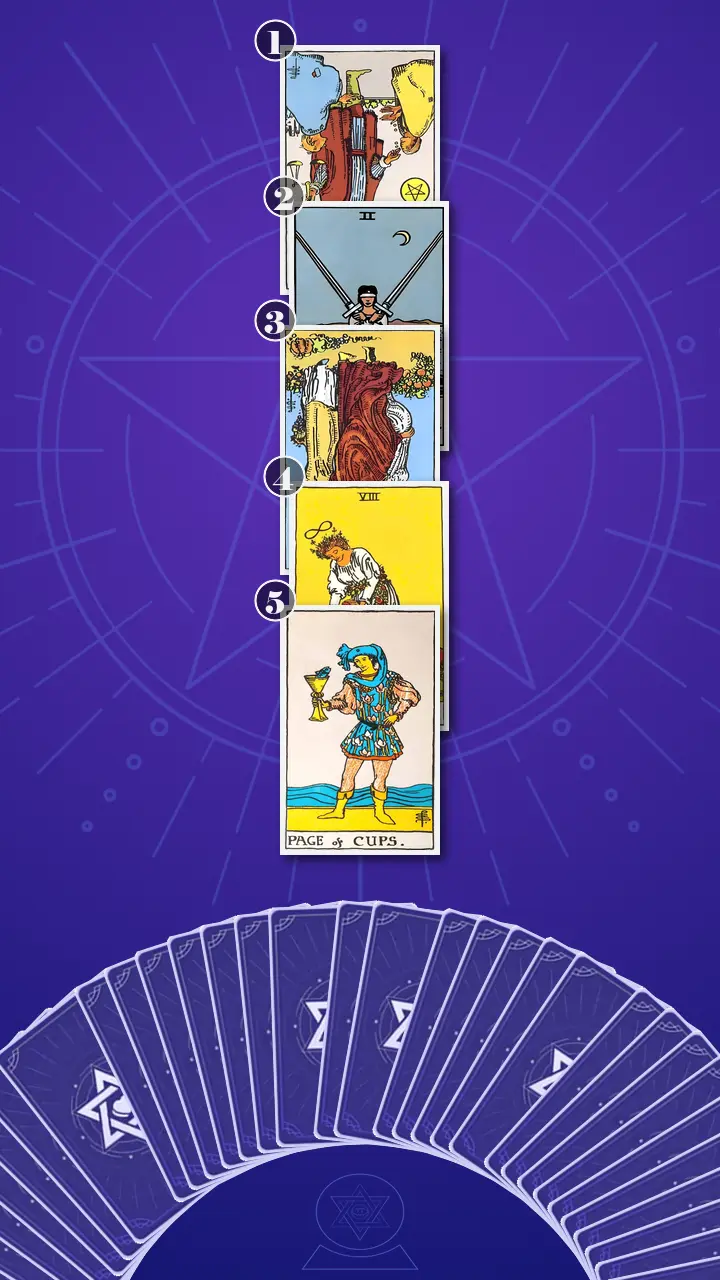
For this reading, I used a five-card Shadow Spread. When people ask me how tarot works in a situation like this, my answer is simple: I am not using the cards to predict whether strangers will like you. I am using them to reveal the visible behavior, the hidden fear underneath it, the emotional cost of that defense, the inner quality that can loosen it, and the next practical move.
A smaller spread would have flattened Jordan’s question into vague advice about confidence. A bigger one would have overcomplicated a defense loop that was actually very precise. The Shadow Spread gave us exactly what we needed: the helper role on the surface, the stalemate underneath it, the cost of staying defended, the antidote, and one realistic experiment for re-entering the room as a participant. I laid the five cards in a straight line between us, like a staircase down into the habit and back out through a door.
I told her what I tell readers too: the first card would show the coping move everyone can see, the middle cards would explain why it keeps repeating, and the final two would show how to shift from social armor into real contact without pretending awkwardness does not exist.
Reading the Cards of Busy, Not Connected
Position 1: The Sign-In Sheet as a Scale
Now I turned the card that shows the concrete social behavior described in the issue: stepping into logistical help at meetups instead of entering the group as a participant.
The Six of Pentacles, reversed.
In modern life terms, this was Jordan spotting the check-in flow before she spotted an actual social opening. The room went a little The Bear-coded; the second the energy felt socially chaotic, she slipped into service mode. She handled name tags, pointed people toward the room, straightened the snack table, maybe offered to take photos. From the outside, it looked thoughtful. Inside, it was a fast trade: task for uncertainty, usefulness for exposure.
Reversed, the energy was imbalanced. Too much giving, not enough receiving. The scales in the card became, in my mind, the sign-in sheet itself—a tidy little system for measuring whether she had earned the right to stay. My old Wall Street instincts still notice imbalance fast. When effort keeps going out and the return never compounds, I do not call that generosity alone; I call it a pattern. Jordan was entering the room as unofficial staff in a place she had actually come to join as a peer.
When I said that, she gave a short laugh with a wince. ‘That’s brutally accurate.’ Her fingers pinched the paper sleeve on her coffee cup, then let it go.
Position 2: The Freeze Behind the Helpful Smile
Next I turned the card representing the hidden fear and inner stalemate underneath the pattern: the tension between wanting to join in and needing a safer, scripted role.
The Two of Swords, upright.
This is the threshold freeze. I told her I could see the exact moment: standing near sparkling water and paper cups, mentally drafting five possible openers, rejecting all of them, then noticing someone struggling with extra chairs and moving toward that instead. The crossed swords over the heart translated perfectly here into overthinking as heart-protection. If her hands were full, nobody could clock that she did not know where to stand.
Upright in this position, the energy is blocked rather than absent. She does want connection. She is not cold. She is split. One part of her wants to walk toward the pair laughing by the windows; another part would rather be unreadable than risk interrupting. It reminded me, honestly, of Severance—the competent task-self ready to work while the human self stays behind the glass.
I asked, ‘Think about the first five seconds before you volunteer. What happens in your body first?’ She exhaled sharply. ‘Shoulders up. Jaw tight. Stomach drop. Then my hands start looking for a job.’ That answer landed between us with the force of recognition.
Position 3: In the Group Photo, Not in the Group Chat
The third card showed what this strategy blocks in real life: mutual belonging, group joy, and being personally known rather than merely appreciated.
The Three of Cups, reversed.
I told Jordan this card always hurts a little in readings like this because the celebration is still there. The raised cups, the shared rhythm, the easy circle—nothing is fully missing except access. In her life, that became the TTC ride home: warm coat still smelling like venue pizza, feet aching, phone bright with event Stories, and that flat thought pulsing underneath it all—I was there, so why do I feel like I missed it?
Reversed, the energy is blocked Water. Community is present but not metabolized. She helps create the vibe for other people and gets none of the afterglow. You can be busy all night and still leave socially untouched.
Jordan looked down at the table for a long moment. Her throat moved before she said anything. ‘That part makes me kind of sad,’ she said quietly. ‘People are grateful to me. They just don’t know me.’
When Strength Spoke in the Fluorescent Light
Position 4: The Antidote Is Not More Technique
Then I turned the card in the fourth position—the one that names the transforming quality needed to loosen the defense: self-trust and embodied courage while feeling socially exposed.
Strength, upright.
The room changed when this card landed. A band of late light from the window caught the gold in the image, and even the air seemed warmer for a second. Strength does not ask for fake confidence. It asks for regulated warmth. The lion is not a character flaw; it is the hot rush in the chest, the restless hands, the small urge to flee into a task the second awkwardness buzzes.
You know that moment when you get to the venue early, find the name tags before you find a person, and feel immediate relief because now your hands have something to do while the room fills up behind you? That is the hinge. Belonging starts a beat earlier than usefulness. The trap is not that you help. It is that you use helping to skip the exposed, human moment where belonging actually begins.
You do not need a clipboard to deserve the room; let Strength calm the lion of awkwardness and step into the circle as yourself.
I have a blunt name for the next layer of this, inherited from my finance years: Network ROI Analytics. Not because people are transactions, but because misallocated social energy can leave you starving in a crowded room. Jordan was making high-effort deposits into logistics and getting gratitude back, but not the return she actually wanted—reciprocity, warmth, remembrance. Strength was not asking her to become louder. It was asking her to stop confusing appreciation for belonging.
Jordan went through it in three visible waves. First, she froze—breath suspended, fingertips hovering over the card as if not to smudge it. Then her gaze went slightly unfocused, like she had been dropped back into a Thursday night with sticky labels, cold air at the door, and one almost-conversation abandoned for check-in. Then the emotion came sideways. She gave a small, irritated laugh and said, ‘But if that’s true, doesn’t it mean I’ve been doing this wrong the whole time?’
‘No,’ I said. ‘It means you built an intelligent workaround for a moment that felt too exposed. We’re not shaming the strategy. We’re updating it.’ Her eyes brightened at that—more sting than tears. I watched her shoulders come down a full inch, then stay there. The relief had a second edge to it, the slight blankness people feel when a burden loosens and they realize the next move is theirs. I asked, ‘Now, with this new angle, think back to last week. Was there a moment when one extra breath, one softer jaw, one hand staying on your own bag instead of a task, would have changed the night?’ She nodded slowly. ‘Yeah,’ she said. ‘Right before I offered to do check-in.’
That was the real crossing in front of me: from self-conscious contraction and measured belonging to embodied self-trust and real social contact. Not fearless. Just present enough to be seen.
Position 5: The First-Draft Conversation
Finally, I turned the card that translates insight into one grounded experiment for attending a meetup as a participant before becoming useful.
The Page of Cups, upright.
I smiled. After heavy Earth, defensive Air, blocked Water, and then the warming Fire of Strength, here came the gentlest possible next move. In modern life, this is Jordan asking one low-stakes question—Have you been to this one before? What brought you out tonight?—and then offering one plain, human detail about herself instead of snapping back into helper mode. The fish rising from the cup is exactly what real social contact feels like here: slightly odd, slightly unplanned, and alive because of it.
Upright, the energy is balanced but intentionally small. This is beginner energy, not polished performance. One breath. One glance up. One genuine question. Before I prove I am useful, I can prove I am here. Jordan gave me the first unguarded smile of the session. ‘That,’ she said, ‘I can actually try.’
From Social Armor to Participant-First Entry
When I pulled the whole line together for her, the story became clean. Six of Pentacles reversed showed the visible bargain—service in exchange for safety. Two of Swords showed the freeze underneath it. Three of Cups reversed named the grief: she was helping create belonging without receiving it. Strength showed the antidote—staying warm in her body long enough to remain visible. Page of Cups gave the re-entry move: one real exchange before any job.
I also pointed out something I never ignore: four of the five cards were Minor Arcana, and only Strength was Major. To me, that said habit, not destiny. This was not a personality verdict. It was an ordinary loop with one decisive hinge.
The blind spot was not that Jordan was too kind or too helpful. It was that she had been treating usefulness as her bridge to connection when, in practice, it was often her cleanest exit from being seen. The direction of change was simple and hard at the same time: visible participation before volunteering. The goal is not to stop helping. It is to stop using help as social armor.
Because I like advice that survives real life, I translated that into a compact version of my Social Divestment Plan: no drama, no personality transplant—just a calm reallocation of energy away from unpaid staff mode and back toward actual contact.
- The 10-Minute Participant-First Window Before your next meetup, put a note in your phone that says participant first for 10 minutes. When you arrive, keep your bag, coat, or drink in your own hands and do not ask what needs doing until the timer ends. If someone asks for help immediately, try: I can help in about 10 minutes once I settle in. If 10 minutes feels impossible, start with 3. Delayed help is not refusal.
- Warm-Body Open-Hands Reset Right before you enter—on the sidewalk, in the lift, or in the washroom—take three slow exhales, feel both feet on the floor, and name one sound, one temperature, and one color in the room. If your hands start hunting for a task, keep one hand on your cup, tote strap, or jacket sleeve and silently say: I can be here without a job. If body-based exercises feel cheesy, do the 90-second version in private. One breath still counts.
- The One Real Exchange Rule Use one low-stakes opener—Have you been to this one before? What brought you out tonight? I liked your point about that talk.—then offer one plain detail about yourself and stay in the conversation for one extra beat after the first awkward pause. Minimum viable success is one question and one follow-up. You do not owe the room charisma.
These steps are intentionally small. Small is what lets a nervous system learn that awkward does not equal unwelcome.

A Week Later: The Quiet Proof
A week later, Jordan sent me a message after another meetup downtown. On the TTC ride over, she had put a note in her phone: participant first for 10 minutes. When the organizer asked if anyone could help with check-in, she heard herself say, ‘I can help in about ten minutes once I settle in.’ Then she stood by the drinks tub, kept both hands on her own can, and asked the woman beside her, ‘Have you been to this one before?’ They ended up talking about hybrid design jobs, bad office lighting, and the fake-neutral tone of Figma comments.
She did help later. That part never had to disappear. But this time it was a choice, not a hiding place. She left with one new contact and a different feeling in her body—less like she had just finished shift work, more like she had actually been inside the room.
The next morning her first thought was still, What if I sounded awkward? Then she laughed, made coffee, and sent the follow-up message anyway.
That is what a real Journey to Clarity usually looks like when I witness it. Not a personality overhaul. Not a magical cure. Just a steadier inner algorithm: from earning belonging to tolerating visibility, from busy hands to open hands, from self-conscious contraction to one real exchange.
When a room matters to you more than you want to admit, busy hands can feel safer than letting anyone see you standing there hoping to belong.
So if the name tags, the sign-in iPad, or the cleanup stack keep calling to you like rescue, what might one participant-first moment look like before you reach for the clipboard?
Every reading at AceTarot is a Journey to connect with inner wisdom and empower next step.
Learn more about our Journey to Clarity.