Group Chat Guilt at 6:42 p.m., Then the First Honest Not Tonight

Group Chat Guilt at 6:42 p.m.
When Maya (name changed for privacy) sat across from me, I recognized the pattern immediately: the late-20s city-professional panic reply at 6:40 p.m., because saying no feels socially risky. She was twenty-seven, a marketing coordinator in Toronto, and by the time she found me she was exhausted by a very modern loop of people-pleasing with friends: saying yes when exhausted, then dreading the plan in private.
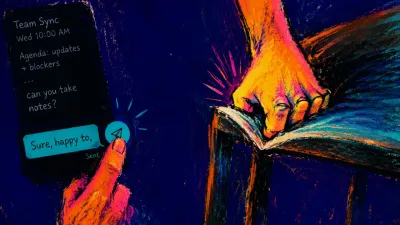
She gave me the scene that had finally pushed her to book the reading. Thursday, 6:42 p.m. She was still half in office clothes on the edge of her bed, cold takeout open beside her, the fridge humming into the too-quiet apartment, Slack still mentally buzzing somewhere behind her eyes. The group chat lit up with dinner plans. Her phone screen felt hot in her palm. Her throat tightened, her shoulders stayed lifted, and before she checked her calendar, her body, or her actual desire, her thumb had already sent an upbeat yes.
Ten minutes later, she told me, she was no longer thinking about dinner. She was calculating transit, wondering if she could leave early, and secretly hoping someone else would cancel first. “I know I’m tired,” she said, rubbing one temple, “but I don’t want to be the one killing the vibe.” That was the whole contradiction in one sentence: she wanted to protect her energy and answer honestly, but she was equally afraid that one no would disappoint the group and slowly move her toward the edge of it.
What she called guilt felt, to me, more like trying to read road signs inside a snowstorm of imagined reactions. Loud. Blurry. Urgent. Completely out of proportion to the simple act of replying to a text. Group chat guilt can do that. It can turn one casual ping into something that feels like a performance review for your likability.
I kept my voice warm. “You are not bad at friendship,” I told her. “You are replying faster than you are checking in. So let’s slow the pattern down and make a map. We are not here to predict doom. We’re here to find clarity before the next invite gets to decide too much for you.”

Choosing the Map: A Relationship Spread for Group Chat Anxiety
I asked her to put both feet on the floor, take one slow breath, and hold the question in plain language: how do I stop saying yes in the group chat when I’m already drained? Then I shuffled slowly, not as theater, but as a way to help both of us move from reaction into observation.
For this reading, I used the Relationship Spread · Context Edition. When people ask me how tarot works in situations like friendship boundaries, my answer is simple: I use card meanings in context. This was not really a scheduling problem about calendars or being “better organized.” It was a relational pattern moving through self, the social field, a hidden belonging fear, the inner bridge, and the voice that would need to speak differently next time.
I chose this spread because it is the smallest structure that still tells the whole story: Maya’s current behavior, what the group chat emotionally represents, the deeper wound turning one casual invite into a test, the boundary medicine she needs, and the clearest next relational move. For questions like how to say no to plans without guilt, I trust this layout because it follows the whole chain instead of fixating on one symptom.
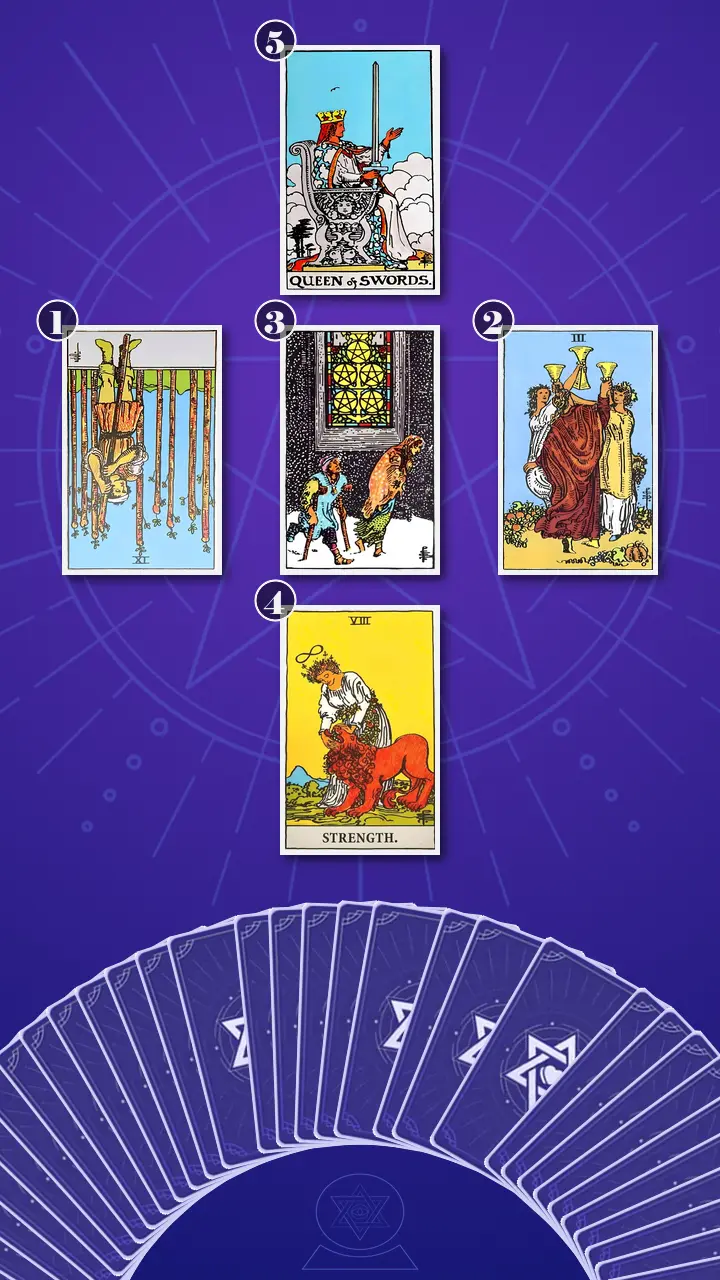
As I laid the cards into a cross, I told her what I would be watching for. The first position would show the visible pattern. The center card would reveal the emotional pressure point underneath it. The fourth position below the center would act as the bridge: the inner capacity that could interrupt the reflex. And the card above would tell us what her boundary voice needed to sound like in real life.
Reading the Bright Chat and the Private Winter
Position 1: The Yes Sent from Low Battery Mode
Now turned over was the card representing the observable pattern of agreeing while depleted and overriding body limits. It was the Nine of Wands, reversed.
I told Maya this card was almost painfully literal. In modern life, it looks like being fried from a client-heavy day, still mentally wearing your work face, when the group chat proposes a spontaneous plan. Instead of checking your calendar, your body, or your desire, you send a cheerful yes from pure overextension. Later you keep reopening the thread, not because you are excited, but because you are bracing for the evening you just committed yourself to.
Energetically, this reversal showed blocked fire: not a lack of care, but a depleted system still trying to perform availability. The bandaged figure in the card was her with her shoulders near her ears, running on Apple low battery mode and still spending her last ten percent on keeping the mood easy for everyone else.
Her reaction came in three quick beats. First her breath caught. Then her eyes drifted down toward her cup as if she were replaying Thursday in real time. Then she gave a short laugh with a bitter edge. “Okay,” she said, “that’s accurate. Also a little rude.”
I smiled. “Only because it’s exact. This card says your body is telling the truth before your text does.” I asked her what her body had known in the first ten seconds that her message did not say. “That I wanted my couch,” she said instantly. Exactly.
Position 2: The Warmth of Being in the Mix
Next came the card representing what the group chat itself stands for emotionally: warmth, inclusion, spontaneity, social momentum. It was the Three of Cups, upright.
This mattered. I never like flattening a reading like this into “your friends are the problem.” The chat is genuinely fun. The jokes fly, somebody drops a meme, the plan sounds easy, and for a second you can almost feel the warmth of being wanted before you have even left your apartment. This is balanced water: real connection, real pleasure, real belonging energy.
I pointed to the raised cups and the shared circle of the dancers. “This is why the ping feels loaded,” I said. “You are not only reacting to the plan itself. You are reacting to the feeling of being in the mix.” She nodded immediately. Her friends were good people. That made the pattern harder, not easier, because the pull was not fake.
Position 3: The Story That Turns One Invite into Emotional Winter
At the center of the cross sat the emotional pressure point of the whole reading. The card was the Five of Pentacles, upright.
Here the split-screen became obvious to me. On one side: the bright chat, the quick jokes, rooftop-drinks energy, everyone sounding effortlessly spontaneous on Instagram Stories and in the thread. On the other: Maya alone in her apartment with cold takeout, or standing on a TTC platform with train brakes screeching in, stomach dropping because one simple drinks? message had somehow become a referendum on whether she still counted. This card names scarcity earth, the inner winter story that says: if I say no again, they will notice.
Through my Jungian lens, I use something I call Group Archetype Decoding. I look for the role the social ecosystem quietly rewards. In Maya’s case, the group had started to know her as The Easy One: warm, fast to reply, low-friction, always game enough. The problem was not that her friends consciously demanded a mask. The problem was that she had learned to protect belonging by wearing one. The moment she imagined saying no, she wasn’t just declining dinner. She was risking the role.
She winced before she nodded. “I keep acting like every invite is a popularity exam,” she said. There it was. Not every ping is a belonging exam, but her nervous system had been reading it that way for so long that the distinction had blurred.
I named the blockage plainly: an exhausted body plus an exclusion story. When depletion meets belonging fear, even a normal pause before replying can feel unbearable.
When Strength Held the Lion
Position 4: The Bridge Between Guilt and Choice
When I turned over the fourth card, the room changed. Even the fridge hum from the kitchen seemed to recede in my mind. This was the bridge card, the turning point of the whole spread: the inner capacity needed to tolerate guilt and choose without self-betrayal. The card was Strength, upright.
I described the exact moment her body knew too well: the invite landing while she was already tired, her body saying not tonight, and her mind still treating the pause before replying like social danger. Strength was not asking her to become tougher, colder, or less caring. It was showing regulated fire: courage held softly, like a yellow light instead of a command to floor it.
You know that exact moment: the invite lands while you are already tired, your body says not tonight, and your brain still treats the pause before replying like social danger. Maya nodded so fast it was almost a flinch.
Stop treating discomfort like a command to say yes; hold it the way Strength holds the lion, and let your honest answer come after the roar passes.
I let the sentence sit between us for a beat. Then I added the truth underneath it. “The boundary doesn’t begin when you type no. It begins when you stop treating guilt like proof that you’ve done something wrong.”
Her reaction came in layers. First she went still, almost frozen, with her fingers hovering over the edge of her phone. Then her focus loosened, her eyes going slightly unfixed as if last Friday on the platform were replaying frame by frame behind them. Then the feeling came out sideways, not as instant relief but as a flash of anger. “But if that’s true,” she said, voice thin at first, “then I’ve been letting guilt run my whole social life.” She pressed the warm side of the phone deeper into her palm, jaw tight, then slowly unclenched it. One shoulder dropped, then the other. Her eyes brightened with the kind of tears that come from recognition more than sadness. Having lived across cultures, I know how exhausting it is to keep offering the right version of yourself to every room. What I call Persona Fatigue Diagnosis was all over this card. Maya was not only tired from work. She was drained from maintaining the cheerful, easy, available persona long after her real energy had left the building. Strength showed her that the lion was not meanness. It was the body’s honest roar.
“Now,” I asked gently, “with that lens, can you think of one moment last week when this would have changed how you felt?”
She exhaled long through her nose. “Friday. On the platform. I could’ve just waited. I didn’t need to solve their reaction before I knew my answer.”
That was the actual crossing. Not from rude to nice. From guilt-driven overcommitting to honest, capacity-based connection. Guilt is not proof. It is just the feeling that shows up when a new boundary meets an old belonging fear.
I asked her to make the turning point concrete right there, while the card was still on the table. Within the next ten minutes, she opened her Notes app and saved one line: Let me check my energy and get back to you. Then I asked her to say it out loud once. When she did, the sentence sounded almost boring. I loved that. Real change often does.
The Sentence That Didn’t Need a Backstory
Position 5: The Boundary Voice
The final card, representing the clearest next direction and the voice of the boundary itself, was the Queen of Swords, upright.
In real life, this card looks almost anti-climactic, which is exactly why it works. One clean text message: Not tonight, I need a quiet evening. No five-paragraph essay. No pre-emptive defense case. No vague future promises she hasn’t actually checked capacity for. This is balanced air: clear thinking translated into speech.
She felt the old reflex push back immediately. “But concise sounds cold,” she said. Her thumb hovered over her locked screen again, as if even imagining the sentence made her want to add three smileys and a full backstory.
“Only if you believe warmth has to be earned through self-erasure,” I said. “A clean no protects more connection than a resentful yes.” The Queen’s upright sword and open hand say the same thing together: clear and kind are not opposites. Kind does not have to mean endlessly available.
I asked her to imagine the message on screen the way a marketer would look at a headline. If the truth is buried in the body copy, nobody actually receives it. She laughed at that, softer this time. The clean sentence landed in her body like something she could actually use.
From Belonging Panic to a Boundary-First Reply
When I gathered the whole spread back into one story, it became very clear. Maya’s pattern was not random flakiness, and it was not proof that she was bad at friendship. It was a chain. She started from depletion and kept answering from a social mask. The group field offered real warmth, which made the pull genuine. Underneath that sat an old scarcity story: if she was not easy, maybe she would become less included. So every invite arrived like an algorithm she feared would stop surfacing her if she did not engage fast enough. The blind spot was not her wording. It was the way she kept treating guilt like a verdict and the chat like a performance review for her belonging.
I told her the transformation direction was simple, though not always easy: move from treating every invitation as a test of belonging to treating it as a choice that deserves a capacity check. Feel the fear. Steady the body. Send the sentence. That is how this Relationship Spread · Context Edition turns insight into actionable advice.
She frowned a little. “But plans move fast. If I wait ten minutes, it looks weird.”
“Only to the part of you that still thinks immediate access is the price of being loved,” I said. “Do Not Disturb can be on without you becoming a bad friend. We are not trying to feel zero discomfort. We are trying to let the real you answer instead of the mask.”
- Mask Detachment PauseThe next time a social invite lands in the group chat after work, on the TTC ride home, or while you are already on the couch, use my Mask Detachment Protocol: send the holding line “Let me check my energy and I’ll confirm in a bit,” then mute the thread, place your phone face down, and set a 10-minute timer before you decide.If 10 minutes spikes your anxiety, shorten it to 3. A delayed reply is not a rude reply.
- The 90-Second Strength SequenceBefore you type anything else, exhale longer than you inhale for three breaths, drop your shoulders, keep both feet on the floor, and name the feeling plainly: “This is guilt, not a command.” Stay with the body reaction for 60 to 90 seconds before deciding.If a hand on your chest feels awkward, just unclench your jaw and feel your feet. The goal is space, not instant calm.
- The Pinned Queen ScriptBuild a tiny Notes app list with three one-sentence boundary texts: “Not tonight, I need a quiet evening.” / “I’m wiped, so I’m sitting this one out.” / “I can’t tonight, but hope you all have fun.” The next time you want to say no, send one exactly as written with no extra paragraph.If the full group feels too exposed, practice first in a one-to-one chat or with a lower-stakes plan.
Those steps are small on purpose. I was not trying to help her become a different personality overnight. I was helping her build a boundary practice that could survive real life: tired eyes, warm phone, fast-moving chat, old fear.

A Week Later, the Quiet Proof
A week later, she sent me a short message. A Thursday plan had popped up while she was still in work clothes, and she felt the usual spike. This time she used the holding line, put the phone face down, did the longer exhale, and chose the simplest script: Not tonight, I need a quiet evening. Then she ate her dinner while it was still warm.
The old thought still showed up the next morning—what if they think I’m distant?—but it no longer sounded like truth. It sounded like an old notification she did not have to tap. That was enough. Not perfection. Just proof.
I love that about a good tarot reading for friendship boundaries. It does not hand my clients a magical answer. It gives them their leverage back. In Maya’s case, the shift was from panic-replying to choosing, from resentful yes to honest no, from belonging anxiety in group chats to steadier self-trust.
When a simple group chat invite lands in a tired body like a test of whether you still matter, even a small not tonight can feel bigger than it should. If the next invite didn’t get to decide whether you belong, what would your most honest one-sentence reply sound like once the lion stopped roaring?
Every reading at AceTarot is a Journey to connect with inner wisdom and empower next step.
Learn more about our Journey to Clarity.