Stuck in Self-Improvement Shopping—and Starting With What You Own

Shopping for a Reset at 9:18 p.m.
I hear some version of the same confession all the time: if you’re a late-20s office worker in a pricey city apartment and the Sunday Scaries keep turning into five open tabs for planners, magnesium, and storage bins, you’re probably not looking at a simple organization problem. You’re in the exact loop of shopping for self-improvement instead of practicing one small habit with what is already available.
When Maya (name changed for privacy), a 27-year-old marketing coordinator, appeared on my screen from her downtown Toronto apartment, it was 9:18 p.m. there. She was at a tiny kitchen table with Amazon, TikTok Sunday-reset clips, and a Notes checklist open at the same time. The smell of dryer sheets from the laundry chair mixed with leftover takeout, the condo HVAC hummed under a too-white overhead light, and her phone had gone warm in her palm from all the scrolling.
‘The cart feels like progress, even when nothing has actually changed,’ she told me. Behind her sat the real cast of the week: unopened mail, half-used notebooks, beauty products, her work laptop. In her browser were magnesium glycinate, an undated planner, clear bins, and cable organizers. Across the room, the actual task—sorting the mail, replying to the email, choosing tomorrow’s top priority—was still sitting there untouched.
What she wanted was simple and painfully human: a reset. What had her stuck was the quieter belief underneath it—that the reset had to be bought before it could begin. Shopping gives you the feeling of change without the friction of change. A cart can look like progress when beginner mode feels exposing.
I could see overwhelm in the way her jaw held on after each sentence, as if her whole nervous system were trying to bite down on the week. It felt less like being disorganized and more like carbonated static trapped inside her ribs. I told her, gently, that none of this made her lazy or unserious. ‘Let’s make a map out of the fog,’ I said. ‘That’s what this reading is for—a real journey to clarity, not a prettier fantasy of it.’

Choosing the Short Runway: A Four-Card Tarot Spread for Overwhelm
I asked her to put both feet on the floor and focus on one exact question: ‘What am I trying to buy my way out of tonight?’ Then I shuffled slowly, not as theatre, but as a way of helping the mind stop ricocheting between tabs.
For her, I chose the Situation-Obstacle-Advice-Outcome · Context Edition. When people ask me how tarot works for something as modern as a cart full of vitamins and organizers, this is one of my clearest answers: I use the fewest cards that still show the whole mechanism. Her problem was a tight loop—one visible symptom, one core block, one essential shift, and one grounded next step—so a four-card spread fit better than a sprawling Celtic Cross that might only give her more to optimize.
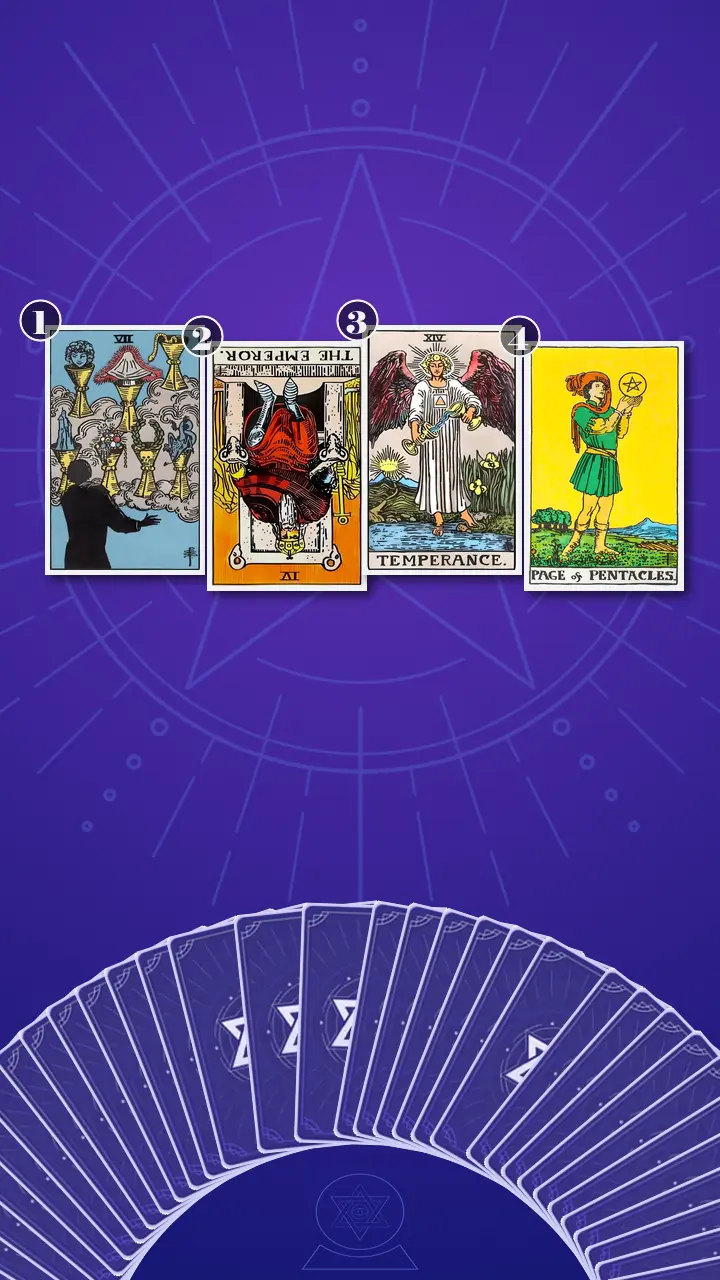
I laid the cards left to right like a short runway. The first card would show the symptom she could already see: the cart, the tabs, the fantasy selves. The second would reveal the control wound beneath it. The third—the hinge of the reading—would show the medicine. And the fourth would stay practical, not predictive: what change looks like once it is embodied instead of purchased.
Reading the Left Side of the Runway
Position 1: The Menu of Future Selves
Now I turned over the card representing the visible symptom from the diagnosis: turning a desire for change into a cart full of products and possibilities. It was the Seven of Cups, upright.
I smiled a little, because the image was almost too exact. In modern life, this card is the late-night Amazon cart as a cloud of alternate selves—sleep-better girl, inbox-zero girl, meal-prep girl, finally-consistent girl. The cart is not just products; it is a menu of future identities. It carries the exact energy of a TikTok Sunday reset montage where every bottle, bin, and planner looks like a portal into a different life.
In tarot terms, this is excess water: imagination everywhere, nothing yet on the floor. The floating cups are her browser tabs and Saved for Later list—visible possibilities with no weight, no friction, no proof. That is why the research can feel so productive while the unopened mail keeps sitting there. The mind is busy, but it is busy in the clouds.
I asked her, ‘The last time you filled a cart like that, what real-life problem was sitting two feet away from you?’ She let out a short laugh with a sting in it and said, ‘That’s almost rude.’ Then she glanced over her shoulder at the pile on the table and rubbed the edge of her thumbnail. The recognition landed; the defense had started to soften.
Position 2: The Plan That Turns Into a Verdict
I turned to the card showing the main psychological blockage: the fear-driven need to control uncertainty through external structure. The Emperor appeared reversed.
‘There it is,’ I said. ‘Not a lack of discipline. A relationship with structure that has gotten hard and scared.’ In real life, The Emperor reversed looks like building a hyper-detailed Monday routine in Notes or Notion to feel safe, then having one client fire drill, one late wake-up, or one Slack ping turn the whole structure into evidence against you. It is less about the planner itself than about borrowing authority from a system because your own steadiness does not feel trustworthy yet.
The imagery matters here: stone throne, armor under the robe, barren mountains. This is fire energy distorted into control—too rigid to adapt, too brittle to hold. I often explain this card with an astronomy image from my other life. A telescope mount has to be stable, yes, but if I lock it too tightly, it stops tracking the sky. Structure is supposed to help you follow motion, not punish you for the existence of motion. The Emperor reversed is that overbuilt Notion dashboard that breaks the second real life gets messy.
Maya winced before I even finished. ‘That’s exactly it,’ she said. ‘I make this perfect Monday version of me, and by 10:15 I’ve already failed her.’ Her shoulders lifted toward her ears; then she caught herself doing it and exhaled. For a second, her eyes had that Severance look people get when they wish their polished work self and their apartment self could live on different floors of consciousness. I told her, ‘This card isn’t calling you chaotic. It’s showing me that your routines have been acting like judges instead of support.’
When Temperance Poured Between Two Cups
Position 3: The 10 Percent Reset
When I reached the third card, the room changed. On my screen, the harsh overhead light in her kitchen caught the rim of a plain water glass, and for a moment everything felt very still, as if even the HVAC hum had stepped back. This was the card representing the key transformation: moving from all-or-nothing reinvention toward balanced, sustainable self-regulation. It was Temperance, upright—the core of the whole reading.
Before I spoke, I asked her to try what I call Pulsar Breathing, one of my favorite ways to sync a body back to rhythm: inhale for four, hold for two, exhale for six, as if you were listening for a distant cosmic pulse instead of obeying the panic of the moment. I spend my days under a planetarium dome telling people that pulsars survive by repetition, not spectacle. Temperance works the same way. It is not makeover energy. It is rhythm.
The basic message was already clear: this card does not ask for a dramatic clean-slate Monday. It asks what 10 percent more regulated would look like with one foot in feeling and one foot in real life. Not fantasy versus failure. Emotional care mixed with practical follow-through.
I named the scene back to her as plainly as I could: it is 9:18 p.m., your phone is warm, the laundry chair is staring at you, and three tabs are open for things that promise a cleaner life than the one in front of you. The room is quiet, but your jaw is not.
Stop treating a reset like a shopping list and start pouring change between the cups you already hold, one balanced adjustment at a time.
I let that sit between us for a beat.
A reset stops being something you buy the moment you let one ordinary action count as real change.
She went still in three stages, the way people do when a truth lands before they decide whether they like it. First her breath paused halfway in, and her fingers froze around the phone. Then her gaze slipped past me, unfocused, as if she were replaying every Sunday night she had spent comparing planners while the same small pile of life waited nearby. Then came the reaction I half-expected: not relief, but resistance. ‘But doesn’t that mean I’ve been doing this wrong?’ she asked, sharper than before. Her eyes brightened, not with tears yet, but with the anger that sometimes shows up when shame loses its hiding place.
I shook my head. ‘No. It means you’ve been trying to soothe overwhelm with the cleanest tool you had available. That makes sense. But it also means the cart was never the cure.’ I pointed back to the card. ‘See the two cups? Seven of Cups gave you a whole cloud of possible selves. Temperance gives you two cups already in the kitchen. Enough. Real enough to use.’
Her jaw loosened. One shoulder dropped, then the other. There was that odd, brief blankness I see after a real insight—the slight dizziness of setting down a weight you had mistaken for part of your skeleton. I asked, ‘Now, with this new perspective, think back to last week. Was there a moment when this would have changed how you felt?’ She laughed softly, but this time without the sting. ‘Wednesday,’ she said. ‘I could’ve just written tomorrow’s top task in the notebook on the table instead of watching another reset video.’ I nodded. ‘Exactly. You do not need a better reset aesthetic; you need one boring action you can repeat on a bad Tuesday.’ That was the crossing point: from overwhelmed urgency and fantasy shopping to the first flicker of grounded self-trust.
Position 4: The Notebook Already on the Table
I turned over the last card, the one that translates insight into embodied integration instead of prediction. It was the Page of Pentacles, upright.
I love this card for people who think small actions are too small to count. In modern life, this is the half-used notebook already on the table, the one breakfast cue, the one checkbox, the one mug for morning water. More Duolingo streak than full life rebrand. The Page does not care about looking transformed; the Page wants something measurable enough to learn from.
Here the energy becomes earth—steady, tangible, beginner-minded. The single pentacle in the card mirrors the one routine that gets full attention instead of four systems competing for meaning. This is where the reset becomes visible because it is small enough to survive a normal week, not just an ideal Monday. Data, not judgment. Repetition, not identity performance.
‘So the goal isn’t to become a new person by next Monday,’ Maya said slowly. She looked down at the card as if it had lowered the volume in the room. ‘It’s to actually do one thing long enough that I believe myself.’ I smiled. ‘Yes. Self-trust grows from kept promises, not perfect setups.’ She pressed her palm flat to the table, grounded now in a way she had not been when we started.
From Insight to Action: The Already-On-The-Table Method
When I looked at the whole line of cards, the story was clean. Seven of Cups showed the symptom: too many possible selves, too many tabs, the cart as a cloud of relief. The Emperor reversed showed why the loop had teeth: underneath the shopping was a fear that if life stayed messy after the reset, it would prove she couldn’t manage basic adulthood. So she prepared for change instead of rehearsing change. Temperance broke the spell by replacing drama with regulation. The Page of Pentacles grounded it in practice.
The blind spot, I told her, was not that she lacked motivation. It was that she had been treating discomfort as proof she needed a better setup, when often it was simply the sensation of beginning without aesthetic protection. Her direction of change was clear: move from buying the image of being organized to repeating one low-drama practice with the tools already on hand. A reset is a rhythm, not a haul. Use what is already on the table.
- The One-Tab Rule + Single-Surface Reset Before Amazon or TikTok gets a vote, open Notes and write one sentence: ‘What exact problem am I trying to solve tonight?’ Then set a 7-minute timer and reset one surface only—your desk, one section of kitchen counter, or your nightstand. If your brain demands a whole-apartment makeover, use my Supernova focus practice: switch on your phone flashlight, place the beam on that one surface, and let one small light define the job. Stop when the timer ends. If 7 minutes feels impossible, do 2.
- The One-Cup After-Breakfast Anchor Choose one object you already own to hold the whole reset for seven days: one mug for morning water, one vitamin after breakfast, or one basket for incoming mail. If morning slips, lunch still counts. Keep it to one supportive rule for the week. No stacking, no color-coding, no extra system until the first action feels boringly doable.
- Data, Not Drama Notebook Use a half-used notebook or a phone note you already own to track one habit for seven days with a simple yes-or-no mark. At night, add one line only: what helped, what got in the way, or what made it easier. If tracking starts to feel loud, use one emoji instead of words. And if your mind speeds up at bedtime, borrow my CMB Resonance practice: five quiet minutes with the fan, washer, or city hum in the background—just enough time to log the day, not audit your life.
These were not glamorous next steps, and that was the point. A bad Tuesday routine beats a perfect Monday fantasy every time.

A Week Later, the Quiet Proof
Six days later, I got a voice note from her. She had moved most of the cart to Saved for Later, not because she had become enlightened overnight, but because she had finally asked what problem she was trying to solve before shopping. Then she used the plain mug already in her cupboard for morning water, wrote tomorrow’s top task in a half-used notebook, and did a 7-minute reset of one square foot of table. ‘It felt almost stupidly small,’ she said, laughing, ‘which I think means it was real.’
The change was modest and unmistakable. She told me that one morning she still woke with the old thought—What if I lose it by Wednesday?—but this time she smiled, drank the water anyway, and marked one small check. Clearer, but still human. Steadier, not finished.
I thought about the reading line again: from cloud to stone to water in motion to earth. This is the kind of finding clarity I trust most. Not certainty. Ownership. Not a purchased identity, but a lived rhythm that can survive an imperfect week.
When your chest tightens at the sight of the laundry chair, the unopened mail, and Monday coming, it makes sense that a cart full of fixes can feel safer than one imperfect first step. If this week did not have to be a reinvention week, what is one low-drama practice you might be willing to pour between the two cups already in your kitchen?