When Old Friends Make Brunch Feel Like Middle School: Your Adult Voice

When Old Friends Make Brunch Feel Like Middle School
When a woman in her late twenties tells me she can manage her calendar, her rent, and a hybrid marketing job just fine, but one brunch joke from old friends can still make her think, why do my friends' jokes make me feel 12 again? I know exactly what kind of reading we are about to do.
Chloe (name changed for privacy) logged onto my screen from Toronto just as the last of Tokyo evening light thinned at my window. She did not begin with childhood. She began with 2:14 p.m. on a Saturday, on a crowded patio off Queen Street West: forks clinking against plates, citrus and espresso hanging in the air, an already-warm latte damp against her fingers. Someone tossed out the usual line about her being 'the chaotic one,' and she laughed automatically.
Then her face went hot. Her throat tightened. Something small and heavy dropped through her stomach as if the whole table had tilted by one invisible degree. Outwardly, she was still there, smiling, splitting the bill, keeping the vibe moving. Internally, she was somewhere much older, checking whether the circle still felt open to her or whether she had just been quietly handed back an old role.
'I always laugh first and figure out how I actually feel later,' she told me. 'I don't want to be dramatic, but I also don't want to keep being the easy target.'
That was the core contradiction immediately: she wanted to feel relaxed and included with her friends, but she also feared their jokes could shove her back into a younger, powerless version of herself. The shame in her voice was so familiar to me. It did not sound loud. It sounded like trying to hold a smile with a throat full of static.
I nodded. 'Laughing first is not the same as being okay.'
She looked down for a second, then back up, the way people do when a sentence lands a little too cleanly.
'What you're describing,' I said, 'is not you being broken or too sensitive. It's a social trigger opening an old belonging wound. So let's not argue with the fog. Let's map it. Our whole journey tonight is about finding clarity without pretending the hurt isn't real.'
Choosing the Compass: The Shadow Spread for Old Belonging Wounds
I asked Chloe to place both feet on the floor, take one unforced breath, and hold the question in plain language: not 'Are my friends secretly bad people?' and not 'How do I become impossible to hurt?' Just this: 'Why do I feel so young and so small, so fast?'
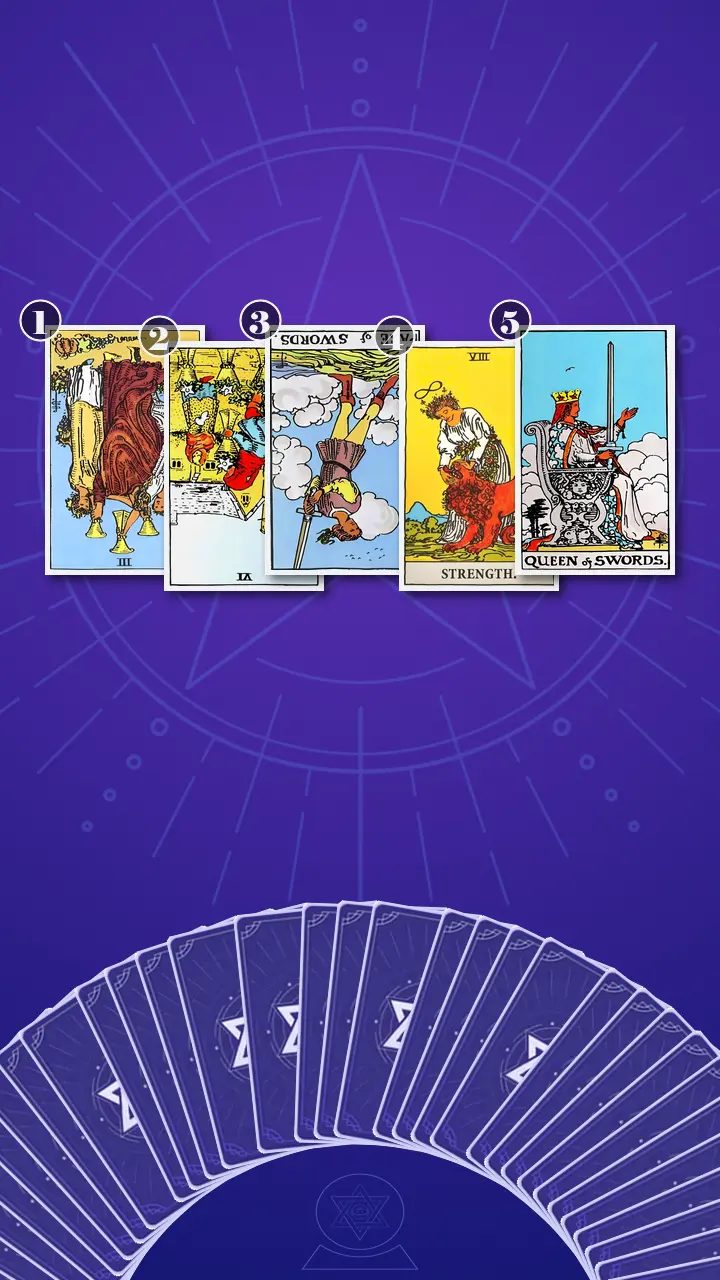
Then I shuffled and laid out The Shadow Spread · Context Edition in a clean line from left to right.
If someone ever asks me what tarot spread helps with friendship triggers and old social wounds, this is one of the first I think of. The issue here was not prediction. Chloe did not need a larger spread telling her the fate of the friendship. She needed a shadow spread for social triggers: something precise enough to show the live brunch symptom, the older imprint underneath it, the defense pattern keeping it alive, the medicine that could interrupt it, and the next step that would let her respond as an adult instead of spiraling on the TTC afterward.
That is how tarot works best for this kind of question. It gives me card meanings in context. It helps me separate the visible moment from the older story hiding inside it.
I told Chloe what I would be looking for as I turned each card: first, the exact point where the social vibe changed and she started managing the room; second, the older memory-script that made the moment feel loaded; third, the shadow defense that turned contact into surveillance; fourth, the integrating quality that could keep her in her present self; and fifth, the relational action that could become one calm boundary instead of another night of unsent drafts.
Reading the Table, Reading the Time-Slip
The Circle That Stops Feeling Mutual
Now the card representing the concrete brunch-time symptom from the diagnosis was the first one on the left.
Three of Cups, reversed.
I felt Chloe straighten a little before I even spoke. This card made immediate sense. In modern life, reversed Three of Cups looks exactly like a cute weekend brunch that should feel easy until a playful jab lands and you start monitoring the table instead of inhabiting your own story. You laugh, keep the conversation moving, and quietly check whether the social circle still feels mutual or whether you have just been nudged back into the role of punchline.
The energy here was reversed Water: not a lack of connection, exactly, but a distortion of it. Belonging stopped feeling like something shared and started feeling like something measured. Who laughed hardest? Who looked away? Who piled on? The group was still visually intact, just like the raised cups in the card are still lifted together. But from the inside, the circle no longer felt equally safe.
'This is the moment,' I told her, 'when your attention leaves your own body and gets reassigned to the room.'
Chloe gave a quick laugh, but there was a bitter edge to it. 'Okay,' she said, 'that is accurate enough to be rude.'
I smiled. 'Good. I would rather the card be precise than polite.'
Her fingers tightened around her mug, then loosened. That was my first sign that recognition had already started to soften her defensiveness.
The Table in Front of You, the Table in Your Body
The next card I turned represented the root memory-script behind feeling 12 again, the older belonging wound activated underneath the surface reaction.
Six of Cups, reversed.
This is the card that tells me the moment is not staying in the present. In Chloe's life, a current joke from friends did not stay current for long. One teasing line made the whole interaction feel older than it was, as if the adult brunch table in Toronto got overlaid with a much earlier cafeteria rule: stay easy, stay funny, do not show the sting. The body heard a familiar old verdict before the adult mind had even finished checking the facts.
I said it to her as simply as I could: 'Sometimes the table in front of you is adult, and the table in your body is still twelve.'
She stopped moving altogether.
There is a particular silence I have learned to trust after ten years of guiding strangers under a planetarium dome. It is the silence people make when the lights go down and a constellation they have never quite understood suddenly becomes obvious. Chloe's reaction had that same quality. First came the freeze: her inhale stalled halfway. Then the cognitive slip: her eyes unfocused, not dramatically, just enough to tell me she was replaying something. Then came the recognition: a small nod, almost embarrassed by its own truth.
'Yes,' she said quietly. 'That is exactly the weird part. Nothing huge even happens, and my body acts like it already knows the ending.'
'Right,' I said. 'Your adult mind is still at the table with poached eggs, rent, weekend plans, all of it. But the nervous system has already opened an old browser tab you did not mean to revisit.'
The energy here was old Water dragged backward. This was the major blockage in the spread. Not because she was overreacting, but because time was collapsing. The discomfort at brunch was touching a much older script about being small, silly, easy to dismiss, and having to earn her place by being good about it.
The Live Transcript in Your Head
The third card represented the current defense strategy and limiting pattern: the hyper-reading of tone, the self-editing, the bracing before she even decided what had actually been meant.
Page of Swords, reversed.
'Here,' I told her, 'is the part of you that turns a social moment into surveillance.'
That card translation was almost brutally modern. Once the trigger was active, Chloe's mind became a live transcript. Did I miss a tone shift? Should I fix that sentence? Did they mean that? Did I sound weird? She rewrote what she was about to say mid-story, watched for smirks, and later replayed exact wording like she was moderating comments on her own life. It was like an internal Slack tone-checker stuck on maximum sensitivity.
The energy here was blocked Air. Her perception was sharp, but it was being used for bracing and prediction rather than clear expression. Instead of asking, 'What actually landed for me?' she was asking, 'How do I prevent the next hit?'
I leaned a little closer to the camera. 'Your sensitivity is not the problem; the autopilot is.'
She pressed her lips together, then let out a breath through her nose. That discomfort on her face was not disagreement. It was the relief of finally having language for a pattern she had been doing automatically for years.
'That is so exhausting,' she admitted. 'I do this all the time.'
'Of course you do,' I said. 'It once helped you stay safe. But now it keeps you from staying real.'
When Strength Put a Hand on the Lion
When I reached the fourth card, the room shifted. The little lamp beside my table caught the gold of the card and made it warmer than the others. In every reading, there is a hinge. This was ours.
The Antidote: Staying in the Room as Your Current Self
Now the card representing the integrating medicine, the quality that could transform the whole pattern, lay in front of me.
Strength, upright.
This was the antidote card in the spread, and I felt it immediately. In modern life, Strength is not about becoming tougher than everybody at brunch. It is the moment Chloe notices the shame flare in her body, keeps breathing, and remembers she does not have to answer from the twelve-year-old version of herself. She can stay with the discomfort for one beat longer and let her current standards decide what happens next.
Because of my work at the planetarium, I almost always think of a pulsar when this card appears. A pulsar is a collapsed star sending out an incredibly steady signal through enormous darkness. The universe around it can be chaotic, noisy, messy, but the pulse remains precise. When social shame hits, most people assume they need to decode the whole room before they can trust themselves. I teach the opposite. I call it Pulsar Breathing: one hand on the glass or coffee mug, both feet on the floor, one inhale and one longer exhale that gives your body a reliable rhythm before your mind starts building a case. Not cosmic theater. Just a way to find one true signal inside social static.
Chloe was still caught in the ride-home logic of the problem when I said the next part: sunglasses on, phone warm in her hand, group chat open again, body behaving as if the table had been much higher-stakes than anyone else at brunch seemed to think. She was trying to decide what the joke meant before she let herself fully notice what it did.
You do not have to bare your teeth or shrink in your chair; like Strength's steady hands on the lion, stay with the surge long enough to answer from your adult self.
I let that sit between us.
Then I added, more quietly, 'What hurts is real, but it does not get to run the room.'
Chloe's reaction came in layers. First her breath caught, visibly, a tiny freeze right under the collarbone. Then her eyes drifted off-screen, unfocused, as if some exact brunch clip had started replaying behind them. When she looked back at me, they were brighter. Not tearful, exactly. More like the first second after someone opens a stuck window and cold air finally gets in.
'But if I do that,' she said, and here a flash of anger came up before the sadness did, 'doesn't that mean I missed this for years? Doesn't that mean I let people do it?'
I shook my head. 'No. It means your younger self learned a fast strategy for staying in the group. We are not here to shame her for that. We are here to make sure she is no longer the only one answering the room.'
Her shoulders dropped, not all at once, but enough that I could see the release. There is often a strange vulnerability right after clarity arrives, almost a little dizziness. When the pattern finally has a name, people can feel both relieved and exposed. Chloe looked exactly like that: steadier, but also briefly unsure what to do in a reality where she no longer had to keep over-managing the table.
'Okay,' she said at last, voice thinner and truer now. 'So the goal isn't to become impossible to hurt.'
'Exactly,' I said. 'The goal is to stay current enough to choose.'
I asked her, 'Using this new angle, can you think of one moment from last week when a single extra breath would have changed how you felt, even by five percent?'
She nodded immediately. 'Yes. I would have known faster that I didn't like it.'
That was the crossing right there: from laugh-first shame management and private replay to the first glimpse of present-moment self-trust. Not perfection. Just the beginning of her adult standards coming back online before the old role swallowed the whole interaction.
The Sentence That Brings Air Back Into the Room
The final card represented the embodied next step: the relational action that could protect self-respect without forcing distance.
Queen of Swords, upright.
By the time this card appears after Page of Swords reversed, I know the mind is being asked to mature. Not more analysis. Better language. In modern life, Queen of Swords is one clean adult line at the table or in a follow-up text: 'Okay, roast me lightly.' 'Not my favorite joke.' 'Wait, that landed a bit sharp.'
The energy here was balanced Air. No more scanning the room, no more drafting seventeen messages and sending none. Just discernment. The upright sword is the sentence itself. The open hand is what keeps it from becoming punishment.
'You do not need a perfect comeback,' I told her. 'You need one honest sentence.'
For the first time that night, Chloe smiled without wincing around it. 'I could actually say, 'Okay, roast me lightly,'' she said. 'That sounds like me.'
'Exactly,' I said. 'That is the whole point. An adult boundary works better when it sounds like your own mouth.'
From Emotional Time-Travel to One Honest Sentence
When I stepped back from the full spread, the story was clean. First, reversed Three of Cups showed the visible symptom: a friend-group moment that should have felt easy turning into subtle social scorekeeping. Then reversed Six of Cups showed why the reaction was so fast and so confusing: the present joke was being filtered through an older belonging wound, which made an adult brunch table feel like a school cafeteria with better coffee. Reversed Page of Swords revealed the maintenance loop: laugh first, self-edit, monitor everyone, replay it later, and call that clarity. Strength interrupted that loop by restoring nervous-system steadiness. Queen of Swords translated the steadiness into language.
The blind spot Chloe had not fully seen was this: she had been treating every shame flare as proof that she had already been pushed back into the old role. That made her look to the room for the verdict before checking her own actual experience. The transformation direction was simpler and harder at once: move from automatically assuming the joke has already defined you to checking what is happening now and responding from your adult standards.
I told her, 'Regulate first, interpret second. Then speak only as much truth as the moment actually needs.'
- The One-Breath ResetAt your next brunch or dinner, the first time your face goes hot or your throat tightens, put one hand on your glass or mug. Silently name three body cues: 'hot face, tight throat, stomach drop.' Then take one full breath and ask yourself, 'Did that feel playful to me, or did it feel pointed?'Keep the bar absurdly low. One breath counts. If you want structure, use my Pulsar Breathing rhythm: a steady inhale, then a slightly longer exhale.
- The Then/Now Split ScreenWithin ten minutes after the hangout, open Notes and make two columns: 'Then' and 'Now.' Under 'Then,' write the old role or memory the moment touched. Under 'Now,' write only the observable facts from today's interaction, no more than three bullet points total.Do not turn this into a courtroom. If you feel yourself spiraling, stop after one sentence per column or record a two-minute voice note while walking to the streetcar.
- Adult Voice, One SentenceBefore your next social plan, write three one-line scripts in your own tone: 'Okay, roast me lightly,' 'Not my favorite joke,' and 'Wait, that landed sharp.' Say each line out loud once at home. If the live moment feels too charged, send one follow-up text to the safest friend instead of disappearing into resentment.Short is stronger. Overexplaining usually comes from panic, not clarity. Text absolutely counts if that is what keeps you honest.
Those were her next steps. Not a personality transplant. Not a total friendship verdict. Just actionable advice that could help her tell the difference between playful banter and a boundary crossing, while staying in herself.

A Week Later: The Quiet Proof
Four days later, Chloe sent me a message after seeing the same group again. She wrote, 'I did the hand-on-glass thing. Then when the chaotic joke came up, I said, 'Okay, roast me lightly.' Everyone laughed, but differently. Softer.' A minute later she added, 'Walked to the streetcar alone after and still stared at my phone for a bit. But I wasn't trying to figure out who I was anymore. I was deciding what I actually thought.'
That is the version of change I trust most. Not the dramatic movie-ending kind. The real kind. The kind where the old trigger still flickers, but it no longer gets the whole microphone.
In my work, a Journey to Clarity is rarely about becoming fearless. It is about becoming easier to return to. Chloe did not solve friendship forever. She did something better: she stopped asking the joke to tell her who she was.
When everyone else is still laughing over brunch and your throat has already tightened, it can feel like belonging is something you have to earn by acting unbothered. If that is where you are, noticing that squeeze before you disappear inside it already means you are no longer at the beginning.
So if the next joke lands a little off, what might change if you gave yourself one real breath—your own tiny pulsar—before deciding what it means or what version of you has to answer it?