From Panic-Archiving Old Posts to Steadier Self-Respect Online

The 8:12 a.m. TTC Courtroom Scroll
“If you’ve ever opened Instagram on your morning commute and got hit with an ‘On This Day’ notification before you’d even fully woken up—instant face-heat, instant urge to hide the screen,” I said, and Taylor’s eyes flicked up like I’d read her Notes app out loud.
On my screen, she sat at the edge of her condo kitchen chair in Toronto, mug in both hands. But the scene she described was so specific it felt like I could hear it through my own window: 8:12 a.m., packed into a streetcar, tote bag wedged against her hip; the TTC’s low electric hum under a faint Spotify podcast in her earbuds. Her phone warm in her palm. The little banner—On This Day—popping up like an ambush. And then that instant bodily hit: her face flushing hot, her throat tightening as if she’d swallowed a pebble, and the stomach-drop that made her thumb hover over Archive like it was a reflex.
“It’s like my old posts are trying to embarrass me on purpose,” she said, then laughed once—small, sharp, not amused. “And I know how dramatic that sounds. But it’s… physical. Like I want to fold my phone in half.”
I watched her swallow. Her shoulders were barely lifted, but her neck did the thing I recognize from a thousand sessions—muscles bracing for impact, as if shame had a sound and she wanted to muffle it before anyone else heard. This wasn’t nostalgia. This was an On This Day shame spiral: notification, freeze, reread, panic-archive, then the long aftertaste of self-prosecution.
“So the question you’re bringing me,” I reflected back gently, “is: why does a memory trigger shame so fast—what past is this echoing? And why does it feel like proof against you instead of proof of growth?”
She nodded, eyes bright with that contained kind of emotion people wear when they’ve been ‘fine’ all day and then one small thing cracks the seal. “I want to feel proud of how far I’ve come,” she said. “But when I see old me, I get scared she proves I was… unworthy. Like I didn’t deserve to belong.”
I let that land. “Okay,” I said, soft but clear. “Let’s make a map. Not to judge your past self—but to understand what’s happening in your nervous system, your beliefs, and your environment. We’re going to walk this toward clarity.”

Choosing the Compass: Celtic Cross · Context Edition
I asked Taylor to take one slow breath—nothing mystical, just a clean transition. Then I shuffled. I’ve guided people across oceans and through breakups and job changes on cruise ships where the floor never stops moving; I’ve learned that a simple, steady rhythm does something important to the mind. It gives it a railing to hold.
“For this,” I said, “I’m using the Celtic Cross · Context Edition.”
And for you reading along: this is why that spread works so well for a question like Why do ‘On This Day’ memories trigger shame? Because it doesn’t stop at the surface trigger. It traces a full chain: what happens in the first ten seconds, what mechanism turns it into a spiral, what belief system sits underneath, what chapter of your past it’s echoing, and then—most importantly—what integration path creates real relief instead of another round of self-editing.
In this version, two positions are tuned for the modern problem: one card explicitly names the echoed chapter behind the memory, and another surfaces the hidden “growth narrative” that can quietly fuel shame.
I pointed to the shape I was building on my table. “Card one is the immediate shame response. Card two crosses it—your main blockage. Card three is the deeper belief underneath. And card six, on the right, is what’s approaching if you work with the trigger instead of fighting it. That one is our bridge.”
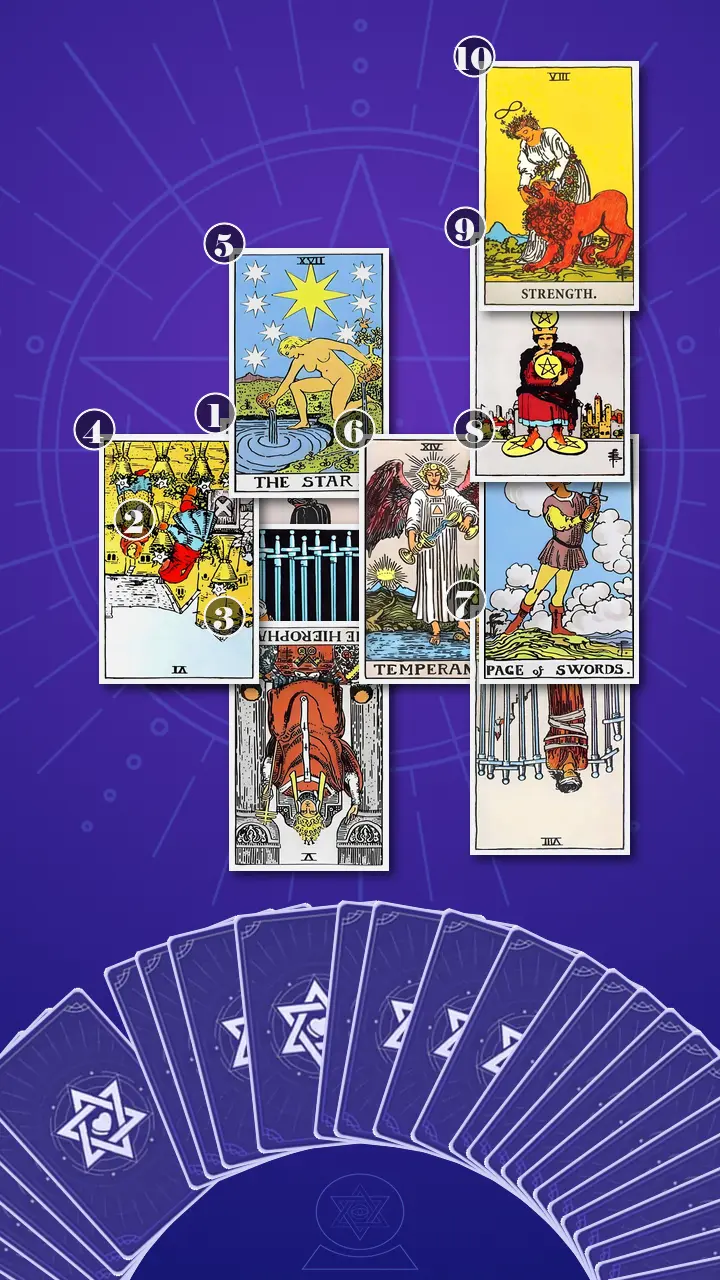
Reading the Map: How Tarot Works in a Shame Spiral
Position 1: The immediate shame response (Present) — Five of Cups, upright
“Now turning over,” I said, “is the card representing the immediate shame response and what the memory is doing to your focus in the present moment.”
Five of Cups, upright.
“This is the exact moment you described on the streetcar,” I told her. “Your attention doesn’t just land on the memory. It locks onto whatever feels spilled—whatever looks ‘wrong’—and it becomes the whole story.”
I gave her the modern translation so it didn’t float away into symbolism. “It’s like you see an old post and your brain zooms in on the one ‘embarrassing’ detail—an emoji, a pose, who you tagged—while everything else about that era stays out of frame.”
In energy terms, Five of Cups is contraction: your inner field narrows until the past is a spotlight on regret. And yet, in the image, two cups still stand behind the cloaked figure. There’s still value. Still resilience. Still something you carried through.
“If I asked you right now,” I said, “what are the two upright cups—what did that past version of you manage, survive, or care about—what comes up?”
Taylor exhaled and did that unexpected little laugh again, bitter at the edges. “That’s… kind of brutal,” she said. “Because my brain is like, ‘Nothing. She was cringe.’”
I nodded. “That reaction is important. It means we’ve found the switch your mind flips.”
Position 2: The main blockage (Challenge) — Nine of Swords, upright
“Now turning over is the card representing the main blockage that turns a neutral memory into a spiral.”
Nine of Swords, upright.
I didn’t soften this one, because the honesty is part of the relief. “This is the late-night tribunal,” I said. “The loop that pretends to be accountability, but functions like punishment.”
And I framed it exactly the way it happens in real life, because that’s what makes tarot practical: card meanings in context. “1:07 a.m. Screen brightness on low. You reread the caption like it’s evidence.”
My voice took on a courtroom cadence, not to dramatize her—only to name what her mind is already doing. “Exhibit A: the emoji. Exhibit B: the pose. Exhibit C: the friend tag.”
“And here’s the part that keeps you trapped,” I added. “No new information is coming in—only new punishments.”
Nine of Swords is an Air choke point: mental speed without emotional resolution. It’s excess thought—hyper-interpretive, prosecutorial—and it blocks the natural grieving and releasing Five of Cups wants to do.
Taylor’s shoulders dropped by a millimeter. Her eyes pinched, then softened. The recognition wasn’t dramatic; it was a quiet, involuntary exhale, like her body was relieved I’d named the pattern without calling her ridiculous.
“Also,” I said, letting my tone warm but stay sharp-eyed, “if you wouldn’t bully a friend for it, don’t cross-examine yourself for it.”
Position 3: The deeper belief system (Root) — The Hierophant, reversed
“Now turning over is the card representing the deeper belief system underneath the shame—the old rulebook the memory activates.”
The Hierophant, reversed.
I felt Taylor go still even before I explained. The Hierophant is the inner authority: rules, belonging, acceptability. Reversed, it’s misalignment—an inherited standard running your life like an outdated operating system.
“This isn’t only about the post,” I told her. “It’s about the grading system you’re applying to it.”
I used the borrowed-rulebook reveal because it’s so modern it hurts in the best way. “Hierophant reversed is like inheriting a style guide you never agreed to,” I said. “A high school ‘cool policy.’ A corporate brand guideline for your personality. ‘People with self-respect don’t post like that.’ And your mind treats it like law.”
I watched her eyebrows lift. The tiniest pause—wait… whose rule is that?—moved through her face.
“If you posted that,” I continued, “your shame voice says you broke a rule. But here’s the real question: who wrote the rule? And does it match what you value now—or is it a belonging strategy you learned when you didn’t feel safe being fully yourself?”
As a Jungian psychologist, I’m always listening for shadow material—not the ‘bad’ parts, but the disowned human parts you had to exile to stay acceptable. Hierophant reversed often shows the moment the psyche says: the old approval system kept you safe, but it’s not your truth anymore.
Position 4: The echoed past chapter (Recent past) — Six of Cups, reversed
“Now turning over is the card representing what past chapter this is echoing—the emotional era underneath the specific memory.”
Six of Cups, reversed.
“This is tenderness blocked,” I said simply. “This is your younger self showing up, and your present self reacting like she has to reject her to prove you’ve evolved.”
I described it the way it felt: tender-but-awkward, like finding an old note in a jacket pocket. “An old friend group. Old captions. An identity phase where you were trying—maybe too hard, maybe beautifully, maybe messily—to be liked.”
“When you look at her,” I said, “it’s almost like you’re looking at a younger sibling. She’s trying so hard to belong.”
Taylor’s throat moved as she swallowed. Her hand tightened around the mug, then loosened. That familiar body cue: throat tight, stomach drop—not pure cringe, but grief slipping in under it.
“I hate that,” she whispered, voice small for the first time. “Because I can see her. And I’m mean to her.”
“That’s not a moral failure,” I told her. “That’s a learned survival reflex. But it’s also the exact place integration begins.”
Position 5: The ideal self-story (Conscious aim) — The Star, upright
“Now turning over is the card representing your ideal story about what growth should look like—what you consciously want to feel instead of shame.”
The Star, upright.
Taylor stared at the card on my table as if it were a window she’d forgotten existed.
“This is you wanting a relationship with your history that’s honest and breathable,” I said. “Not erasure. Not an excuse. Integration.”
The Star is balance after rupture: gentle consistency, repair without self-punishment. “You’re trying to be a person who can look at the past and still feel whole,” I told her. “You’re trying to be able to say: that was me then, and I’m allowed to have been her.”
I leaned in. “You don’t need a cleaner past,” I said. “You need a safer relationship with your past.”
When Temperance Poured Between Two Cups
Position 6: The most likely next internal shift (Near future / Bridge) — Temperance, upright
I let my hands pause over the deck for half a second. The air in my little Venetian studio—salt from the lagoon, the soft knock of water against stone—felt suddenly more present. “We’re turning over the bridge now,” I said. “The shift that approaches if you work with the trigger rather than fighting it.”
Temperance, upright.
Temperance is the middle option—measured mixing instead of extremes. And I could feel Taylor’s mind reaching for it the way tired hands reach for a railing.
“In real life,” I began, “Temperance looks like this: you open the memory, and instead of going straight to delete-everything or pretend-it-never-hurt, you do something almost boring.” I smiled gently. “You add one fact. You add one kindness. You don’t over-stir.”
In my Energy State Diagnosis lens, I mapped it in three dimensions the way I would on a ship in rough seas: environment, relationships, self. “Environment: the app is designed to interrupt you and trigger quick judgment. Relationships: that memory is often tied to a social ecosystem—an ex, an old friend group, an old ‘role’ you played to belong. Self: the inner critic uses today’s standards to prosecute yesterday’s coping.”
“Temperance,” I told her, “is how we stop the leak across all three: we slow the environment down, we add relational context, and we give your nervous system a kinder internal tone.”
Her jaw tensed, then she blurted, suddenly sharp: “But if I ‘add compassion,’ doesn’t that mean I’m just letting myself off the hook? Like—was I wrong? Was I embarrassing or not?”
There it was: the unexpected resistance. Not relief—anger, because clarity can feel like it steals your only defense.
I held her gaze. “I hear that,” I said. “And no—compassion isn’t an acquittal. It’s context. It’s you refusing to sentence a younger version of you using a borrowed rulebook.”
Then I moved into the moment that changes the whole map.
Setup: She was half-awake on a streetcar, thumb on autopilot, when the notification landed before coffee—and her body reacted like the whole city could see her screen. She’d been trapped in a binary: delete it all or drown in it, because anything in between felt unsafe.
Stop treating the memory like a verdict and start mixing context and compassion like Temperance pouring between cups.
I let silence sit for a breath, the way the canal goes still between boat wakes.
And then I watched the three-step reaction chain ripple through her in real time.
First, a physical freeze: her breath caught high in her chest, and her fingers stopped moving around the mug as if her hands had been paused mid-animation.
Second, cognitive penetration: her eyes unfocused for a second, not looking at me, not looking at the screen—looking through time, replaying a specific memory with a new angle, like switching tabs without panic.
Third, emotional release: her shoulders dropped, not dramatically, but like a tight jacket unzipped. Her mouth opened on a long exhale that sounded almost like a laugh and almost like a cry. “Oh,” she said quietly. “There’s… a middle option.”
I nodded. “Yes. And here’s the other line I want you to keep nearby—because it’s the antidote to the courtroom app in your pocket: A memory isn’t a verdict on your character—it’s a timestamped snapshot of what you needed to survive and belong back then.”
Her eyes went wet. She blinked hard, once, then again. “I hate how true that is,” she whispered. “Because I can feel how badly I wanted to be… chosen.”
“That’s the shift,” I said softly. “This isn’t just about a post. It’s about moving from self-prosecution to self-respect. From ‘my past is evidence against me’ to ‘my past is data about needs and coping.’ That’s how you get from the shame spike to steadier choice.”
I leaned forward, voice gentle but practical. “Now, with this new lens—can you think of one moment from last week when a memory hit, and this would have changed how it felt in your body?”
Taylor nodded slowly. “Wednesday,” she said. “I was on the streetcar and it was a 2017 caption. I went straight to Archive. If I had… mixed context, I would’ve remembered I was in a totally different job. Different friends. I was lonely. I was trying.”
“Exactly,” I said. “And that’s not you romanticizing it. That’s you being accurate.”
Position 7: The agency point (Self) — Eight of Swords, reversed
“Now turning over is the card representing your agency point—where you can unbind from the loop through a small, realistic change.”
Eight of Swords, reversed.
“You’re closer to freedom than you think,” I told her. “But it won’t come from the perfect explanation. It comes from realizing you have options while you feel uncomfortable.”
I zoomed in on the most honest modern detail. “That hover over Archive/Delete? That’s your release point. The moment your nervous system says ‘danger’ and you can gently answer, ‘This is discomfort, not danger.’”
Eight of Swords reversed is unblocking: the ropes are loose, but you have to choose to step out.
Taylor’s eyes dropped to her own phone on the table like she was seeing it as an object instead of a judge.
Position 8: The environmental amplifier (Environment) — Page of Swords, upright
“Now turning over is the card representing the environmental amplifier—how design, audience, and comparison culture feed the trigger.”
Page of Swords, upright.
“This is the algorithmic wind,” I said. “Constant prompts. Constant commentary energy. The sense of an unseen audience waiting for a hot take.”
“When the memory appears,” I asked, “are you reading it like a journalist gathering facts—or like a critic hunting flaws?”
Page of Swords is excess alertness in the environment. It’s not all your fault. The platform rewards speed and judgment; your nervous system pays the cost.
Position 9: The safety need underneath (Hopes & fears) — Four of Pentacles, upright
“Now turning over is the card representing what you’re trying to protect, and what you’re afraid you could lose.”
Four of Pentacles, upright.
“This is you gripping your personal brand like a fragile package on a crowded subway,” I said. “Any bump feels like a threat.”
Four of Pentacles is over-control as safety. It makes total sense: you’re trying to protect belonging, respect, credibility—especially in a creative corporate role where feedback is constant and visibility is high.
“And I want to name something that might surprise you,” I added. “Archiving isn’t the problem—panic-archiving is.”
She gave a tiny nod that looked like permission to stop punishing herself for the coping strategy.
Position 10: Integration outcome (Outcome) — Strength, upright
“Now turning over is the card representing the quality you can build so memories stop functioning as self-punishment.”
Strength, upright.
Strength isn’t hype. It’s soft power: the ability to hold intensity without escalating it. “This card changes the order of operations,” I told her. “Kind voice first. Then decide.”
I described it with a body-based detail, because shame is bodily first. “Unclench your jaw before you touch the screen. Drop your shoulders. Take one breath where the exhale is longer than the inhale. Then you choose.”
Strength is balanced Fire: courage that doesn’t perform. It contains rather than dominates.
From Insight to Action: The Temperance Pour Next Steps
I looked at the full spread as one story. “Here’s the coherent arc,” I said. “A memory hits and Five of Cups pulls your focus to what feels spilled. Nine of Swords turns it into an all-night tribunal. Underneath, Hierophant reversed shows a borrowed rulebook about ‘acceptable’ behavior running the sentencing. Six of Cups reversed reveals the echoed chapter: a younger you trying hard to belong, now judged by today’s standards. The Star proves your real aim is healing without erasure. Temperance offers the method—mix context and compassion—while Eight of Swords reversed gives you a small agency lever. Page of Swords explains the environmental speed, Four of Pentacles names your safety grip, and Strength is the integration: steady self-respect.”
“Your cognitive blind spot,” I continued, “is this: you’re treating shame as if it’s evidence you should erase something. But shame is often a signal you’re afraid of being seen without a rulebook.”
“And your transformation direction,” I said, “is the shift you already felt when Temperance landed: memories aren’t verdicts on your character. They’re data—about needs, belonging, coping, and the context you lived inside.”
Then I made it practical—coffee-break practical—because insight without a next move just becomes another mental tab.
“We’re going to use a Venetian strategy here,” I told her. “In Venice, you don’t fight the current. You regulate it. You create a lock, a slower lane, so the water can move without flooding the streets. That’s what we’re doing with your phone: regulating the current of memory triggers.”
- The 60-Second No-Archive PauseOnce this week, when an ‘On This Day’ memory appears, keep your finger off Archive/Delete for 60 seconds. Do nothing but notice where shame lands (face heat, throat tightness, stomach drop, jaw clench).If you feel a full purge spiral starting, make it smaller—one memory, one minute. Aim for “less prosecutorial,” not “fully serene.”
- The “Temperance Pour” (10 minutes, once—then stop)Open the memory without touching Archive/Delete for 60 seconds (or, if too intense, place the phone face-down and picture it). Say out loud: “This is shame + (regret/grief/irritation).” Then write two lines in Notes: (A) “Context then:” one fact about your life at that time. (B) “Value now:” one sentence about what you care about today. Finally, choose one intentional action: keep as-is, hide from your own memories, or archive—whatever supports safety without punishment.Boundary rule: if your chest tightens or you start spiraling, close the app immediately and come back later. The point is choice, not endurance.
- The One-Tab Rule (Anti-Spiral Friction)During a trigger, stay with the single memory for 2 minutes. No switching to your profile grid, no searching your name, no Highlights checking—just the one item, then one decision.If curiosity turns into interrogation, pause and do one Strength cue first: unclench jaw, shoulders down, longer exhale.
“And if you want a modern cleansing method that doesn’t turn into self-attack,” I added, invoking my most contemporary tool on purpose, “do a digital detox through photo album organization—not to erase, but to re-contextualize. Make one folder called ‘Then’ and one called ‘Now.’ Your brain loves clear containers.”

A Week Later: Ownership, Not Erasure
Six days later, Taylor messaged me. Not a paragraph. Just: “Got an On This Day. Didn’t archive. Did the two-line note. Felt gross for 30 seconds. Then… it passed.”
She added, almost as an afterthought: “I turned off memories on Facebook for a week, too. I didn’t realize how much I was bracing every morning.”
In my mind, I saw the subtle shift Temperance always promises: not a dramatic reinvention, but a regulated current. A phone that stopped being a courtroom for a minute. A past self no longer treated like contraband.
Her bittersweet proof came in one small line at the end: “I slept through the night. Woke up and my first thought was still ‘what if I’m cringe?’—but this time I actually laughed. Like, okay. Hi, old fear. We’re not driving today.”
I closed my notebook and felt that familiar quiet satisfaction I used to feel at sea when the horizon finally steadied after a storm. This was her Journey to Clarity: not deleting history, but building the capacity to face it with dignity.
When an “On This Day” memory hits and your face goes hot, it’s not just cringe—it’s the fear that the version of you who tried hard back then is proof you don’t deserve respect now.
If you treated the next memory as data—not a verdict—what’s one small piece of context you’d let in before you decide what to do with it?