Stuck as the Emotional Middleman Between Friends—and Stepping Out

The 6:42 Streetcar and the Unofficial Referee
I have learned that if you are a 20-something city person who spends all day coordinating deadlines at work and then gets two back-to-back 'can I vent?' texts after your friends fight, you may be stuck in emotional middleman mode.
That was exactly how Jordan (name changed for privacy) arrived on my screen one rainy Thursday night. She was 27, a project coordinator at a marketing agency in Toronto, and she had the very specific look I know well: competent everywhere else, quietly over-assigned in friendship. Before I even touched the deck, she described 6:42 p.m. on a westbound TTC streetcar. One hand gripping the pole, one hand warming around her phone. Damp wool coats smelling faintly like rain. The overhead stop announcement crackling. One friend's voice note playing at 1.5x. The other chat already open so she could check whether her reply sounded equally supportive.
'I did not sign up for this,' she said, rubbing the hinge of her jaw. 'But somehow I am always in the middle.'
What she was really asking me was the question people type into Google after midnight: why do my friends always vent to me about each other, and how do I stop being the middleman between friends without sounding disloyal?
I could see the pattern in her body before I named it. Her shoulders were halfway to her ears. Her jaw looked like it had been holding a secret all day. Her resentment was not dramatic; it sat in her like carrying two overfilled grocery bags in one hand until the wrist started to throb. She was not trying to pick sides. She was trying not to lose her place in the room.
I told her gently, 'Support is not the same job as translation.' Then I said what I say when the fog is thickest: I was not here to judge who was right. I was here to help us draw a map, so she could see what was hers, what was theirs, and where clarity actually began.

Choosing the Compass: The Energy Diagnostic Map for Friendship Triangulation
I asked Jordan to take one slower breath and hold the real question in mind: why do two friends vent to me, and how do I step out of the referee role without feeling cruel? While she breathed, I shuffled slowly, the cards making that soft, dry whisper against the linen on my table. This is how tarot works best for me: not as stage fog, but as a structure that helps the nervous system stop spinning long enough for the truth to come forward.
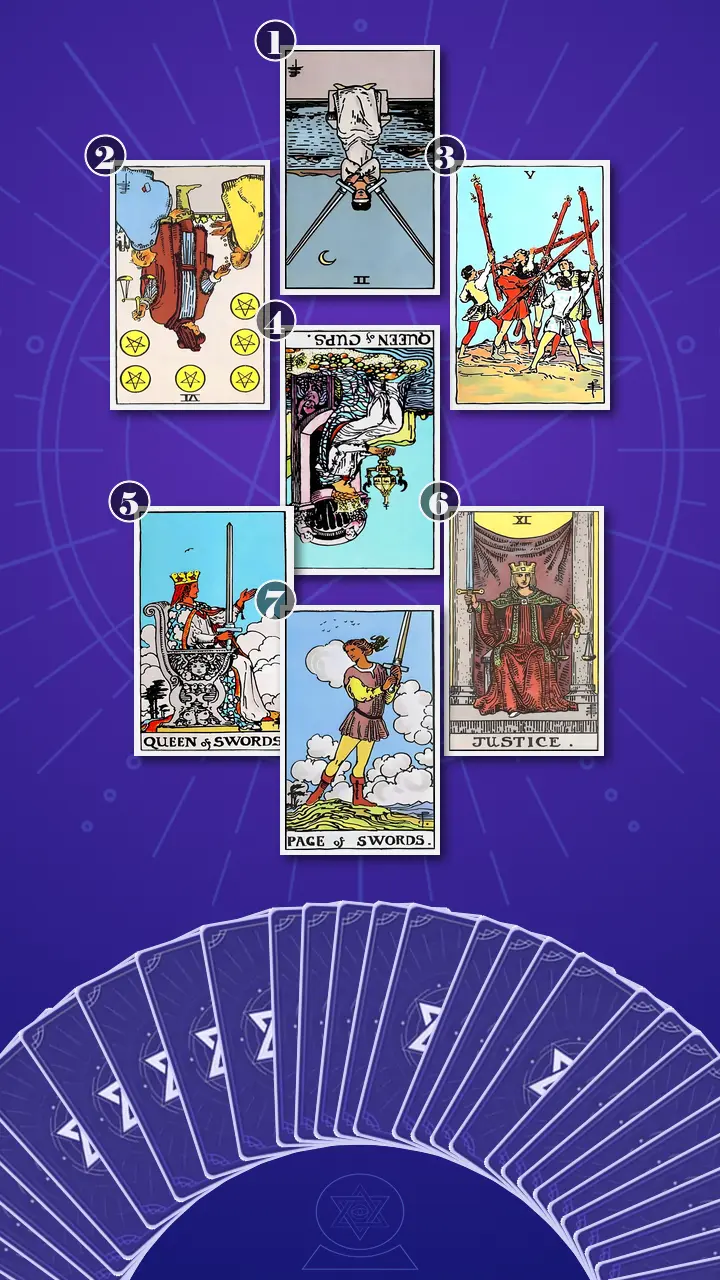
For her reading, I used my seven-card Energy Diagnostic Map · Context Edition. I chose it because this was not a simple one-to-one relationship issue. This was friendship triangulation: two people in conflict, one person absorbing both sides, and a role that keeps reinforcing itself through guilt and usefulness. A smaller cross would have missed the whole loop. A standard relationship spread would have over-centered a single dyad. This map let me trace the visible symptom, the inner bargain, the outside pressure, the deeper wound, the available resource, the turning point, and the one next step she could test in real life.
I showed her the circular layout. The first card would reveal the role she was already performing in ordinary life. The center card would expose the actual blockage under the overthinking. The sixth card would name the transformation capable of breaking the referee identity. The seventh would ground everything in one practical move, because actionable advice matters more than beautiful insight that never leaves the table.
Reading the Pressure Ring
Position 1: The Loop That Calls Itself Thoughtfulness
Now I turned the first card, the one that shows the most visible symptom in the situation right now. It was the Two of Swords, reversed.
I told Jordan this card looked painfully ordinary in her life. It looked like keeping both friends' chats open on the commute home, listening to each version back-to-back, and delaying any real boundary because she was still trying to find the one response that sounded perfectly fair to both of them. The result was not peace. It was mental gridlock with her nervous system stuck in brace mode.
The blindfold on the card felt like refusing to check her own preference. The crossed swords over the chest looked exactly like her tight shoulders and locked jaw every time her phone lit up.
In energy terms, this was blockage. Not a lack of care, and not wisdom either. It was fairness paralysis dressed up as thoughtfulness, like having two tabs open in your brain all day and never hitting send on your own opinion.
Jordan gave a tiny laugh that landed bitter at the end. 'That is so accurate it feels rude,' she said.
I smiled. 'That is usually how the first honest card enters a room.' Then I asked her the question beneath the card: when neutrality stops being a value and starts being a full-time job, who exactly is that job serving?
Position 2: The Private Bargain Under the Kindness
Next I turned the card representing the inner tug that kept her engaged with the pattern. It was the Six of Pentacles, reversed.
I told her this was the private bargain under the kindness. She kept giving time, validation, careful wording, and emotional translation to both friends because part of her hoped that being useful would keep her safely included. Her support was real, but the exchange was not equal, and her own energy budget never made it into the conversation.
The scales in this card mattered. Here, balance was something she was performing by hand, manually measuring whether both people got the same amount of warmth, reassurance, and access. In energy terms, this was excess giving paired with self-erasure, like covering the whole group bill in invisible currency called her bandwidth.
As a Jungian psychologist, I pay close attention to the shadow that hides inside goodness. In Jordan's case, it was the shadow of the reliable friend: the part that says, If I am useful enough, no one can call me cold, and maybe no one can leave. When I named that, her eyes dropped to the table and her fingers loosened around her mug.
Position 3: The Noise That Was There Before You
Then I turned the third card, the one mapping the outside force in the relationship system. It was the Five of Wands, upright.
I told Jordan this was the surrounding pressure field itself: two friends with incompatible narratives, both wanting to be heard first, both sending urgency into her inbox, and no one actually tolerating the discomfort of direct repair. It had the same overstimulated energy as a The Bear kitchen scene, everybody activated, everybody talking, nobody actually regulating the room.
In energy terms, this was excess fire. Too many voices, no shared rhythm, no leader, no pause. The important truth in this card was that the chaos existed before Jordan stepped in. She did not create it. She simply kept getting recruited as the place where the noise landed.
'So I am not secretly causing it by being there?' she asked.
'No,' I said. 'But staying available as the human side-DM does help the triangle keep running.'
Position 4: When Care Turns Absorbent
Then I turned the center card, the one placed where the spread keeps its real weight. This card represented the core blockage beneath the presenting issue. It was the Queen of Cups, reversed.
The room shifted the moment she saw it. This card named the fear of losing belonging and the boundary blur that turns empathy into responsibility. In modern life, it looks like walking into a Friday bar on Queen Street, hearing one clipped hello, seeing the other friend stare into their drink, and feeling your own stomach drop before a single hard word is spoken. The bass is too loud, ice knocks against glass, somebody's perfume hangs heavy in the booth, and suddenly part of your attention leaves your own night so you can start mood-managing theirs.
'Yes,' Jordan said, very quietly. 'I can feel myself leaving my own night to manage theirs.'
That was the card exactly. At the core, this was not just conflict avoidance. This was other people's emotions moving into her body rent-free. Her sleep, focus, and plans bent around a problem she did not own. The queen's closed cup reminded me of an emotional holding tank: trying to contain everything safely while quietly becoming overfull.
In energy terms, this was overflow through porous boundaries. Care had become absorption. I thought, as I often do, of long Atlantic crossings from my cruise years: a wave can strike the hull without becoming water inside the ship. Sensitive people suffer most when they mistake impact for obligation.
Jordan went still, then exhaled so deeply her shoulders dropped an inch. 'This is what happens in my body too,' she said.
When Justice Took the Scales Back
Position 5: The Queen Who Cuts the Paragraph Down
I wanted Jordan to know the reading was not only diagnosing the loop. It was also showing the exit. So I turned the fifth card, the one revealing the internal resource already available to her. It was the Queen of Swords, upright.
This was the part of Jordan that already knew one clear sentence could be more respectful than a page of careful diplomacy. In real life, this queen appears when a long message gets edited down to the single line that is actually true. An out-of-office reply for emotional bandwidth. Clear limit, open hand.
In energy terms, this was balance restored through air: discernment, directness, adult language. Not coldness. Not punishment. Just structure. I told her, 'A short boundary can be kinder than a long rescue.'
She nodded immediately, and for the first time that night I saw relief arrive before fear. That was the shift this card often brings: the sudden possibility that maybe she did not need the perfect explanation, only the truthful one.
Position 6: Justice and Return-to-Sender Fairness
Then I turned the sixth card, the one naming the key transformation that changes the whole pattern, and the room went noticeably quiet. Even through the screen, I could hear the little hum of her fridge and the rain easing against her window. We had reached the hinge of the reading.
The card was Justice, upright.
I told Jordan that Justice was not asking her to decide who was right. It was asking her to stop carrying a fairness problem that belonged to the people in conflict. The restored scales in this card answered the distorted scales we had already seen in the Six of Pentacles reversed. Earlier, balance was manual, personal, exhausting. Here, balance came from structure, accountability, and each person carrying their own weight.
Whenever Justice appears in a reading like this, I use what I call Energy State Diagnosis. I check three places for leaks. Environment: side-DMs, late-night voice notes, post-brunch private recaps. Relationships: two people avoiding direct discomfort by outsourcing it to a third. Self: the limiting belief that usefulness is the price of belonging. Justice closes all three leaks at once. It does not numb care. It gives care a container.
Jordan stared at the card. I could almost see her back on that streetcar after work, two chats open, editing one reply so it sounded just as supportive as the other while her shoulders tightened and her evening quietly disappeared into somebody else's argument.
The Sentence That Changed the Whole Spread
Stop trying to hold everyone's scales level by hand, and let Justice replace people-pleasing with clean accountability.
I let the sentence sit between us.
Then I said it one beat more plainly. Fairness is not you carrying both sides by hand. Fairness begins when the conflict goes back to the people who actually own it.
Her reaction came in three waves. First, a freeze: her breath caught, and her thumb stopped halfway along the rim of her mug. Then the thought reached her face; her eyes unfocused, as if a dozen old message threads were replaying at once. Then the emotion arrived. She leaned back, not relieved at first but irritated, almost angry. 'But if that is true,' she said, 'does that mean I have been doing all of this wrong?'
I shook my head. 'No. It means you were trying to create safety with the tools you had. Justice is not here to shame the old strategy. It is here to retire it.'
Something in her jaw unclenched. Her eyes went bright. She pressed her lips together, inhaled, and then let out the kind of breath that begins in the chest and ends in the whole spine. It was relief, yes, but I also recognized the slight dizziness that sometimes follows real clarity. When the burden drops, space opens. And space, at first, can feel strangely naked.
I asked her, 'Now, with this new lens, can you think of one moment from last week when this would have changed how you felt?'
She nodded almost immediately. 'Thursday night. I got that long paragraph that started with I know you get both sides but... If I had seen it like this, I would not have spent forty minutes trying to write the perfect answer.'
'Exactly,' I said. 'This is the first real step from guilt-driven peacekeeping to self-respecting fairness.'
Before the feeling could evaporate back into theory, I asked her to do the reinforcement immediately. Within the next ten minutes, I wanted her to open her Notes app and write one redirect sentence under 25 words. If it felt too exposed, she did not have to send it yet. Practice still counted.
Position 7: The First Boundary Text
Finally, I turned the seventh card, the one grounding the spread in one practical move she could try this week. It was the Page of Swords, upright.
This card always feels refreshingly unpolished to me. It is the honest beginner of boundary language. In modern life, it looks like your thumb hovering over Send, your stomach dropping a little, and you still sending the brief, respectful text anyway. Not elegant yet. Still real.
In energy terms, this was forward motion through slight discomfort. The Page does not wait to feel perfectly composed. He practices. Clean still counts. Awkward still counts. Not overexplaining still counts.
Jordan made a face that was half hope, half panic. 'But what if I only have thirty seconds on the streetcar and I can feel myself about to cave into the long paragraph?'
'Then we use one of my Instant Adjustment Techniques,' I said. 'Ten seconds. Name your feeling in one word. Check your bandwidth. If your body says no, you do not owe them instant processing. The first boundary is not a speech. It is a redirect.'
I watched her type into her Notes app as I dictated the bones of it. That was the Page of Swords doing its job: not waiting for a perfect identity, just practicing a truer sentence.
From Insight to Action: The Referee Exit Text
When I looked back over the whole spread, the story was clean. The upper ring showed the loop: Two of Swords reversed, Six of Pentacles reversed, Five of Wands. Mental gridlock, unequal emotional giving, and a conflict field loud enough to recruit a third person. The center card, Queen of Cups reversed, explained why the loop got under Jordan's skin so fast: empathy had blurred into responsibility because belonging felt safer when she was useful. Then the lower path opened: Queen of Swords, Justice, Page of Swords. Discernment. Right-sized responsibility. One spoken boundary.
The blind spot was not that Jordan cared too much. It was that she kept mistaking fairness for equal soothing from her own body and time. She had been acting as if friendship could only stay stable when she served as a human translation app. The transformation direction was simpler and harder: stop translating both friends' feelings for them, state one clear boundary, and redirect them to talk directly to each other.
Growing up among Venetian canals taught me that you do not fix overflow by scooping water with your hands. You regulate the gates. The same is true here. We were not trying to make Jordan colder. We were helping her regulate the current so care could move without flooding her.
I gave her three small, usable next steps.
- Write the Referee Exit Text Tonight, open your Notes app and save this script: I care about you, but I do not want to mediate this. I think this needs to be a direct conversation between you two. Use it the next time either friend asks for a recap, a ruling, or a private debrief.Keep it to two sentences max. If the urge to add a balancing paragraph flares up, that is the old role trying to keep itself alive.
- Do a 10-Second Bandwidth Check Before you open any message about their conflict, pause and name your state in one word: dread, guilt, annoyed, tender, tired. Then decide whether you actually have capacity today. If not, reply later or send: I am not up for processing this right now.Use the body cue as data: jaw, shoulders, chest, stomach. Information is not the same thing as obligation.
- Try the One-Reply Rule For one week, give one supportive response and no follow-up emotional translation. After that first reply, put your phone face down and do one five-minute non-social action: make tea, shower, fold laundry, or walk to the corner store.Expect a guilt spike. Discomfort after a boundary is not automatic proof the boundary was wrong.
Jordan looked at the list and asked the most human question possible. 'What if they push back and say I am being weird?'
'Then repeat the boundary once,' I said. 'Not because you are punishing them. Because clean accountability is not a debate. You can care without becoming the group's unpaid crisis manager.'

A Week Later: Ownership, Not Certainty
Five days later, Jordan messaged me. One friend had sent a familiar opener, can I tell you what actually happened, and her stomach had dropped exactly on schedule. This time she did the bandwidth check, opened her Notes app, and sent the script almost word for word. Then she muted the thread for an hour and walked out for coffee. She told me she sat alone by the window afterward, relieved and a little shaky, staring at the steam like it might argue back.
Nothing cinematic happened. No perfect resolution. No instant group-chat harmony. But she had stepped off a court that was never hers to officiate. That was the proof that mattered.
When I think about her reading now, I do not remember the conflict first. I remember the moment her body understood what the cards were saying before her mind fully did. The Energy Diagnostic Map had shown us that finding clarity in friendship triangulation is not about a better verdict. It is about returning responsibility to its rightful owners and letting self-respect become more trustworthy than over-explaining.
When your phone lights up and your shoulders tense before you even open the message, that is often the moment you realize you were never just listening; you were bracing to prove you still belong by keeping everyone okay.
If you let this stop being your court for just one conversation this week, what is the one sentence you might want to try first?